Expert Vessel Conversion Landing Page Template
The Refit landing page template is built for ship conversion and retrofit yards targeting fleet decision-makers. A full-bleed aerial dry dock hero opens with delayed stat overlays, then a stats-first split-screen layout stacks hard proof, 127 conversions, 4.2M GT retrofitted, 98.7% on-schedule delivery, across every scroll section, driving qualified visitors toward a feasibility consultation request.
by Rocket studio
Quick summary
Refit is a high converting landing page template engineered for maritime industrial businesses operating in ship conversion and retrofit. The page opens with an aerial dry dock photograph, holds back its headline for two full seconds, then drops hard numbers in weld-spark amber across a 50/50 split-screen layout. Every scroll section leads with a dominant statistic before explanation follows, turning a single landing into a stacked, arithmetic case for conversion.
Who this template is for
This landing page is designed for shipyards, marine engineering firms, and retrofit specialists who sell complex, high-value conversion services to professional buyers. The template speaks directly to people who evaluate evidence first and respond to adjectives last. It is a business tool, not a brochure.
- Fleet managers working against IMO 2030 compliance deadlines who need fast, credible proof that a yard can deliver on schedule
- Marine asset owners running cost-per-berth calculations and deciding whether vessel conversion beats a newbuild order
- Offshore operators who need a platform reconfigured for decommissioning work without losing charter revenue
What problem this template solves
Most maritime service pages bury their strongest proof beneath paragraphs of narrative. Visitors who are making decisions worth tens of millions of euros do not scroll that far. They leave. This landing page template solves that problem by reversing the order: proof arrives first, explanation follows, and the call to action appears repeatedly before doubt has time to form.
- Decision-makers land on a page that leads with numbers, not adjectives, closing the credibility gap in the first viewport
- The split-screen layout separates data from imagery, so visitors can absorb financial and operational evidence without confusion
- Repeated calls to action placed after every second section keep the conversion path visible at every scroll depth, so no qualified visitor reaches the bottom without a clear next step
What you get with this template
This is a complete, single-page layout structured around seven distinct content zones, each designed to report a specific category of proof to a specific type of buyer. You get a desktop-first design with a mobile fallback, a Corporate Precision visual identity, and a layout where every element earns its position the same way every weld on a working vessel does.
- A full-bleed hero with a two-second stat delay, a primary call to action, and a secondary download path built into the above-the-fold zone
- Five core content sections covering conversion economics, project showcase, operational precision, a consultation form, and a linear single-row footer
- GSAP scroll reveal animations, staggered number count-up effects, parallax transitions, hover states on project cards, and magnetic call to action buttons
Feature list
This landing page template is built around a defined set of components, each grounded in the source brief. The features below report exactly what the template delivers.
Stats-First Split-Screen Layout
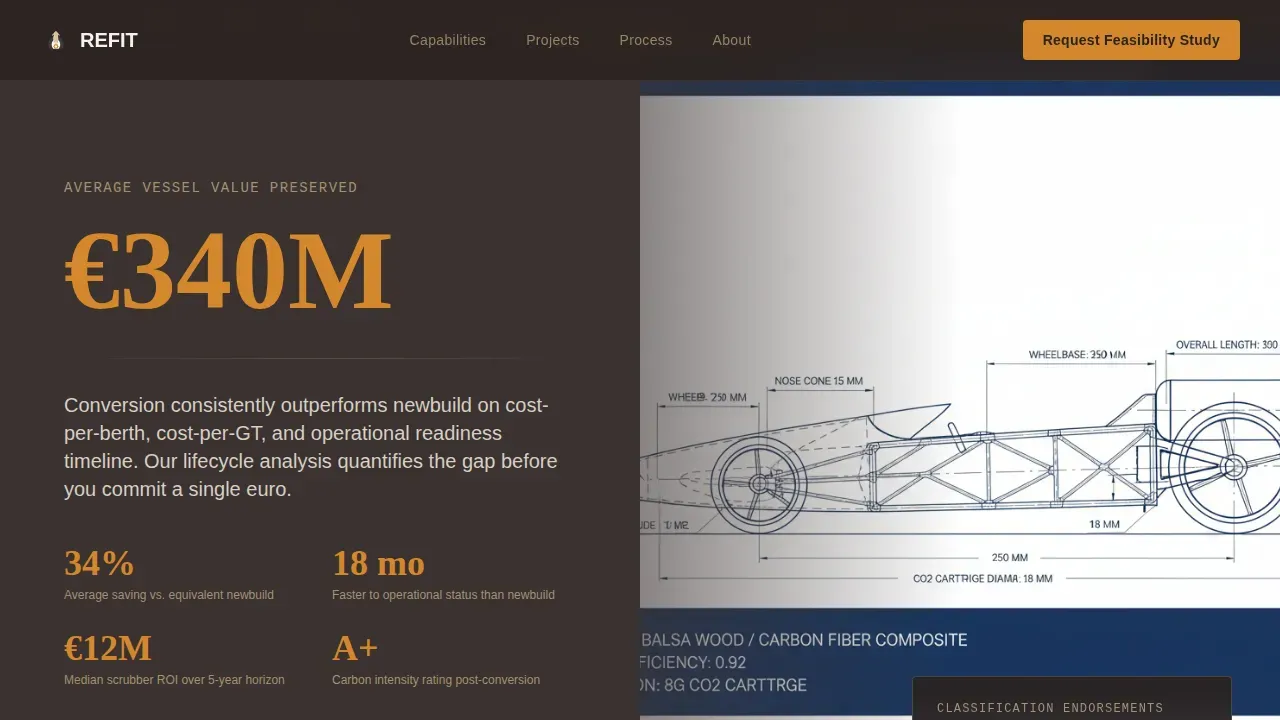
The template uses a strict 50/50 split-screen structure throughout. The left panel holds typographically dominant figures in weld-spark amber. The right panel displays corresponding project photography, technical diagrams, or classification society endorsements. This layout is the engine behind the page's high converting performance: data and evidence sit side by side, and visitors never have to search for the numbers that matter. Each scroll section opens with a hard figure before any sentence of explanation appears, which mirrors the way a qualified fleet person actually evaluates a yard.
Full-Bleed Aerial Hero with Delayed Stat Overlay
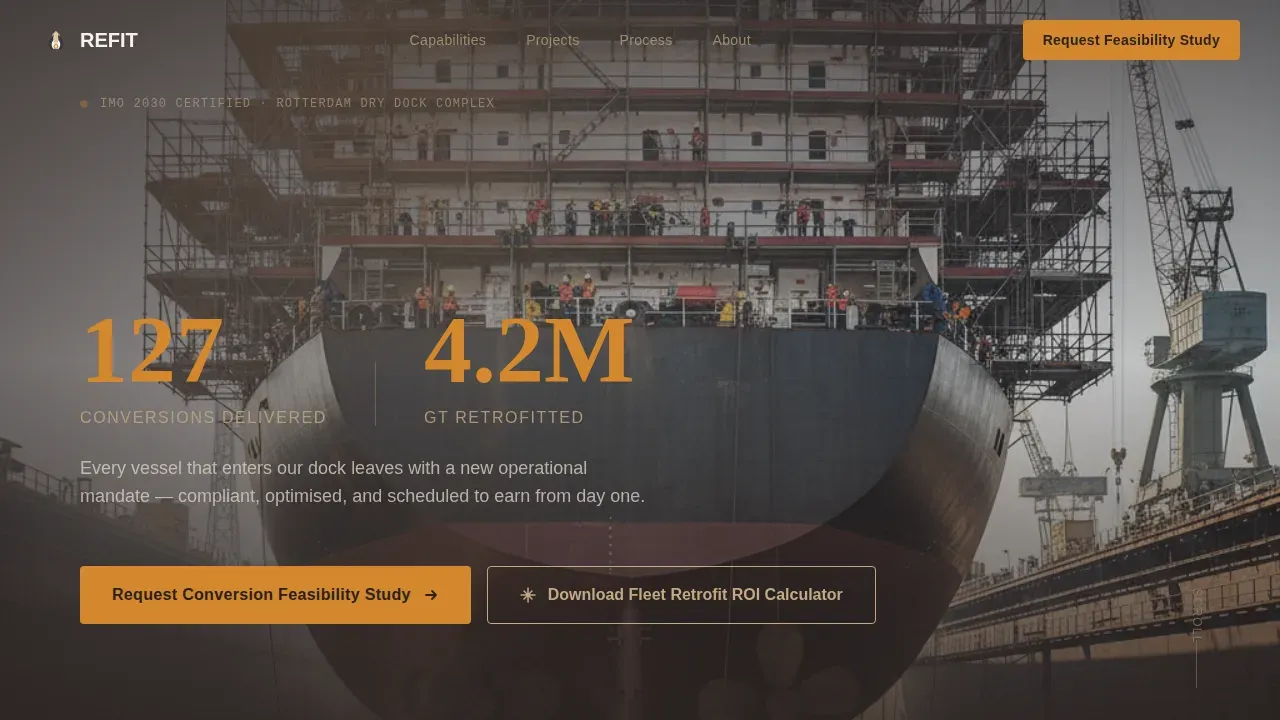
The header is a full-bleed photo zone: an aerial drone shot of a vessel mid-conversion in a dry dock, hull plates removed, machinery being craned in, workers visible on scaffolding for scale. The composition splits naturally between raw steel on the left and newly installed systems on the right. No headline appears for the first two seconds. Then a stat fades in over the image: "127 conversions delivered. 4.2M GT retrofitted." This delayed entry technique is one of the most effective tools for commanding attention on a high converting landing page, because it forces the visitor to watch before they read.
GSAP Animation and Interactive Elements
The template includes high-complexity animations built around GSAP scroll reveals, staggered number count-up effects, and parallax section transitions. Project cards carry hover states. Call to action buttons use a magnetic interaction that responds to cursor movement. These interactive elements increase the perceived value of the page and hold attention across a longer scroll session, which is critical for a business that needs to deliver substantial evidence before a visitor will submit a consultation request.
Asymmetric Project Showcase Bento
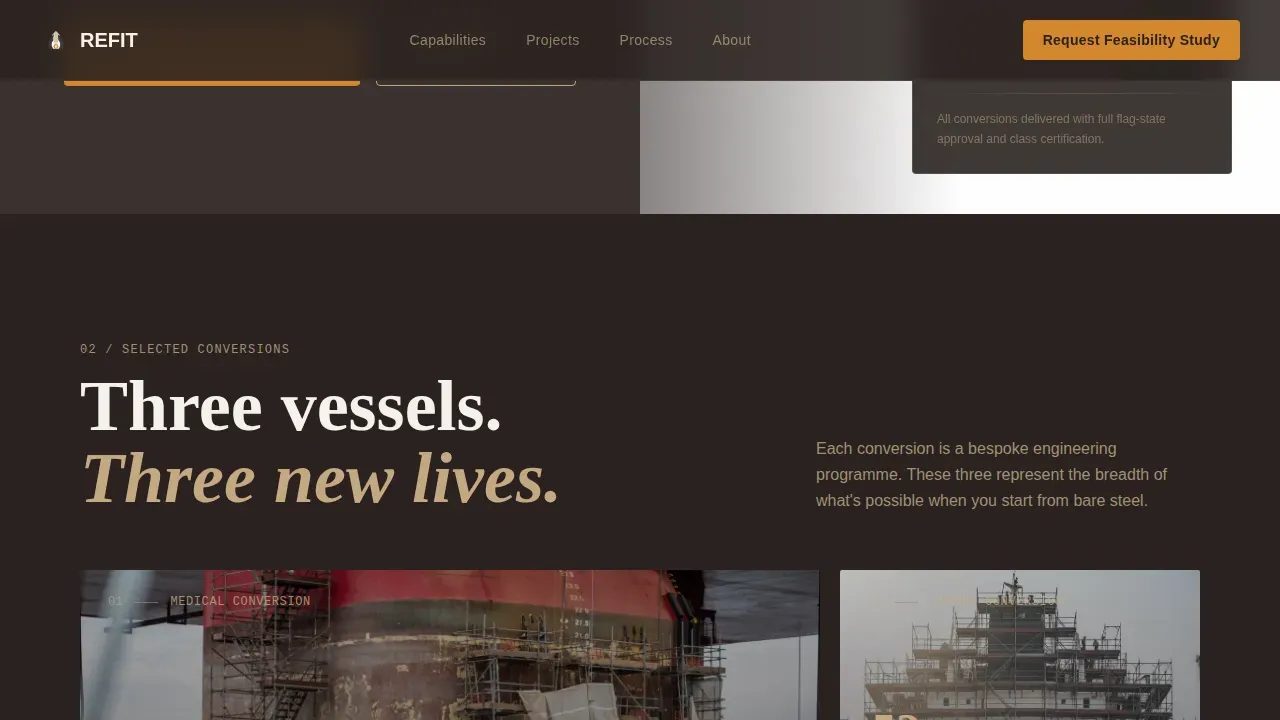
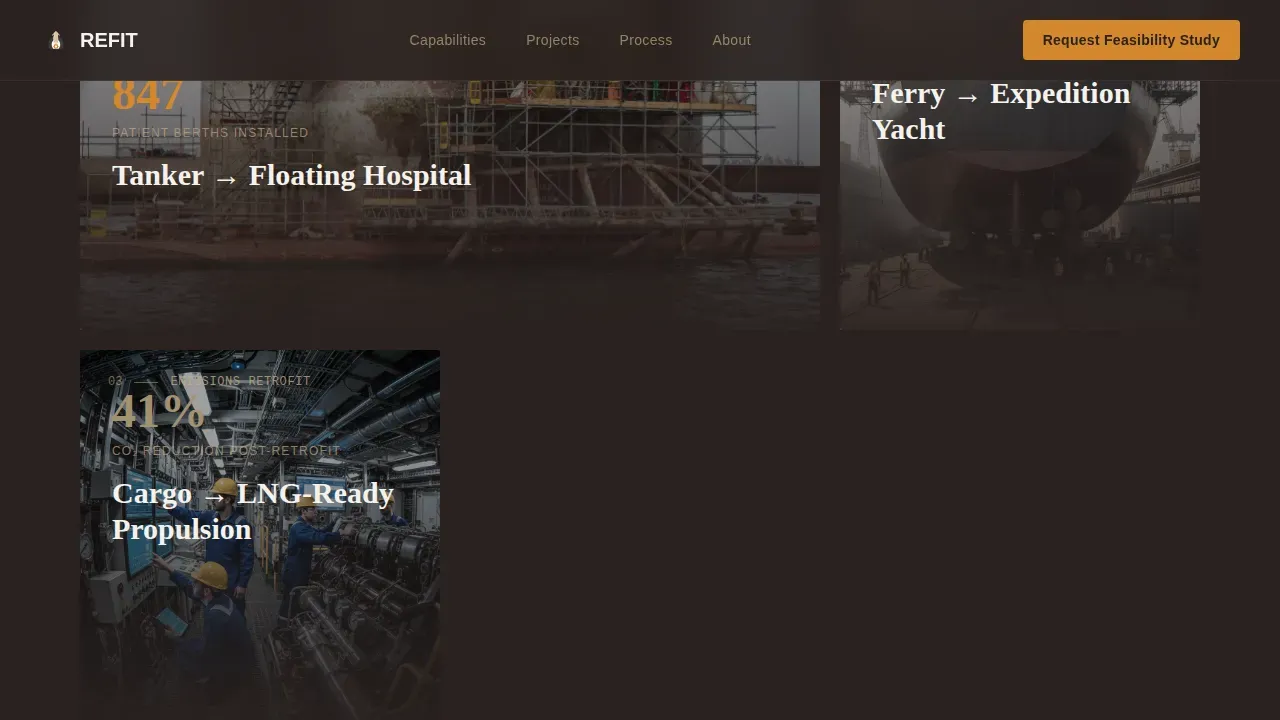
Section three presents three conversion types in an asymmetric bento grid: tanker to floating hospital, ferry to expedition yacht, and cargo ship to LNG-ready propulsion. Each card entry documents a distinct conversion category, giving visitors a fast visual report of the yard's range. The bento format lets the page display multiple examples without creating a list-like document that slows reading pace. Hover states animate each card, keeping the section interactive and encouraging visitors to watch the full range of work before moving on.
Dual Call-to-Action Architecture
The primary call to action, "Request Conversion Feasibility Study," appears first beneath the hero stats and repeats after every second section. A secondary path, "Download Fleet Retrofit ROI Calculator," captures earlier-stage prospects who are not yet ready for direct contact. This dual structure ensures the page can guide visitors toward conversion at two different stages of readiness. A conversion-focused form collects only required information, keeping fields minimal so visitors are more likely to complete and submit without hesitation.
Conversion Economics Section with ROI Data
Section two anchors on "€340M average vessel value preserved" and builds a lifecycle cost analysis around that figure. The split panel pairs the data callout with supporting photography or classification society endorsement material. A secondary call to action for the ROI calculator download appears here, capturing visitors who need more document-level proof before they will request a consultation. This section directly addresses the financial calculation every fleet manager runs before they will sign off on a conversion project.
Page sections overview
| Section | Purpose |
|---|---|
| Hero dry dock | Opens with aerial photo, two-second stat delay, and primary call to action |
| Conversion economics panel | Reports €340M vessel value stat with lifecycle cost analysis |
| ROI calculator call to action | Captures earlier-stage prospects with secondary download path |
| Project showcase bento | Displays three conversion type examples in asymmetric grid |
| Operational precision panel | Leads with 22-week duration and 98.7% on-schedule delivery stat |
| Process methodology block | Explains the yard's scheduling and delivery approach |
| Consultation form section | Hosts the feasibility study request form with minimal fields |
| Secondary download path | Reinforces the ROI calculator offer for undecided visitors |
| Linear footer row | Single-row footer with contact and navigation links |
Design & branding system
The visual identity follows a Corporate Precision theme. Every color in the Warm Stone palette is drawn from working waterfront surfaces: sun-bleached concrete quay walls, rusted bollards, dry dock shadow, and the brief violent light of a weld spark. The palette carries industrial warmth without softness, which is the correct register for a page selling services to people who manage vessels worth hundreds of millions of euros.
- Quarry sandstone (#C4A882), dry dock shadow (#3B3230), and structural khaki (#A39171) form the base palette; weld-spark amber (#D4872C) is reserved exclusively for call to action elements, data callouts, and hover states
- Typography pairs Fraunces, a serif display face, for large statistical figures and section headers, with DM Sans for body copy and data labels, creating a readable contrast between evidence and explanation
- The design language is industrial precision: no decorative softness, no gradients that apologize for the subject matter, every visual element positioned to support the conversion goal of the landing page
Mobile & speed optimization
The template is built desktop-first, which reflects the reality that fleet decision-makers working on vessel conversion budgets typically operate from workstations in a port office or a fleet management department. Mobile optimization is still present as a fallback, because key decision-makers often view projects on their phones when they are away from their desk. The layout adapts cleanly without losing the stat-first hierarchy.
- The split-screen structure collapses gracefully on smaller screens, keeping the amber data figures prominent and the call to action visible without requiring the visitor to scroll past unnecessary content
- GSAP animations are structured to use Server Components for static content and Client Components for animated elements, keeping the interactive experience smooth across devices without blocking the initial page render
How this template helps you convert
A high converting landing page works by aligning traffic intent, persuasive messaging, visual hierarchy, and a clear call to action within one focused environment. This template is designed around that principle from the first viewport to the footer. The average conversion rate for landing pages across all industries reaches only 2.35%, but industry averages for landing page conversion rates vary widely depending on traffic source, trust level, and how well the page matches visitor intent. This template is built to push well past the baseline by eliminating every source of friction and doubt.
- The stats-first scroll order ensures that every visitor absorbs hard financial and operational proof before they encounter a call to action, so the request feels like a logical next step rather than a sales push. Social proof in the form of classification society logos, hard metrics, and project photography reinforces credibility at each scroll depth, removing the hesitation that kills conversion rates in high-value B2B services.
- Compelling headlines and dominant amber data figures act as trust signals throughout the page, signaling to every visitor that this yard reports results rather than claims them. Repeated call to action placement after every second section means the page can guide visitors toward the conversion goal at multiple scroll points, capturing both the fast-deciding visitor and the person who needs to read every section before they will submit a form.
- Conversion rate optimization on this page is built into the structure: the form collects only required information, the secondary download path captures undecided visitors, and the skip navigation design keeps the visitor focused on a single outcome rather than wandering to other pages on the site.
Other information about this template
This section covers additional context that supports practical decision-making for anyone evaluating this template for their maritime business or for a client in the shipbuilding and repair sector.
- The refit stats first ship conversion landing page template is specifically categorized under Marine and Maritime, Shipbuilding and Repair, and Ship Conversion and Retrofit, making it one of the most niche-specific examples of a high converting landing page available in this category
- Landing page conversion rates for B2B consulting and maritime services tend to sit between 1.4% and 8.8% depending on the quality of traffic and the trust level built by the page; a well-executed stats-first layout with strong social proof and compelling headlines can push results toward the upper end of that range
- Financial services landing pages report an average conversion rate of 15.8%, while B2B landing pages average 8.7% according to Unbounce; the Refit template borrows structural techniques from high-performing financial and consulting pages to close the gap in the maritime sector, where transport and logistics landing pages historically average only 1.4%
- Successful campaigns in industrial B2B rely on the same key elements that define this template: above-the-fold stat clarity, minimal form friction, trust signals, and a focused single conversion goal
- Using templates designed with conversion in mind helps businesses launch faster and reduce design errors; a structured template shortens the time between brief and live page, which matters when deadlines like IMO 2030 compliance are driving client urgency
- Landingi is a dedicated landing page platform that allows marketers to build, duplicate, test, and optimize campaign-focused pages without developer involvement; Landingi enables drag-and-drop editing, A/B testing, fast publishing, and seamless integration with mar-tech tools, making it a practical environment for launching and iterating on a page like Refit
- Landingi provides over 400 professionally designed templates, including tools for ongoing conversion rate optimization, so teams can watch performance data and act on it without waiting for development support
- Evolo's landing page, which promotes building management and energy efficiency software, is one of the best-performing examples of a stats-led B2B page, achieving a 17.72% conversion rate by using structured messaging and a clear visual hierarchy that guides visitors from value proposition to call to action without cognitive overload; the Refit template follows the same structural logic applied to the maritime industrial context
- The average conversion rate for webinar landing pages reaches 22.84%, for eBook landing pages 24%, and for mobile landing pages 28.63% according to Instapage; these figures confirm that well-structured, single-goal pages with strong trust signals and easy access to a clear next step consistently outperform multi-purpose pages
- Young people entering fleet management and maritime asset roles are increasingly comfortable making vendor contact decisions through digital channels, which means a professional, evidence-heavy landing page is becoming a more important entry point than traditional mail or office visits
- Supporting documents such as the ROI calculator download and classification society endorsement material function as trust-building assets that extend the page's persuasion beyond the scroll session itself; these supporting documents give the visitor something to take into an internal review meeting, which is a realistic step in any high-value maritime procurement process
- The template does not include a death certificate or any government filing document; references to official regulatory dates such as IMO 2030 are editorial context within the template's copy zones, not built-in document management or filing features
- Item numbers, vessel gross tonnage figures, and project dates are placeholder data fields within the template's content zones; the yard operator fills in their own report data, conversion totals, and schedule dates before publishing the page
- J K L keyboard shortcut navigation is not a built-in feature of this template; the skip navigation approach is handled through the page's focused single-column scroll flow, which removes the need for complex site navigation by design
- The travel information and passports content referenced in some landing page optimization guides relates to a different category of landing page entirely; the Refit template is scoped exclusively to maritime industrial services and does not include any travel information, passports, or government department form processing
Theme
Corporate Precision
Creative direction
Stats-First Impact
Color system
Warm Stone
Style
Split Screen (50/50)
Direction
Click-Through
Page Sections
Stats-first 50/50 Split-screen Layout
Full-bleed Hero with Delayed Stat Overlay
GSAP Scroll Animations and Magnetic Ctas
Asymmetric Bento Project Showcase
Dual Call-to-action Architecture
Conversion Economics Data Section
Related questions
What type of business is this landing page template built for?
Can I customize the statistics and project examples in the template?
Does the template support a two-path call-to-action structure?
How does the stats-first layout improve conversion rates?
Is this template suitable for paid advertising campaigns?