Aquaculture Fish Feed Manufacturer Website Template
Pellet is a stats-first aquaculture feed manufacturer landing page template built for B2B fish feed brands competing on data. It leads with a split before-and-after case study hero, anchors five scroll spokes around verified field metrics, and drives procurement-ready visitors toward a species-formula catalog request. The Industrial Raw design system keeps every proof point front and center.
by Rocket studio
Quick summary
Pellet is a hub-and-spoke landing page template designed for aquaculture feed manufacturers who sell on evidence, not promises. It opens with a field-verified before-and-after pond comparison, delivers oversized metrics at every scroll transition, and routes high-intent buyers toward a species catalog request. The design feels grounded and industrial, exactly like the feed production environments it represents.
Who this template is for
This template is built for businesses and professionals operating inside the commercial aquaculture industry. It speaks directly to the people who make purchasing decisions about fish feed, and it gives them the data format they already trust.
- Hatchery managers and procurement officers at vertically integrated shrimp, tilapia, catfish, and carp operations who track feed conversion ratios and need cost-per-kilo evidence before committing to a supplier
- Cooperative directors and fish farmers in developing countries who manage smallholder ponds and need a reliable, affordable feed supply backed by documented field results
- Production supervisors and aquaculture department leads at mid-to-large fish farm operations who require proof of pellet durability, nutrient retention, and species-specific feed formulations before a procurement meeting
What problem this template solves
Skepticism is the default posture of every experienced aquaculture buyer. Feed costs represent 40 to 60 percent of total operating costs in intensive aquaculture, so procurement officers cannot afford to switch suppliers based on marketing copy alone. For a fish farm to be profitable, feed cost ideally should not exceed 20 percent of the farm-gate value of the product, which means every percentage point of feed efficiency matters enormously. Feed manufacturers operating across various regions face a trust gap: their products are technically superior, but their web presence looks generic, and generic does not close deals.
- Buyers arrive skeptical and leave without requesting a catalog because no named-farm evidence is visible above the fold
- Feed formulations are buried in brochure-style copy rather than presented as filterable, species-specific data
- The page fails to convert high-intent technical buyers who need downloadable trial data before a procurement meeting
What you get with this template
You get a fully structured, data-first landing page layout that turns verified field results into a persuasive scroll journey. The template is built around five anchor-nav spokes, each opening on a single oversized metric before unpacking the supporting evidence beneath it. Feed manufacturers get a professional site structure without the high expenses associated with custom web design, enabling quick market entry for aquaculture feed brands.
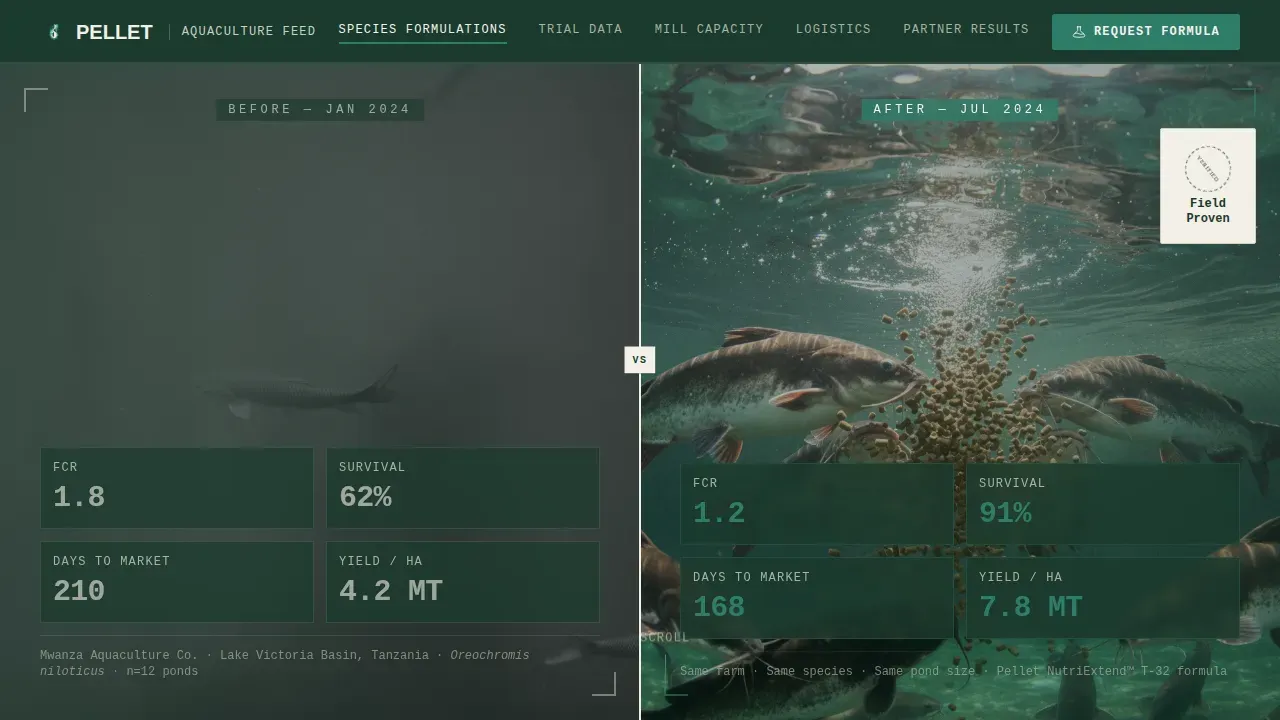
- A split-frame Case Study hero comparing the same tilapia pond at two points in time, with FCR and survival rate overlays that let the numbers speak before any headline appears
- Five hub-and-spoke anchor sections covering Species Formulations, Trial Data, Mill Capacity, Logistics Network, and Partner Results, each scroll-triggered with bold stat reveals and staggered content animations
- A sticky call-to-action bar anchored to "Request Your Species Formula" plus secondary "Download Trial Results PDF" buttons embedded inside partner result cards for high-intent technical buyers
Feature list
This template includes a focused set of design and layout capabilities. Every feature below is drawn directly from the template brief.
Split Before-and-After Hero Frame
The header is built as a Case Study comparison layout. Left panel shows a fish farm pond with sparse, uneven fish and poor metrics overlaid in monospaced type: 1.8 Feed Conversion Ratio, 62 percent survival. Right panel shows the same pond after feed transition, with dense uniform fish rolling at the surface and updated metrics: 1.2 Feed Conversion Ratio, 91 percent survival. Farm name, region, and species appear in a quiet caption bar. No headline competes with the data because the data is the headline. This structure builds immediate trust with potential customers before a single sentence of body copy loads.
Hub and Spoke Anchor Navigation
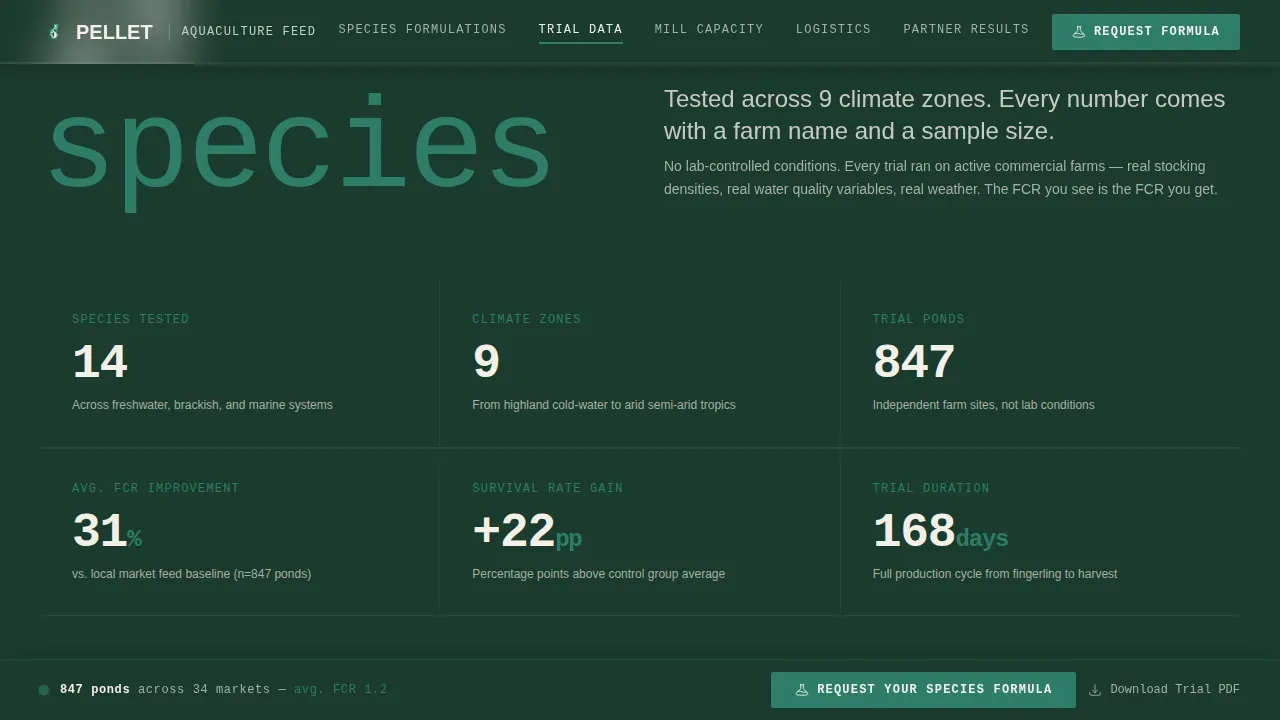
Five named anchor sections connect from a persistent hub navigation: Species Formulations, Trial Data, Mill Capacity, Logistics Network, and Partner Results. Each spoke opens with a single oversized stat, for example "340,000 metric tons extruded annually" or "Tested across 14 species in 9 climate zones," before the supporting evidence loads beneath it. The rhythm is intentional: punch, then proof. Each metric is more surprising than the last, so the visitor hunts for the next one rather than bouncing.
Sticky Call-to-Action Bar
After the visitor scrolls past the first spoke, a persistent sticky bar activates at the top of the viewport. The primary call to action, "Request Your Species Formula," links directly to a product catalog filterable by species and growth stage. This keeps the conversion path visible throughout the entire scroll journey without interrupting the data narrative. A secondary call to action, "Download Trial Results PDF," is embedded inside each Partner Results card for procurement-focused buyers who need documentation before a meeting.
Stats-First Scroll Animation System
Every major section transition is triggered by scroll. Stats counter up on entry. Section headers appear with beam-border animations. The hero frame uses a scan-line reveal effect. Staggered reveals allow dense data blocks to appear in sequence rather than all at once. This animation rhythm reinforces the stats-first creative direction by ensuring each metric registers before supporting context arrives.
Species Filter Cards
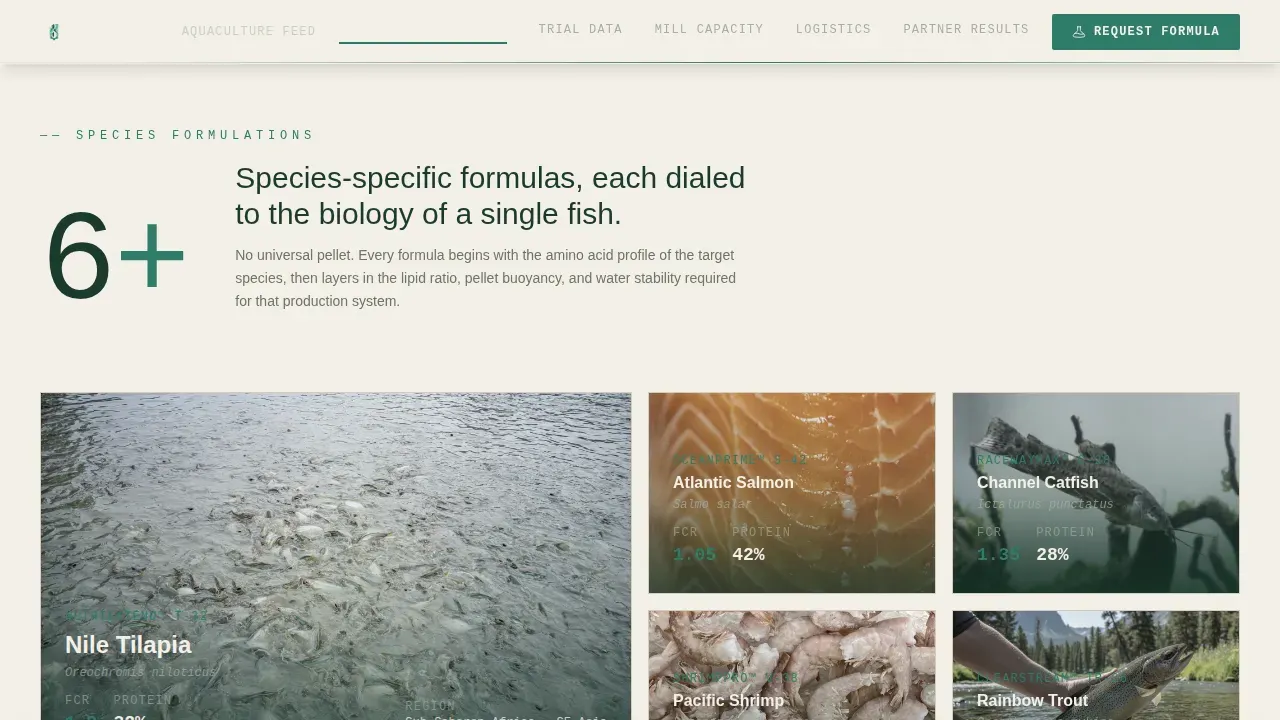
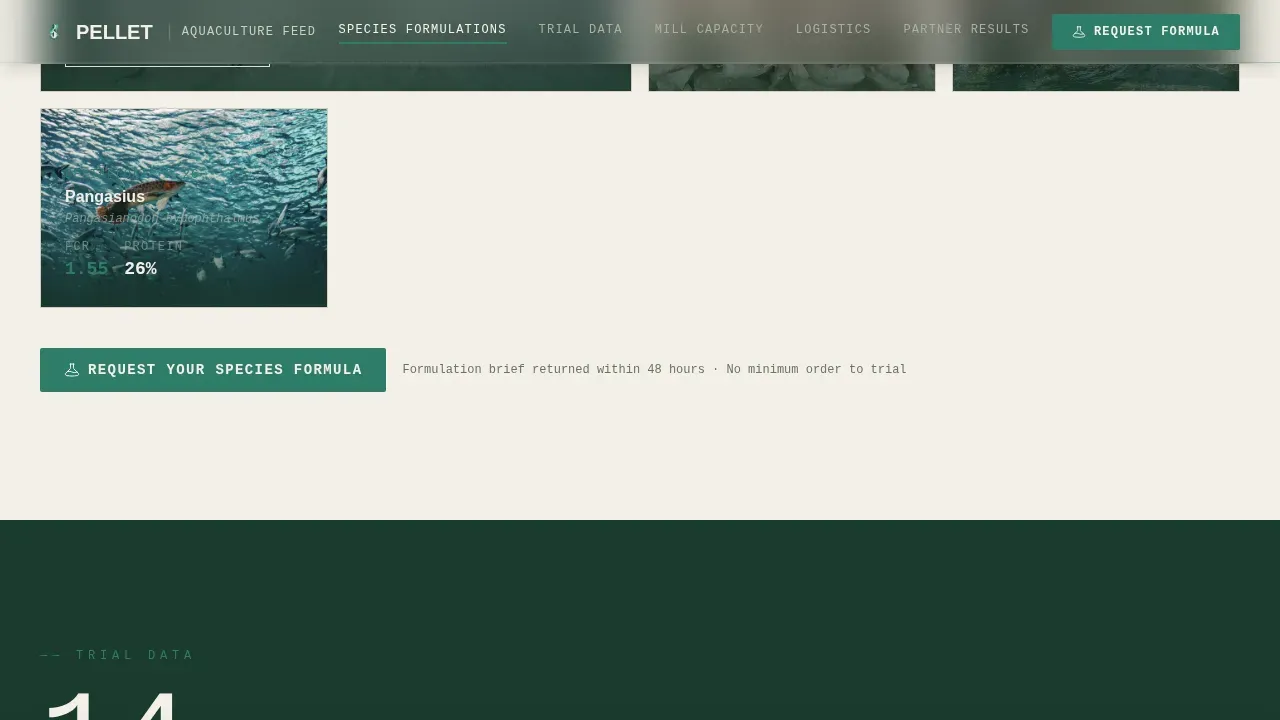
The Species Formulations spoke is built around interactive filter cards. Buyers can filter feed formulations by aquatic species, including tilapia, catfish, trout, carp, and shrimp, and by growth stage. Each card surfaces the relevant pelleted feed specification for that species, making it efficient for procurement officers to find the exact high quality feed data they need. Pellet durability ratings, nutrient density values, and target feed efficiency benchmarks are displayed per species card.
Partner Results Cards with PDF Download
Named farm results are presented as structured cards. Each card displays the farm name, GPS region, species farmed, sample size, and before-and-after feed conversion metrics. A "Download Trial Results PDF" button is anchored to each card, giving technical buyers a shareable document they can bring to a procurement meeting. No claims appear without a named source, and no percentages appear without a sample size. Pellet durability data and reduced environmental impact figures are included where field trials support them.
Page sections overview
| Section | Purpose |
|---|---|
| Split Hero Frame | Before-and-after FCR pond case study with overlaid metrics |
| Species Formulations Spoke | Filterable feed formulation cards by species and growth stage |
| Trial Data Spoke | Climate and species-specific proof points across 9 zones |
| Mill Capacity Spoke | Industrial production scale stat reveal: 340,000 MT per year |
| Logistics Network Spoke | Global supply and distribution network overview |
| Partner Results Spoke | Named farm cards with FCR data and PDF download actions |
| Sticky call to action Bar | Persistent species formula request bar active after spoke one |
| Footer | Linear single-row footer with company links |
Design & branding system
The template uses an Industrial Raw visual theme expressed through a Forest Trust color system. The palette was built to feel like walking the perimeter of an aeration pond at the edge of a pine forest: functional, grounded, and alive beneath the surface. Typography is set in DM Sans for body and interface text, paired with IBM Plex Mono for stat callouts and metric overlays, reinforcing the data-dense, factory-floor tone.
- Core palette: deep mill green (#1B3A2D) anchors the navigation spine and section headers; weathered steel gray (#A8B0A0) holds body text and secondary containers; pond-water teal (#2E7D6A) activates on hover states and stat highlights; sun-dried grain white (#F4F0E8) breathes across open backgrounds between dense data blocks
- Layout structure: the asymmetric bento species grid, beam-bordered section headers, and scan-line hero animation all reinforce the industrial raw aesthetic while keeping pellet durability data, feed efficiency metrics, and aquatic species specifications visually organized and easy to scan
Mobile & speed optimization
The template is designed desktop-first, reflecting the reality that procurement officers and hatchery managers typically review feed formulations, pellet durability data, and trial results at a desk. All layout breakpoints are included so the experience remains functional and readable on tablet and mobile screens.
- Server Components handle all static content blocks, including the hero frame, section headers, species cards, and partner results, keeping the base page load lean while Client Components manage scroll-triggered animations, hover states, and the sticky call-to-action bar
- The animation system uses scroll-triggered reveals and staggered entry effects that are designed to complement the data-first reading rhythm without creating visual noise or slowing the page on lower-powered devices
How this template helps you convert
The entire page is engineered around a single conversion goal: getting a qualified aquaculture buyer to request a species formula or download a trial results document. Every layout decision reinforces that path.
- The split-frame hero leads with independently verifiable field data before any product claim appears, so the visitor's trust is earned in the first viewport rather than asked for later; pellet durability, feed conversion improvement, and survival rate gains are visible immediately
- The hub-and-spoke anchor navigation gives procurement officers a clear map of the evidence available, letting them jump directly to the spoke most relevant to their decision, whether that is species-specific feed formulations, mill capacity for volume reliability, or named-farm partner results with downloadable PDFs
- The sticky call-to-action bar ensures the primary conversion action stays accessible throughout the entire scroll journey, and the secondary PDF download inside each partner results card captures high-intent technical buyers who need documentation before committing to a feed supplier
Other information about this template
The Pellet template sits at the intersection of a fast-growing global market and a trust deficit that data-first design can close. The floating fish feed market is estimated at USD 10.91 billion in 2025 and is expected to reach USD 15.05 billion by 2032, with a compound annual growth rate of 4.7 percent. The aquaculture industry's rapid expansion, driven by rising demand for fish and seafood products across countries on every continent, has made reliable feed manufacturers more critical than ever.
- Extruded pellets are projected to dominate the floating fish feed market in 2025 due to their superior digestibility, nutrient density, and stability in water; extrusion technology is the production standard the template's mill capacity section is built to showcase
- Tilapia is projected to dominate the global aquaculture market in 2025 owing to its adaptability and rapid growth, and the template's species filter cards reflect this priority alongside catfish, trout, carp, shrimp, and ornamental fish formulations
- The pellet stats first aquaculture feed manufacturer landing page template is purpose-built so feed manufacturers can establish credibility quickly; landing pages help avoid high expenses associated with custom web design, making this template a cost-effective route to market
- Pellet durability is a primary trust signal for aquaculture buyers because poorly manufactured pellets disintegrate in water, causing nutrient loss, elevated feed conversion ratios, and measurable environmental impact on pond water quality; the template's design puts pellet durability data front and center in every relevant section
- Many developing nations are promoting aquaculture to enhance food security and support economic development; the template's localization-ready structure accommodates USD pricing, metric ton quantities, and global farm names from Africa, Asia, and the Americas, making it practical for feed manufacturers serving most developing countries and other countries with growing aquaculture production
- Feed pellets must maintain their structure during transportation, storage, and feeding processes; the template surfaces pellet durability specifications alongside nutritional benefits, protein quality data, and nutrient retention figures so buyers can evaluate feed quality comprehensively before requesting a formula
- Aquaculture systems including recirculating aquaculture systems and offshore aquaculture operations demand consistent, high quality feed; the template's five-spoke structure can surface feed formulations and trial data relevant to closed, semi-closed, and open-water production environments
- In most developing countries, fish production depends on affordable pelleted feed with documented feed efficiency; the template's partner results section is designed to make that evidence accessible to cooperative directors and fish farmers who supply fish and seafood for human consumption
- Competitive payment terms and reliable supply are critical relationship factors in the aquaculture industry; the template's logistics network spoke and catalog call to action give buyers a clear path to exploring those terms without needing to find a separate contact page
- The aquaculture department at any vertically integrated operation will expect to see trial data organized by aquatic species, climate zone, and growth stage; the template's Trial Data spoke is structured to meet that expectation with agriculture-grade rigor and data-first visual presentation
Theme
Industrial Raw
Creative direction
Stats-First Impact
Color system
Forest Trust
Style
Hub & Spoke (Anchor Nav)
Direction
Click-Through
Page Sections
Split Before-and-after Case Study Hero
Hub and Spoke Anchor Navigation
Sticky Species Formula Call to Action
Species Filter Cards with Feed Specs
Partner Results Cards with PDF Download
Stats-first Scroll Animation System
Related questions
Who is this landing page template built for?
Does this template support multiple species feed formulations?
How does the template handle social proof from named farms?
Can the design be adapted to match an existing brand?
Why does the page lead with data instead of a marketing headline?