Seafood Traceability Platform Website Template
Trace is a modular card-grid landing page built for seafood traceability platforms. It walks visitors through a single catch event, from vessel GPS ping to retail shelf scan, using a scrolling timeline structure, a full-viewport stats wall, and gated resource downloads. The design uses an Industrial Raw aesthetic that signals precision, compliance, and operational depth to serious industry buyers.
by Rocket studio
Quick summary
Trace is a single-page landing page template built for seafood traceability platforms. It opens with a near-black stats wall, then scrolls through a four-row timeline of catch-to-consumer custody stages. Every card is a discrete module. The primary call to action is a gated playbook download. The design feels like a processing floor, precise, utilitarian, and built to earn trust.
Who this template is for
This template is designed for platforms and services operating in the seafood supply chain compliance space. It speaks the language of people who work with regulatory documentation, cold-chain data, and catch certification every day.
- Compliance officers at seafood importers managing Seafood Import Monitoring Program (SIMP) documentation
- Sustainability directors at grocery chains defending Marine Stewardship Council (MSC) certification claims
- Fleet managers on factory trawlers logging catch coordinates and species identification data
What problem this template solves
Manual seafood traceability is slow, fragmented, and difficult to defend under audit. This template helps a platform make the case for digital chain-of-custody tracking, visually and structurally, without overselling.
- Visitors struggle to grasp the full regulatory weight of tracking a catch from harvest to retail; the timeline layout makes that complexity visible
- Generic landing pages fail to signal industry credibility; the data-first design and compliance-focused card content build immediate trust with technical buyers
- Long sales cycles require proof of depth before a visitor will share their contact details; ungated spec sheets and gated playbook downloads create a layered conversion path
What you get with this template
The template is a complete, ready-to-customize single-page layout with every section and module pre-built. You get a structured starting point that reflects the real operational stages of seafood traceability.
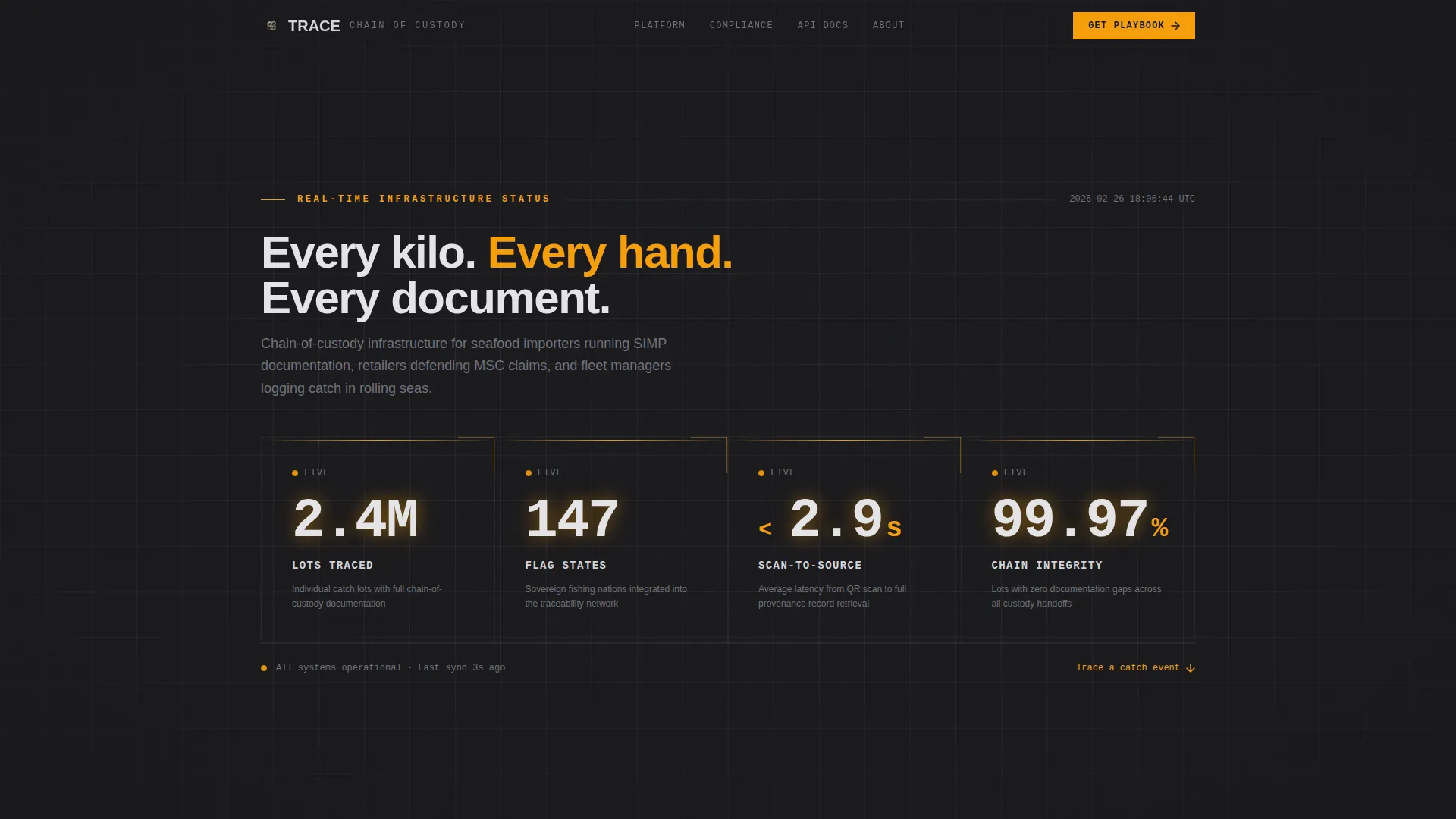
- A full-viewport Stats/Metrics header with four live-style counters: "2.4M Lots Traced," "147 Flag States," "< 3 sec Scan-to-Source," and "99.97% Chain Integrity"
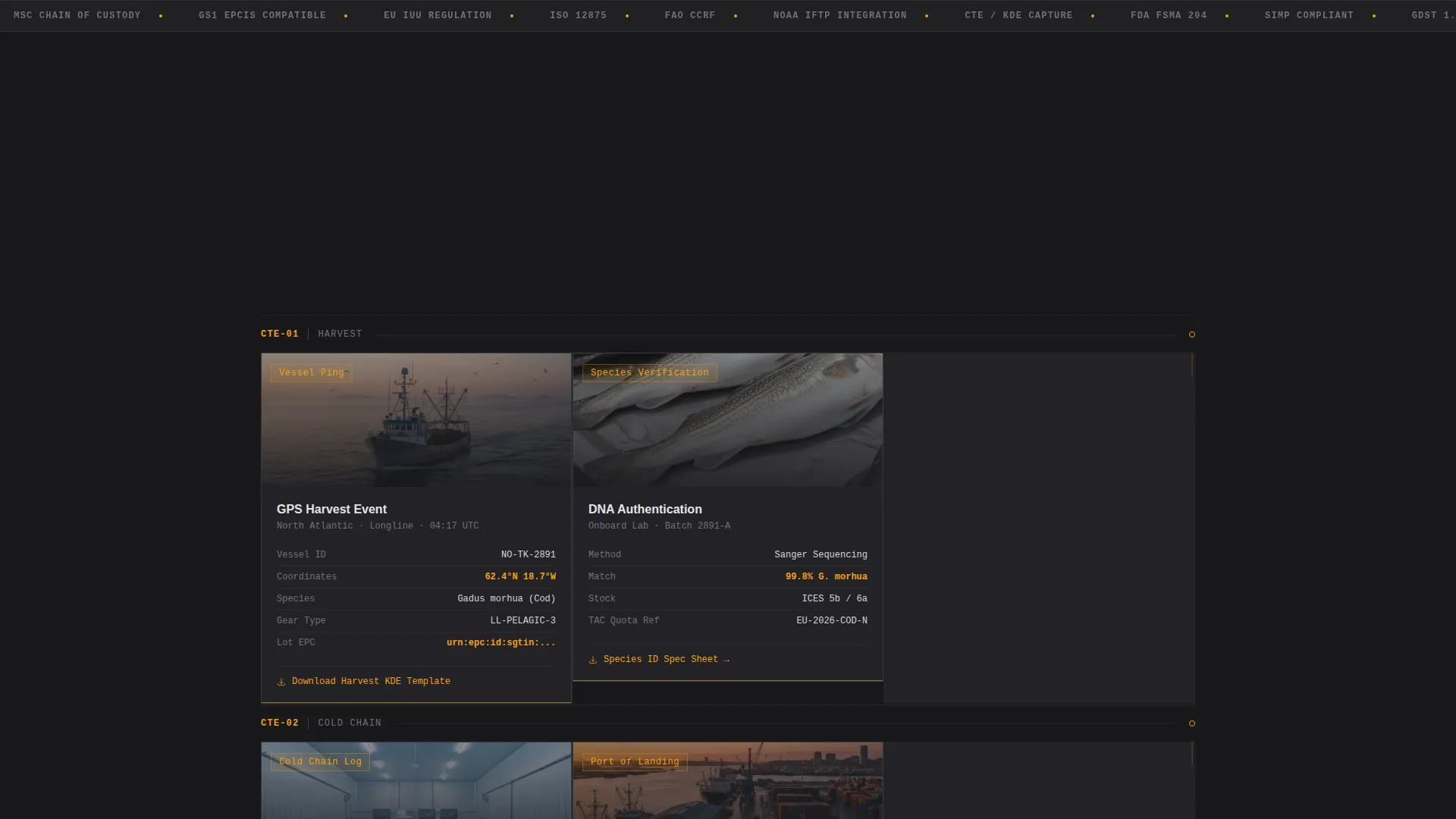
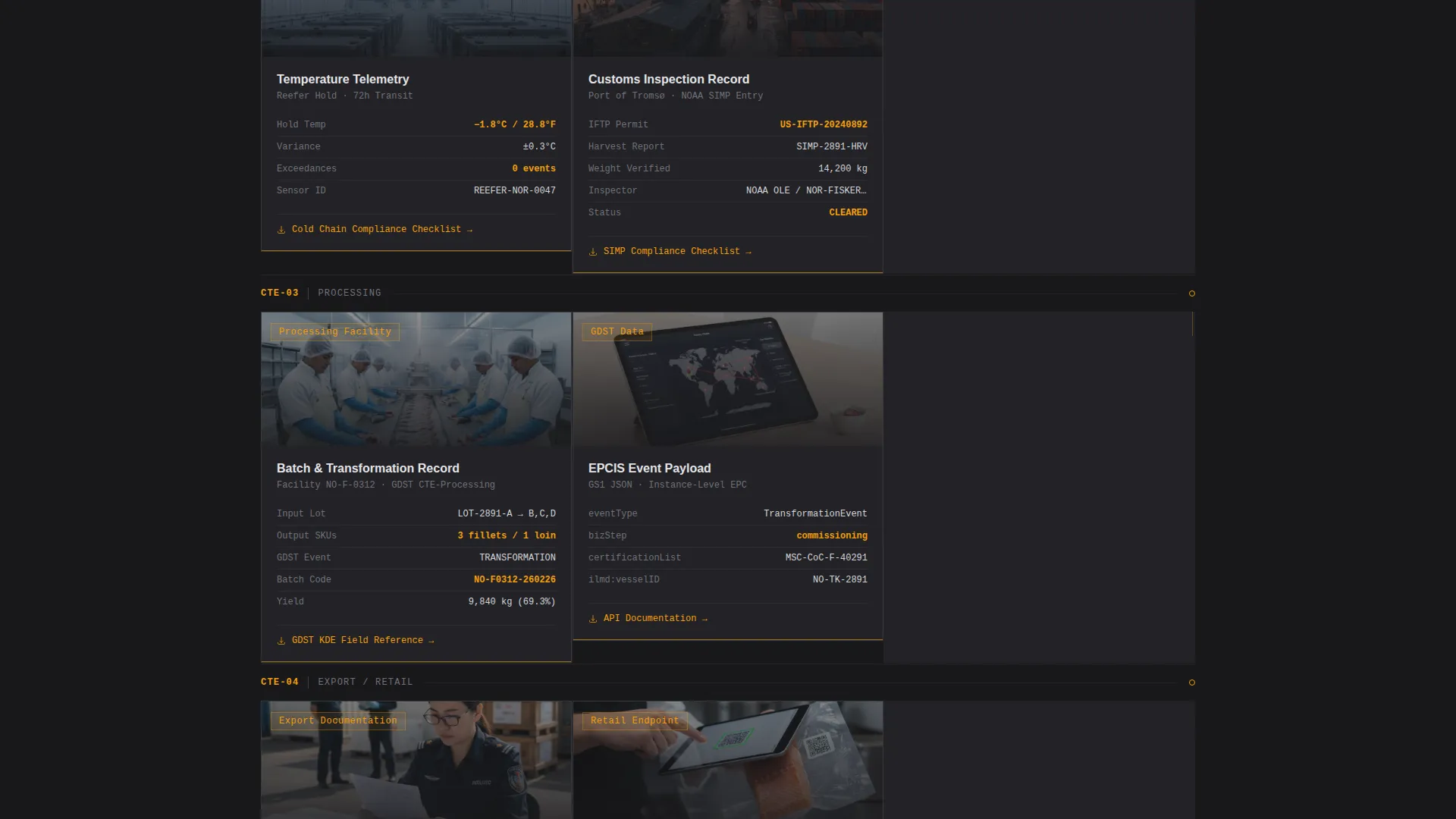
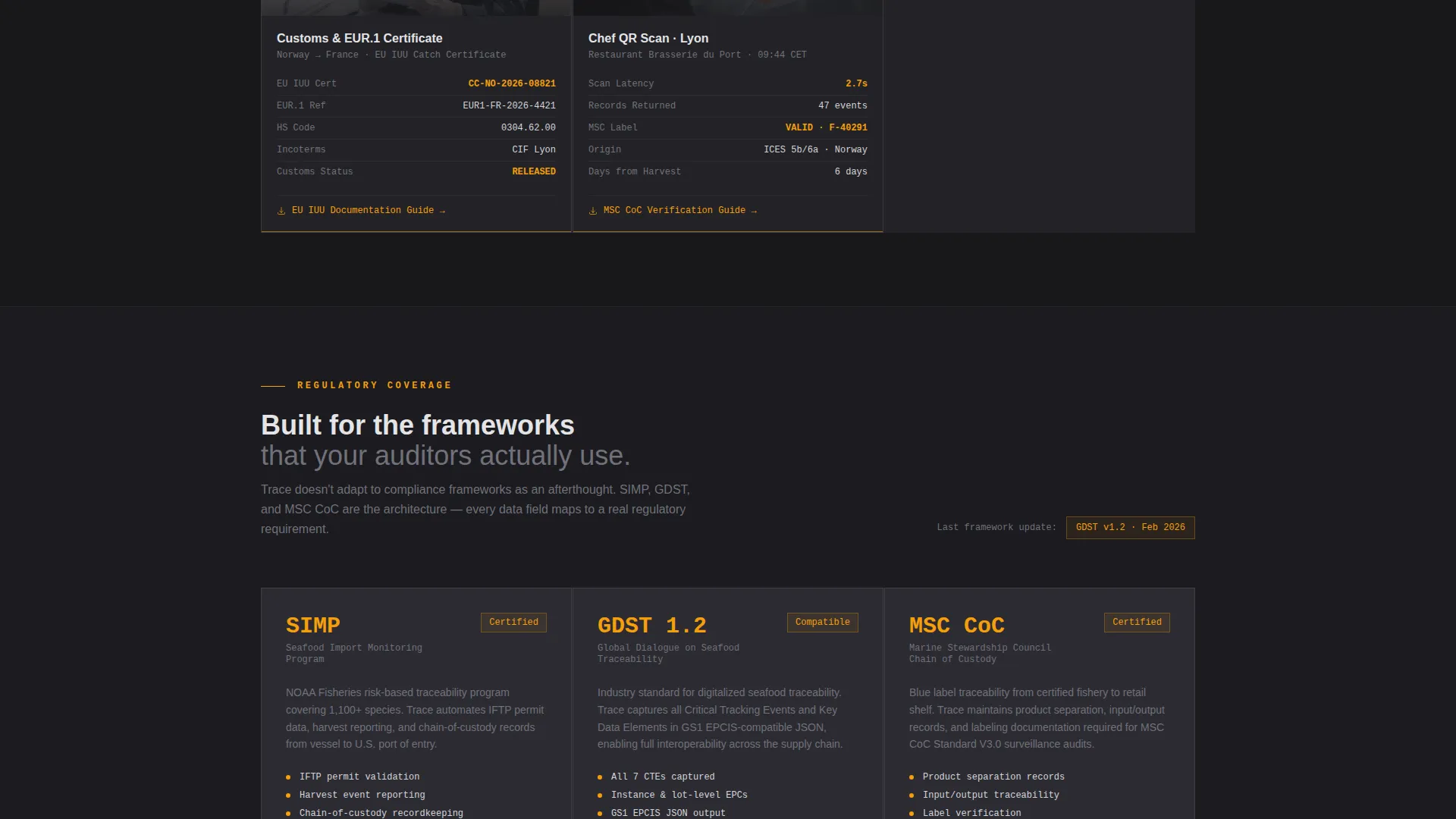
- Four card rows mapping the catch lifecycle, from vessel harvest through cold-chain logging, processing batch codes, and export documentation to retail scan
- A gated "Download the Traceability Playbook" call to action with a single-field email capture that expands to reveal company name and role selector
Feature list
This template includes purpose-built components designed for a seafood traceability platform audience.
Stats Wall Header
A full-viewport grid on a near-black field displays four oversized counters in a monospaced typeface. A faint grid overlay reinforces an infrastructure aesthetic. No hero image is used, the data itself is the visual hook.
Timeline Progression Layout
Scrolling moves the visitor forward through four distinct catch-event stages. Each stage maps to a real regulatory milestone, from GPS ping and species ID at harvest to customs clearance and retail shelf scan. The escalating complexity makes the cost of manual tracking tangible.
Modular Card Grid
Each card is a self-contained module with a thumbnail, a data snippet, and a link to a downloadable resource. Cards in later rows carry heavier regulatory context, such as Global Dialogue on Seafood Traceability (GDST) data fields and export documentation.
Gated Playbook Download
The primary call to action is a single-field email capture. On click, it expands to collect company name and role, importer, retailer, producer, or non-governmental organization (NGO). The form earns the download by surrounding it with demonstrated industry knowledge.
Ungated Secondary Resources
Individual cards link directly to spec sheets, SIMP compliance checklists, and API documentation without requiring a form submission. These secondary conversion paths keep technically-minded visitors engaged without friction.
Industrial Raw Visual Identity
The Monochrome Steel color system uses mill-finish aluminum, heavy plate steel, wet-deck black, and a single regulatory amber accent. Typography is monospaced for data elements. The overall feel is a stainless-steel processing table under halogen light.
Page sections overview
| Section | Purpose |
|---|---|
| Stats metrics wall | Opens the page with four credibility-building data counters on a near-black field |
| Harvest vessel row | First card row covering GPS ping, species identification, and catch-event data |
| Cold chain row | Second card row covering temperature logs and port-of-landing inspection records |
| Processing batch row | Third card row covering batch codes and GDST data field documentation |
| Export documentation row | Fourth card row covering customs clearance, export docs, and retail shelf scan |
| Playbook download call to action | Gated email capture with role selector for the Traceability Playbook resource |
Design & branding system
The visual identity follows an Industrial Raw theme. Every color choice and typographic decision reinforces the idea that this platform handles serious operational data, not marketing copy.
- Color palette: mill-finish aluminum (#D4D4D8), heavy plate steel (#3F3F46), wet-deck black (#18181B), and regulatory amber (#F59E0B) reserved strictly for data points, status badges, and interactive states
- Typography: monospaced typeface for all counters and data snippets, creating a mechanical, instrument-panel feel across the stats wall and card modules
- Surface aesthetic: faint grid overlay on the header background suggests a spreadsheet or radar screen; no illustrations, no hero imagery, no decorative warmth
Mobile & speed optimization
The modular card-grid structure is well-suited to responsive stacking. Each card is a discrete unit, which means the layout adapts row by row without restructuring content hierarchy.
- The four card rows reflow cleanly into single-column stacks on smaller screens, preserving the timeline reading order
- Oversized counter typography scales down proportionally, keeping the stats wall legible and impactful at any viewport width
How this template helps you convert
The template is built around a content-first conversion strategy. It earns the download before asking for the email address.
- The stats wall establishes immediate platform credibility in the first viewport, giving technical visitors a reason to keep scrolling before any form appears
- Each card row adds a layer of regulatory proof, demonstrating that the platform understands SIMP documentation, cold-chain records, and GDST data fields at a working level
- Ungated resources lower the barrier for early-stage visitors, while the gated playbook captures higher-intent leads who have already engaged with the timeline content
Other information about this template
This template is part of the Marine and Maritime category, filed under Maritime Services, and purpose-built for the Seafood Traceability Platform niche. It is compatible with any design tool or front-end framework that supports modular card-grid layouts.
- The template style is Card Grid (Modular), meaning individual sections can be reordered, duplicated, or removed without breaking the overall layout structure
- The header concept is Stats/Metrics, a format that works particularly well for data-infrastructure platforms where numbers carry more persuasive weight than imagery
- The creative direction is Timeline Progression, a scroll-based narrative that mirrors how chain-of-custody documentation actually works in practice
- The landing-page direction is Content and Resource distribution, meaning the page is optimized to distribute downloadable assets and build a qualified lead list
Theme
Industrial Raw
Creative direction
Timeline Progression
Color system
Monochrome Steel
Style
Card Grid (Modular)
Direction
Content/Resource
Page Sections
Stats Wall Header with Live Counters
Scroll-driven Timeline Progression
Modular Card Grid Layout
Gated Playbook Download with Progressive Form
Ungated Secondary Conversion Paths
Industrial Raw Color and Type System
Related questions
Can I customize the counter values in the stats wall?
How does the gated download form work?
Can I add or remove card rows from the timeline?
Is the amber accent color used throughout the design?
What types of downloadable resources can I link from the cards?