Agricultural Education & Extension Professional Website Template
Tillage is a hero-dominant landing page template built for agricultural universities seeking research partnerships. It features an illustrated aerial map header, scroll-reveal partnership story sections, a fixed call-to-action bar, and a slide-in proposal form. The design uses a Pastoral Calm palette to build B2B trust through documented, named project outcomes across every section.
by Rocket studio
Quick summary
Tillage is a single-page template designed for land-grant and agricultural universities that need to attract serious research partners. It leads with a hand-drawn illustrated aerial map, then walks visitors through named partnership stories, facility statistics, and a direct proposal form. Every design choice earns credibility before asking for a commitment.
Who this template is for
This template is built for agricultural universities and research institutions that actively pursue external partnerships. It speaks directly to the people responsible for growing those relationships on both sides of the table.
- University partnership offices and research development staff marketing field trial capacity to industry and government
- Partnership directors at seed companies, fertilizer companies, and agricultural input firms looking for multi-season trial sites
- State agency program managers commissioning watershed, soil health, or runoff studies that need defensible, documented data
What problem this template solves
Most university research pages read like faculty directories. They list credentials but never prove field capacity or show what a partnership actually looks like in practice. Potential partners leave without confidence.
- Prospective partners cannot quickly assess available acreage, active projects, or real-world outcomes from a standard university web page
- The gap between "we do research" and "here is the exact data your organization needs" costs universities high-value, multi-season partnerships
- Without a clear proposal path, qualified leads from agencies and companies quietly move on to competitors with more direct outreach processes
What you get with this template
This template delivers a complete, section-led landing page built around proof and conversion. Every section is designed to move a skeptical B2B visitor closer to submitting a proposal.
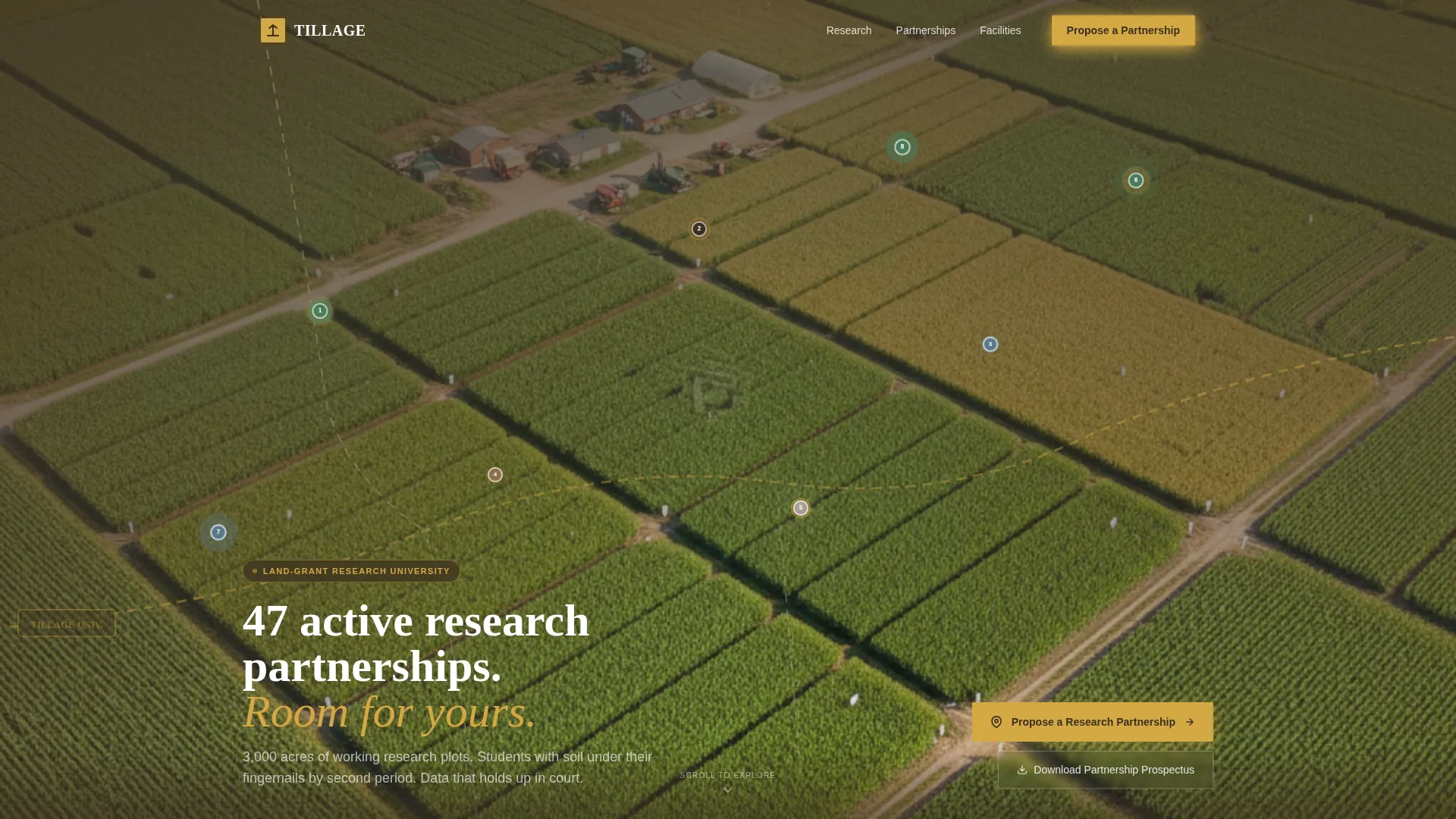
- An illustrated aerial map header occupying ninety percent of the viewport, with pulsing numbered pins and a bottom-anchored headline
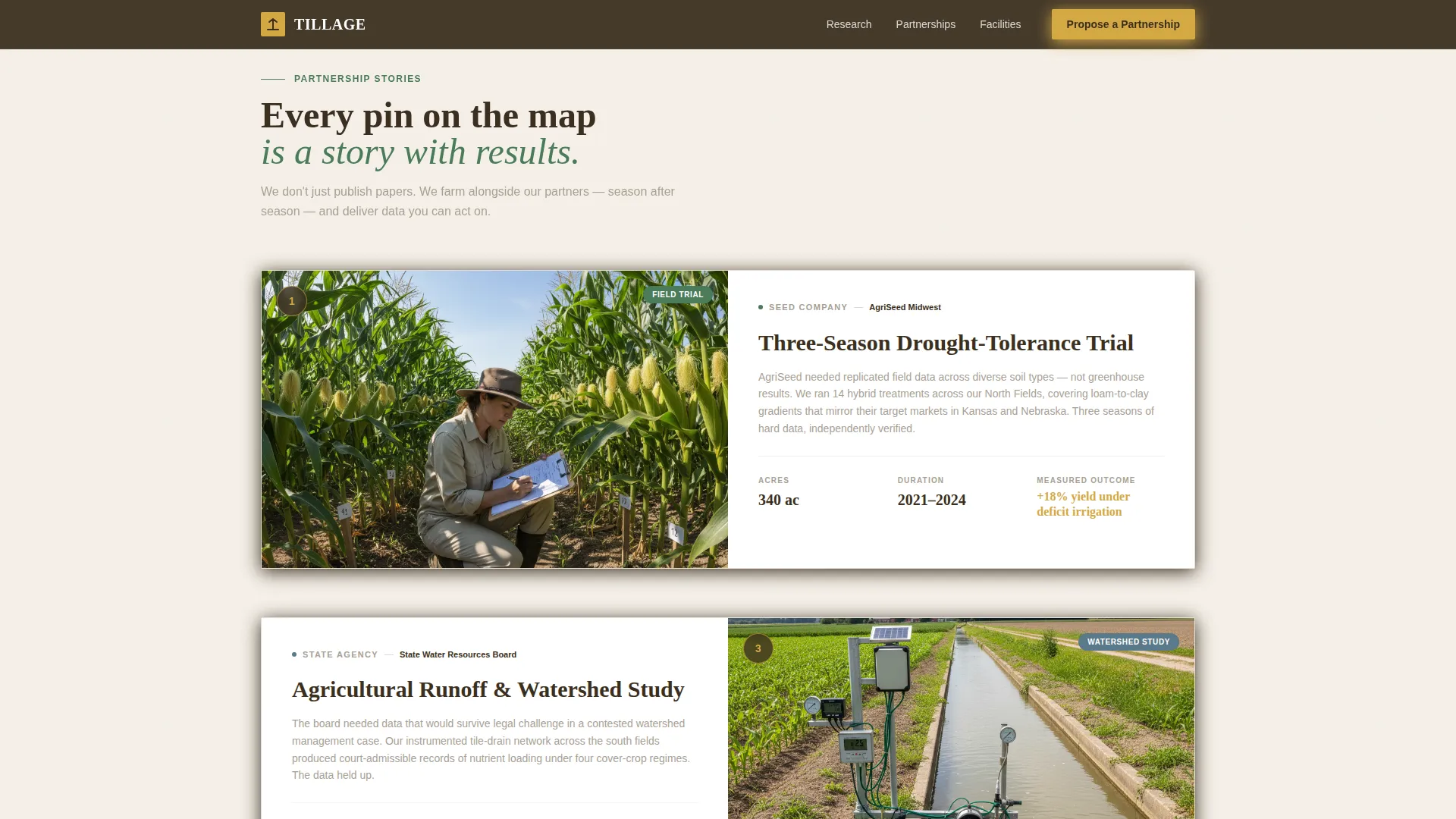
- Scroll-reveal partnership story cards that name the partner, state the acreage, cite the years active, and report one measurable outcome per project
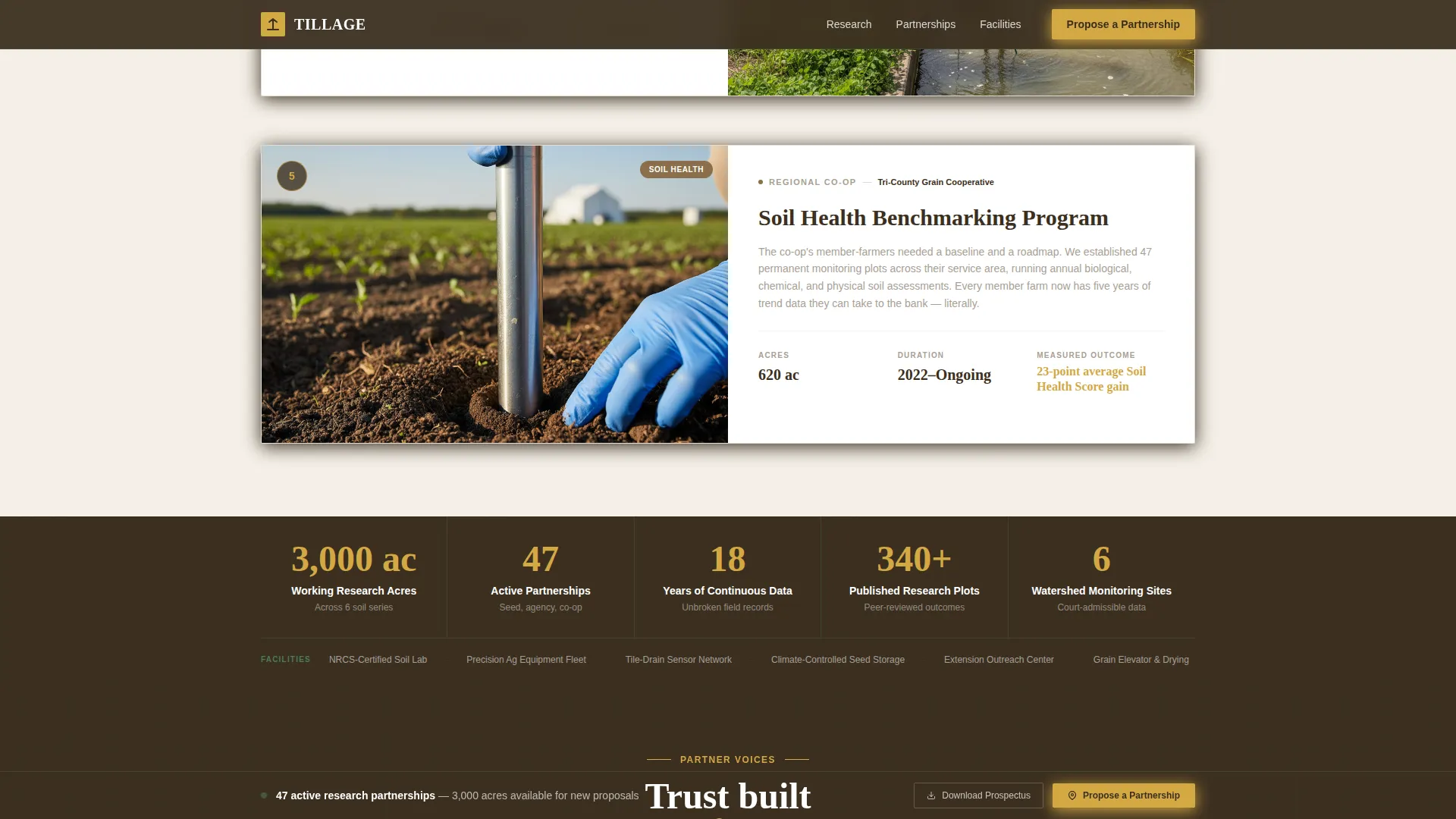
- A horizontal capabilities bar displaying key facility statistics alongside a fixed bottom call-to-action bar that appears after the second scroll section
- A slide-in proposal form panel capturing organization name, partnership type, crop or livestock focus, and a free-text field for the partner's core research question
- A secondary lead capture path offering a downloadable partnership prospectus for visitors who are not yet ready to propose
Feature list
This template packages several purpose-built components that work together to support partnership-focused conversion.
Illustrated Aerial Map Header
The hero fills ninety percent of the viewport with a hand-drawn-style aerial map of the university's research landscape. Trial fields, livestock units, the soil-science lab, the extension outreach center, and watershed monitoring stations are all labeled and connected by dotted dirt-road lines. Small numbered pins pulse gently, each representing a partnership opportunity. A single anchoring headline sits in the bottom ten percent of the viewport.
Scroll-Reveal Partnership Story Cards
Each section below the hero zooms into one map pin and tells a specific partnership story. Cards display the partner organization name, the acreage involved, the number of seasons the project has run, and one concrete measurable outcome. Documentary-style photography of muddy boots, clipboard data sheets, and combine cabs at dusk reinforces the field-level authenticity.
Fixed Bottom Call-to-Action Bar
After the visitor scrolls past the second section, a persistent bottom bar appears with the primary call to action. This keeps the proposal prompt visible without interrupting the reading experience. The bar uses the grain gold accent color to draw the eye precisely where it needs to land.
Slide-In Proposal Form Panel
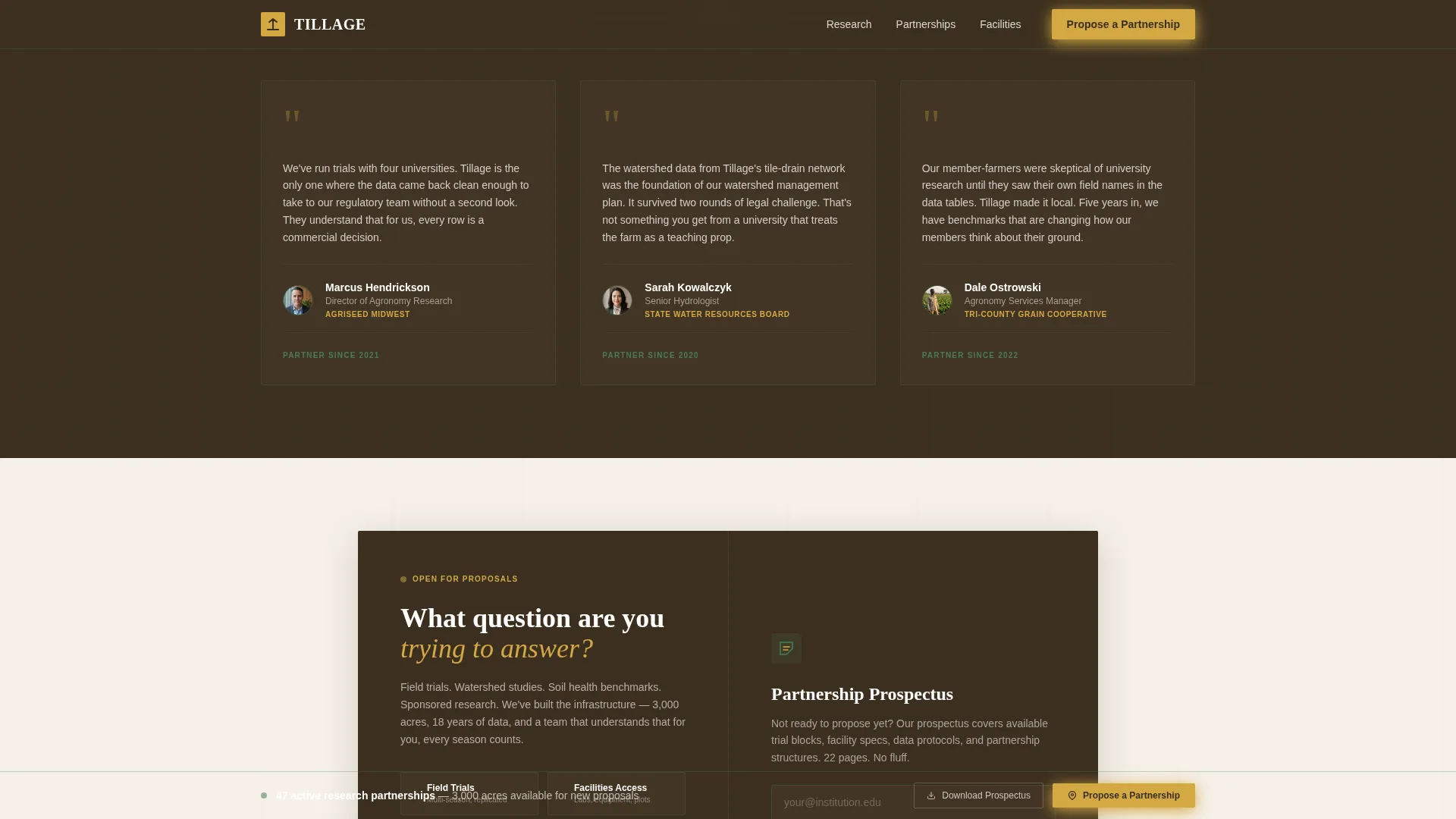
The primary call-to-action triggers a panel that slides in from the side. The form asks for organization name, partnership type selected from four options (field trials, facilities access, extension collaboration, or sponsored research), crop or livestock focus, and a free-text field labeled "What question are you trying to answer?" The lighter secondary path captures an institutional email address in exchange for the partnership prospectus.
Capabilities Statistics Bar
A horizontal strip between the partnership stories and the testimonials section presents key facility numbers at a glance. This includes the 3,000-acre working research footprint, the count of active partnerships, and supporting facility statistics. The bar gives data-driven visitors a fast, scannable proof point before they reach the proposal form.
Page sections overview
| Section | Purpose |
|---|---|
| Hero Map Header | Establishes research scale and invites exploration via illustrated aerial map with pulsing partnership pins |
| Partnership Story Cards | Builds trust through named, outcome-specific project narratives drawn from real partnership types |
| Capabilities Statistics Bar | Delivers fast, scannable proof of research capacity with acreage and partnership counts |
| Testimonials Section | Reinforces credibility with documentary-style quotes attributed to named partner organizations |
| Partnership Call to Action | Converts engaged visitors through a proposal form panel and a prospectus download fallback |
| Footer | Closes with a single-row linear layout providing navigation and contact essentials |
Design & branding system
The visual identity follows a Pastoral Calm theme rooted in the Forest Trust color system. The palette is intentionally unpolished, honest, and earned rather than corporate or overly designed.
- Core colors: deep loam brown (#3B2F20) as the primary background, perennial ryegrass green (#4A7C59) for navigation and section dividers, warm grain gold (#D4A843) reserved for calls to action and data callouts, and soft parchment white (#F5F0E8) for light-background sections
- Typography pairs Fraunces as the display serif for headings with DM Sans for body copy, creating a blend of editorial authority and clean readability
- Photography direction is documentary and field-level: muddy boots, field data clipboards, and combine cabs at dusk sit alongside the illustrated map to keep the aesthetic grounded in real agricultural work
Mobile & speed optimization
The template is built desktop-first to match how B2B decision-makers typically review partnership opportunities at a desk. Full mobile support is included so the page works cleanly across all screen sizes.
- CSS scroll-behavior and Intersection Observer are used for scroll-reveal section animations, keeping transitions smooth without heavy JavaScript dependencies
- The fixed bottom call-to-action bar and slide-in form panel are designed to reflow correctly on smaller screens, maintaining usability for mobile visitors
- Images are optimized for web delivery so the documentary photography and illustrated map header load without blocking the initial page view
How this template helps you convert
The page is structured to build trust progressively, then present a low-friction proposal path at exactly the right moment.
- The aerial map header immediately communicates scale and specificity, showing 47 active research partnership slots before a single paragraph is read, which frames the university as a serious, capacity-proven partner rather than a generic academic institution
- Named partnership story cards replace vague capability claims with real project data, so by the time a visitor reaches the proposal form, they have already seen proof that the university delivers measurable, documented outcomes season after season
- The dual conversion path, a direct proposal form and a prospectus download, captures both high-intent leads ready to propose and early-stage contacts who need one more piece of information before committing
Other information about this template
This template is a strong fit for institutions operating within the land-grant university model, where applied research and community extension work sit alongside academic programs. The design vocabulary, from the hand-drawn map to the documentary photography direction, is specifically calibrated for the Midwest agricultural context and imperial measurement conventions used across the United States.
- The illustrated aerial map is oriented campus-gate-in rather than north-up, so the visitor's visual journey mirrors the experience of driving onto the property
- The proposal form's free-text field, "What question are you trying to answer?", is a deliberate design choice that positions the university as a problem-solving partner rather than a vendor of services
- The page is suited for agricultural education and extension programs that need to present research collaboration opportunities to both private-sector companies and public-sector agencies within the same experience
Theme
Pastoral Calm
Creative direction
Local & Neighborhood
Color system
Forest Trust
Style
Hero-Dominant (90/10)
Direction
Partnership/B2B
Page Sections
Illustrated Aerial Map Hero
Scroll-reveal Partnership Cards
Fixed Bottom Call-to-action Bar
Slide-in Proposal Form Panel
Capabilities Statistics Bar
Dual Lead Capture Paths
Related questions
Who is the primary audience for this landing page template?
Can I customize the partnership form fields for my institution?
Does the template include the illustrated aerial map artwork?
How does the secondary lead capture path work?
Is this template suitable for a university with fewer than 47 active partnerships?