Specialist Emergency Management Government Professional Website Template
Hearth is a hub-and-spoke emergency management landing page designed for tribal emergency management authorities. It mobilizes sovereign communities from personal preparedness to collective coordination using cause-and-effect storytelling, inline resource access, and a primary alert signup flow. Built for mobile-first use on spotty connections, it serves elders, families, caregivers, and volunteer crews with equal clarity.
by Rocket studio
Quick summary
Hearth is a single-page emergency resource hub designed for tribal emergency management authorities. It walks community members from household readiness to coordinated public response using scenario-driven storytelling and amber-highlighted calls to action. The page is built to work on small screens with limited connectivity, so every resource reaches the people who need it most.
Who this template is for
This template is designed for sovereign tribal nations that need a community-facing emergency management presence. It serves the full range of people involved in emergency preparedness and response at the tribal level.
- Tribal emergency management coordinators and tribal council members who make time-sensitive decisions
- Elders sheltering on allotment land, families with young children, and caregivers supporting vulnerable household members
- Volunteer fire crews, chapter house coordinators, and community members ready to get involved
What problem this template solves
Emergency information is often scattered across documents, state agency portals, and outdated notices. For individuals with limited connectivity or language barriers, that fragmentation can cost lives. Tribal emergency management programs need a single hub that is ready before disaster strikes.
- Families and caregivers cannot find evacuation routes, shelter locations, or emergency kit guidance in one place
- Alert signup services are buried or require complex steps that work poorly on spotty cell service
- Communication between coordinators and households breaks down because no clear, accessible hub exists
What you get with this template
Hearth provides a complete set of page sections, design assets, and interactive components designed to inform, protect, and mobilize a tribal community. The layout prioritizes immediate actionability and user trust, so visitors can act without hesitation.
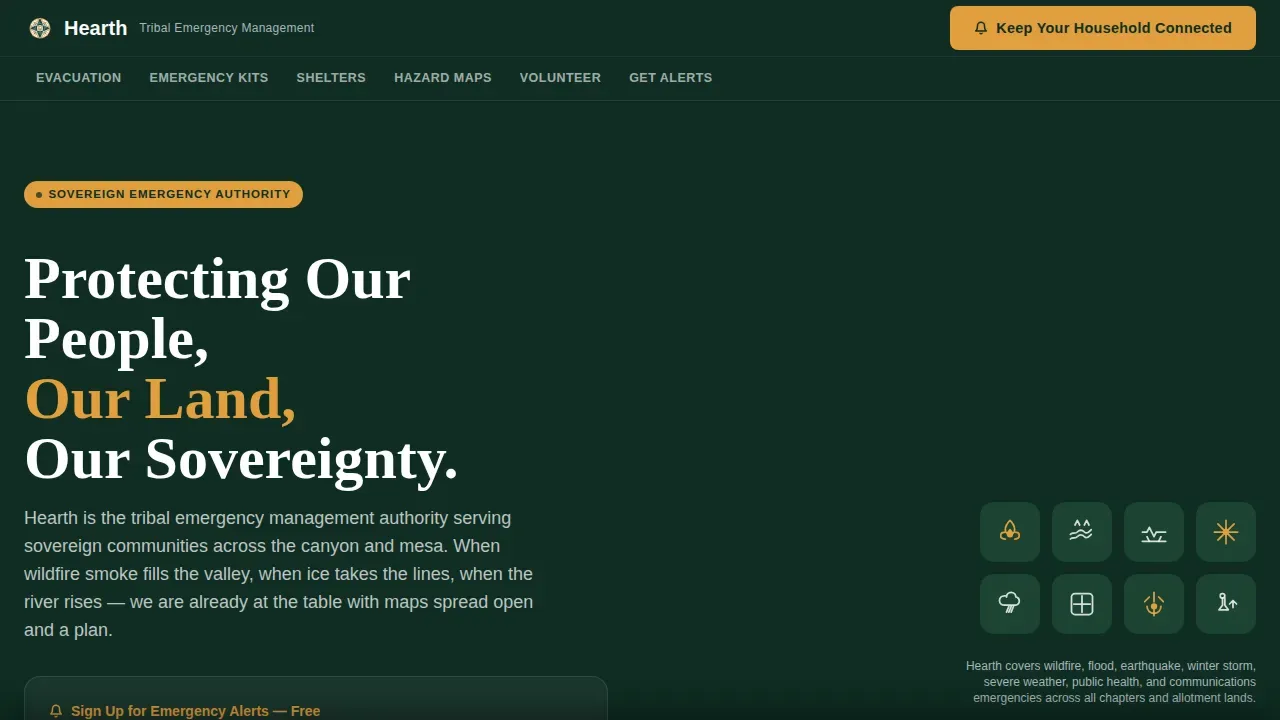
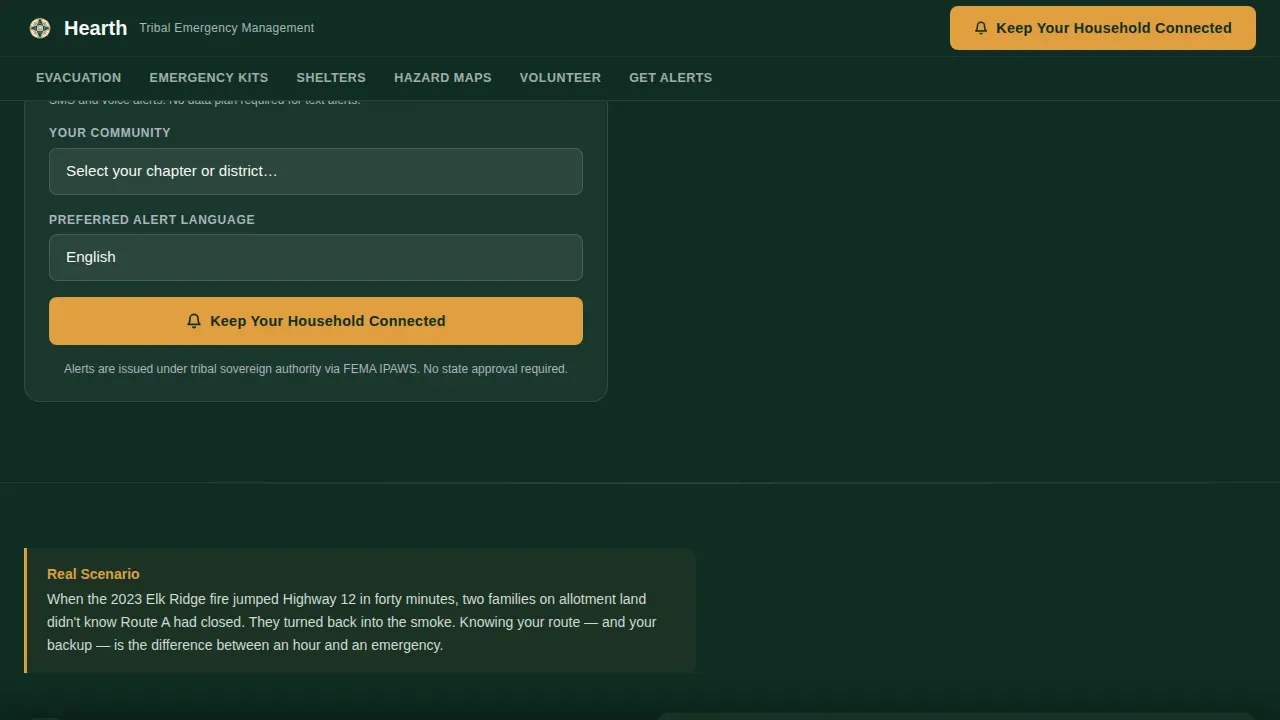
- A hero section with an anchor navigation bar, an icon grid mosaic, and a primary alert signup form with phone, community dropdown, and language selector
- Six spoke sections covering evacuation routes, emergency kits, shelter locations, hazard maps, volunteer sign-up, and alert registration
- Amber-styled calls to action on every spoke, a sticky alert bar, and inline resource access so visitors receive value before any gate
Feature list
Hearth packages every component a tribal emergency management authority needs to prepare, inform, and mobilize its community.
Anchor Navigation Hub and Spoke Layout
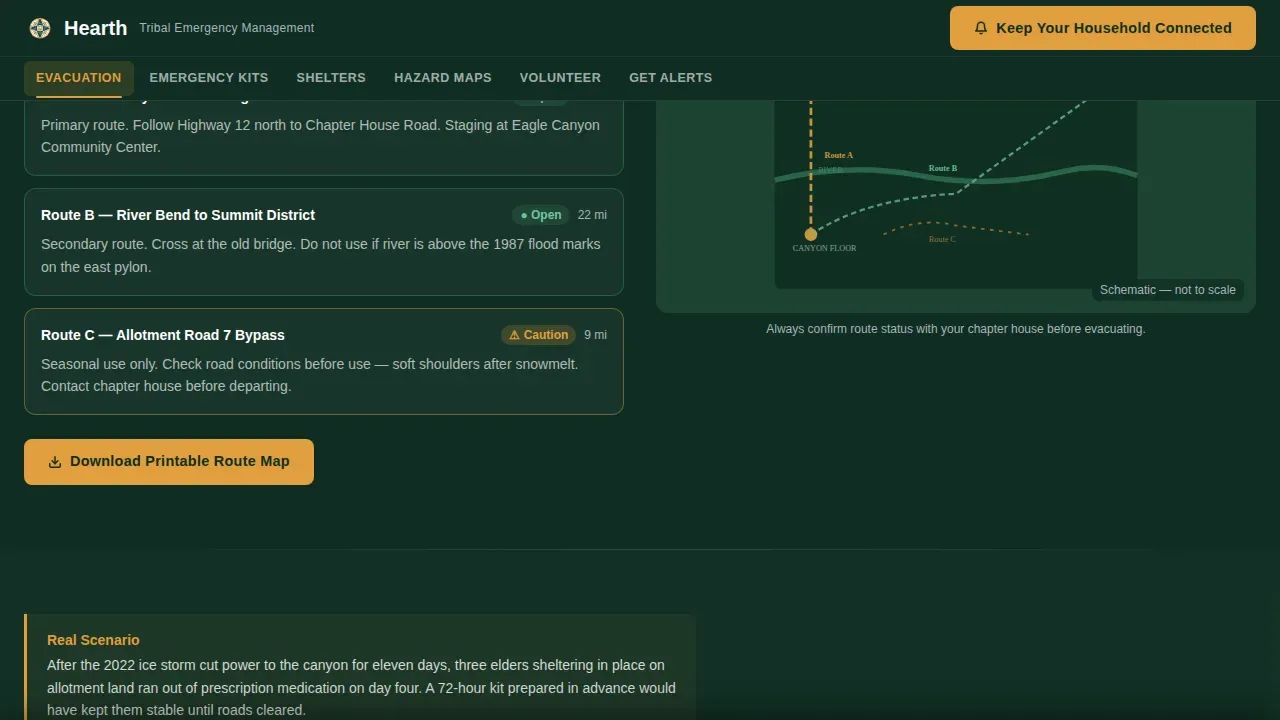
The page is designed around a central anchor navigation bar that smooth-scrolls to six dedicated resource spokes. Each spoke covers one emergency discipline: evacuation, kits, shelter, hazards, volunteering, and alert registration. Visitors can jump directly to the information they need without scrolling through unrelated content.
Cause-and-Effect Scenario Storytelling
Each spoke opens with a short real-scenario paragraph, such as the moment a wildfire jumps a highway, before presenting the resource that scenario demands. This storytelling structure helps individuals understand why each resource matters and moves the reader from personal preparedness toward community-wide responsibility.
Primary Alert Signup with Language Selector
The emergency alert signup form appears in the hero and repeats as a sticky bar after the visitor scrolls past the second spoke. The form includes a phone number field, a community name or zip code dropdown, and a language selector that supports English and tribal language options, so every household can receive alerts in a familiar language.
Inline Maps and Checklist Access
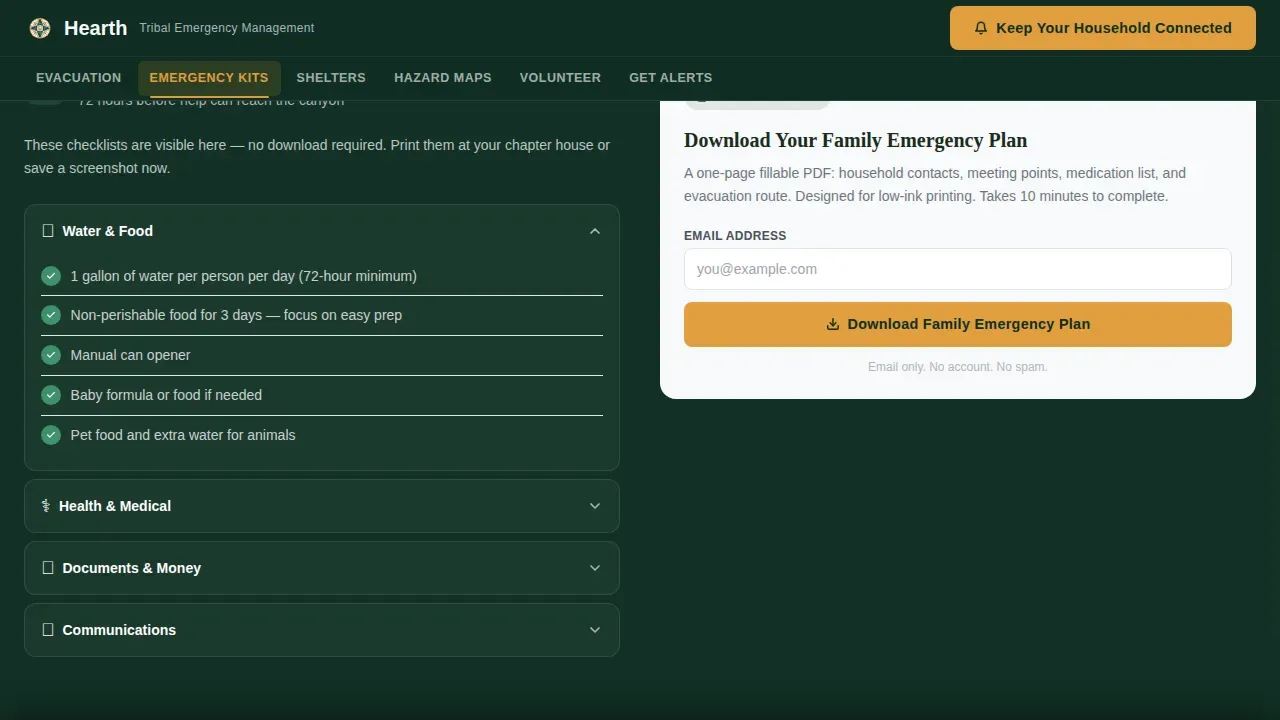
Hazard maps load inline on the page, and emergency kit checklists are visible without a download gate. This open-access approach lets families and caregivers review critical information immediately. Resource management tools, including supply lists for a home emergency kit covering food, water, prescriptions, and medical necessities, are presented clearly before any signup request.
Volunteer and Family Plan Conversion Paths
Two secondary conversion paths sit alongside the primary alert signup. "Download Your Family Emergency Plan" offers a printable, email-gated guide. "Volunteer With Your Chapter" links to a short intake form where community members can pre-register skills or equipment useful during a response.
Alpine Fresh Visual Identity with Amber Action Layer
The design is built on a four-color Alpine Fresh system: deep evergreen for backgrounds, snow-melt white for content panels, river-stone gray for body text, and high-visibility amber reserved exclusively for buttons, alert badges, and anchor navigation highlights. Amber never decorates; it only appears where action is required.
Page sections overview
| Section | Purpose |
|---|---|
| Hero Icon Grid | Establish authority and capture alert signups |
| Anchor Navigation Bar | Enable fast, direct spoke access |
| Evacuation Routes Spoke | Present route and assembly point information |
| Emergency Kits Spoke | Provide supply list and kit guidance |
| Shelter Locations Spoke | Display shelter and warming center details |
| Hazard Maps Spoke | Show localized hazard zone maps inline |
| Volunteer Sign-Up Spoke | Connect members to chapter intake form |
| Alert Registration Repeat | Reinforce signup with sticky bar prompt |
| Family Plan Download | Gate printable emergency plan with email |
| Footer Directory | Provide quick-access emergency service links |
Design & branding system
The visual identity follows a Community Hearth theme that feels functional, warm, and authoritative. The header uses a structured icon grid of hand-drawn-style symbols representing each emergency discipline, set above a slab serif authority name and a sovereignty tagline.
- Alpine Fresh palette: deep evergreen (#1B4332) backgrounds, snow-melt white (#F8F9FA) panels, river-stone gray (#6C757D) body text, high-visibility amber (#E09F3E) for all actionable elements
- Fraunces slab serif for headings, DM Sans for body text
- No stock photography; icon symbols serve as the sole visual identity, designed to feel carved and permanent
Mobile & speed optimization
The template is designed mobile-first because many community members access emergency information on phones with limited bandwidth and spotty cell service. Every layout decision reflects that context.
- Minimal JavaScript with CSS scroll-behavior handles anchor navigation and sticky bar triggers
- Scroll-linked reveals and anchor nav highlights are designed to work smoothly on low-bandwidth connections
- Inline maps and checklists load without heavy assets, so families can access critical information even when the signal is weak
How this template helps you convert
The page earns the alert signup by giving resources freely first. Visitors receive real value before they are asked for anything, which makes the primary call to action feel like a natural next step.
- Open-access checklists, inline maps, and scenario context build trust before the first form field appears, so the signup feels communal rather than transactional
- The sticky alert bar repeats the "Keep Your Household Connected" signup prompt after the visitor has already engaged with two spokes, catching visitors who scroll past the hero
- Two secondary paths, the family plan download and the volunteer intake form, provide lower-commitment entry points that serve different visitor needs without competing with the primary emergency alert goal
Other information about this template
This template can support the development, implementation, and maintenance of a tribal emergency preparedness program. It is designed to be culturally appropriate for sovereign communities and can be tailored to reflect local hazards, languages, and geographic assets.
- The template is designed to assist in showcasing public health emergency services, including information on exposure risks, infectious disease outbreaks, and natural disaster response
- Emergency response programs designed to assist children, elders, and vulnerable individuals are supported through dedicated spoke sections and clearly communicated community services
- The Hearth sovereign community emergency management landing page template includes components that help organizations expand the reach of emergency preparedness materials, consistent with guidance from federal emergency management publications
- Alert banners in the template are designed to state timestamped, color-coded status updates such as "Active Evacuation" or "All Clear," so residents always know the current state of an emergency
- The template can help tribal emergency management programs educate community members and serve as a central hub for all preparedness resources, keeping households informed and ready before a crisis begins
Theme
Community Hearth
Creative direction
Movement & Cause
Color system
Alpine Fresh
Direction
Content/Resource
Page Sections
Anchor Navigation Hub and Spoke Layout
Cause-and-effect Scenario Storytelling
Primary Alert Signup with Language Selector
Inline Maps and Open-access Checklists
Volunteer and Family Plan Conversion Paths
Alpine Fresh Visual Identity with Amber Action Layer
Related questions
Can this template support multiple tribal languages?
Does the template include emergency kit and evacuation content?
How does the alert signup work on mobile?
Can the page display real-time emergency status updates?
Is this template customizable to fit a specific tribal community?