Special Education & Learning Center Specialist Professional Website Template
Articulate is a modular card grid landing page built for speech and language therapy practices. It combines a data-driven header with animated outcome statistics, a timeline-progression scroll structure, and a gated resource hub. The template is designed to build clinical trust with parents, referral coordinators, and school specialists while driving email capture through genuine free resources.
by Rocket studio
Quick summary
Articulate is a single-page, card grid landing page template for speech and language therapy clinics. It opens with animated outcome statistics, then guides visitors through a three-row therapeutic journey covering assessment, intervention, and outcomes. Every card carries a secondary call to action, and a single email capture unlocks downloadable resources across the entire page.
Who this template is for
This template is built for speech and language therapy practices that serve both children and adults. It speaks directly to the people who make referral and enrollment decisions, not just casual browsers.
- Parents holding pediatric referral letters who need clear, evidence-based information before booking
- Rehabilitation coordinators and school Special Educational Needs coordinators searching for a practice that can demonstrate measurable progress
- Clinic owners and therapy leads who want a credible online presence that earns trust before asking for a commitment
What problem this template solves
Most therapy clinic pages either look too clinical to feel approachable or too friendly to feel credible. Neither extreme works for the audience making high-stakes referral decisions.
- Visitors leave without a clear picture of the therapeutic process, so they move on to a competitor
- Practices give away no upfront value, which means the email capture feels like a barrier rather than a reward
- There is no visual narrative showing what a client's journey actually looks like from first assessment to final outcome
What you get with this template
You get a fully structured landing page that doubles as a content and resource hub. Every section is pre-built, pre-sequenced, and ready for your clinic's real content.
- An animated header section with three rotating outcome statistics and a waveform visual motif
- Three rows of modular cards covering assessment tools, intervention conditions, and animated outcome charts
- A primary email capture form and auto-populated secondary card-level gating for downloadable resources
Feature list
This template packages several purposeful design and content mechanisms into one cohesive layout.
Animated Outcome Statistics Header
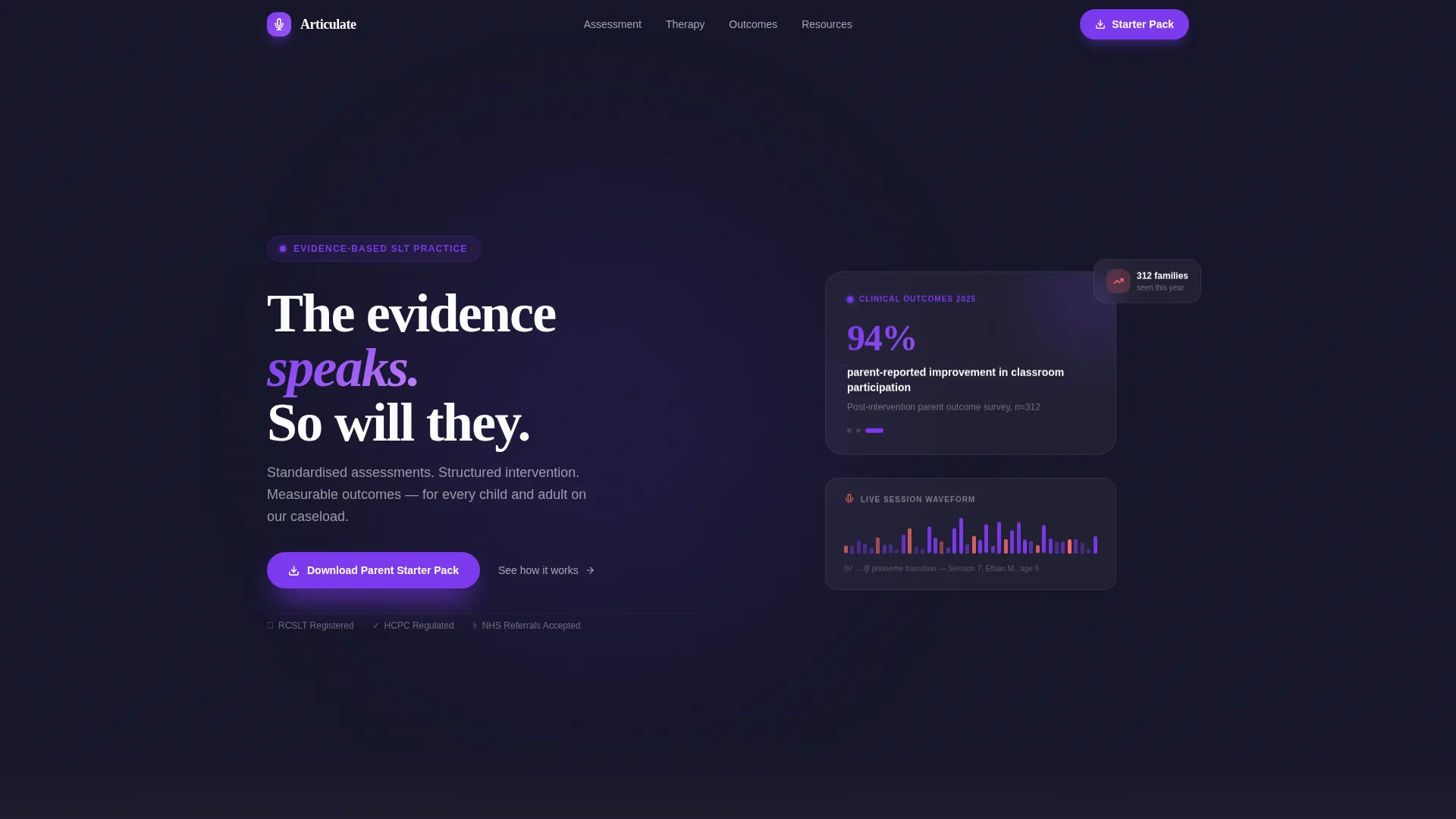
The header displays three real outcome figures that tick upward on page load. Numbers render in electric violet against deep charcoal, each accompanied by a subtle waveform animation. A single anchor sentence closes the header block.
Three-Row Therapeutic Journey
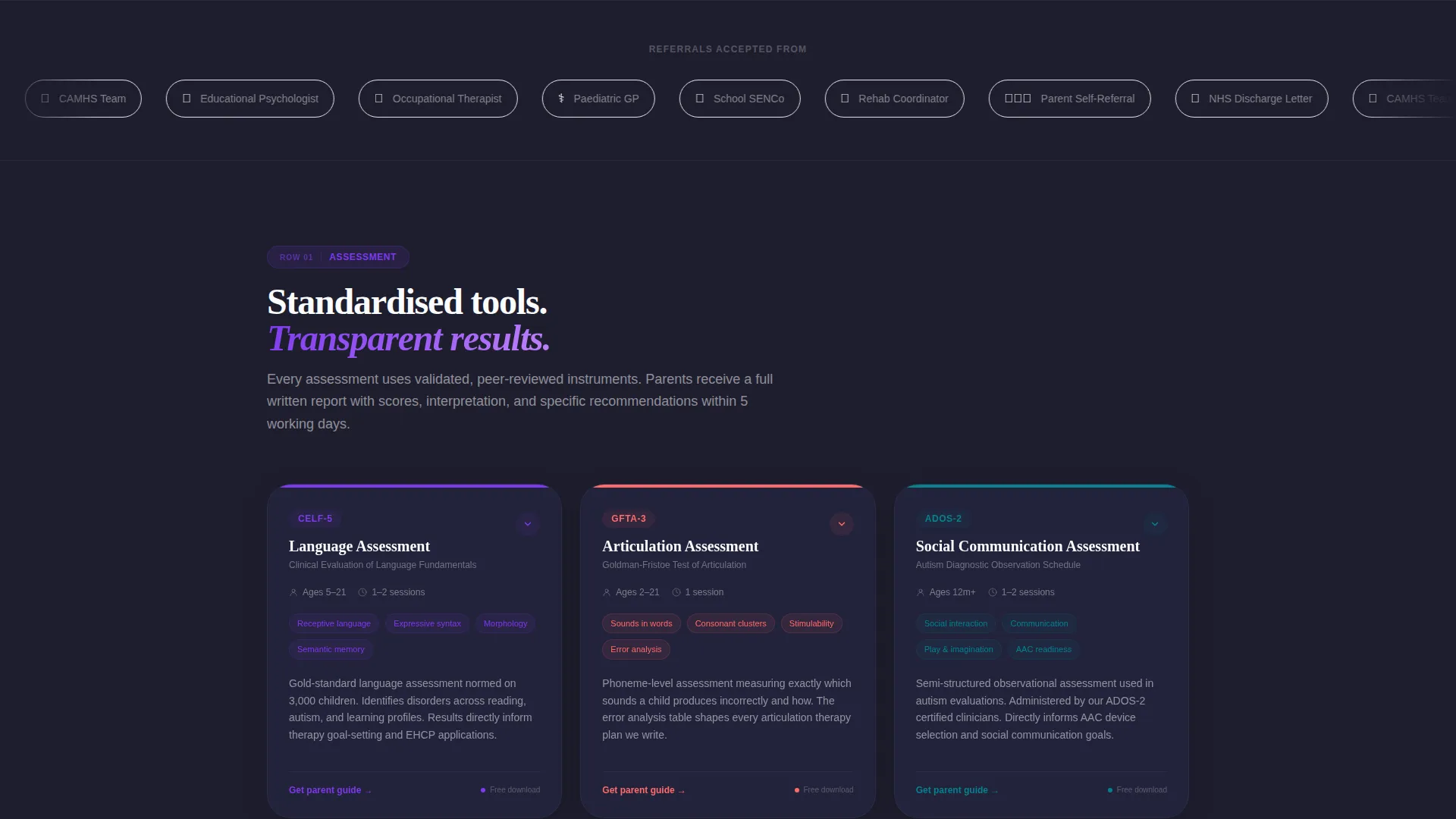
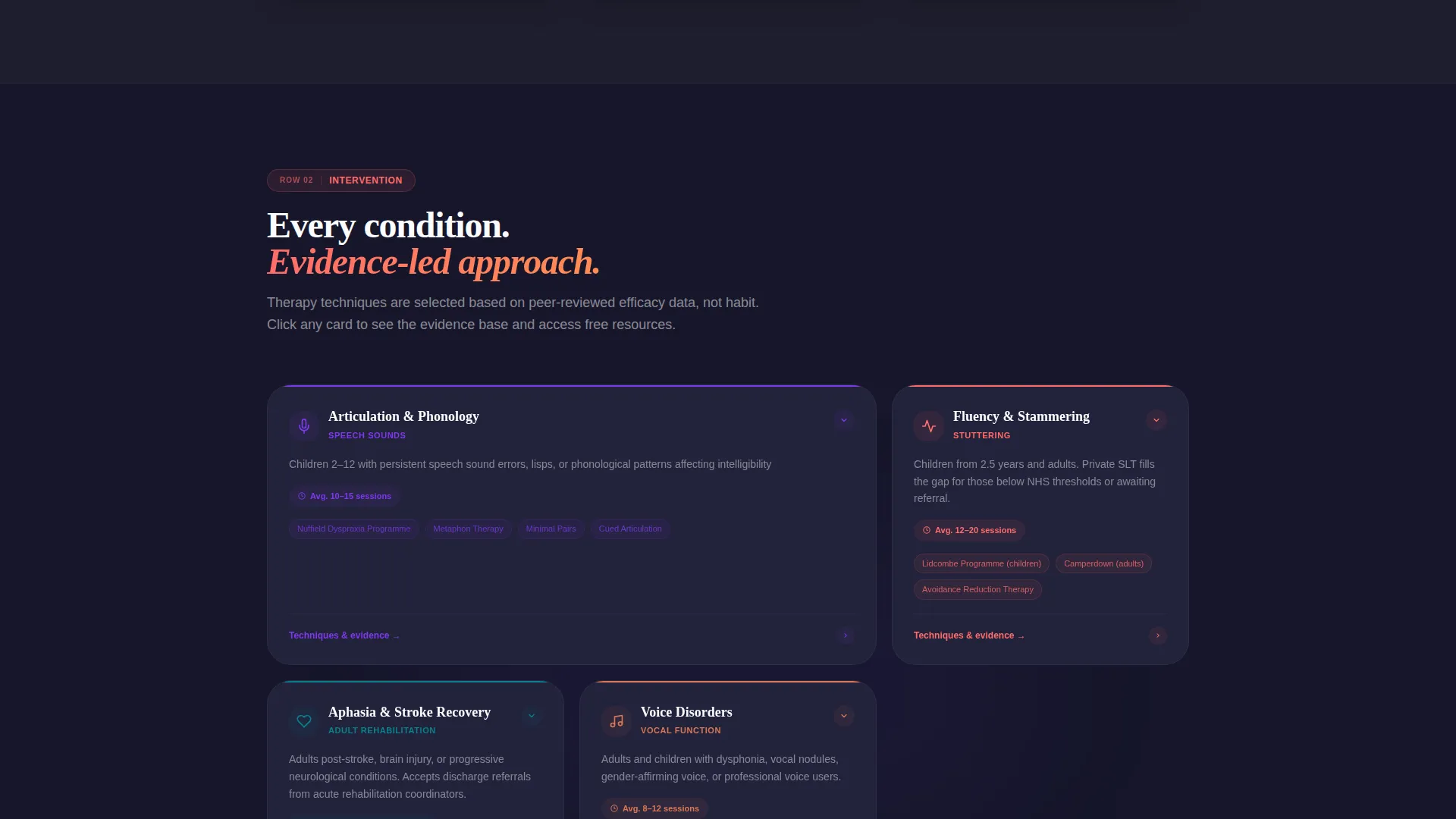
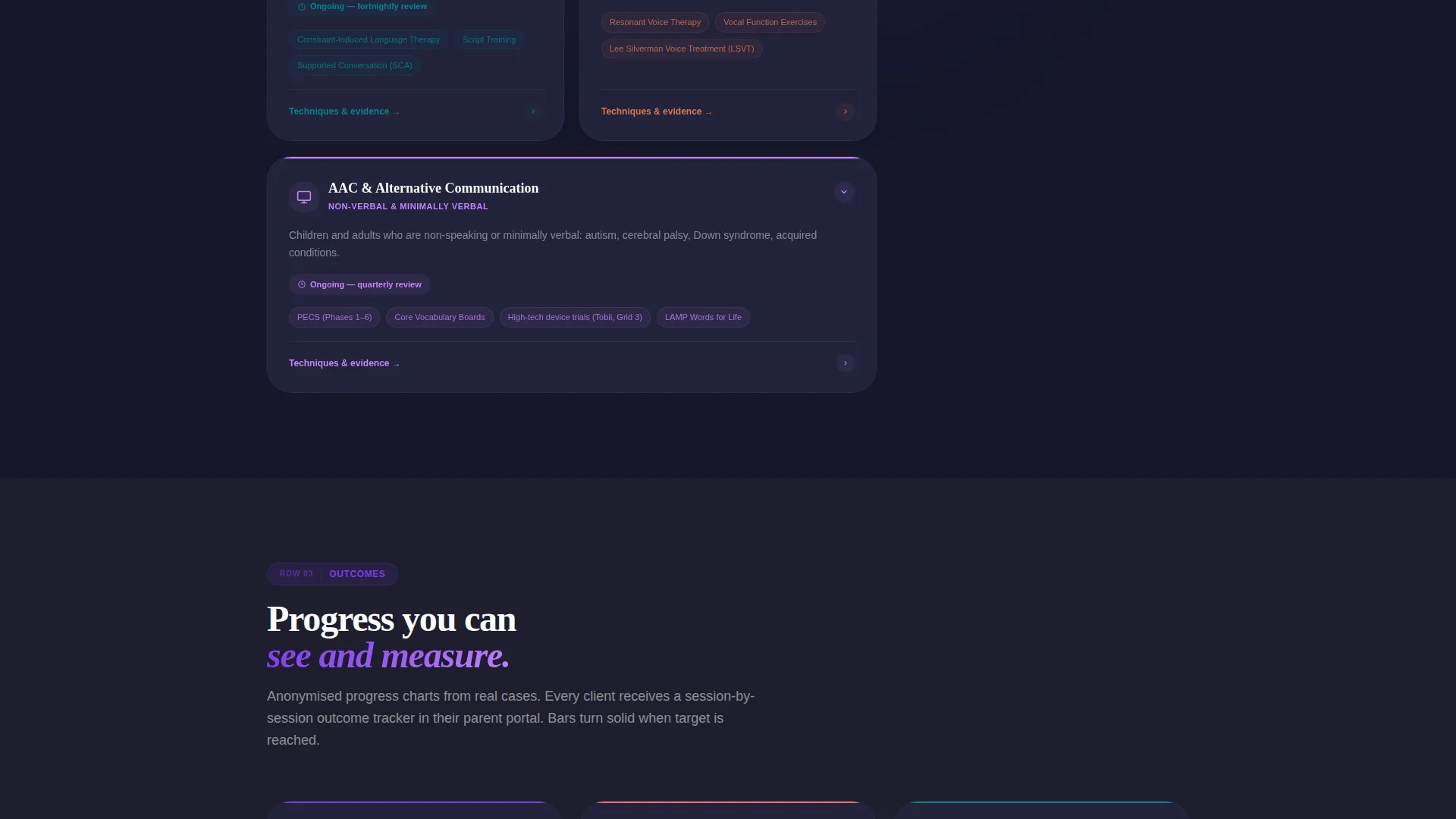
Cards are arranged in three sequential rows that mirror the actual client experience. The first row covers standardized assessment tools with downloadable parent guides. The second covers intervention conditions such as articulation, fluency, aphasia, voice, and Augmentative and Alternative Communication. The third row displays anonymized progress charts that animate as they enter the viewport.
Single Email Capture with Auto-Population
A primary download form collects first name, email address, and concern area. After first submission, the same gate auto-populates across every secondary card-level call to action on the page. Visitors only register once to access all resources.
Modular Card Grid Layout
Each card is an independent content unit with its own title, description, and call to action. Cards can be updated individually without restructuring the page. The grid adapts naturally as content volume changes.
Condition-Specific Intervention Cards
The intervention row organizes cards by therapy area. Each card surfaces the relevant techniques and links to a free printable resource. This structure helps different visitor types, such as a parent of a late talker versus a stroke rehabilitation coordinator, navigate directly to what they need.
Viewport-Triggered Progress Charts
Outcome cards contain anonymized session-by-session progress bars. The bars animate upward as the card enters the visible screen area. This gives visitors a transparent, visual sense of what clinical progress actually looks like over time.
Page sections overview
| Section | Purpose |
|---|---|
| Animated Statistics Header | Opens with three ticking outcome counters and a waveform motif to establish clinical credibility immediately |
| Assessment Tools Row | Showcases standardized tools with downloadable parent guides per card |
| Intervention Conditions Row | Organizes therapy areas into individual cards with technique summaries and free printables |
| Animated Outcomes Row | Displays anonymized progress charts that animate on scroll to show session-by-session gains |
| Primary Download Form | Captures first name, email, and concern area to unlock the Parent Starter Pack |
| Card-Level Resource Gates | Secondary calls to action on each card, auto-populated after the primary form is submitted |
Design & branding system
The visual identity follows a Corporate Precision theme executed through a Dopamine Pop color system. The result sits at an unusual intersection: serious enough for a clinical referral report, alive enough that a young child would notice it.
- Deep charcoal (#1E1E2E) anchors all text and structural elements; clinical white (#FAFBFC) fills card backgrounds to keep content scannable
- Electric violet (#7C3AED) drives interactive states and progress indicators, while reward-burst coral (#FF6B6B) marks milestone moments and download buttons
- Waveform animations reference the sound frequencies that speech therapists actually analyze, giving the motion design a functional, not decorative, logic
Mobile & speed optimization
The modular card grid is structured so that rows reflow cleanly on smaller screens. Each card is a contained unit, which means the layout scales without visual overlap or content clipping.
- Cards stack vertically on mobile, preserving the top-to-bottom therapeutic journey narrative
- Viewport-triggered animations only fire when the relevant card is visible, avoiding unnecessary motion on screens that have not yet reached that section
How this template helps you convert
The page is built around a content-first conversion model. Visitors receive genuine clinical value before they are asked for anything in return.
- The animated outcome statistics in the header establish credibility within the first few seconds, giving skeptical referrers a reason to keep reading rather than bouncing
- The three-row card structure walks each visitor through the exact journey their child or patient would experience, which reduces uncertainty and builds the kind of trust that drives form submissions
Other information about this template
This template fits naturally into a broader digital presence for a speech and language therapy practice. A few additional details worth knowing before you start customizing:
- The concern area field in the primary form covers five options: speech sounds, late talker, stuttering, stroke recovery, and other, reflecting the full range of presenting conditions described in the brief
- The template is designed for a single-page layout, so all content lives within one scrollable experience rather than across multiple separate pages
- Secondary card calls to action include "Get This Worksheet," "Read the Evidence Brief," and "Watch the Technique Demo," giving you three distinct resource types to populate
- The waveform animation in the header is a visual motif tied to the therapy context, reinforcing the clinical positioning without requiring any written explanation
Theme
Corporate Precision
Creative direction
Timeline Progression
Color system
Dopamine Pop
Style
Card Grid (Modular)
Direction
Content/Resource
Page Sections
Animated Outcome Statistics Header
Three-row Therapeutic Journey Layout
Single Email Capture with Auto-population
Condition-specific Intervention Cards
Viewport-triggered Progress Chart Animation
Downloadable Assessment Parent Guides
Related questions
Can I update the outcome statistics in the header with my own clinic data?
How does the single email capture work across multiple cards?
Is this template suitable for a clinic treating both children and adults?
What resource types are built into the card calls to action?
Do I need design experience to customize this template?