Music & Performing Arts School Booking Website Template
Aria is a conservatory-style opera training landing page built for serious vocal programs. It combines a bold typographic header, a modular faculty card grid, and a focused event registration flow. The design uses a Victorian Botanical palette to signal prestige and warmth. Visitors meet real faculty, review program details, and reserve an audition slot before they leave.
by Rocket studio
Quick summary
Aria is a single-page template built for opera training programs that recruit emerging performers. It opens with a commanding centered headline, moves through a faculty card grid that builds trust through faces and teaching philosophy, and closes with a structured audition registration form. The Botanical color system and refined serif typography give the page a conservatory authority that matches the caliber of the program itself.
Who this template is for
This template is designed for professional vocal training programs that need to attract serious candidates and convert interest into audition registrations. It works best for programs led by working professional faculty with real stage credits.
- Opera training programs running masterclass intensives, coached recitals, or role preparation workshops
- Conservatory-affiliated or independent vocal programs preparing students for young artist program auditions
- Music educators and répétiteurs who want a credibility-first page that leads directly to event sign-up
What problem this template solves
Most music program pages bury the faculty, front-load logistics, and ask visitors to commit before they feel anything. Aria reverses that order entirely. The faculty grid does the persuasion. The form arrives only after trust has been built.
- Visitors scroll past hollow credential lists instead of connecting with the people who will actually teach them
- Programs lose warm leads because there is no secondary path for browsers who are not yet ready to audition
- Registration forms ask for too much too soon, before the program has earned that level of commitment
What you get with this template
Aria delivers a complete, section-led landing page structured around the full visitor journey from first impression to confirmed audition slot. Every component is purposeful and program-specific.
- A giant centered headline block with mauve subtext for program dates and city
- A modular faculty card grid with flip or expand interactions revealing each instructor's teaching philosophy in their own words
- A dual-conversion layout featuring a primary audition registration form and a secondary catalog download path for undecided visitors
Feature list
The Aria template is built around components that reflect how opera training programs actually earn trust and drive enrollment. Each feature maps directly to a stage of the visitor's decision process.
Giant Centered Headline Header
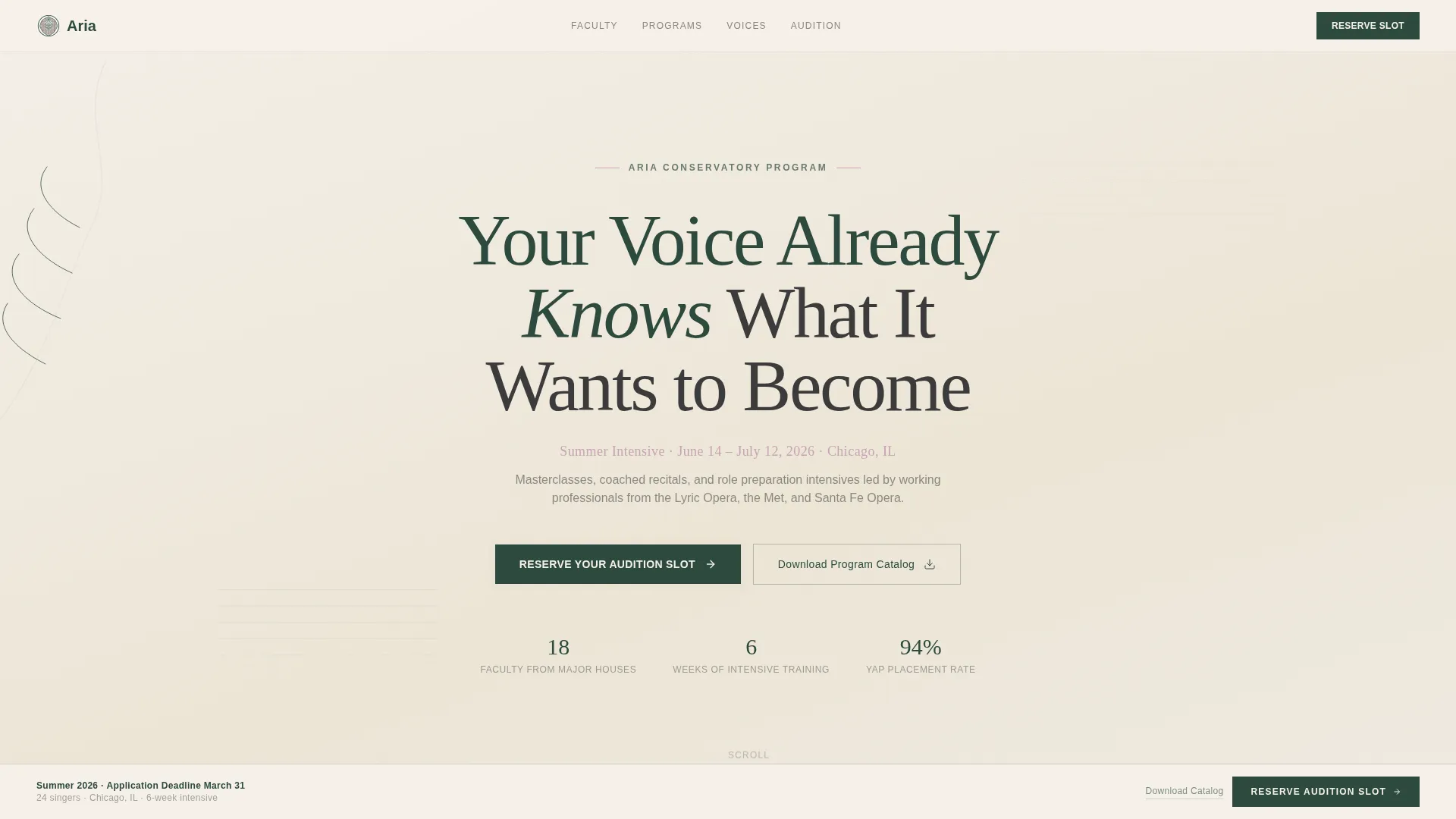
The header opens with a large-scale serif headline set against the aged parchment background. A single line of mauve subtext beneath it names the next program dates and location. No image competes with the words. The typography carries the full dramatic weight of the program's promise.
Modular Faculty Card Grid
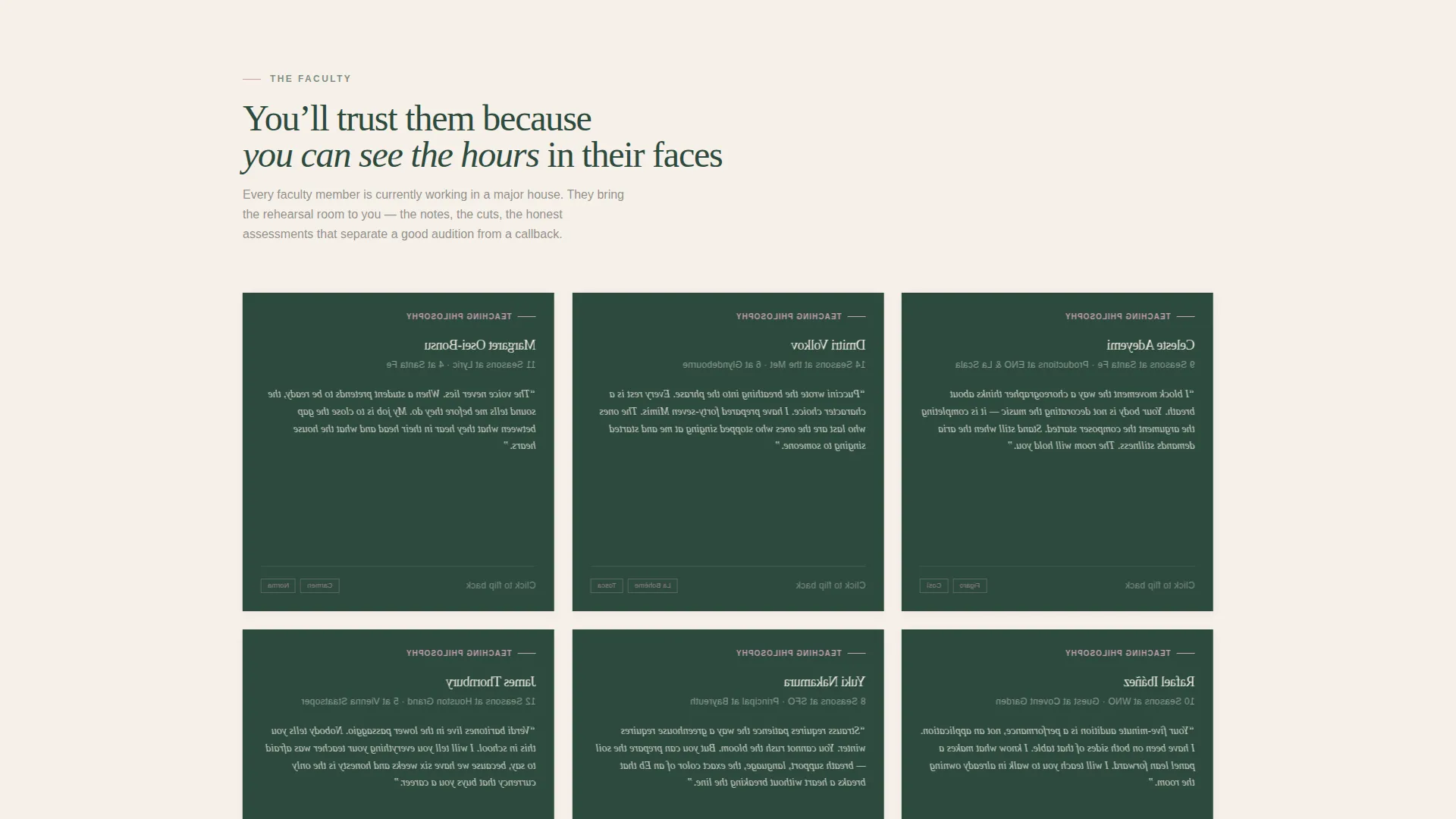
Each card in the grid pairs a faculty portrait with the instructor's professional home stage and the specific repertoire they coach. Cards flip or expand to reveal a teaching philosophy written in the instructor's own words. The grid builds credibility through faces and real professional histories, not just titles.
Dual-Path Conversion Layout
The primary call to action, "Reserve Your Audition Slot," appears directly beneath the header and again as a sticky bottom bar that activates after the third faculty card. A secondary path, "Download the Program Catalog," captures email addresses from visitors who want to review the repertoire list and schedule before committing to an audition.
Structured Audition Registration Form
The registration form collects voice type via a dropdown covering soprano, mezzo, tenor, baritone, and bass. It also gathers current training level, preferred intensive dates, and a field to upload a recent recording or link to an external video clip. Every field serves a clear intake purpose.
Sticky Bottom Conversion Bar
A persistent bottom bar appears after the visitor scrolls past the third faculty card. It keeps the primary call to action visible without interrupting the faculty browsing experience. The bar activates at the moment the visitor is most likely to feel ready.
Botanical Color and Typography System
The palette pairs deep conservatory green with pressed-flower mauve, aged parchment, and thorn-stem charcoal. Parchment dominates backgrounds. Green anchors headers and card borders. Mauve highlights hover states and accent details. Charcoal carries body text for sustained readability across long reading sessions.
Page sections overview
| Section | Purpose |
|---|---|
| Headline Header Block | Opens the page with the program's central statement and upcoming dates |
| Faculty Card Grid | Builds trust by introducing each instructor with portrait, stage credits, and coaching focus |
| Card Flip Detail | Reveals teaching philosophy in the instructor's own words on interaction |
| Primary call to action Block | Invites visitors to reserve an audition slot immediately after the header |
| Audition Registration Form | Collects voice type, training level, dates, and recording submission |
| Catalog Download Path | Captures email from visitors who want program details before committing |
| Sticky Bottom Bar | Keeps the primary call to action persistent after the third faculty card |
Design & branding system
The Aria template uses a Botanical color system that evokes a Victorian greenhouse attached to a music library. Every color choice is intentional and tied to reading hierarchy.
- Deep conservatory green (#2D4A3E) anchors headers and card borders; pressed-flower mauve (#C9A2B5) marks hover states, accent lines, and subtext details
- Aged parchment (#F5F0E8) dominates all background areas to create warmth and visual rest between content blocks
- Thorn-stem charcoal (#3B3B3B) carries all body text, keeping long passages easy to read without the harshness of pure black
Mobile & speed optimization
The card grid layout is modular by design, which means it reflows cleanly across screen sizes. Each section is built to prioritize content legibility on smaller viewports without sacrificing the visual weight of the typographic header.
- The faculty grid adjusts column count based on available width, keeping portrait cards readable and tap-friendly on phones and tablets
- The sticky bottom conversion bar is sized for thumb reach on mobile screens, so the audition registration path stays accessible throughout the full scroll
How this template helps you convert
Aria is structured so that every scroll moves the visitor closer to a decision. The persuasion happens through the faculty grid. The form appears only after the visitor has already imagined studying with someone specific.
- The giant headline creates an emotional entry point that speaks directly to the visitor's ambition, and the mauve subtext immediately grounds that emotion in real program dates and location details.
- The faculty card grid earns trust progressively as visitors meet each instructor. By the time a visitor reaches the audition form, the program has already made its case through the people who teach it.
- The dual-path conversion layout ensures no interested visitor leaves without a next step. Those ready to audition submit the form. Those still deciding download the catalog and leave an email address.
Other information about this template
Aria is categorized under Education and Training, with a specific focus on music and performing arts schools. It is purpose-built for the opera training program niche and the intersection of performing arts education with event-driven enrollment.
- The template style is a card grid with modular layout, suited to programs with multiple faculty members each worth individual introduction
- The creative direction follows a Team and People approach, meaning faculty portraits and personal teaching statements are the primary trust signals
- The header concept is a Giant Headline Centered, using a refined serif typeface at maximum typographic scale
- The landing page direction is Event Registration, and every structural decision reinforces that primary goal
- The Educational Guide theme means the page positions the program as a knowledgeable, trustworthy guide rather than a hard-sell enrollment machine
Theme
Educational Guide
Creative direction
Team & People
Color system
Botanical
Style
Card Grid (Modular)
Direction
Event Registration
Page Sections
Giant Centered Headline Header
Modular Faculty Card Grid
Dual-path Conversion Layout
Structured Audition Registration Form
Sticky Bottom Conversion Bar
Botanical Color and Typography System
Related questions
Can I add or remove faculty cards from the grid?
What information does the audition registration form collect?
Is there a way to capture leads from visitors who are not ready to register?
Who is this landing page template best suited for?
How does the sticky bottom bar work?