Advanced Low Income Finance Professional Website Template
Qualify is a split-screen mortgage landing page template built for lenders, loan officers, and brokers who serve first-time homebuyers and low income borrowers. It pairs a stats-driven left panel with a multi-step lead form on the right, guiding visitors from doubt to pre-qualification through empathetic copy, structured data reveals, and a clear finance-focused visual system.
by Rocket studio
Quick summary
Qualify is a single-page mortgage landing page template designed for finance professionals who help families access FHA, USDA, and state bond loan programs. The layout pairs a bold statistics panel with a progressive multi-step form, moving visitors through a confidence-building journey that converts hesitation into qualified leads. It is built for lead generation in the low income mortgage space.
Who this template is for
This template suits lenders, brokers, and loan officers who work with buyers who have been turned away before. It is especially well-matched for services targeting low-to-moderate income first-time homebuyers who need clarity, not jargon, to begin the process.
- Mortgage companies running paid ads to reach underserved borrowers
- Independent loan officers and brokers building a dedicated landing page for FHA or USDA programs
- Finance teams looking to attract more leads from social media and search engines without rebuilding a full website
What problem this template solves
Today's buyers in the low income mortgage space face a trust gap. They have often been rejected, given confusing details, or overwhelmed by documentation-heavy processes before they ever fill out a form. A reliable mortgage landing page must bridge the gap between financial anxiety and the real possibility of homeownership.
- Visitors abandon mortgage landing pages when forms ask for too much personal data too soon
- Borrowers distrust generic marketing that does not acknowledge their specific income bracket or credit range
- Lenders lose qualified leads because their page lacks visible social proof, program descriptions, or empathetic copy
What you get with this template
This template delivers a fully structured landing page built around the Stats-First Impact creative direction. Every section is designed to post a data point before asking anything of the visitor, building the statistical case for your service before your form requests contact details.
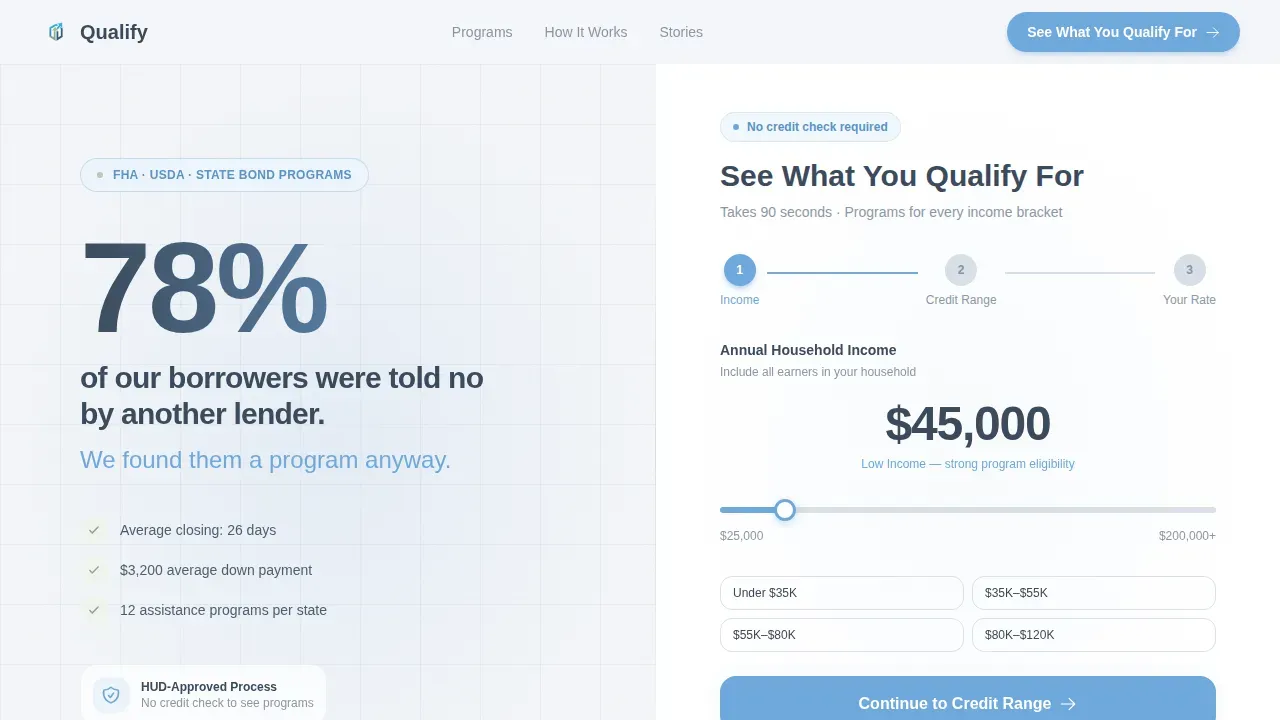
- A 50/50 split-screen hero with an oversized statistic on the left and a three-step qualification form on the right
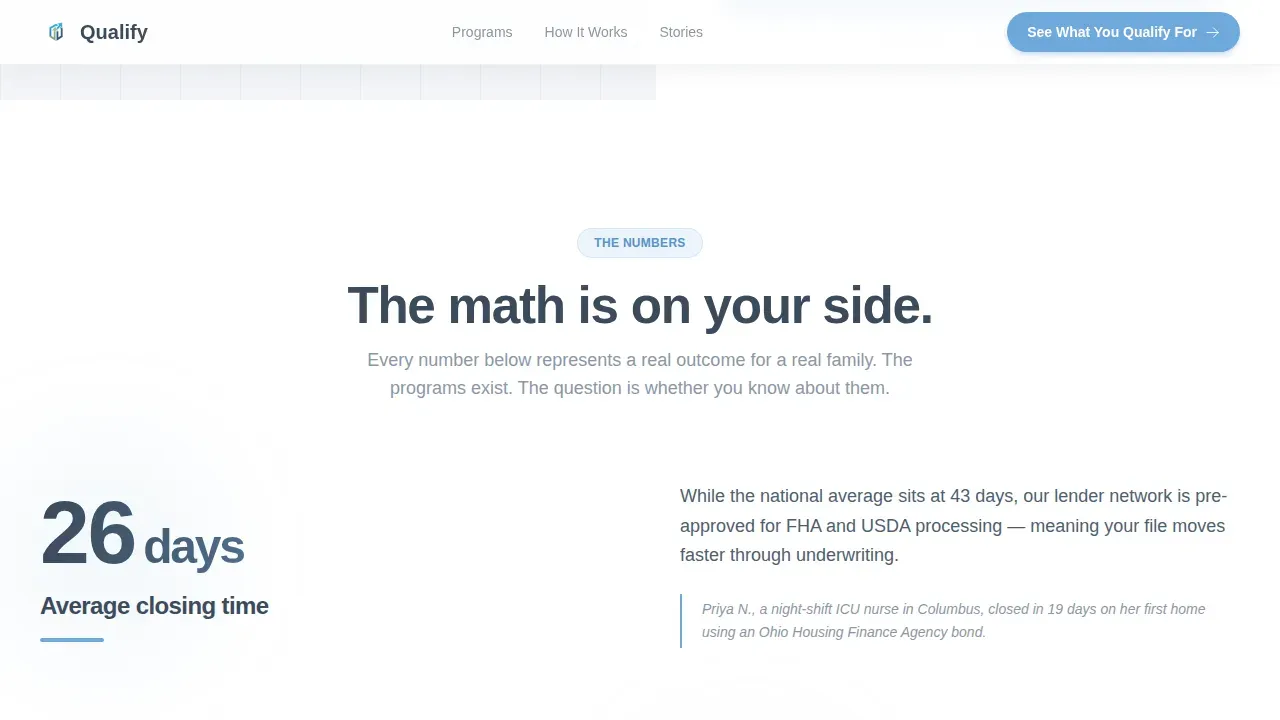
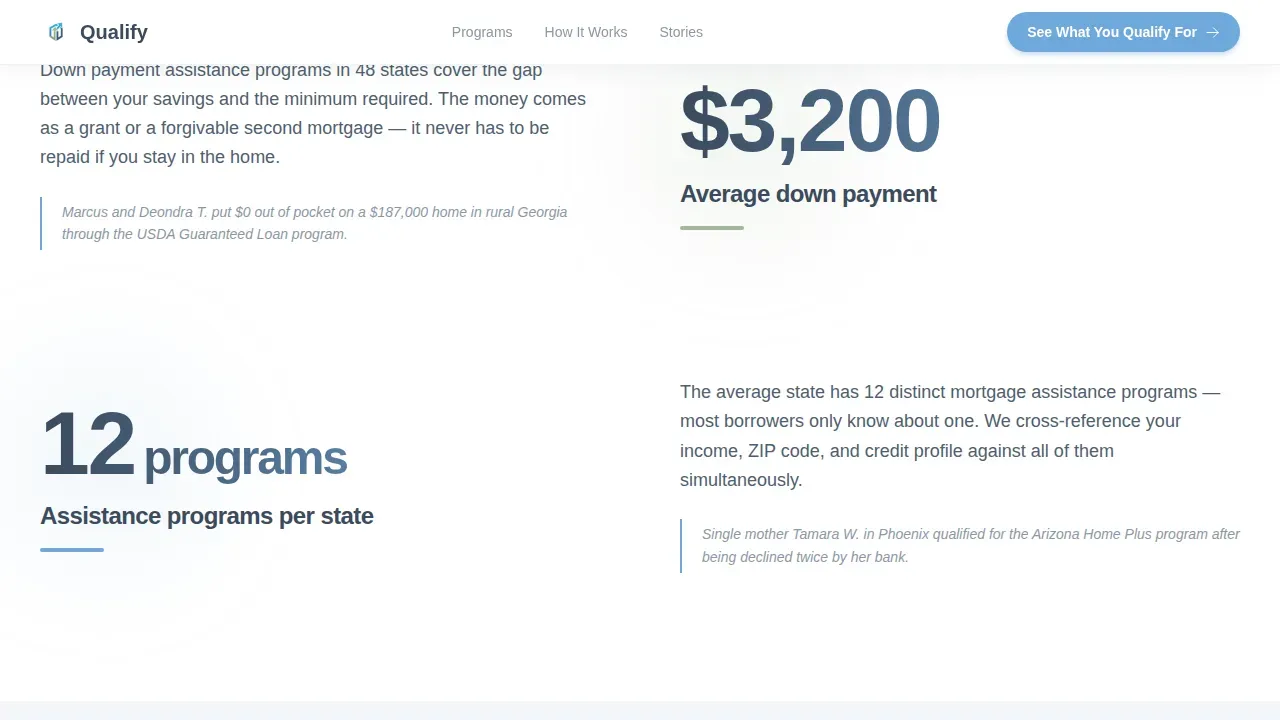
- A stats cascade section where each scroll reveals numbers such as average closing time, down payment cost, and available assistance programs
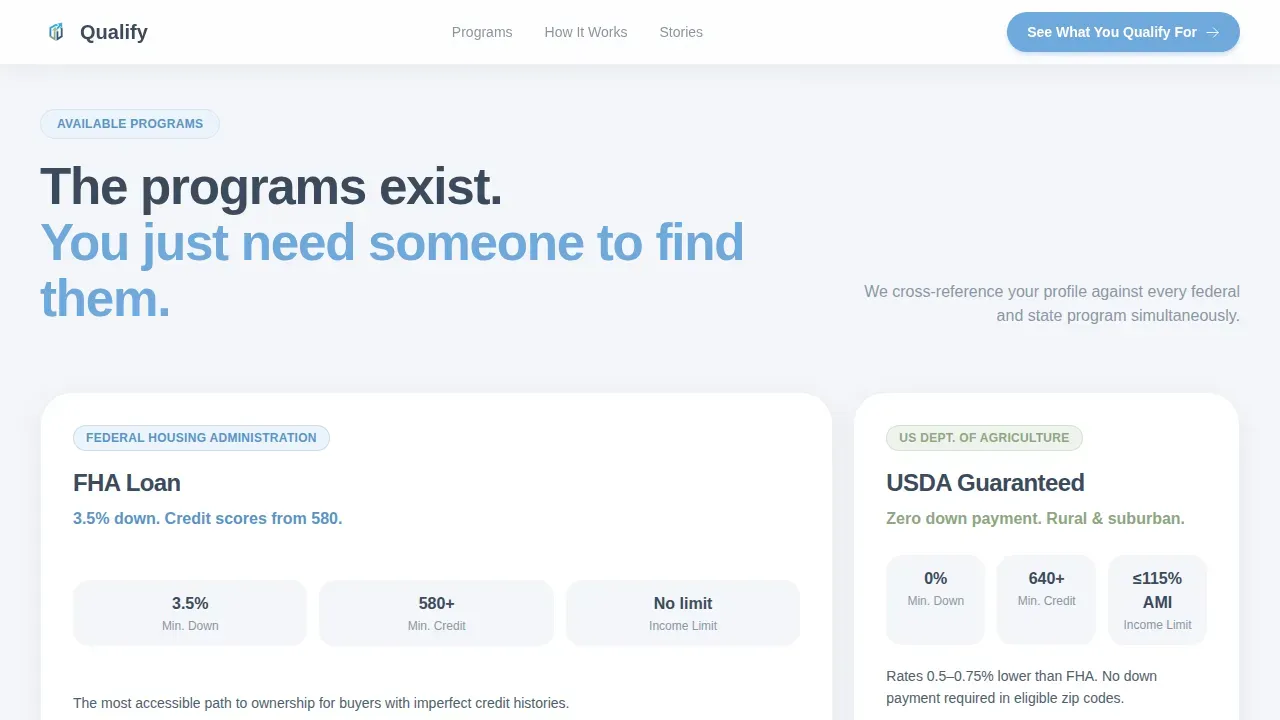
- Program feature cards for FHA, USDA, and state bond options, a borrower stories section, and a zip-code-based state program lookup with a linear single-row footer
Feature list
This landing page template includes purpose-built components that solve real problems for mortgage marketing. Each feature supports the goal of turning site visitors into leads through clarity, empathy, and structured data presentation.
Split-Screen Stats Hero
The hero section divides the page into two equal halves. The left side displays a single oversized statistic in slate typography, such as "78% of our borrowers were told no by another lender," paired with a sky-blue resolution line. The right side holds the multi-step form with a progress indicator, creating immediate tension and resolution without any stock photography.
Progressive Multi-Step Lead Form
The form collects data in order from least to most personal: annual household income via a slider starting at $25,000, credit range via a dropdown labeled Poor, Fair, or Good, zip code, then first name and phone number. This sequence reduces anxiety and builds commitment gradually, following best practices for lead forms on high-friction finance pages.
Stats Cascade with Context Cards
Each scroll section leads with a large slate numeral, examples include 26-day average closing time, $3,200 average down payment, and 12 assistance programs available per state, followed by a single paragraph of context or a mini case study. The rhythm punches with data, then explains, turning the page into a closing argument for your service.
Program Feature Cards
Three asymmetric cards present FHA, USDA, and state bond programs side by side. Each card gives a clear description of the program, its eligibility focus, and its key payment or property benefit. Visitors can compare options without needing to search elsewhere, keeping them on your landing page longer.
Zip-Code Program Lookup
A secondary call-to-action section invites visitors to check programs available in their state by entering only a zip code. This lower-friction path captures leads who are not yet ready to share personal details, expanding your reach to prospects at an earlier stage of consideration.
Borrower Stories Section
Real-format case studies include income bracket, program name, and closing outcome. These stories provide empathetic social proof and help visitors see themselves in the data. Verified, outcome-specific examples outperform generic testimonials on mortgage landing pages by making the result feel personally attainable.
Page sections overview
| Section | Purpose |
|---|---|
| Split-Screen Hero | Stat plus form above the fold |
| Stats Cascade | Scroll-reveal data proof |
| Program Feature Cards | FHA, USDA, bond comparison |
| Borrower Stories | Income-specific case studies |
| State Lookup Call to Action | Zip-code program finder |
| Footer | Linear single-row brand close |
Design & branding system
The template uses a Corporate Precision visual theme built on the Cloud Canvas color system. The palette feels institutional enough to earn trust and warm enough to not intimidate visitors who are wary of finance pages.
- Cloud white (#F4F6F9) backgrounds, slate (#3B4A5C) headlines, sky blue (#6FA8DC) buttons and progress indicators, and sage green (#A3B899) for success states and approval confirmations
- Plus Jakarta Sans headings paired with DM Sans body text for a clean, readable typographic hierarchy
- No stock photography or house imagery; the design relies on numbers, form structure, and color to communicate confidence and clarity
Mobile & speed optimization
This landing page template is built mobile-first, reflecting the reality that 60 to 75 percent of financial traffic arrives from mobile devices. Visitors such as night-shift nurses checking mortgage rates on a break need thumb-friendly buttons and fast-loading sections.
- Large tap targets on the multi-step form, slider controls, and call-to-action buttons are sized for one-handed mobile use
- Staggered fadeInUp animations and scroll-reveal transitions are set to medium intensity, keeping the page dynamic without slowing perceived load time
- Client-side interactivity handles the form steps and zip lookup while static sections use server components, keeping the page responsive across devices
How this template helps you convert
A well-designed mortgage landing page earns the click before asking for contact details. This template is structured to build belief through data, then move visitors toward a form submission naturally.
- The hero's oversized statistic creates immediate empathy and relevance, so visitors feel understood before they interact with any form field, reducing the drop-off that plagues most mortgage landing pages.
- The progressive form structure collects income and credit data first, delaying the request for name and phone until the visitor has already invested three steps, which significantly improves conversions on finance lead forms.
- The secondary zip-code lookup path captures prospects who are not yet ready for the primary form, giving you a second route to generate leads from the same page traffic.
Other information about this template
This template is part of a no-code platform that allows users to create and launch mortgage landing pages without coding skills. You can upload your own data, post borrower case studies, manage copy updates, and scale your campaigns without a developer. Built-in tools help your page perform in search engines and attract traffic from paid ads, social media posts, and direct links.
- Connect the template to Google Analytics to track page data, measure visitor behavior, compare conversion rates across traffic sources, and research which form steps create drop-offs
- The template supports addition of NMLS identification numbers, Equal Housing Opportunity logos, SSL badges, and APR disclosures near lead capture forms, in line with mortgage industry compliance standards
- Loan officers and brokers can use the qualify trusted low income mortgage landing page template to reach more people in underserved zip codes, scale outreach through social media and paid ads, and save time by starting from a proven page structure rather than building from scratch
- Use the page as a destination for Google search campaigns, social media posts, or referral links from real estate partners, keeping all leads in one manageable funnel
- The template can support video embeds in the borrower stories section to add dynamic social proof for customers who respond better to visual examples
- Feedback from clients and customers can be added to the borrower stories section to keep the page current and relevant as your business grows
- For brokers and lenders working across multiple states, the zip-code lookup section provides a resource that answers a key buyer question without requiring a full website rebuild
Theme
Corporate Precision
Creative direction
Stats-First Impact
Color system
Cloud Canvas
Style
Split Screen (50/50)
Direction
Lead Generation
Page Sections
Split-screen Stats Hero
Progressive Multi-step Lead Form
Stats Cascade with Context Cards
Program Feature Cards
Zip-code Program Lookup
Borrower Stories Section
Related questions
Can I edit the statistics and program descriptions in this template?
Is the multi-step form suitable for collecting leads from first-time homebuyers?
How does the zip-code lookup section help generate more leads?
Does this template work for paid ads and social media traffic?
Can I add compliance details such as NMLS numbers and security badges?