CS Learning Landing Page Template | Start the Diagnostic
The Algorithmia Start the Diagnostic Computer Science Learning landing page template is a single-column flow built for EdTech platforms targeting career-switchers, bootcamp graduates, and self-taught developers. It opens with an interactive algorithm quiz, guides visitors through a structured curriculum journey, and converts through a dual-path diagnostic call to action. The botanical color system and playful geometric style make dense computer science content feel alive and approachable.
by Rocket studio
Quick summary
This template is designed for computer science learning platforms that want to earn trust before asking for commitment. It opens with a live algorithm puzzle, walks visitors through a hero's journey narrative, and closes with a personalized skills diagnostic. Every section serves a clear purpose: prove the teaching quality, show the curriculum depth, and give learners a reason to act now.
Who this template is for
This template is purpose-built for EdTech founders and course creators who teach computer science, software engineering, and data science. It works especially well when your audience already knows something is missing from their training and just needs the right prompt to commit.
- Career-switchers preparing for technical interviews and grinding algorithm practice problems at odd hours
- Bootcamp graduates who need deeper foundations in data structures, system design, and machine learning
- Self-taught developers stuck in tutorial hell who want structured mastery with real production outcomes
What problem this template solves
Most CS learning platforms look the same: a hero headline, a feature grid, and a sign-up button. That approach fails learners who are skeptical, busy, and tired of platforms that promise transformation but deliver PDFs. This template solves the credibility gap by demonstrating the teaching model before asking for anything.
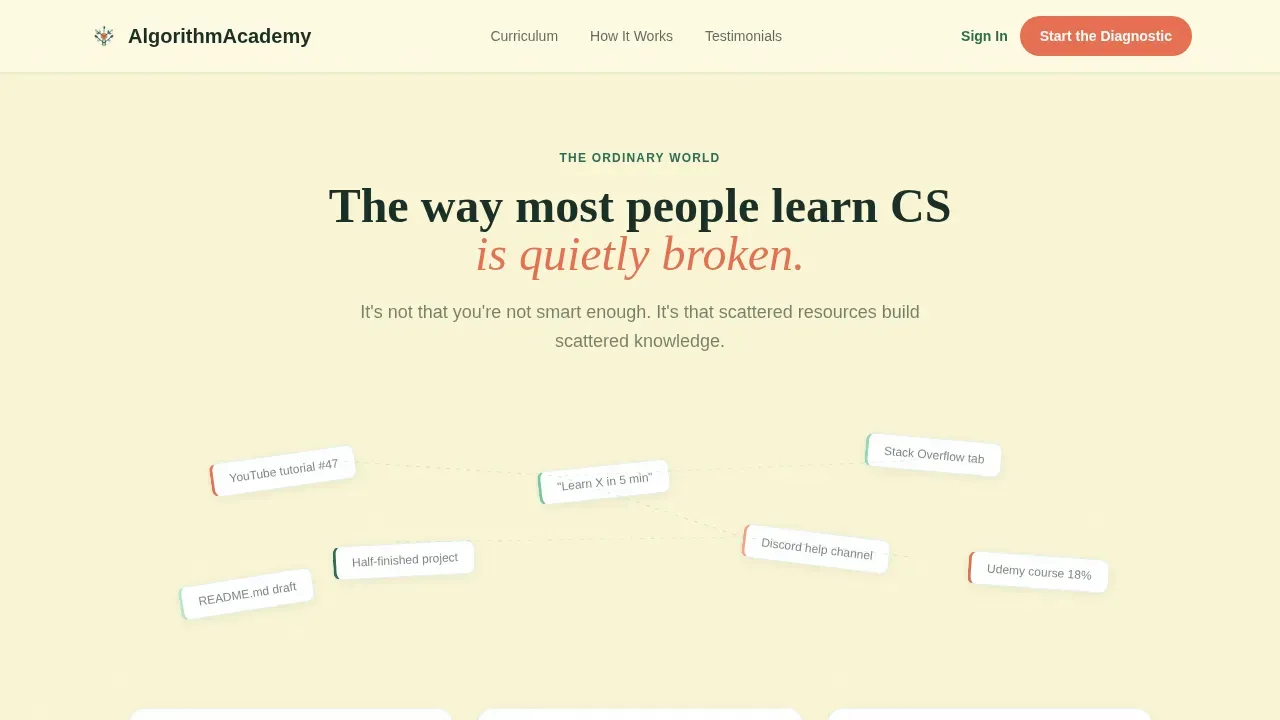
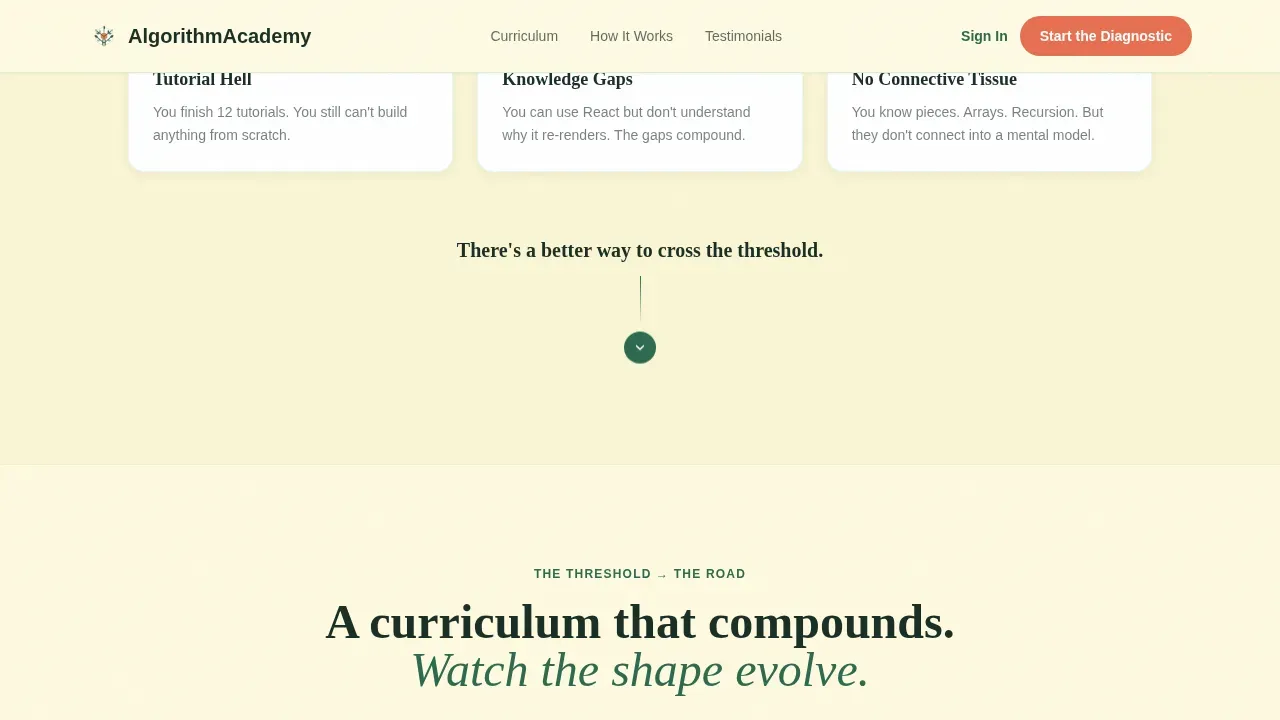
- Fragmented learning experiences leave users switching between scattered tabs and half-finished projects with no clear roadmap
- Generic course pages fail to show pedagogical depth, leaving motivated learners unsure whether the training matches their level
- Conversion suffers when there is no immediate value exchange, and visitors leave without understanding the quality of the curriculum
What you get with this template
You get a fully structured single-column landing page built around a hero's journey narrative arc. Each section escalates in capability, mirroring how CS knowledge compounds. The layout is clean, authoritative, and benefit-driven from top to bottom.
- A five-section page flow: interactive quiz hero, fragmented-world pain section, geometric curriculum journey, mentor moment testimonials, and a diagnostic call to action with a dual-path footer
- Playful geometric visual components including hexagon answer cards, morphing SVG shapes, and scroll-linked reveal animations that make complex topics feel engaging
- Two conversion paths: a primary "Start the Diagnostic" free skills assessment and a secondary "Download the Roadmap" email-gated PDF
Feature list
This template ships with a focused set of high-impact features. Each one is grounded in the project brief and designed to serve a specific conversion or engagement goal.
Interactive Algorithm Quiz Hero
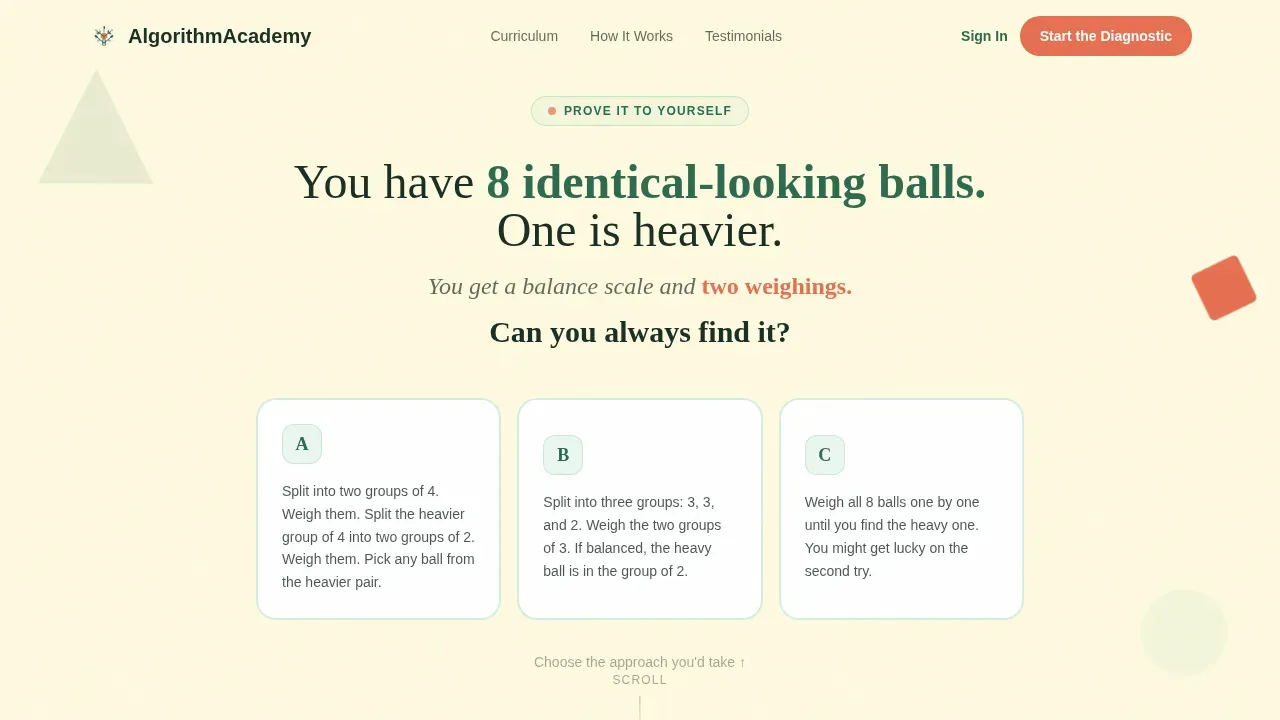
The page opens with a single typeset puzzle question and three hexagon answer cards. Choosing one triggers an animated step-by-step solution breakdown. This mini-demo lets users experience the teaching style immediately, before any sign-up friction. It proves educational quality in under sixty seconds.
Geometric Curriculum Journey
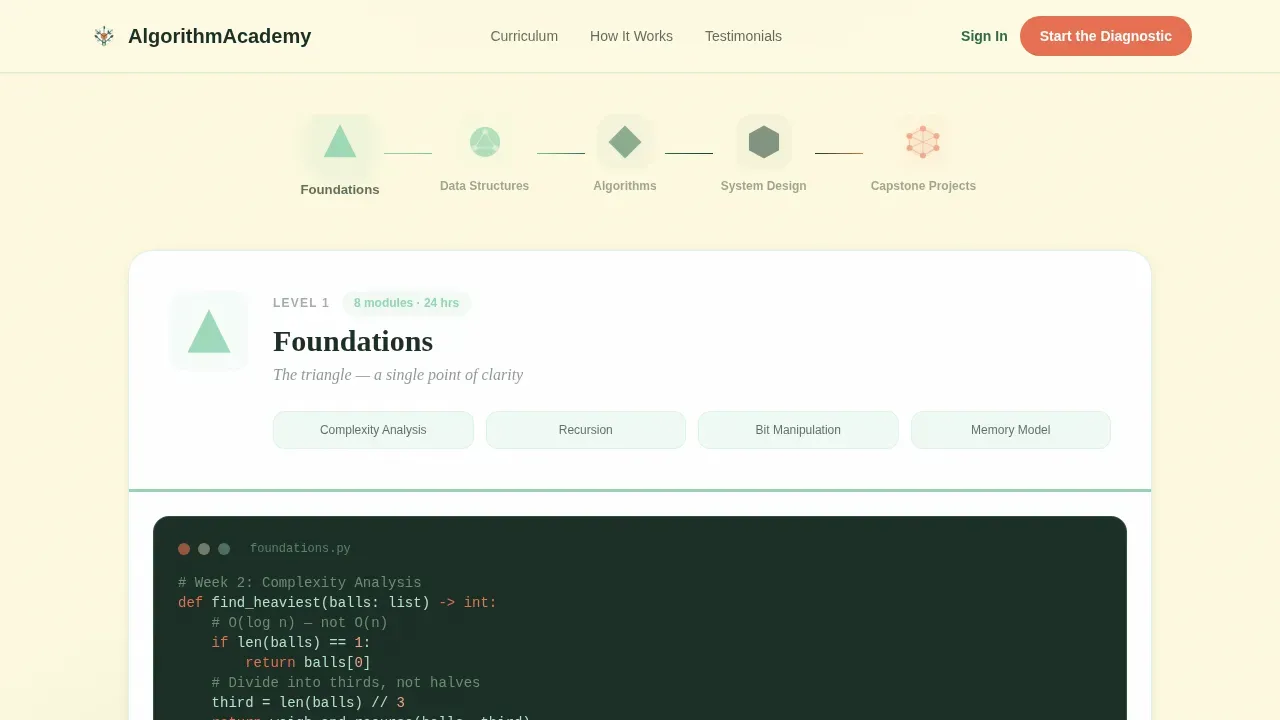
A scroll-linked section shows CS concepts compounding visually. A triangle morphs into a tree, then a graph, then a network. Each stage maps to a curriculum tier: fundamentals, data structures, system design, and capstone projects. This image of growth gives users a clear figure of what they will build toward.
Mentor Moment Testimonials
Testimonials are framed as inflection-point quotes from real learners. Each card includes a name, photo, and role to build credibility. The format mirrors a mentor conversation rather than a generic review, making social proof feel specific and earned rather than decorative.
Dual-Path Diagnostic Conversion
The call-to-action section offers two entry points. The primary path leads to a free skills assessment covering six CS domains, with a personalized roadmap delivered by email. The secondary path offers a downloadable course tree PDF requiring only an email address. Both paths prioritize giving value before asking for commitment.
Botanical Color System and Playful Geometric Design
The visual identity uses deep fern green for headers and navigation, soft moss on section backgrounds and code block containers, warm parchment as the primary canvas, and persimmon berry on buttons and interactive highlights. Fraunces serif handles display headings while DM Sans serves body text and interface elements. The result feels like a greenhouse-meets-IDE aesthetic.
Scroll-Linked Animations and State Machine Interactions
The template supports high-animation interactions: quiz card state transitions, staggered word reveals, and morphing SVG components tied to scroll position. These features automate the narrative pacing, guiding users through the hero's journey without requiring manual navigation.
Page sections overview
| Section | Purpose |
|---|---|
| Hero Quiz Section | Trigger algorithmic thinking with an interactive puzzle and animated answer reveal |
| Fragmented World Pain | Show the ordinary-world problem: scattered tabs, incomplete projects, no clear path |
| Curriculum Journey | Visualize compounding CS knowledge through geometric shape morphing tied to scroll |
| Mentor Moments | Build trust with inflection-point learner testimonials including names, photos, and roles |
| Diagnostic Call to Action | Convert visitors through a dual-path: free skills assessment or downloadable roadmap PDF |
| Footer | Linear single-row footer with essential links and a final conversion prompt |
Design & branding system
The visual language is Playful Geometric with a Botanical color palette. It balances the logic of computer science with the warmth of a living, growing environment. The result is a page that feels both technically credible and genuinely inviting.
- Color tokens: parchment (#FEFAE0) canvas, fern green (#2D6A4F) structure, moss (#95D5B2) accents on code containers and backgrounds, persimmon berry (#E76F51) on all calls to action and progress indicators
- Typography pairing: Fraunces serif for display headings and emotional moments, DM Sans for body copy, labels, and interface text, creating a clear visual hierarchy that guides the scanning eye
- Geometric shape language: hexagons with rounded corners and soft drop shadows for quiz cards, morphing SVG forms for the curriculum journey, and staggered reveal animations for testimonial and section content
Mobile & speed optimization
The template is built desktop-first to match the primary use case: a developer at a desk, working through course material with focus. It scales responsively for mobile, which matters for the secondary audience grinding algorithm problems late at night on a phone.
- Touch-friendly hexagon quiz cards and accordion curriculum components are sized and spaced for clean mobile interaction
- Static sections use server-rendered components to keep loading times low and the initial page experience fast
- Interactive elements including the quiz state machine and scroll-linked animations are isolated as client components to avoid blocking the initial page load
How this template helps you convert
This template converts by earning trust before requesting it. The structure is deliberate: every scroll reveals more value, and both calls to action give something before asking for an email address.
- The opening quiz functions as a live product demo. Users interact with the teaching model in the first ten seconds. This gives immediate proof of quality, making it far easier to confirm the platform's value before any commitment is required.
- The dual-path call to action meets users at two different readiness levels. Visitors ready to assess their skills can start the diagnostic. Visitors who want to explore first can pull the free roadmap PDF. Both paths collect an email while delivering real value.
Other information about this template
This template is well suited for teams building in the broader machine learning and data science education space. The structural model works equally well for platforms teaching machine learning models, deployment workflows, and production engineering. Here is additional context on how the template fits that ecosystem.
- The Algorithmia Start the Diagnostic Computer Science Learning landing page template is named to reflect the MLOps platform context in which algorithm diagnostics, model monitoring, and structured training paths converge
- Algorithmia is an MLOps platform with capabilities for deploying, managing, governing, and securing machine learning models in production, and the diagnostic framing of this template mirrors that model-evaluation mindset
- Algorithmia Insights provides a metrics pipeline to measure and monitor machine learning models, making it a reference point for the kind of dashboard-style progress tracking this template's roadmap section can support
- TensorFlow Serving is a flexible, high-performance serving system for machine learning models designed for production environments; it supports version control, monitoring, and batching, all of which are relevant training topics this platform can cover
- Serving machine learning models at scale requires a high performance serving system with robust metrics, data drift detection, and model performance tracking built in
- The Deep Learning Reference Stack integrates TensorFlow Serving as part of its serving container image, allowing users to deploy models efficiently with fewer infrastructure bottlenecks
- Machine learning models require faster iteration than traditional software development, making version control critical for retraining and re-evaluating model performance
- Good Machine Learning Practices, or GMLP, require teams to monitor model performance after deployment, assess data drift against real world data, and retrain when metrics degrade
- Data scientists and machine learning engineers benefit from training that covers business intelligence reporting, analytics integration, cloud deployment, and production-grade system design
- Scientists across data science and machine learning research fields use tools like MLflow, Pachyderm, Kubeflow, and DataRobot alongside Algorithmia to manage the full model lifecycle
- AI can automate certain tasks in diagnostics, acting as a support system that enhances objectivity rather than replacing human expertise; AI algorithms require rigorous validation to confirm their reliability
- For teams who want to build and deploy similar pages quickly, no-code builders can configure and push a functional landing page without writing infrastructure from scratch
Theme
Playful Geometric
Creative direction
Hero's Journey
Color system
Botanical
Style
Single Column Flow
Direction
Content/Resource
Page Sections
Interactive Algorithm Quiz Hero
Geometric Curriculum Journey
Mentor Moment Testimonials
Dual-path Diagnostic Conversion
Botanical Geometric Visual System
Scroll-linked Animations and Quiz State Machine
Related questions
Who is the primary audience for this template?
What conversion paths does the template include?
Does the template include social proof components?
What animation and interaction features are included?
Can this template be adapted for machine learning or data science courses?