Results Family Lawyer Landing Page Template
This custody compelling case study child support lawyer landing page template is built for family law firms that want results before they ask for a commitment. Three anonymized comparison tables show what the opposing side proposed versus what the firm actually secured. The Editorial Magazine design and case-study narrative turn raw legal outcomes into a persuasive, trust-building scroll that moves distressed parents toward booking a free consultation.
by Rocket studio
Quick summary
This template gives a family law firm a single-page, evidence-first landing page structured around three real-outcome comparison tables. Each table shows "Their Offer" against "Final Order" across line items such as monthly support, medical coverage, education contributions, and custody splits. The editorial design and case-study narrative work together to convert visitors who arrive in crisis into parents ready to act.
Who this template is for
This template is built for any family law firm or family lawyer whose primary goal is to turn anxious, first-time visitors into booked consultations. It is especially well suited for practices that already have anonymized case outcomes worth sharing and want a law firm landing page that leads with proof rather than promises.
- Family law attorneys handling child custody modifications, interstate disputes, or high-income imputation cases
- Divorce attorney practices that want to attract potential clients through narrative-led, evidence-backed landing pages
- Grandparent and non-parent legal counsel seeking legal standing for children in their care
What problem this template solves
Most law firm landing pages for family law services lead with attorney bios, generic mission statements, and a contact form. That approach asks potential clients to trust before they have any reason to. The result is a high bounce rate and low conversion on visits from people who are frightened, overwhelmed, and actively comparing their options on a search engine.
This template solves that problem by flipping the sequence. It leads with outcomes and lets the numbers argue the case before a single call to action appears.
- Parents arrive in a crisis state and need to see proof of successful outcomes before they can trust a law firm
- The opposing side has already made an offer, and the client does not know if it is fair or enforceable
- Generic legal services copy fails to create an emotional connection with a parent whose financial security and time with their children are at stake
What you get with this template
This template delivers a fully structured, single-page layout with every section pre-built and ready to populate with your firm's own anonymized case data. The page is organized so that each section earns the next click. Nothing is decorative for its own sake. Every element serves the core task of moving a prospective client from fear to action.
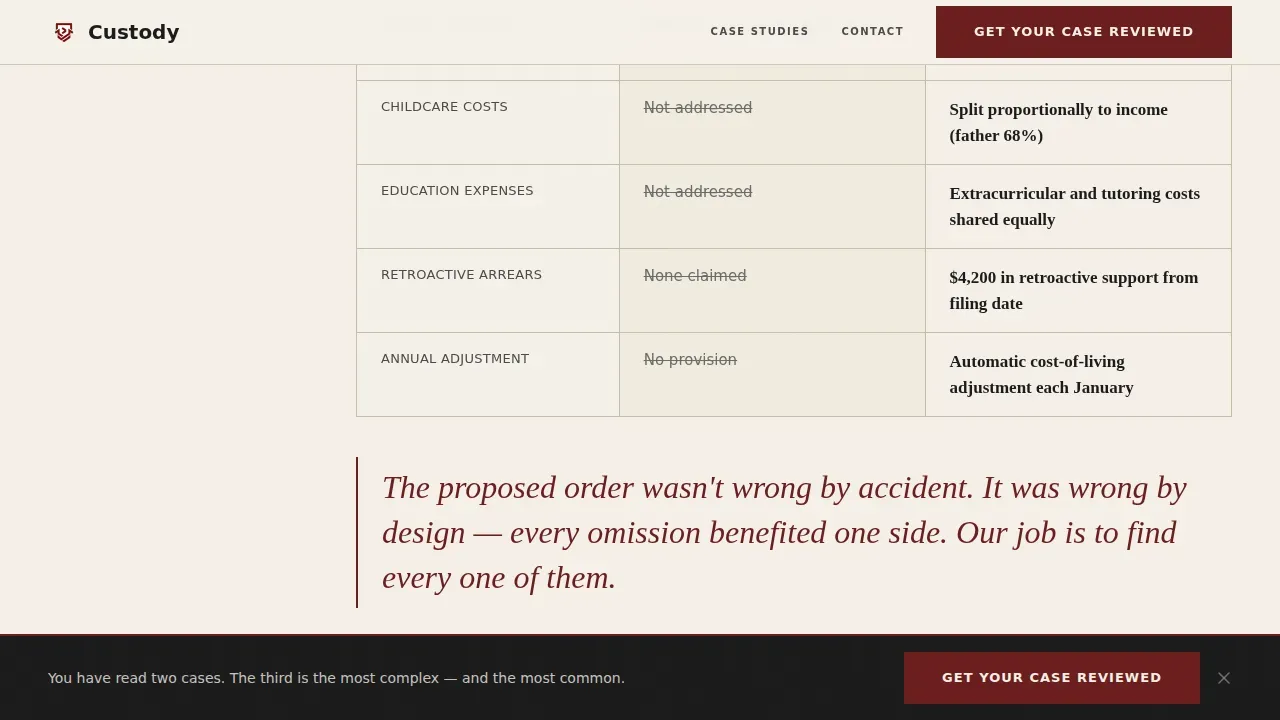
- Three side-by-side comparison tables with "Their Offer" and "Final Order" columns covering monthly support, medical coverage, education contributions, and holiday custody splits
- Three contextual editorial paragraphs that frame each case in plain language, escalating from a straightforward modification to a contested interstate dispute to a complex high-income case
- Three strategically placed call to action blocks, including a post-case-study button, a sticky call to action bar, and a full-width closing section
Feature list
This template includes the following built-in capabilities, each designed to support the specific conversion goals of a family law firm targeting distressed parents.
Giant Flush-Left Headline Section
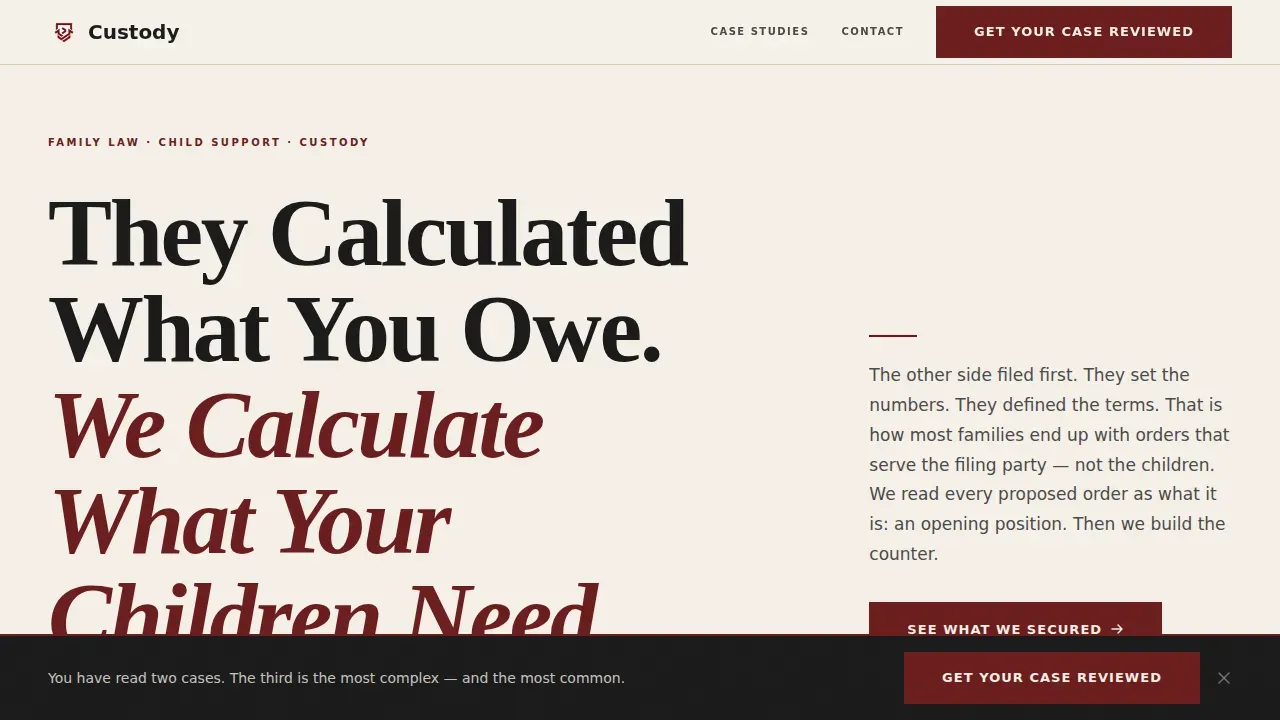
The hero section uses enormous serif type set flush-left against a warm parchment background. The headline occupies sixty percent of the viewport, with a single paragraph of supporting body text and a thin oxblood red rule separating it from the scroll below. There are no images in the hero. The typography is the visual statement, deliberate and impossible to scroll past without reading.
Three Anonymized Case Study Comparison Tables
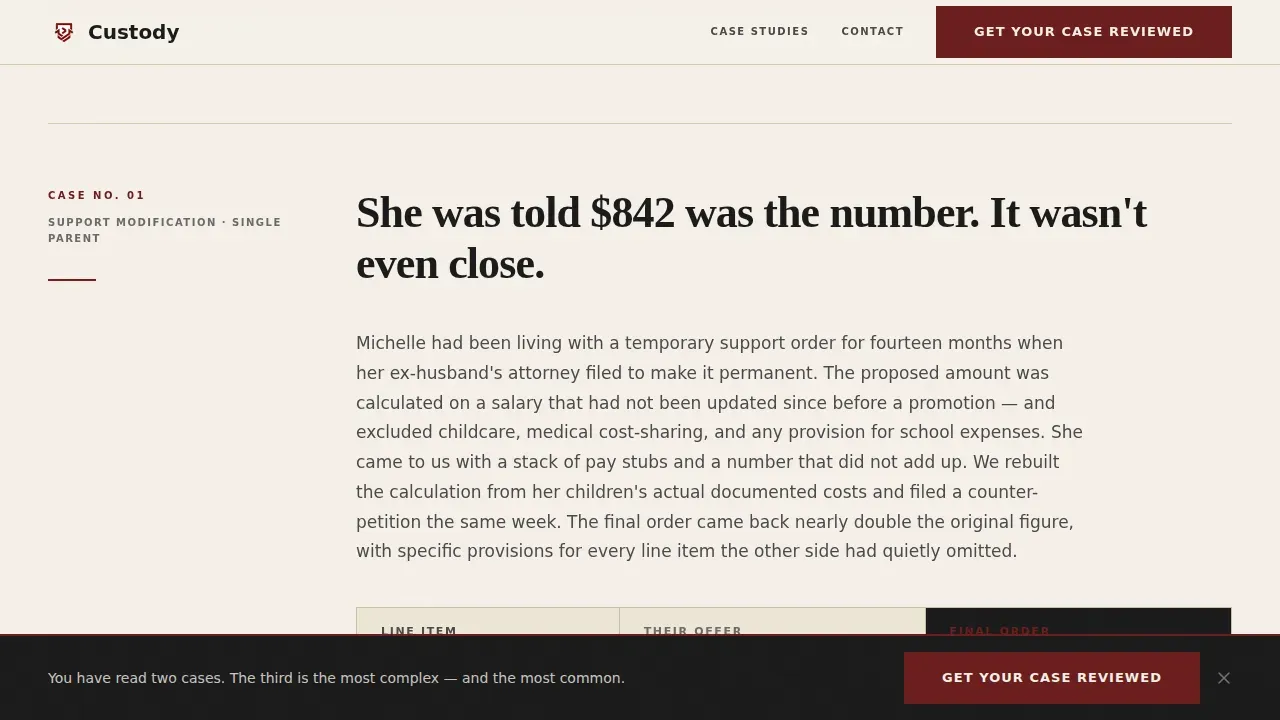
Each comparison table is structured with two columns: "Their Offer" and "Final Order." Line items cover monthly support amounts, medical coverage, education contributions, and custody splits. The numbers are specific and concrete, reflecting the kind of clear proof that reassures potential clients far more effectively than general claims about a firm's expertise.
Escalating Editorial Narrative Structure
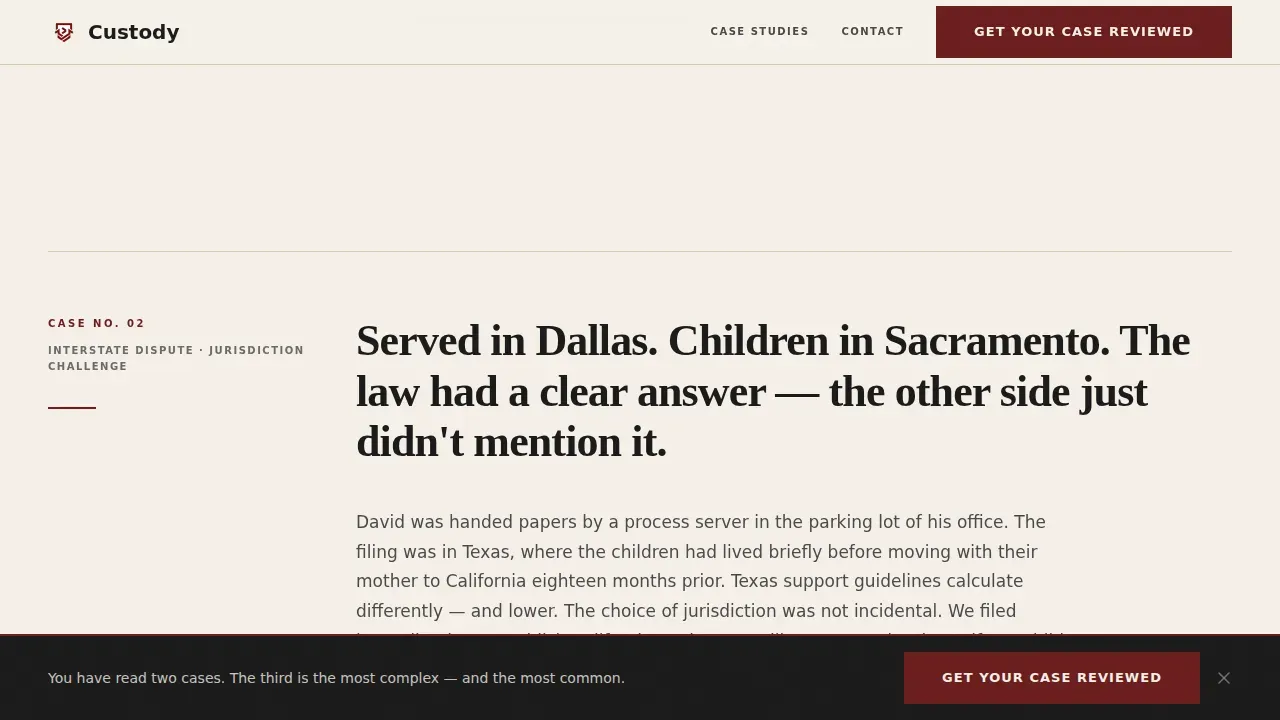
Between each comparison table, a short editorial paragraph contextualizes the case in plain language. The three cases escalate in complexity, moving from a basic modification to an interstate dispute to a high-income imputation scenario. This escalating structure builds credibility progressively and keeps prospective clients reading through the full page.
Strategically Staged Call to Action Blocks
The primary call to action, "Get Your Case Reviewed," appears three times across the page. The first placement follows the initial case study. The second appears as a sticky bar after the second case study. The third anchors the final section as a full-width parchment-to-black closing block. Each clear call to action is staged to catch visitors at the moment their confidence peaks.
Sticky Call to Action Bar
After the second case study, a sticky bar locks to the top of the viewport on scroll. It keeps the primary call to action visible without interrupting the reading experience. This is one of the key elements that separates strong landing pages from passive ones in the legal industry.
Linear Single-Row Footer
The footer follows a clean, single-row pattern that includes contact details and the firm's core services without adding visual noise. It closes the page with practical information while keeping the reader focused on the primary conversion goal.
Page sections overview
| Section | Purpose |
|---|---|
| Hero Headline | Set editorial tone and frame the firm's core value proposition |
| Case Study One | Show a support modification outcome using a side-by-side comparison table |
| Call to Action Block One | Prompt visitors to book a free consultation after the first proof point |
| Case Study Two | Show an interstate dispute outcome with specific enforceable order details |
| Sticky call to action Bar | Keep the primary call to action visible as visitors scroll through the second case |
| Case Study Three | Show a high-income imputation outcome with detailed financial line items |
| Final call to action Block | Close the page with a full-width conversion section anchoring the next step |
| Footer Row | Provide contact details and firm information in a clean single-row layout |
Design & branding system
The design follows an Editorial Magazine theme using an Ink and Paper color system. The overall feel is that of a longform quarterly feature printed on heavy stock. There is no gloss, no stock-photo styling, and no decorative imagery. The typography carries the visual weight, and every color choice serves a specific function.
- Deep editorial black (#1A1A1A) for headlines, muted charcoal (#4A4A4A) for body text, and warm parchment (#F5F0E8) for the primary background
- Oxblood red (#6B1D1D) reserved exclusively for call to action buttons and pull quotes, functioning as the single confident accent across the page
- Fraunces serif for headlines and DM Sans for body text, creating a clear typographic hierarchy that guides the eye from heading to evidence to action
Mobile & speed optimization
The template is built desktop-first to reflect typical legal research behavior, where most clients are seated at a computer when they begin comparing law firm landing pages in detail. That said, the layout is fully responsive and adapts cleanly to mobile devices. Over sixty percent of legal searches occur on mobile devices, and this template accounts for that without sacrificing the editorial weight of the desktop experience.
- All three comparison tables reflow cleanly for narrow viewports so that line items remain readable on smaller screens
- Animations are deliberately minimal, using only subtle fade-in-on-scroll transitions that do not distract from the content or slow the reading experience
- The sticky call to action bar functions on both desktop and mobile viewports, keeping the primary conversion point accessible throughout the scroll
How this template helps you convert
A law firm landing page is designed to drive one specific action: in this case, clicking through to a free consultation booking page. The average landing page conversion rate across industries is 5.81 percent. A well-targeted law firm landing page focused on a single practice area can reach 8.33 percent. This template is built with that gap in mind.
- Social proof through case outcomes arrives before any call to action. Client testimonials and case results can increase conversions by up to 34 percent. This template leads with the equivalent of three verified success stories presented as enforceable order comparisons, which reassures potential clients before they are asked to do anything.
- Every call to action is staged at a moment of peak confidence. The clear call to action after the first table catches early converters. The sticky bar after the second table captures visitors who needed more evidence. The final full-width block closes the page for anyone who read through all three cases and is now ready to act.
- The page removes friction deliberately. There is no contact form on this page. The click-through model sends visitors to a separate booking page, which means the landing page itself never asks for personal information. That single-step commitment keeps the barrier low for prospective clients who are still deciding.
Other information about this template
This template sits in the Legal and Compliance category under Family and Domestic Law, with a niche focus on child support and child custody matters. It is a single-page click-through landing page, not a multi-page law firm website. It is designed to complement an existing family law website by serving as a dedicated campaign or practice area page that handles one conversion goal extremely well.
Family law website design best practices informed the structure here. A family law website should be designed with the target audience in mind. This template takes that principle further by designing around a specific emotional state: a parent who has just been served papers or received an unacceptable settlement offer and is searching for legal assistance with a sense of urgency.
The template can support a variety of traffic sources. Whether visitors arrive through search engine results, Google Ads campaigns, a Google Business Profile listing, or retargeting ads following an initial law firm website visit, the page is built to receive them with immediate credibility.
The template is also practical for law firms that operate across practice areas beyond family law. The case-study-narrative format and comparison-table structure could inform how a law firm approaches landing pages for related practice areas. Attorneys practicing in areas such as criminal defense, civil litigation, probate law, or personal injury may find the narrative evidence model applicable to their own practice area pages. Firms handling personal injury cases, for example, can adapt the "offer versus outcome" table model to show demand versus settlement. A personal injury law firm running targeted campaigns would benefit from the same staged call to action structure. Similarly, a law firm covering real estate law disputes or other service pages could use this template's editorial framework as a starting point.
A well-designed family law website creates an emotional connection with prospective clients by addressing their fears directly. This template does not use professional images to achieve that effect. Instead, it uses compelling headlines and real case numbers to build trust. That approach reflects a key insight from emotional design in legal services: when the stakes are high, specificity creates safety. A parent reading that a firm increased monthly support payments by a material amount, or reduced alleged arrears significantly, feels seen. That feeling is what moves them from browsing to booking.
The template supports local search engine optimization goals by functioning as a focused landing page that targets a specific niche within family law. Relevant keywords can be matched naturally to the page content, and the page's single-topic focus makes it easier to rank for specific queries. Strong local search engine visibility ensures a family law practice appears when the right clients need legal services most.
Family law firms investing in reputation management will find that the template's success stories section, the anonymized comparison tables, provide the kind of social proof that positive reviews and satisfied clients typically deliver in other formats. Former clients cannot always speak publicly about sensitive custody matters. This template gives the firm a way to present its track record without compromising privacy.
The page is designed to encourage visitors to take a single next step. It does not try to explain every practice area, display attorney bios in detail, or serve as an all-purpose law firm website. It is a dedicated conversion tool. That focus is what makes it effective. Family law clients in crisis do not want to browse. They want someone to tell them what to do next. This template gives them that direction clearly and calmly.
Additional context for firms evaluating this template:
- The template does not include a contact form on the landing page itself; the click-through model routes visitors to a separate booking page
- Practice area pages for child custody and support modification are the primary intended use case, though the format is adaptable
- The page uses data driven strategies in its structure: each case study is presented as evidence, not as marketing, which reflects how most clients research legal assistance
- Attorney bios are not a built-in section of this template; the focus is on outcomes rather than individual profiles
- The footer includes contact details in a minimal single-row format consistent with the editorial design system
- This template is well suited for law firms running Google Ads to a specific practice area page rather than to a general law firm website homepage
- Firms with satisfied clients willing to allow anonymized outcome sharing will get the most value from this template's case study format
Theme
Editorial Magazine
Creative direction
Case Study Narrative
Color system
Ink & Paper
Style
Comparison Table
Direction
Click-Through
Page Sections
Giant Flush-left Editorial Hero Headline
Three Side-by-side Case Study Tables
Escalating Editorial Narrative Paragraphs
Three-stage Call to Action Placement
Sticky Call to Action Bar
Linear Single-row Footer
Related questions
Can I use this template for a family law firm that handles multiple practice areas?
Does the template include a contact form for collecting client information?
How do I populate the comparison tables with my own case data?
Is this template suitable for a family lawyer running paid search campaigns?
Can grandparent custody cases be represented in the comparison tables?