Intellectual Property Booking Website Template
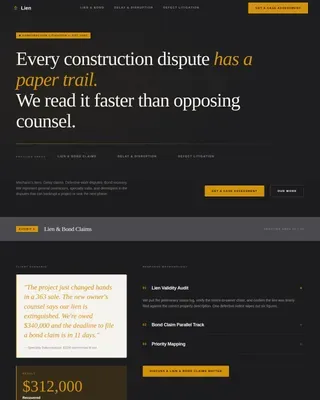
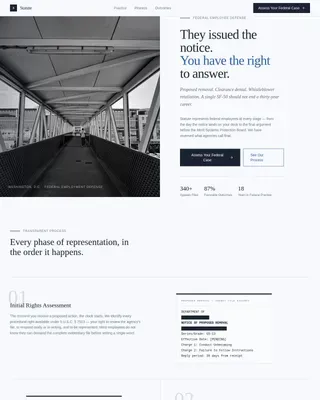
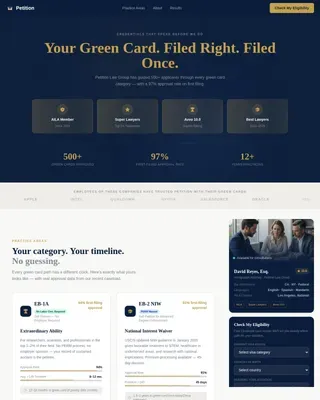
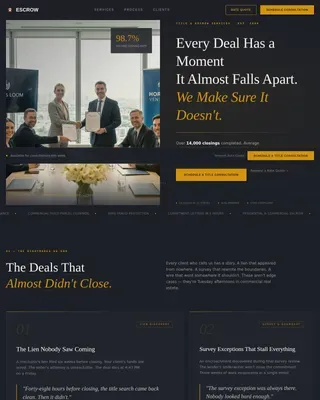
Counsel is an editorial-style IP licensing attorney landing page template built for intellectual property law practices. It combines a federal courthouse visual identity with a transparent, long-form process layout that teaches visitors before it asks them to book. Press mention headers, sidebar fee callouts, client pull quotes, and a sequential scheduling form work together to turn IP owners into consultation requests.
by Rocket studio
Quick summary
Counsel is a single-page, editorial-format lawyer landing page template designed for IP licensing attorney practices. It opens with a staggered press mention grid, guides visitors through five numbered engagement phases, and closes with a sequential booking form. The design draws from federal courthouse aesthetics: deep navy, cream content panels, and gold used sparingly on calls to action and pull quotes.
Who this template is for
This template is built for IP law practitioners who need a law firm landing page that does more than list credentials. It suits attorneys and small legal teams whose clients arrive with real, high-stakes questions about patents, royalty structures, and infringement disputes. It is equally well suited to solo practitioners and boutique IP firms expanding their consultation pipeline through digital marketing.
- Solo inventors and patent applicants seeking an attorney who communicates process clearly
- Mid-size manufacturers, university tech-transfer offices, and IP portfolio holders who need a law firm website that earns trust before asking for contact details
- IP law practices that want lawyer landing pages aligned to specific ad campaigns and audience intent
What problem this template solves
Most lawyer landing page designs in the legal space bury the process behind a generic "contact us" wall. Potential clients land on a law firm website and leave without booking because nothing answered their core question: what actually happens after I call? This template solves that by making the process the page itself.
- Visitors leave without booking because the firm's expertise is never made tangible, this template surfaces it through editorial phases and sidebar callouts
- Landing pages for IP attorneys often fail to differentiate between client types, this template uses asymmetric client archetype panels to speak directly to each visitor's situation
- Standard legal website forms intimidate users with too many fields, reducing submissions before a first consultation is ever scheduled
What you get with this template
This template delivers a fully structured, editorial law firm landing page designed around one goal: converting IP owners into booked consultations. Every section is intentional and grounded in transparent process communication. You get a complete page layout ready for your content, your press mentions, and your scheduling flow.
- A staggered press mention hero section, five numbered process phases with sidebar callouts, client archetype panels, case outcome rows, and a full-width booking module
- A sequential three-question scheduling form asking IP type, current status, and preferred consultation window, plus a secondary email-gated PDF checklist download
- A Navy Authority color system using deep congressional navy, marble corridor white, brass fixture gold, and brief-paper cream, combined with Fraunces display serif and DM Sans body typography
Feature list
Staggered Editorial Press Mention Hero
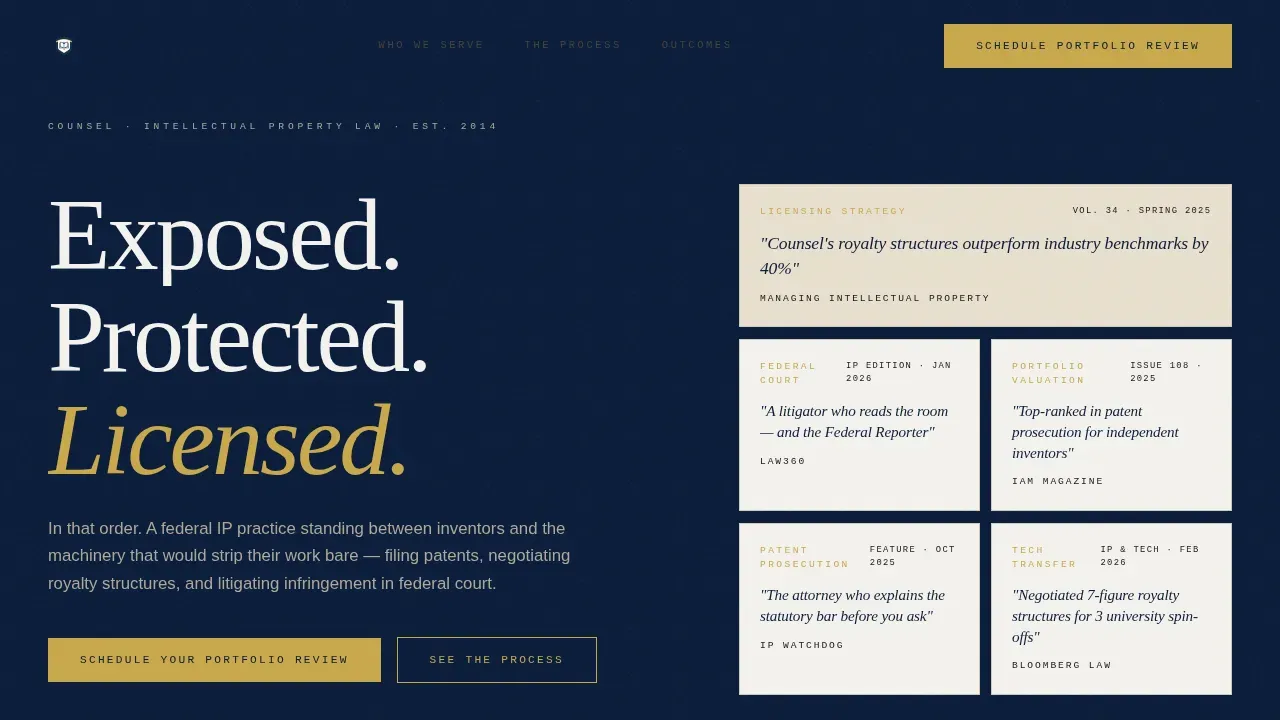
The first section of the page replaces a traditional hero image with a bento-style grid of real publication mastheads. Each card shows a headline or attributed quote from a recognized legal trade outlet. A single editorial line anchors the section beneath the grid. This approach uses social proof at the very first point of contact, establishing attorney authority before a visitor reads a single word of body copy. High quality photos and abstract graphics are intentionally absent; the printed evidence speaks for itself.
Long-Form Transparent Process Layout
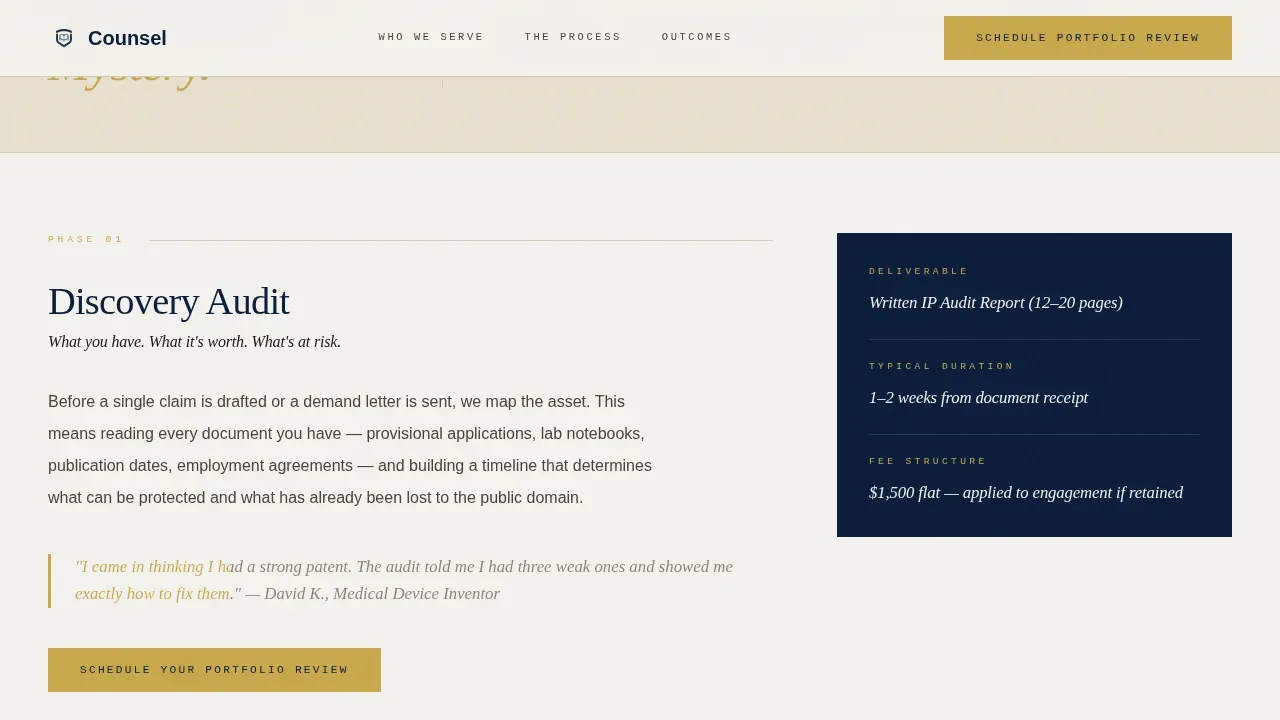
The core of the page is a five-phase editorial scroll covering Discovery Audit, Portfolio Valuation, Term Sheet Drafting, Negotiation, and Execution. Each phase is presented as a numbered section with generous margins and pull quotes from past clients breaking the columns. Sidebar callouts display estimated timelines and typical fee structures openly. This transparent process direction is the template's unique selling proposition: giving visitors detailed information about what the engagement looks like before they ever contact the firm.
Sequential Three-Question Booking Form
The primary booking module appears three times across the page: as a fixed gold button in the navigation, after the Discovery Audit section, and as a full-width closing module. The form presents three questions in sequence, IP type, current status, and preferred consultation window, reducing friction by showing only one question at a time. A short, action-oriented form structure is proven to increase submissions and encourage visitors to complete the booking process rather than abandoning mid-form.
Email-Gated PDF Checklist Path
A secondary conversion path offers a downloadable Licensing Readiness Checklist gated by email address. This secondary call to action captures prospective clients who are not yet ready to schedule a free consultation but are ready to engage. The gate modal is triggered separately from the primary booking form, keeping the two conversion paths distinct and measurable. It serves visitors at an earlier stage of the marketing funnel without diluting the primary consultation booking goal.
Civic Service Visual Identity System
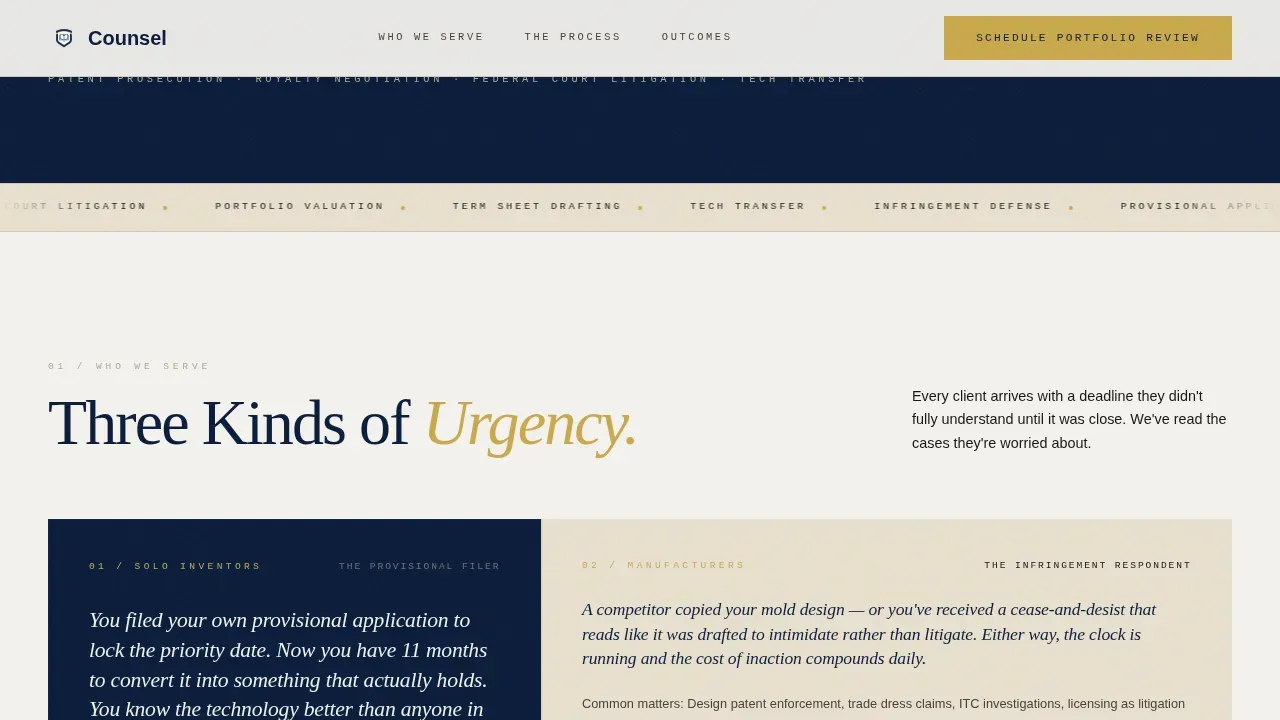
The design applies a Navy Authority color system across all key sections. Deep congressional navy dominates headers and section dividers. Brief-paper cream holds body text in wide, readable columns. Brass fixture gold appears only on links, pull quotes, and the booking button, kept scarce enough to feel earned. Typography uses Fraunces for display and italic headlines and DM Sans for body and labels. Scroll reveals, text-scrub pull quote animations, spotlight card hover effects, and a marquee press ticker add medium-level interactivity throughout.
Asymmetric Client Archetype Panels
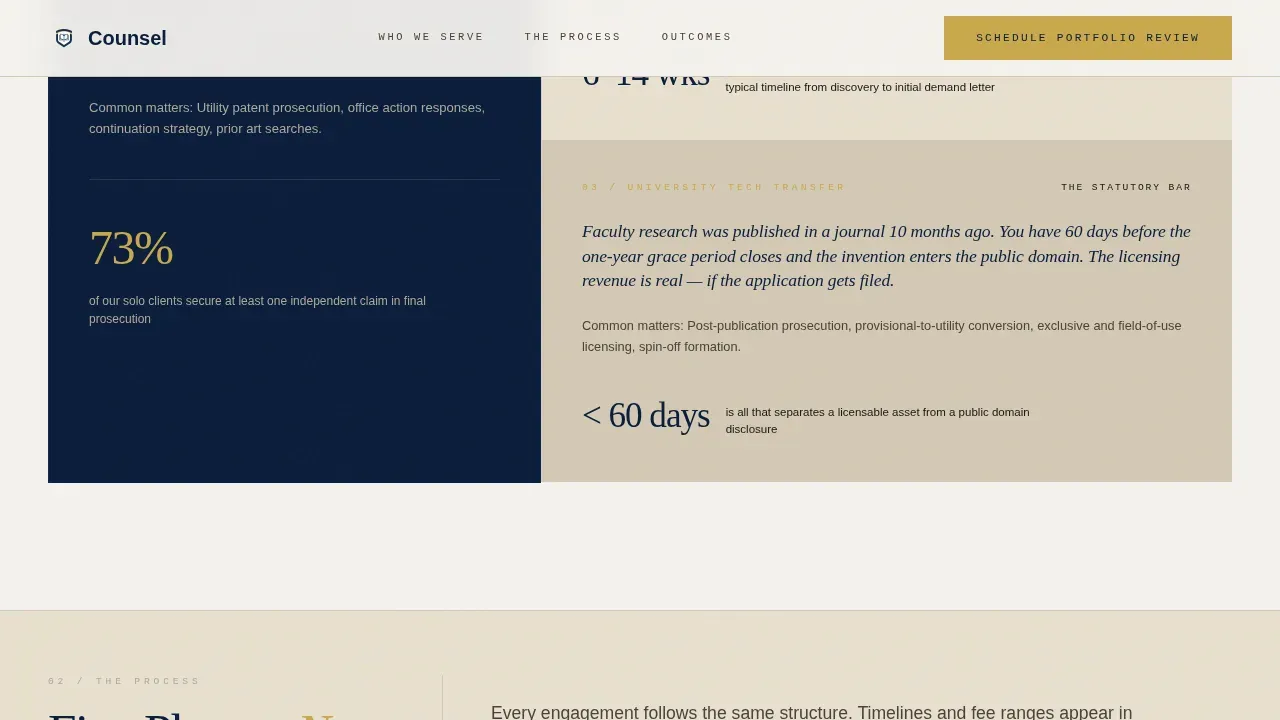
The "Who We Serve" section uses three panels of varying sizes rather than a uniform grid. Each panel represents a distinct client type: the solo inventor, the mid-size manufacturer, and the university tech-transfer office. This asymmetric layout signals that the firm understands the difference between each situation rather than treating all IP matters as identical. These panels function as trust signals that speak directly to the specific concerns each client type carries into a first consultation.
Page sections overview
| Section | Purpose |
|---|---|
| Press Mentions Hero | Establishes attorney authority through editorial publication grid |
| Who We Serve | Introduces three client archetypes with asymmetric panels |
| The Process Phases | Walks visitors through five numbered engagement stages |
| Sidebar Fee Callouts | Displays timeline and fee detail openly within process sections |
| Client Pull Quotes | Breaks column layout with attributed testimonials for social proof |
| Case Outcomes Row | Lists past matter types with outcome metrics in editorial format |
| Booking Form Module | Sequential three-question form for consultation scheduling |
| PDF Checklist Gate | Email-capture secondary path for pre-booking nurture |
| Single-Row Footer | Linear footer with contact links and navigation |
Design & branding system
The design language reads like a federal courthouse translated into editorial magazine format. Navy dominates the structural frame. Cream carries the reading experience. Gold is rationed deliberately so every instance carries weight. Fraunces, a variable display serif with expressive italics, handles all headlines. DM Sans handles all body text and labels, keeping body copy clean and legible at the wide column widths the layout requires.
- Color palette: deep congressional navy (#0B1D3A), marble corridor white (#F4F2EE), brass fixture gold (#C9A84C), brief-paper cream (#E8E0D0) applied with strict hierarchy
- Typography: Fraunces for display, pull quotes, and phase headings; DM Sans for body paragraphs, labels, sidebar callouts, and form fields
- Visual style: no stock photography, serif fonts at magazine scale, staggered editorial grid, generous margins, and structured column layout throughout
Mobile & speed optimization
The template is built desktop-first to serve the legal research audience that skews heavily toward desktop browsing. Full mobile responsiveness is included so visitors on mobile devices can still navigate, read, and complete the booking form without layout breakdown. The design uses native CSS smooth scroll and IntersectionObserver for scroll reveals, avoiding heavy JavaScript libraries that can slow load times.
- Responsive design adapts all editorial columns, press mention grids, and process phase layouts for mobile devices and tablets
- Fast load times are prioritized through native CSS animation and IntersectionObserver-based reveals, targeting sub-three-second load performance to reduce bounce rates
- Clickable contact details on mobile devices ensure prospective clients can reach the firm directly without additional navigation steps
How this template helps you convert
Every structural decision in this template is made with one goal: turning a skeptical IP owner into a booked consultation. The page does not ask visitors to trust the attorney blindly. It shows them exactly what working with the firm looks like, phase by phase, before the call to action appears. This builds the kind of trust that makes booking feel like the logical next step rather than a risk.
- The press mention hero builds immediate authority using real editorial coverage as trust signals, giving visitors a reason to keep reading from the very first section; client testimonials and case results embedded throughout reinforce the firm's expertise at every scroll depth, with research showing that testimonials and case results can increase conversions by up to 34 percent.
- The transparent process layout removes legal mystique by presenting fee structures, timelines, and phase detail openly in sidebar callouts; a well-targeted law firm landing page focused on one clear booking goal can reach conversion rates of 8.33 percent compared to the industry average of 5.81 percent, and this template's structure is built to support that performance by reducing every point of uncertainty before the form appears.
- The sequential booking form and email-gated PDF checklist create two distinct conversion paths for visitors at different readiness levels, encouraging visitors who are not ready to book a free consultation to stay engaged through the checklist download, keeping the firm's pipeline active across the full marketing funnel.
Other information about this template
This template is classified under Legal and Compliance, Intellectual Property, within the IP Licensing Attorney niche. It is designed for the editorial and magazine template style and applies a Transparent Process creative direction. The page type is a single-page landing page, not a multi-page law firm website, though it covers the depth and detail of a full-service firm presentation.
- The template supports marketing contexts where landing pages are used as destinations for ad campaigns, ensuring that the landing message matches the audience intent that brought visitors to the page in the first place
- Practice area specificity matters: while this template focuses on IP law, the structural approach of editorial phases with sidebar callouts can inform design thinking across real estate law, family law, civil litigation, and personal injury law firm contexts where process transparency also builds trust
- The template's professional tone and professional design reflect what legal marketing research consistently identifies as core to earning clicks from prospective clients: a professional website that communicates authority, clarity, and approachability simultaneously
- Strong personal branding is embedded into the design through the press mention grid; the attorney's name and quoted coverage become the hero image equivalent, giving the firm a distinct identity without relying on generic legal stock photography
- For IP law firms running ad campaigns, landing pages that match the audience and the ad they came from consistently outperform generic law firm website pages; this template is structured to support that alignment by keeping one goal visible throughout
- Strong trust signals, including press mentions, client pull quotes, sidebar outcome data, and the secondary trust badges of publication mastheads, are woven into the layout rather than isolated to a single testimonials block
- The Counsel authoritative IP licensing attorney landing page template is the correct full title when referencing this template in documentation or marketplace listings
- Platforms such as those used by attorneys like Alexandre Ballerini, practitioners in the family law space like Harbour Family Law, and IP-focused pages like June James Legal all demonstrate that specific, niche-targeted landing pages outperform generic law firm landing pages across every conversion metric; this template applies those lessons directly to the IP licensing attorney context
Theme
Civic Service
Creative direction
Transparent Process
Color system
Navy Authority
Direction
Booking/Scheduling
Page Sections
Staggered Press Mention Hero Grid
Five-phase Transparent Process Layout
Sequential Three-question Booking Form
Email-gated PDF Checklist Module
Asymmetric Client Archetype Panels
Civic Service Navy Authority Design System
Related questions
Can I use this template without existing press mentions?
Does the sequential booking form connect to a scheduling platform?
Is this template suitable for practice areas outside IP law?
How does the PDF checklist download capture leads?
What makes this different from a standard lawyer landing page?