Mediation & Alternative Dispute Portfolio Website Template
Accord is an editorial landing page template built for elder mediation practices. It uses a longform case study narrative structure, a stacked typographic hero, and an inline five-question conflict assessment to move emotionally exhausted family members from recognition to action. The design follows a monochrome steel palette on warm parchment, built to feel authoritative, calm, and trustworthy.
by Rocket studio
Quick summary
Accord is a single-page editorial landing page template designed for elder mediation professionals. It pairs a striking stacked type hero with longform case study storytelling and an inline quiz that helps visitors name their conflict stage. The result is a page that earns trust before it asks for anything.
Who this template is for
This template is built for elder mediation practitioners who need to reach families at their most overwhelmed. It speaks directly to people who are searching for help at odd hours and do not yet have language for what they are experiencing.
- Elder mediators and family dispute professionals running a private practice
- Legal-adjacent service providers handling caregiving conflicts, estate disagreements, or blended-family disputes
- Practitioners who want a content-led approach rather than a conventional services brochure
What problem this template solves
Families dealing with aging parent care decisions rarely arrive at a mediator's website feeling calm. They arrive feeling guilty, exhausted, or quietly desperate. A standard professional services page with credentials and contact forms does not reach them where they are.
- Visitors cannot see themselves in generic copy, so they leave without taking action
- The emotional stakes are high but the decision to seek help feels vulnerable and exposing
- Practitioners lose potential clients because the page asks for commitment before offering understanding
What you get with this template
Accord gives you a fully structured editorial landing page with five distinct content sections and a built-in interactive assessment. Every design and layout decision reflects the emotional register of the audience it is built for.
- A stacked typographic hero section that commands attention without any imagery
- Three longform editorial case study sections with pull quote styling and stat callout blocks
- An inline five-question conflict assessment with staged result categorization and tailored next steps
Feature list
A paragraph introduces the features below. Each capability in this template is grounded in the source brief and serves the core goal: turning a distressed family member into a booked consultation.
Stacked Type Tower Hero
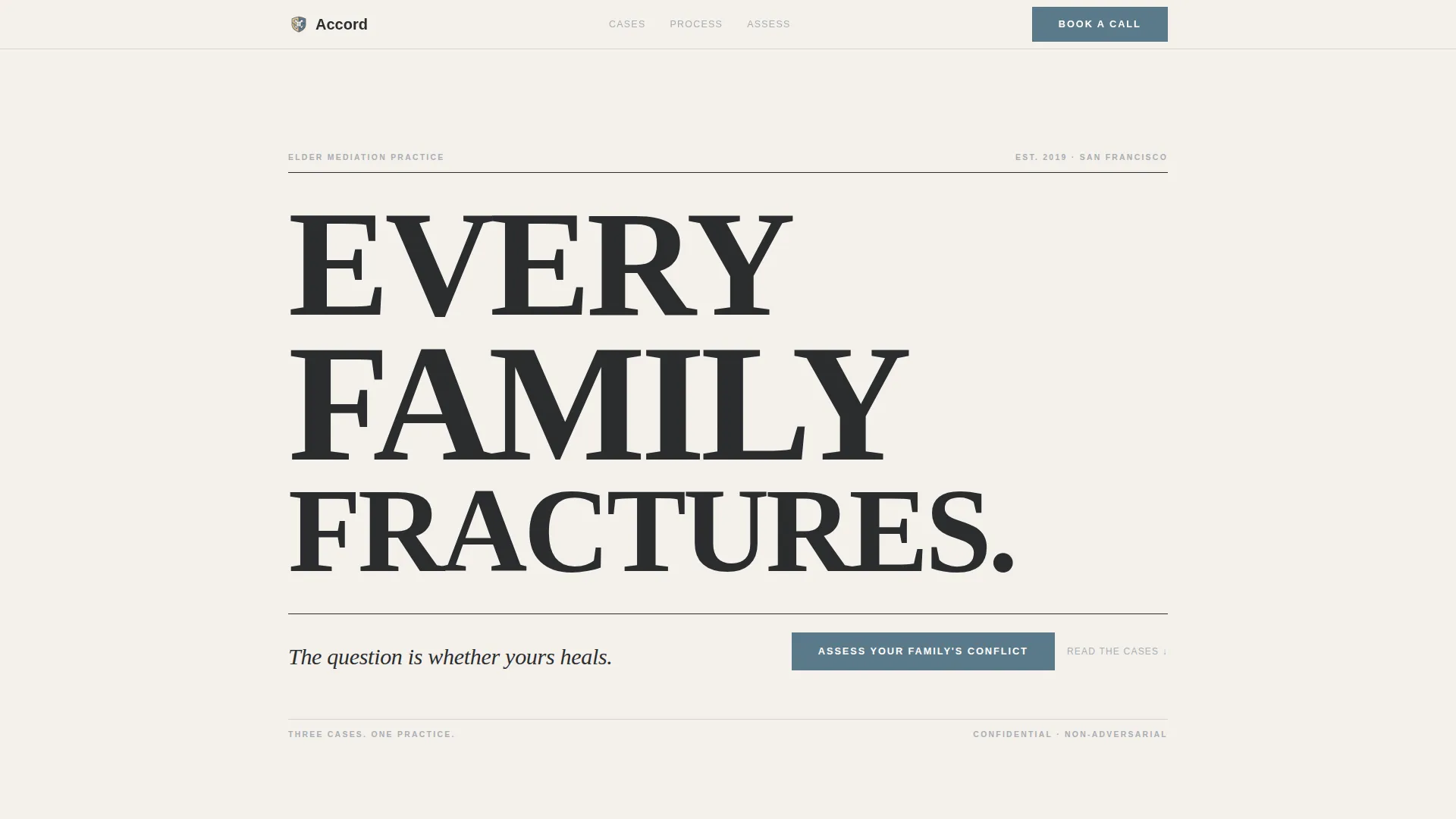
The hero section fills the viewport with three stacked lines of oversized condensed serif type spelling out "EVERY / FAMILY / FRACTURES." A single italic subhead sits below. No photography is required. The typography carries the full emotional weight of the opening.
Longform Case Study Narrative
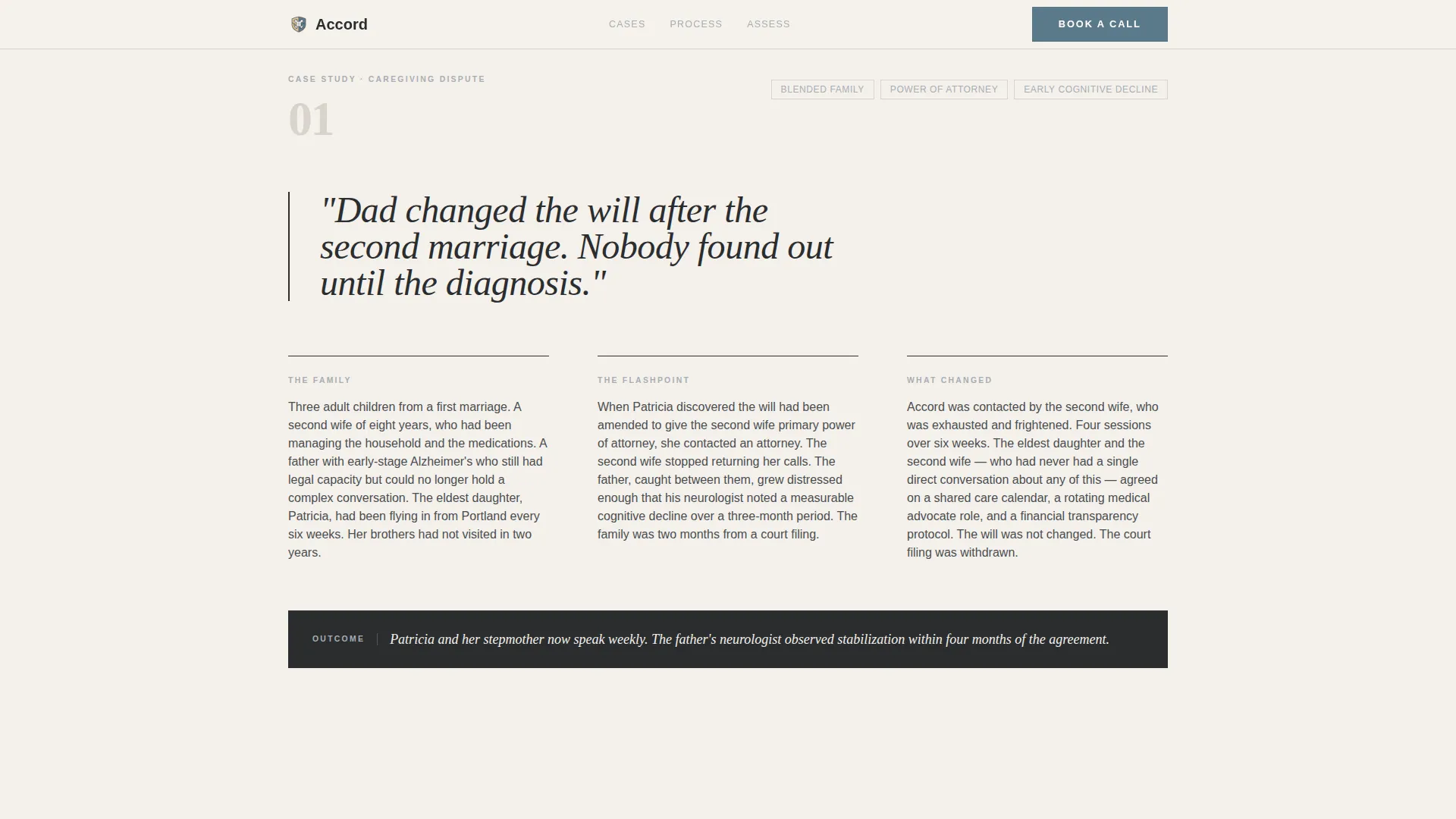
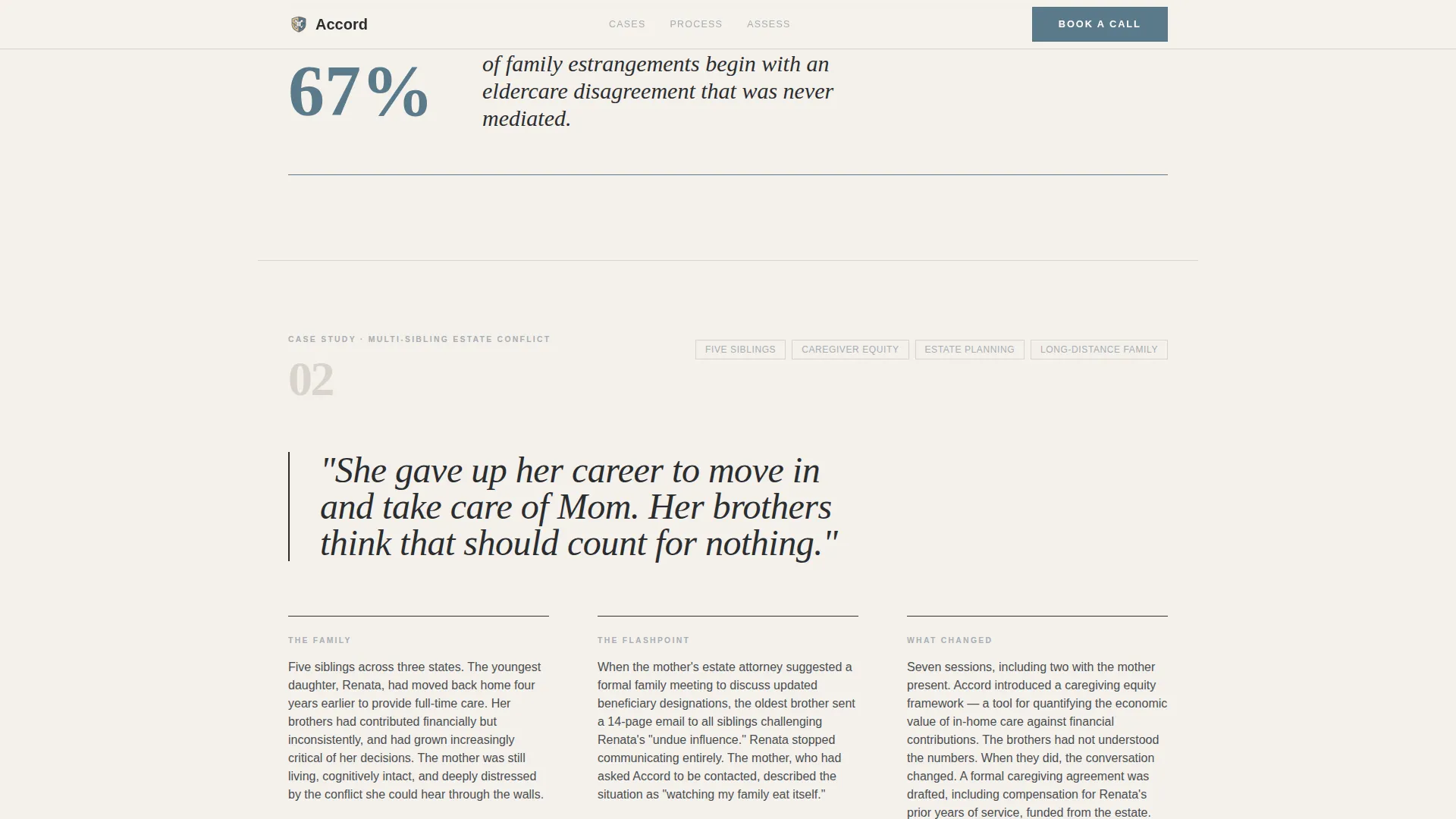
Three editorial case studies unfold across the page like a magazine feature. Each opens with a two-sentence pull quote scenario, then traces the family dynamic, the intervention point, and the resolution. Complexity escalates across cases, from a straightforward caregiving dispute to a blended-family capacity crisis.
Inline Conflict Assessment Quiz
A five-question diagnostic opens inline without leaving the page. Questions move from low-threat to revealing, and results categorize the visitor's situation into one of three conflict stages: Early Tension, Active Dispute, or Communication Breakdown. Each result offers a tailored next step.
Stat Callout Blocks
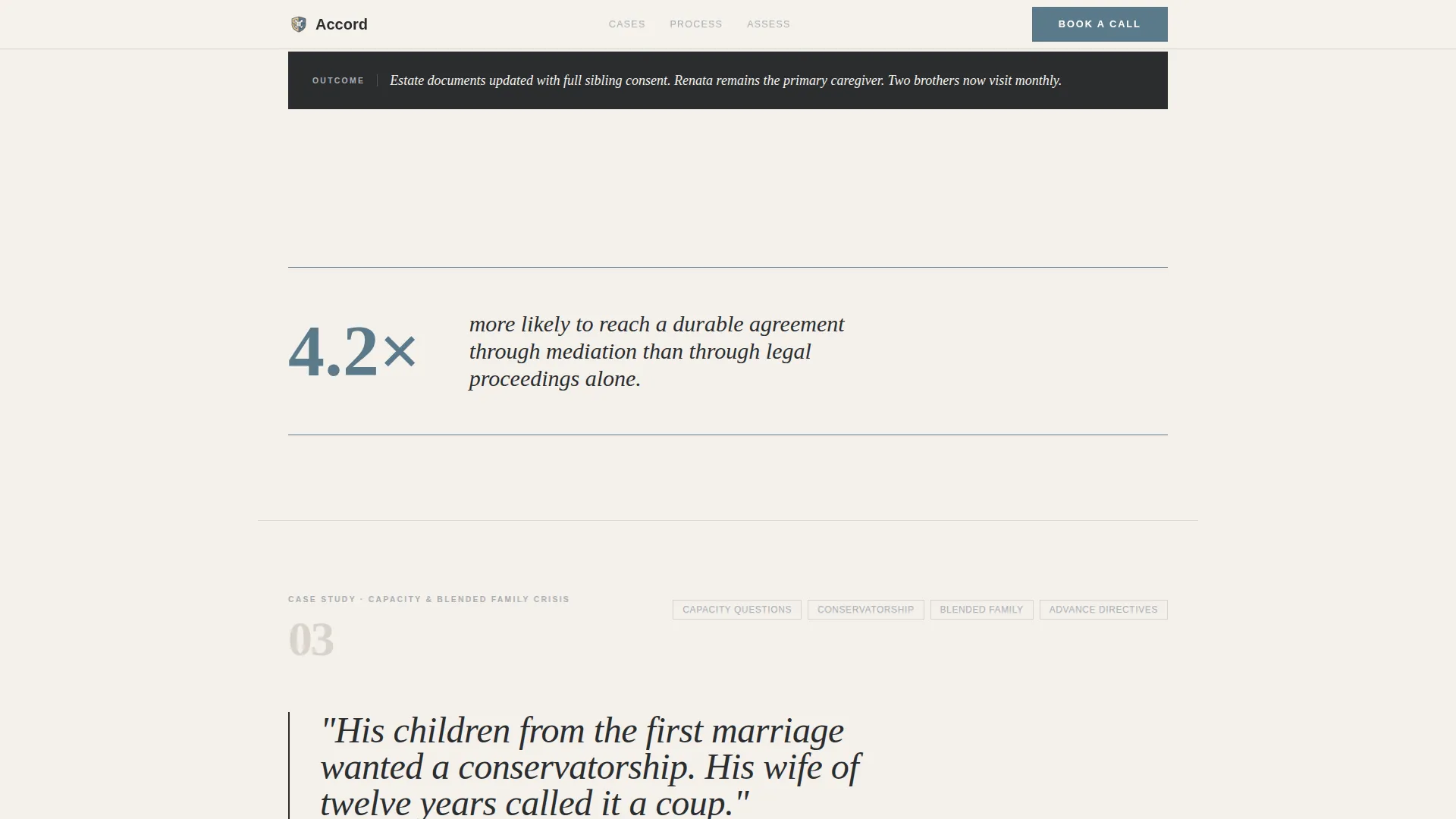
Between case studies, single-stat callouts appear in the steel blue accent color. These data points add editorial authority and reinforce the gravity of unresolved family conflict without interrupting the narrative flow.
Process Section in Editorial Style
The "How Accord Works" section is written as a magazine feature rather than a numbered checklist. It explains the mediation approach in prose, matching the tone of the surrounding case studies and keeping the reader in the same calm, authoritative register throughout.
Quiet Authority Call to Action
The final section closes with a "Book a Confidential Call" call to action. The language is deliberate and low-pressure, designed to feel like an invitation rather than a sales push.
Page sections overview
| Section | Purpose |
|---|---|
| Hero Type Tower | Opens with impact using stacked typographic headline filling the viewport |
| Case Study One | Introduces a caregiving dispute narrative with pull quote and resolution |
| Case Study Two | Escalates to a multi-sibling estate conflict with editorial detail |
| Case Study Three | Covers a blended-family capacity crisis as the most complex scenario |
| Stat Callout Blocks | Reinforces urgency between cases with single-stat steel blue inserts |
| Conflict Assessment Quiz | Inline diagnostic that categorizes the visitor's conflict stage |
| Quiz Results Pages | Delivers tailored next steps based on Early Tension, Active Dispute, or Breakdown |
| Process Overview | Explains how the mediation practice works in editorial prose format |
| Final Call to Action | Closes with a confidential booking prompt at low emotional pressure |
| Footer | Horizontal flow footer pattern with essential practice information |
Design & branding system
The visual identity follows an editorial broadsheet aesthetic. Every design choice prioritizes whitespace, typographic hierarchy, and restraint. The palette feels like the front section of a Sunday newspaper, authoritative and unhurried.
- Colors: warm parchment (#F4F1EC) background, deep charcoal (#2B2D2F) body type, cold silver (#A8ADB3) for pull quotes and secondary text, muted steel blue (#5B7A8A) reserved for interactive elements and calls to action
- Typography: Fraunces display serif for headlines and pull quotes, DM Sans for body copy, creating a clear and readable contrast between editorial weight and functional clarity
- Decoration philosophy: whitespace does the heavy lifting; no imagery appears in the hero or between case studies, keeping visual focus on the words themselves
Mobile & speed optimization
The template is designed desktop-first, reflecting the primary user behavior of someone on a laptop late at night. Mobile layout is fully considered and structurally sound, ensuring the page functions well across screen sizes.
- Animation is low to medium in intensity, using measured scroll reveals with no disorienting flash or motion
- The page is text-heavy with minimal images, which supports fast load behavior across connection types
- The inline quiz interaction is optimized for both mouse and touch input, keeping the assessment accessible on smaller screens
How this template helps you convert
Every section of Accord is sequenced to reduce emotional resistance before asking for commitment. The page earns trust through recognition, not persuasion.
- Visitors see themselves in the case studies first, which creates identification before any service claim is made, making the subsequent quiz invitation feel natural rather than transactional.
- The inline quiz lets visitors privately name their conflict stage without speaking to anyone, lowering the barrier to engagement and producing a tailored result that makes the "Book a Confidential Call" step feel like a logical, self-chosen next move.
Other information about this template
This template is built for the elder mediation niche within the broader mediation and alternative dispute resolution category. It sits at the intersection of legal-adjacent professional services and emotionally sensitive family communication.
- The target audience spans primary caregivers, out-of-state siblings, second spouses navigating stepfamily dynamics, and any adult family member involved in aging parent care decisions
- The quiz result stages, Early Tension, Active Dispute, and Communication Breakdown, give the practitioner a natural framework for guiding first conversations with prospective clients
- The footer uses a horizontal flow layout pattern, keeping the closing section clean and uncluttered
- Localization is set for the United States market, in English, with USD as the implied currency context for service pricing or consultation fees
- The template style is editorial magazine, and the creative direction is case study narrative, making it well suited for practitioners who have real client stories to draw on
- The landing page is designed for a desktop-first audience but renders solidly on mobile devices
Theme
Editorial Magazine
Creative direction
Case Study Narrative
Color system
Monochrome Steel
Style
Editorial/Magazine
Direction
Quiz/Assessment
Page Sections
Stacked Type Tower Hero
Longform Editorial Case Studies
Inline Conflict Assessment Quiz
Stat Callout Blocks
Process Section in Editorial Prose
Quiet Authority Closing Call to Action
Related questions
Does this template require professional photography or custom imagery?
Can I replace the sample case studies with my own client stories?
What does the conflict assessment quiz produce for visitors?
Is this template suitable for a practitioner who is just starting out?
Can the call to action button connect to an external booking or scheduling page?