
How does vibe solutioning give teams a faster path compared to traditional development? Vibe solutioning places stronger focus on rapid guidance, shared clarity, and smoother team flow. It highlights quick direction, steady feedback loops, and a lighter lift compared to traditional coding methods.
Traditional development still gets the job done, but many teams are looking for faster ways to work.
And with good reason.
Gartner reports that AI-assisted development tools can increase developer productivity by up to 30%. That’s a noticeable jump when deadlines are tight, and projects keep growing in complexity.
So what does this mean for your workflow?
This is where vibe solutioning steps in. It offers a fresh approach that works alongside familiar coding methods while helping teams move faster.
As you read on, you’ll see how vibe solutioning compares to traditional development, what sets each apart, and how to pick the right fit for your next project.
Understanding Vibe Solutioning
Vibe solutioning is essentially using AI to generate code from natural language prompts. Instead of writing every line manually, developers guide AI to create functional code. Think of it as having a coding assistant that handles routine tasks while you focus on solving the tricky problems.
It comes with several benefits:
- Rapid prototyping without tedious boilerplate code
- AI suggestions for complex logic or UI components
- Faster development for mobile apps and large-scale projects
- Built-in automated testing to verify functionality
But make no mistake, human oversight is still crucial. Developers still review code, enforce coding standards, and ensure error handling is in place.
AI doesn’t replace expertise; it supports it.
Vibe solutioning is ideal for projects that require rapid experimentation, where AI-generated solutions can speed up the process without compromising quality.
Traditional Development Approaches
Traditional development has been the backbone of software creation for decades. Here, developers manually write code line by line, following structured workflows and coding standards.
It’s slower, yes, but it gives complete control over every part of the system.
Traditional development is best when:
- Backend logic needs to be fully controlled
- Complex systems demand detailed planning and testing
- Large-scale applications require strict adherence to coding standards
- High-quality, well-structured code is a priority
Some key features of traditional development include:
- Manual coding ensures transparency in every function
- Structured development processes
- Thorough error handling and quality assurance
- Detailed code reviews by professional developers
The main downside?
It can be time-consuming and less flexible, especially for rapid prototyping or experimentation.
Vibe Solutioning vs Traditional Development
Seeing the differences side by side makes the contrast clear:
| Aspect | Vibe Solutioning | Traditional Development |
|---|---|---|
| Development Speed | Faster thanks to AI suggestions and generating boilerplate code | Slower, manual coding process |
| Coding Process | Developers guide AI-generated code | Developers write code manually |
| Code Quality | High with verification and oversight | High, fully controlled by developers |
| Prototyping | Quick experimentation and working prototypes | Slower, step-by-step development |
| Technical Expertise | Reduces routine coding burden | Full technical expertise required |
| Error Handling | Assisted with automated testing | Manual and detailed |
| Suitability | Mobile apps, weekend projects, rapid experiments | Large-scale apps, complex systems, backend-heavy projects |
From this, it’s clear that vibe coding is great for speed and flexibility, while traditional development is better for structured, high-stakes projects.
Rocket.new: A Complete Vibe Solutioning Platform
Rocket.new is an excellent vibe solutioning platform, making vibe coding practical and efficient. It allows developers to generate code using natural language prompts while retaining control over the project.
Top features
- Prompt-based app generation: Describe your idea and get a full app instantly.
- Figma to code: Turn Figma designs into working, responsive code.
- Built-in backend & auth: Ready-made database, auth, APIs, and security.
- Cross-platform output: Build for web, iOS, and Android from one project.
- One-click deployment: Launch your app instantly with hosting and domains.
- Full code ownership: Export and edit all generated code freely.
- Command-based actions: Use / and @ for quick, precise edits.
People often say Rocket.new strikes a nice balance. You get the speed to launch something quickly, but also the freedom to refine the app until it matches your exact vision.
Choosing Between Vibe Coding and Traditional Development
So, how do you know which approach to choose? It comes down to project needs.
Vibe solutioning is ideal if you need:
- Rapid prototyping or experimentation
- AI-generated solutions to speed up development
- Help with repetitive coding tasks and generating boilerplate code
- Flexibility for mobile apps or smaller-scale projects
Traditional development is preferable if you need:
- Full control over backend logic and complex systems
- Structured development for large-scale applications
- High-quality code with thorough reviews
- Minimal reliance on AI-generated code due to security or compliance
Often, the best solution is a hybrid approach. AI can accelerate routine tasks while developers focus on complex logic, ensuring high code quality and maintainability.
Balancing AI Assistance and Human Expertise
Even with AI-assisted development tools, human oversight remains key. AI suggestions are not perfect, and developers must verify functionality, maintain coding standards, and run tests.
Why Developers Appreciate Vibe Coding?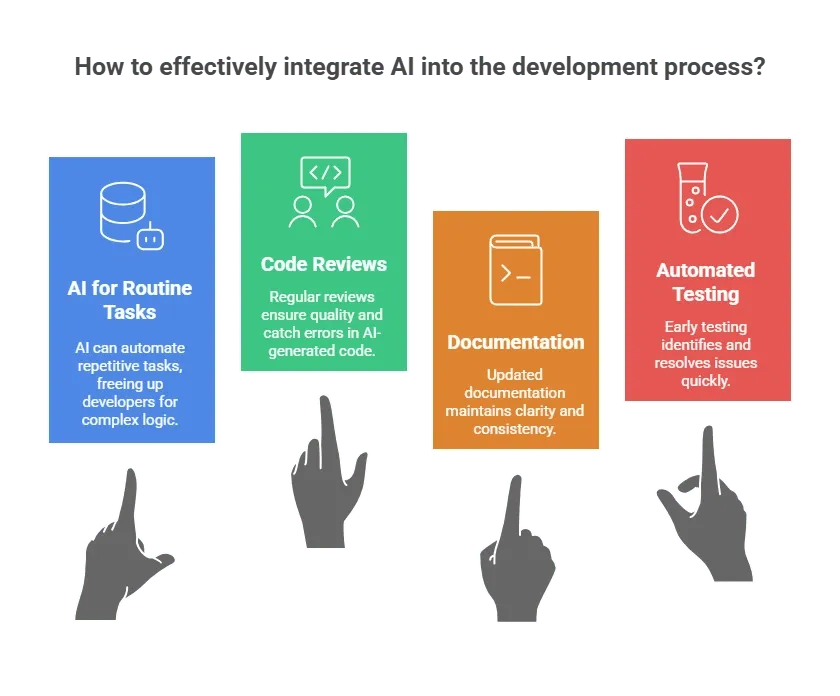
Developers often note that vibe coding accelerates experimentation. A Reddit thread mentioned:
“Vibe coding works best for throwaway projects or rapid prototypes. Traditional development dominates large-scale systems where maintainability and code quality matter”
Vibe Solutioning vs Traditional Development
Vibe solutioning vs traditional development isn’t about picking one over the other. Instead, it’s about understanding the strengths of each approach.
Vibe coding excels in rapid prototyping, AI-generated solutions, and handling repetitive coding tasks. Traditional development shines in complex systems, large-scale applications, and projects where quality and structure are critical.
By combining AI-assisted development tools with traditional practices, developers can write code faster, experiment freely, and still maintain full control over code quality. This balance ensures faster delivery without sacrificing reliability or maintainability.
Table of contents
- -Understanding Vibe Solutioning
- -Traditional Development Approaches
- -Vibe Solutioning vs Traditional Development
- -Rocket.new: A Complete Vibe Solutioning Platform
- -Top features
- -Choosing Between Vibe Coding and Traditional Development
- -Balancing AI Assistance and Human Expertise
- -Why Developers Appreciate Vibe Coding?image (82).png
- -Vibe Solutioning vs Traditional Development