
Vibe solution product creation is how modern teams move from idea to working software without wasted cycles. This blog covers the process, principles, tools, roles, and real-world applications that make it work.
Why do most software projects miss the mark?
Not because teams build poorly, but because they build the wrong thing. Vibe solution product creation closes that gap by keeping thinking and building in the same loop. Teams describe what they want in plain language, AI turns that intent into working code, and every cycle produces something real.
According to McKinsey's 2025 research on AI in the workplace, AI-assisted development can significantly improve developer productivity and business outcomes.
Vibe solution product creation captures that gain by pairing AI speed with human judgment, keeping every build grounded in actual user needs.
Why Vibe Solution Product Creation Matters
Product creation today comes with constant pressure. User expectations shift quickly, business goals change often, and technology stacks grow more complex each year. As a result, traditional software development methods struggle to keep pace with this reality.
Vibe solution product creation keeps teams grounded in user needs while allowing flexibility in how solutions are built. Instead of rigid plans, teams rely on shared understanding and fast feedback. The result is a development culture that is more adaptive, more transparent, and more aligned with real business outcomes.
The cost of building the wrong thing is not just wasted code. It is wasted months, wasted budget, and a product nobody uses. In fact, research consistently shows that over 60 percent of software features built using waterfall-style processes are rarely or never used. That number does not reflect bad engineers. It reflects a process that separates thinking from building.
The Problem With Traditional Product Development
Traditional software development separates thinking from building. Product managers write requirements, designers create mockups, and developers interpret both. Each handoff introduces delay, misinterpretation, and rework.
The problem is not execution. It is building the wrong thing well.
Vibe solution product creation solves this by keeping the thinking and the building in the same loop. Every cycle validates direction before investing more resources. As a result, the team does not wait until launch to find out if the product works. They find out in the first sprint.
What Is Vibe Solution Product Creation?
Vibe solution product creation is a collaborative, intent-driven approach to software development. It blends product thinking, rapid execution, and modern AI tools into a single workflow that runs from the first question to the deployed product.
Teams describe what they want using natural-language prompts rather than writing lengthy technical documents. AI tools then turn those descriptions into generated code, layouts, and backend logic. The team reviews, refines, and ships.
Some teams rely on traditional coding, others use no-code platforms, and many use a hybrid approach. The tooling is secondary. What matters is the sequence: think first, validate early, build from evidence.
Vibe Solution Product Creation vs. Vibe Coding: Key Differences
These two terms are related but not interchangeable. Confusing them leads teams to adopt the wrong workflow for their situation.
Vibe coding is the practice of using AI to generate code from natural-language descriptions. It starts at the code layer, and the assumption is that you already know what to build.
Vibe solution product creation, on the other hand, starts before the code. It includes the thinking, the validation, and the decision about what to build, followed by the building itself. It is the full arc from problem to working product, not just the generation step.
| Dimension | Vibe Coding | Vibe Solution Product Creation |
|---|---|---|
| Starting point | You know what to build | You start with a problem |
| Scope | Code generation | Research, decide, build, deploy, iterate |
| Who drives it | Developers | PMs, designers, developers, stakeholders |
| AI role | Writes the code | Researches, recommends, then writes the code |
| Risk of building the wrong thing | Higher | Lower |
| Context between sessions | Resets | Compounds |
| Output | Working code | Working product grounded in validated need |
For a deeper look at how vibe coding fits into broader workflows, see vibe coding using AI tools to shape next-gen workflows.
Vibe Solution vs. Traditional Development
| Dimension | Traditional Development | Vibe Solution Product Creation |
|---|---|---|
| Starting point | Requirements document | Intent-driven prompt or user need |
| Who can contribute | Primarily developers | Developers, PMs, designers, non-technical stakeholders |
| Feedback cycle | Weeks to months | Days to hours |
| Rework rate | High (misaligned specs) | Low (continuous validation) |
| Technical debt | Accumulates quickly | Managed through iterative review |
| Time to first working build | Weeks | Days or hours |
| AI involvement | Optional, tool-level | Core to the workflow |
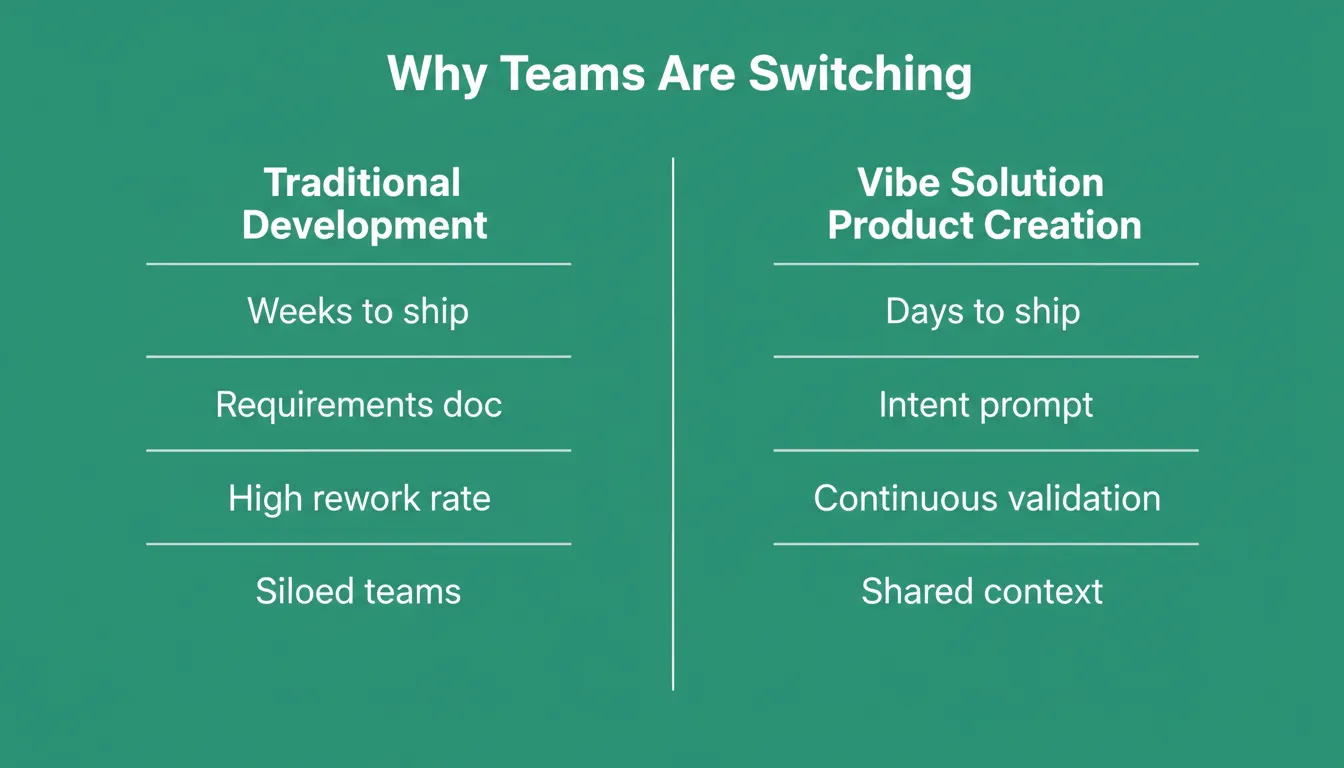
Traditional development vs. vibe solution product creation across seven key dimensions.
Core Principles Behind Vibe-Based Product Creation
Vibe-based product creation works because it follows a few steady principles that guide decisions and behavior across the team. These are not abstract values. They are operating rules that change how work gets done day to day.
- Problem-first thinking keeps attention on the user's pain point instead of jumping straight to features. The team asks "what problem are we solving?" before writing a single prompt.
- Team alignment and shared context help designers, developers, and product managers work from the same understanding. When everyone sees the same research and the same decision rationale, fewer things get lost in handoffs.
- Rapid experimentation and iteration allow teams to test ideas early using working prototypes. A rough working build beats a polished mockup every time.
- Outcome-driven execution shifts focus from output to real results like adoption, retention, and satisfaction. Shipping is not the goal. Shipping something people use is the goal.
- Continuous feedback loops ensure that every sprint cycle incorporates real user signals before the next build begins. The team does not guess. It listens.
- Human oversight on AI output ensures that generated code is reviewed, secured, and refined before deployment. Speed is only valuable if the output is correct.
Together, these principles reduce confusion and help teams avoid building features that do not deliver value. They also create a shared language across roles, making cross-functional collaboration more natural and less prone to misalignment.
Why Teams Are Adopting Vibe Solution Product Creation
Teams adopt vibe solution product creation because it solves the everyday problems they already face. Not abstract inefficiencies, but real ones.
Development time shortens because unnecessary steps disappear. There is no requirements document that nobody reads, and no six-week design phase that produces a mockup developers will reinterpret anyway. Generated code eliminates boilerplate tasks that slow teams down.
Collaboration improves because non-technical contributors can participate earlier in the process. Designers and product managers no longer wait weeks to see real progress, and stakeholders gain visibility sooner. This leads to clearer decisions and fewer costly pivots.
Over time, teams also notice a reduction in technical debt. Features grow from validated needs rather than rushed assumptions, making systems easier to maintain and scale. To understand how AI is reshaping these workflows more broadly, see how AI is changing product development.
What the Shift Looks Like in Practice
Teams that shift to vibe solution product creation consistently report three changes:
- Faster time to first working demo. Not a mockup, not a prototype, but a working build that stakeholders can interact with.
- Fewer revision cycles after stakeholder reviews. Because stakeholders were involved from the start, not presented with a finished product.
- Higher confidence that what they are building matches what users need. Because the research happened before the build, not after.
These are not marginal improvements. They change the rhythm of how a product team operates week to week.
Key Roles in a Vibe Solution Product Team
Even with advanced tools, people remain central to success. Vibe solution product teams rely on flexible roles rather than rigid boundaries, with each person contributing at the layer where their judgment matters most.
| Role | Primary Responsibility | How They Contribute |
|---|---|---|
| Product Manager | Define outcomes and priorities | Writes intent-driven prompts, owns the roadmap |
| UX Designer | Shape user flows and interfaces | Converts Figma designs into working prototypes |
| Developer | Review and extend generated code | Ensures quality, security, and performance |
| QA Engineer | Validate functionality and edge cases | Tests generated outputs before deployment |
| Stakeholder | Provide business context and feedback | Reviews demos and approves direction |
| AI Coordinator | Manage prompt quality and AI output review | Bridges intent and generated output |
How Roles Evolve With AI
The introduction of AI into the product creation process does not eliminate roles. It shifts them. Developers spend less time writing boilerplate and more time reviewing architecture, security, and edge cases.
Product managers become more involved in shaping prompts and validating outputs. Designers see their Figma designs translate directly into working interfaces rather than waiting for developer interpretation.
This shift is not a threat to any role. It is an upgrade. Every person on the team gets to focus on the part of their job that requires judgment, not the part that requires repetition. For a deeper look at this shift, read about vibe coding's impact on modern developer roles.
The Vibe Solution Product Creation Process
The vibe solution product creation process follows a clear but adaptable flow. Understanding each phase helps teams avoid common pitfalls and maintain momentum throughout the development cycle.
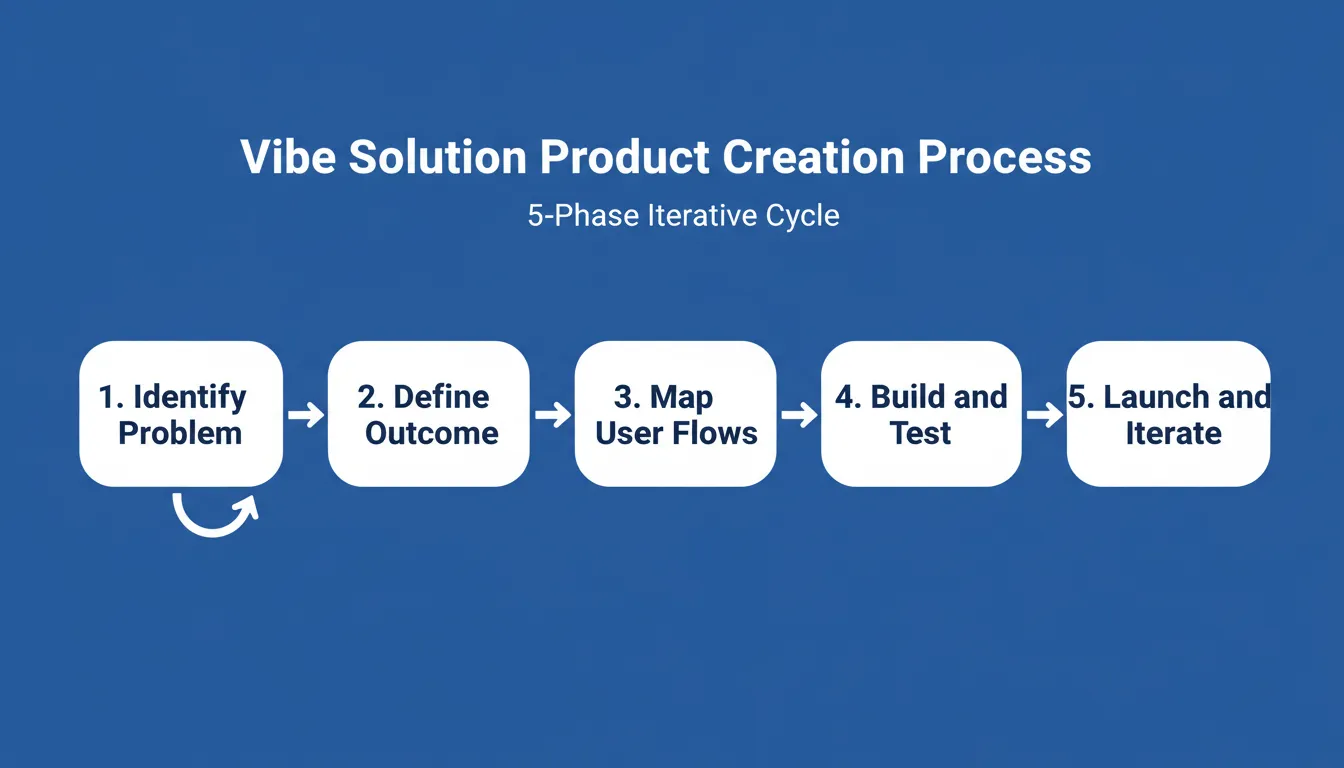
The vibe solution product creation cycle: five phases from problem identification to continuous iteration.
Phase 1: Identify the Right Problem
Start by identifying the right problem. Teams use interviews, support data, usage patterns, and competitive research to understand user needs deeply before writing a single line of code.
This phase is where most traditional development fails. Skipping it is the most expensive mistake a team can make.
Good problem identification means talking to real users before writing a prompt, pulling support tickets to find recurring complaints, and defining the problem in one sentence that any stakeholder can understand and agree with.
Phase 2: Define the Desired Outcome
Next, define the desired outcome. Everyone agrees on what success looks like before building anything. This shared definition of done prevents scope creep and keeps the team focused.
A clear outcome statement answers three questions: who is this for, what problem does it solve, and how will we know it worked. The third question is the one most teams skip. It forces the team to define a measurable signal before the build begins, and that signal becomes the acceptance criterion for every feature in the sprint.
Phase 3: Map User Flows and Logic
Then, map user flows and logic. This often includes sketches, backend logic outlines, and example prompts written in plain language that any team member can understand.
This phase produces the inputs that AI tools need to generate accurate, useful code. A vague prompt produces vague code. A specific, well-structured prompt produces a working feature. For that reason, this is one of the highest-leverage steps in the entire process.
Phase 4: Build and Test With AI
After that, build and test. AI generates functional code or scaffolding while human expertise reviews structure, security, and performance.
Purpose-built AI app builders can reduce the time to a working prototype from weeks to days. For teams starting from scratch, building an app with AI in minutes is a practical starting point. Human review is not optional. It is the quality gate that makes AI speed safe to ship.
Phase 5: Launch, Collect Feedback, and Iterate
Finally, launch to a limited audience. Collect user feedback and refine the solution iteratively, keeping learning continuous and reducing surprises at scale.
Each iteration is faster than the last because the team carries forward context from every previous cycle, compounding their understanding of the product and its users.
Tools That Enable Vibe Solution Product Creation
Several categories of tools support the vibe solution product creation workflow and help teams move faster without losing control.
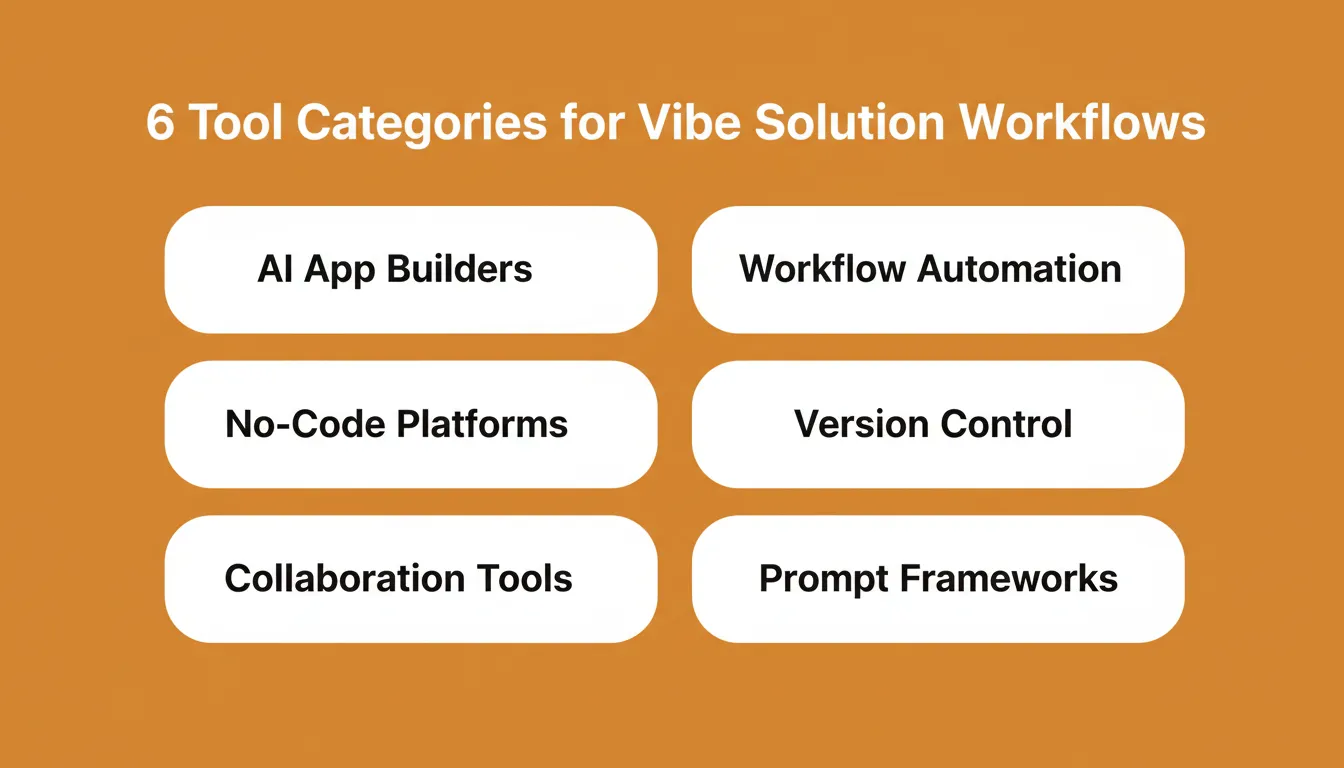
Six tool categories that power the vibe solution product creation workflow from prompt to deployment.
- AI-powered app builders that convert natural language into generated code, handling backend, auth, and deployment automatically
- No-code and low-code platforms that reduce manual coding for interfaces and workflows, enabling non-technical contributors to build and test independently
- Workflow automation tools that connect systems and reduce repetitive tasks, freeing the team to focus on product decisions
- Collaboration and documentation tools that keep shared context visible across roles, so every team member works from the same understanding
- Version control and deployment tools that ensure code quality, enable fast rollbacks, and maintain a clear audit trail of every change
- Prompt engineering frameworks that help teams write better inputs and get more consistent, accurate outputs from AI systems
Used together, these tools support a smoother development process while maintaining human oversight. For a broader overview of the landscape, see the complete beginner's guide to low-code and no-code development.
Choosing the Right Tool Stack
Not every team needs the same tools. A solo founder building an MVP has different needs than an enterprise team extending a legacy system.
The right stack is the one that reduces coordination overhead, not the one with the most features. Start with the tools your team already trusts, then add AI capabilities at the layer where you feel the most friction.
How Vibe Solution Creation Improves Team Collaboration
Vibe solution creation improves collaboration by making progress visible early. Instead of abstract discussions, teams react to working code and real data. This produces more accurate, actionable feedback from everyone involved.
Designers see how backend logic behaves in a real interface. Engineers understand user needs sooner because they are building from validated research. Stakeholders provide feedback before large investments are made, which means their input actually changes the product instead of arriving too late to matter.
This shared rhythm reduces friction and builds trust across roles. As a result, teams that practice this approach consistently report higher satisfaction scores among both developers and non-technical contributors.
Breaking Down the Silos
One of the most persistent problems in product development is the handoff. Design hands off to engineering, engineering hands off to QA, and QA hands off to deployment. Each step introduces delay, misinterpretation, and rework.
Vibe solution product creation compresses these handoffs. When a designer's intent is captured in a prompt and immediately translated into working code, the gap between design and engineering shrinks dramatically. When a stakeholder reviews a working demo instead of a static mockup, feedback is more accurate and actionable.
The silos do not disappear, but they stop being walls.
Common Use Cases for Vibe Solution Products
Teams apply vibe solution product creation across many scenarios, from early-stage validation to enterprise-scale automation. Each use case benefits from faster learning and clearer outcomes.
Internal Tools and Dashboards
Internal tools are a common starting point. Dashboards, admin panels, reporting tools, and HR onboarding systems benefit from quick builds and frequent updates without requiring a dedicated engineering sprint.
A sales operations team, for example, can describe a custom CRM dashboard in plain language and have a working version within days. Teams building internal tools can also explore how to build internal tools with AI without a developer.
MVPs and Rapid Prototyping
MVPs and rapid prototyping help teams validate early concepts before committing large resources. This is where the speed advantage of AI-generated code is most visible.
A founder can test three different product directions in the time it used to take to build one. The ones that do not resonate get discarded cheaply. The ones that do get invested in deeply.
Customer-Facing Portals and SaaS Products
Customer-facing portals evolve based on real user feedback rather than assumptions, reducing the risk of building features nobody uses. SaaS teams use vibe solution product creation to ship feature updates faster and respond to user feedback in days rather than quarters.
Teams building SaaS products can find a practical framework in this guide on how to build a B2B SaaS product with AI.
Automation-Driven Workflows
Automation-driven workflows help connect systems and reduce manual work, even when dealing with legacy systems that lack modern APIs. An operations team can describe a workflow in plain language, have it generated as working code, and deploy it without waiting for a developer sprint.
Healthcare, Compliance, and Regulated Industries
Even in regulated industries, vibe solution product creation adds value. Teams use it to build internal compliance tools, patient intake forms, and reporting dashboards that would otherwise require months of custom development.
The human review layer ensures that generated code meets regulatory requirements before deployment. In this way, speed and compliance become compatible rather than competing priorities.
Challenges Teams Face and How to Overcome Them
Teams still run into practical challenges when using this approach, especially as products and teams grow. The good news is that each challenge has a clear way forward.
- Stakeholder alignment can drift. Regular demos and short review sessions help keep expectations clear and avoid late surprises. The demo is not a presentation. It is a decision checkpoint.
- Scope can expand too quickly. Clear outcomes make it easier to decide what belongs in the current cycle and what can wait. If a feature does not serve the defined outcome, it does not ship in this sprint.
- Scalability becomes a concern over time. Generated code should be reviewed, cleaned up, and refactored as usage increases. The first version is a starting point, not a final architecture.
- Security and performance need ongoing care. AI handles speed, while human oversight protects stability, safety, and long-term quality. Build a review checklist and run it before every deployment.
- Prompt quality affects output quality. Teams that invest in learning how to write clear, specific prompts get dramatically better results from AI tools.
- Context loss between sessions. Without a shared memory system, teams repeat context at the start of every session, slowing down the process.
Addressing these challenges proactively is what separates teams that sustain momentum from those that stall after early wins.
Measuring Success in Vibe Solution Product Creation
Teams measure success using clear signals rather than vague impressions. The metrics below map directly to the outcomes that justify continued investment in this approach.
| Metric | What It Measures | Signal That It Is Working |
|---|---|---|
| Delivery speed | Time from idea to working build | Prototype in days, not weeks |
| User adoption rate | Whether the product meets real needs | High adoption, low churn |
| Revision cycles per sprint | Alignment between intent and output | Fewer than 2 major revisions per sprint |
| Iteration velocity | How fast the team learns and improves | 4 or more meaningful iterations per month |
| Code quality | Long-term maintainability | Passing automated review gates consistently |
| Stakeholder satisfaction | Confidence in the direction | Approvals without major redirections |
Delivery speed is the most visible metric, but it is not the most important. A team that ships fast and builds the wrong thing is still losing. The combination of delivery speed and user adoption is the signal that the approach is working end to end.
Best Practices for Teams Getting Started
Teams new to the vibe solution product creation process often succeed by following a few steady habits from the start.
- Start with a real problem, not a feature idea. The clearer the problem statement, the better the AI output and the more focused the team.
- Write prompts like you are explaining to a smart colleague. Specific context produces specific results. Vague prompts produce vague code.
- Iterate in small cycles. Ship something working within 48 hours of starting. Feedback from a real build is worth more than a week of planning.
- Review every AI-generated output before it ships. Speed is only valuable if the output is correct. Human review is not optional.
- Keep problems and outcomes visible to the whole team. Shared context prevents the misalignment that causes rework.
- Document decisions, not just code. Future team members need to understand why something was built, not just how.
- Set clear iteration boundaries. Know when a cycle is complete. Endless iteration without shipping is just a different kind of stall.
- Build a prompt library. When a prompt produces a great result, save it. The team's collective prompt knowledge is a competitive asset.
For more on how to start building with AI tools effectively, see how to build an app with AI in minutes.
How Rocket Enables Vibe Solution Product Creation
You describe the problem. Rocket researches it, recommends a direction, and builds from that direction.
Rocket is the world's first Vibe Solutioning platform, built for the full arc from thinking to building to operating. It connects natural-language prompts to production-ready code while supporting modern development needs across web and mobile. 1.5 million people have tried Rocket across 180 countries.
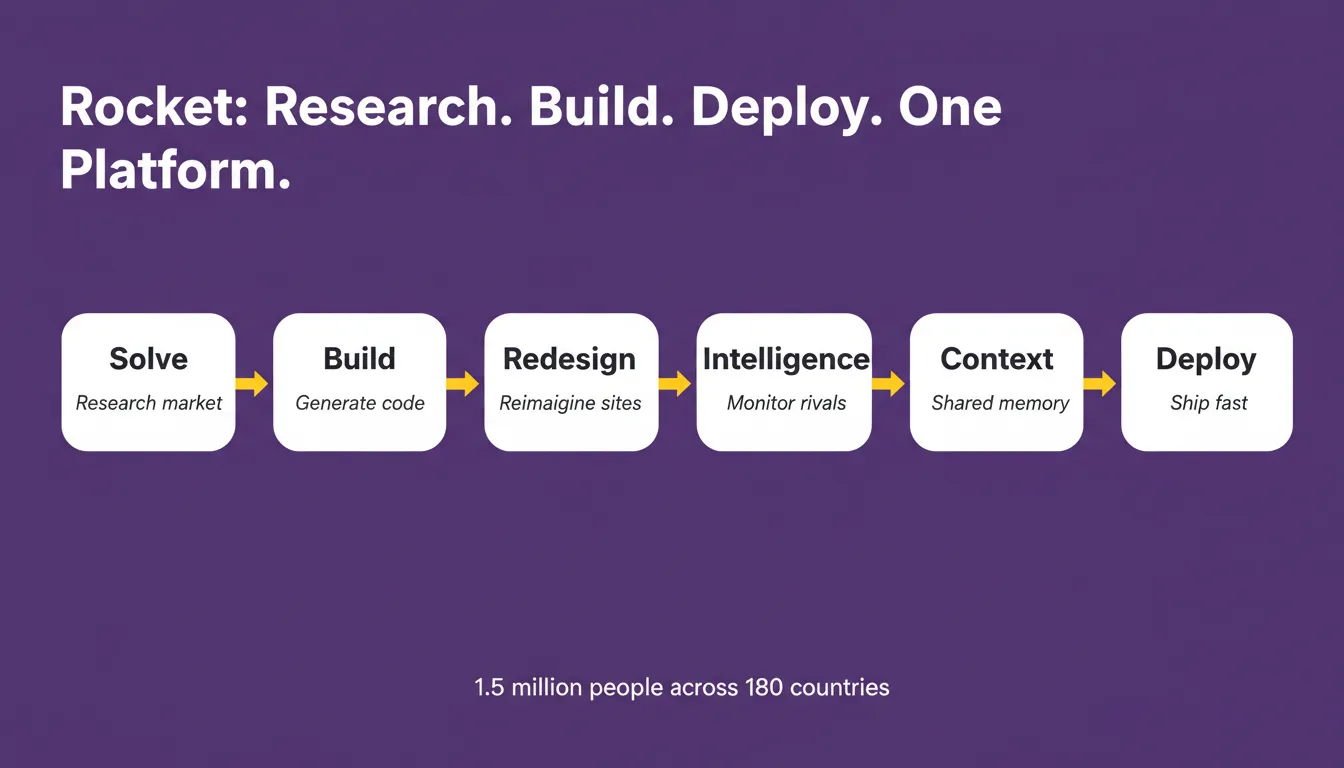
Rocket covers the full arc: from strategic intelligence and competitive research to production-grade building and deployment.
| Feature | What It Does |
|---|---|
| Solve | Type any business problem. Rocket researches the market, maps the competitive landscape, and delivers a recommendation with evidence before you write a line of code. |
| Build | Generate full-stack web and mobile apps from a single text prompt, with automatic backend, auth, and security setup included. |
| Redesign | Convert any existing website or Figma file into a working app, preserving every design decision. |
| Intelligence | Monitor competitors continuously across every platform they operate on. Know what changed before it affects you. |
| Context | Every project carries forward the full accumulated intelligence of everything the team has researched and built. |
| Deploy | Ship quickly with GitHub sync, integrations, and one-click deployment. Export and fully edit the generated code at any time. |
This is not a coding tool. It is the system for the full arc: strategic intelligence, production-grade building, competitive monitoring, and shared context that makes every action smarter than the last. To see how this approach applies specifically to early-stage teams, read Vibe Solutioning for startups: a strategic path to growth.
Start Building From the Right Problem
Vibe solution product creation is how competitive teams build today. The thinking happens before the code, validation happens before the launch, and every cycle compounds the team's understanding of what users actually need.
As AI capabilities continue to advance, this approach becomes more powerful, not less relevant. The teams that master it now will compound that advantage across every product cycle ahead. You describe the problem.
Rocket.new handles the research, the recommendation, the code, and the deployment. Start building for free and see how quickly your next product idea becomes a reality.
Table of contents
- -Why Vibe Solution Product Creation Matters
- -The Problem With Traditional Product Development
- -What Is Vibe Solution Product Creation?
- -Vibe Solution Product Creation vs. Vibe Coding: Key Differences
- -Vibe Solution vs. Traditional Development
- -Core Principles Behind Vibe-Based Product Creation
- -Why Teams Are Adopting Vibe Solution Product Creation
- -What the Shift Looks Like in Practice
- -Key Roles in a Vibe Solution Product Team
- -How Roles Evolve With AI
- -The Vibe Solution Product Creation Process
- -Phase 1: Identify the Right Problem
- -Phase 2: Define the Desired Outcome
- -Phase 3: Map User Flows and Logic
- -Phase 4: Build and Test With AI
- -Phase 5: Launch, Collect Feedback, and Iterate
- -Tools That Enable Vibe Solution Product Creation
- -Choosing the Right Tool Stack
- -How Vibe Solution Creation Improves Team Collaboration
- -Breaking Down the Silos
- -Common Use Cases for Vibe Solution Products
- -Internal Tools and Dashboards
- -MVPs and Rapid Prototyping
- -Customer-Facing Portals and SaaS Products
- -Automation-Driven Workflows
- -Healthcare, Compliance, and Regulated Industries
- -Challenges Teams Face and How to Overcome Them
- -Measuring Success in Vibe Solution Product Creation
- -Best Practices for Teams Getting Started
- -How Rocket Enables Vibe Solution Product Creation
- -Start Building From the Right Problem