
Vibe solutioning is a three-pillar AI methodology combining Solve (research), Build (Next.js and Flutter apps), and Intelligence (competitor monitoring) in one platform with shared context. It is not a synonym for vibe coding.
Vibe solutioning is a product methodology, and the category Rocket defines that covers the complete arc from strategic intelligence to execution to ongoing business operation in a single platform.
It combines three pillars:
- Solve (validate ideas and run market research before you build)
- Build (generate production-ready apps from natural language)
- Intelligence (monitor competitors continuously after you launch)
Unlike vibe coding tools that start at the code editor, vibe solutioning starts at the business question.
For product managers, solopreneurs, front-end developers, small to medium businesses, and other serious app makers, that difference is practical: the most expensive mistake in software is executing well on the wrong idea. Vibe solutioning reduces that risk by helping you validate demand before building, ship production-ready apps or websites with minimal coding, and keep watching the market after launch instead of treating release day as the finish line.
This guide explains what vibe solutioning is, how it differs from vibe coding, how the three pillars work together, where it fits in real app-building workflows, and which use cases and best practices matter if you want to go from idea to launch with fewer costly mistakes.
- Vibe solutioning is not a synonym for AI-assisted coding. It is a three-pillar methodology: Solve, Build, Intelligence.
- The most expensive mistake in any business is a good execution of the wrong thing. Vibe solutioning fixes the thinking before the build begins.
- Rocket generates production-ready Next.js web apps and Flutter mobile apps, not generic code in any language.
- Solve runs thousands of queries across 150+ sources and delivers a structured report in 60 to 90 minutes.
- Intelligence monitors every public platform a competitor operates on, continuously, and interprets what signals mean for your business.
- 1.5 million people across 180 countries have tried Rocket, reached primarily through organic product-led growth.
What Vibe Solutioning Actually Means with Natural Language Prompts
Vibe solutioning is the practice of using AI to cover the full product lifecycle by describing goals and the desired outcome instead of manually writing technical specifications: deciding what to build, building it, and monitoring the market after launch, all inside a single platform with shared context. The term was coined by Rocket.new, which describes itself as the world's first vibe solutioning platform.
The founding insight is simple: the most expensive mistake in any business is not a bad execution. It is a good execution of the wrong thing. A product nobody wanted. A feature that moved no metric. A market entered without understanding what was already there.
Most AI tools were built to do one thing (answer a question, generate code, or search the web) and stop there. Vibe solutioning removes that coordination tax by connecting the thinking and the building in the same place. It shifts the human role toward directing outcomes like a product manager rather than a coder. That also makes software creation more accessible to beginners and non-technical users.
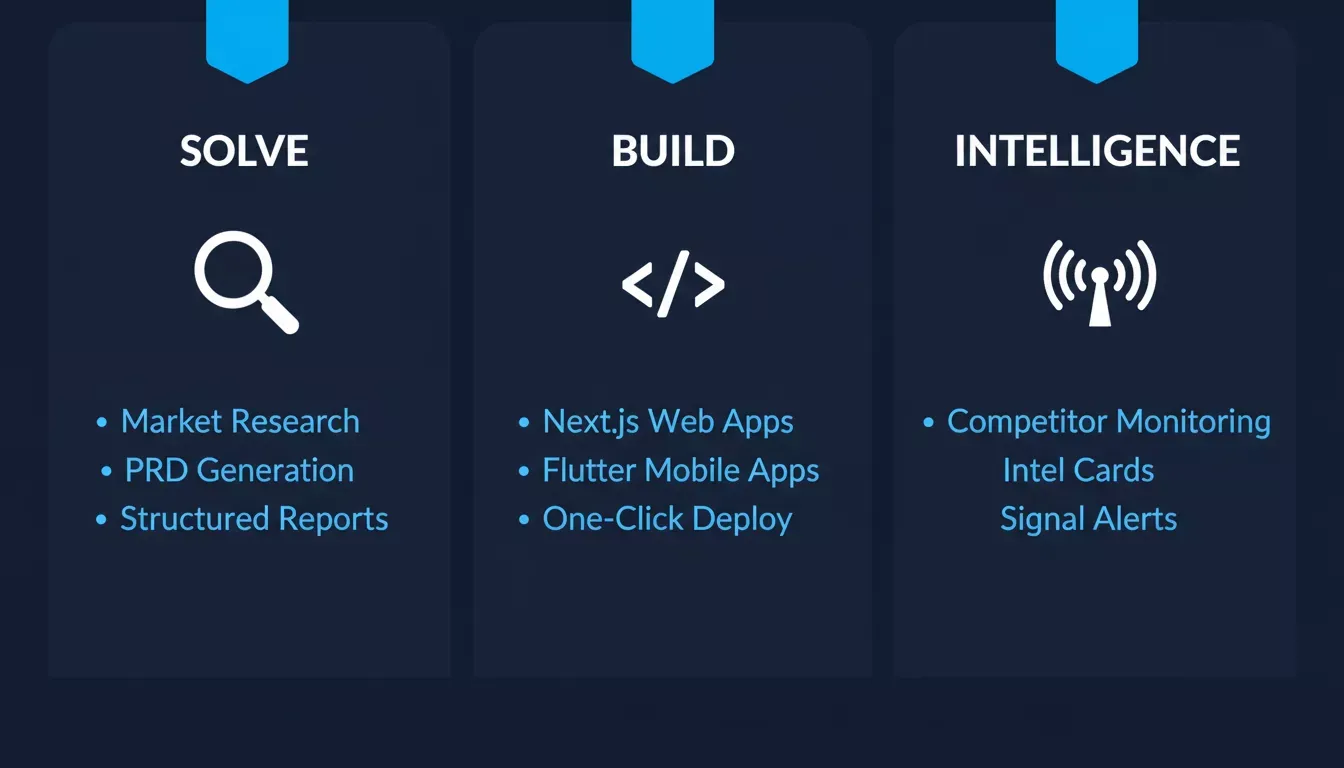
The three pillars of vibe solutioning: Solve for research, Build for production apps, and Intelligence for continuous monitoring.
Vibe Solutioning vs. Vibe Coding
This is the most-asked disambiguation question, and the answer matters for how you use either approach. Andrej Karpathy, co-founder of OpenAI, coined vibe coding in early 2025. Vibe coding refers specifically to generating code from natural language prompts, rather than using traditional programming with precise syntax across programming languages.
Vibe solutioning is the broader three-pillar methodology that includes research before the build and competitive monitoring after launch.
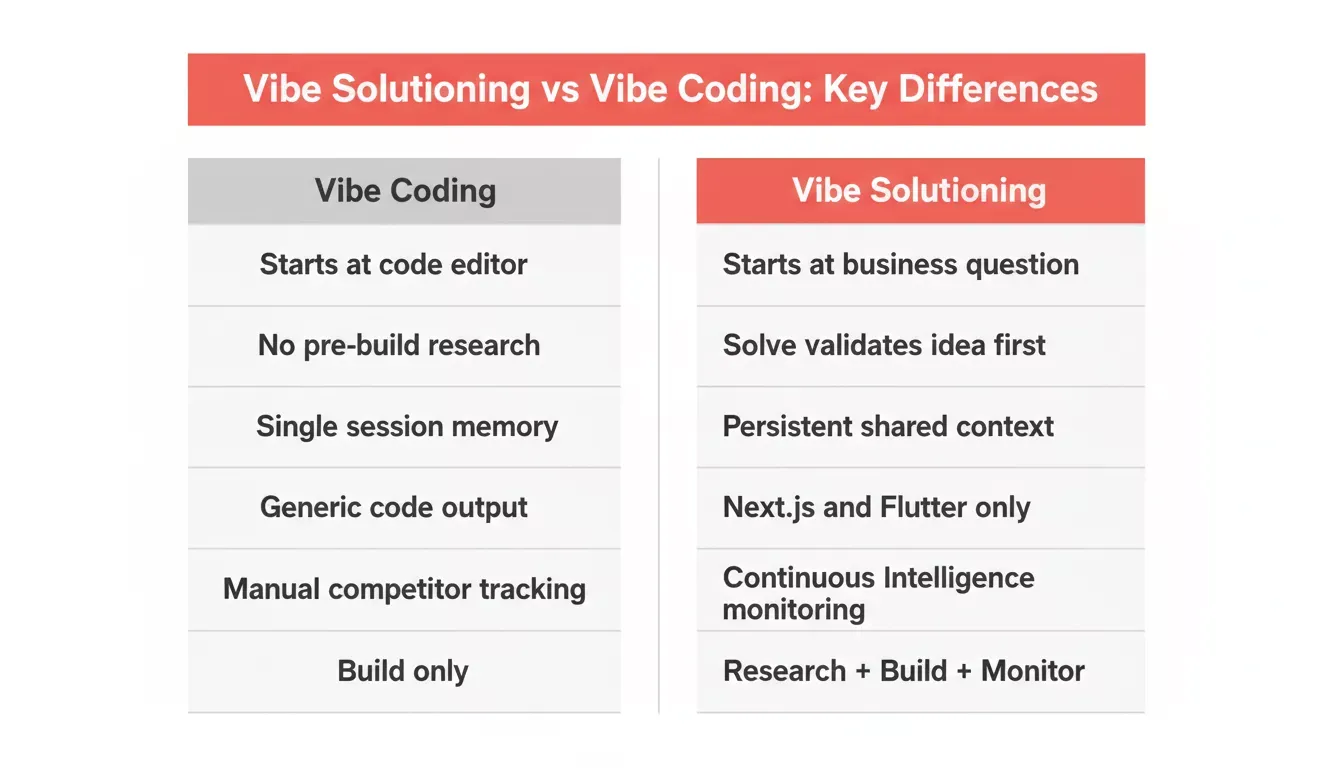
| Dimension | Vibe Coding | Vibe Solutioning |
|---|---|---|
| Scope | Code generation from prompts | Full lifecycle: research, build, monitor |
| Starting point | A feature or app idea | A business question |
| Pre-build intelligence | None; you bring the spec | Built-in: Solve validates the idea first |
| Output | Code files or prototypes | Research reports, production apps, Intel cards |
| Post-launch | Manual monitoring | Continuous competitive intelligence |
| Context memory | Per-session or per-tool | Persistent across all tasks in a project |
| Frameworks | Varies by tool | Next.js (web), Flutter (mobile), production-grade by default |
| Who it serves | Developers and technical builders | Builders, Operators, Platform Consolidators |
The one-sentence difference: Vibe coding tools build what you tell them to build. Vibe solutioning figures out what is worth building, then builds it, then watches the market to tell you what to build next.
Vibe coding is useful for rapid prototyping and a first version, but it is risky to treat that output as a production codebase without code review and human review. That is because ai generated output can reduce accountability and introduce security vulnerabilities and maintainability concerns, especially in production systems.
Vibe solutioning vs. vibe coding: the key structural differences at a glance.
The Three Pillars: Solve, Build, Intelligence
The vibe solutioning loop: Solve informs Build; Intelligence feeds back into the next Solve.
Solve: Decision Intelligence Before You Build
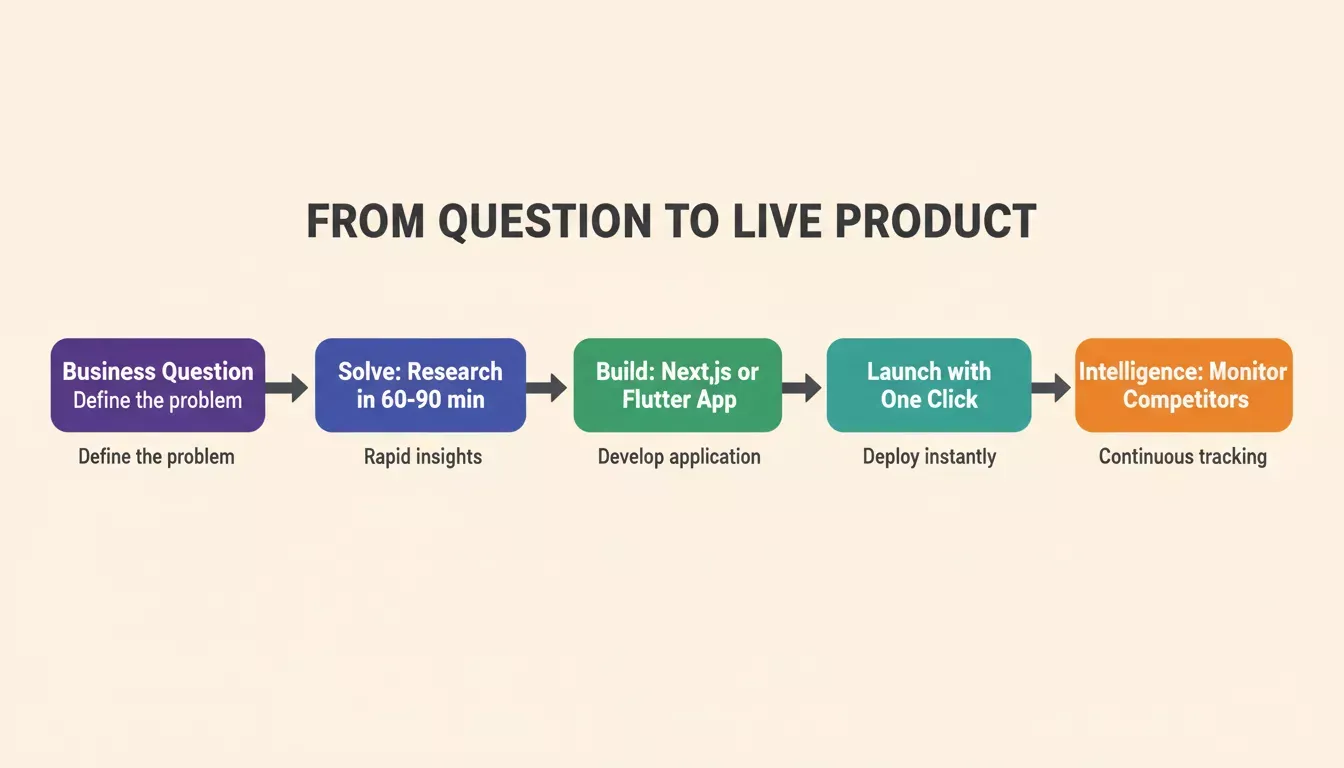
Solve takes any business question described in plain language and delivers a complete, structured solution that is ready to act on, present, or build from. Rocket frames the problem before research begins by identifying every dimension (market dynamics, competitive landscape, risks, opportunities, financial implications), then runs thousands of queries across 150+ sources simultaneously.
Within 60 to 90 minutes, what would have taken a research team days or a strategy firm weeks is complete. Output is a structured analytical deliverable typically covering 8 to 12 sections, with each finding tagged by signal strength (HIGH / MEDIUM / LOW) and conflicting signals called out explicitly rather than smoothed over.
What Solve produces:
- Market entry assessments and competitive teardowns
- Product requirements documents (PRDs) from a single prompt
- Pricing strategy analysis and willingness-to-pay benchmarks
- Board and investor materials
- M&A assessments and regulatory research
- Export as PDF or full presentation deck (PPTX)
The Solve output does not disappear after export. It becomes the foundation of everything that follows in the project. The PRD is present when the developer opens the Build task.
Build: AI Assisted Development and Production-Grade App Generation
Build generates production-grade products from natural language descriptions, Figma files, or existing GitHub repositories. Using artificial intelligence and large language models, Build turns plain-language instructions into functional code instead of requiring users to start by writing code directly.
Web applications are built in Next.js; mobile applications in Flutter, with real design systems, dark/light theming, fluid navigation, and staggered animations. This coding approach can save time and reduce early development time by up to 40% for an initial version or working prototype. Every product ships with SEO-ready structure, WCAG accessibility compliance, GDPR coverage, and performance optimization by default.
What Build produces:
- Web apps (SaaS, dashboards, internal tools, marketplaces, customer portals)
- Mobile apps (iOS and Android from a single Flutter codebase, App Store and Google Play ready)
- Conversion-focused pages built from project context
- Multi-page websites at consistent quality across every page
- Internal tools: OKR trackers, customer health monitors, compliance dashboards, investor data rooms
Many developers now use tools like GitHub Copilot or an AI agent as a pair programmer for ai assisted development, especially to build prototypes or explore personal projects. That works well for throwaway weekend projects or a first draft, but a final product still needs human judgment, review of the underlying code and any existing code, plus unit tests to confirm working code.
After you ship: deploy to a live URL with one action, full version history, one-click rollback, and 25+ integrations (Stripe, Supabase, Google Analytics, Notion, Linear, Airtable, Mailchimp, Mixpanel, and more) that authenticate once and flow into every build.
25% of startups in Y Combinator's Winter 2025 batch reportedly had codebases that were 95% AI-generated. Separately, 16 out of 18 CTOs reported production disasters from AI-generated code.
From business question to deployed product: the vibe solutioning workflow in five steps.
Intelligence: Continuous Competitive Monitoring
Intelligence monitors every public platform a competitor operates on, continuously, and interprets what signals mean for your business. It does not just alert you to what changed; it tells you what it means. Intel cards are the atomic unit: each card is a structured read that connects signals into meaning, not a raw notification.
Intelligence watches nine signal pillars: Product and Technology, GTM, Business and Finance, People and Hiring, Social Media, Website, Reviews and Community, News and Media, and more. Signals are delivered as daily, weekly, or monthly briefs wherever you work.
What Intelligence enables:
- Spot a competitor move, analyze it in Solve, and ship a counter-feature in Build, all in the same platform
- Build competitive deal briefs for sales teams before high-stakes calls
- Monitor Glassdoor, Capterra, G2, Reddit, and app store reviews as competitive inputs
- Track competitor ad spend shifts across LinkedIn, Meta, and Google
How the Three Pillars Work Together
The architectural moat of vibe solutioning is not a single pillar. It is the shared context that connects all three. Without this architecture, the strategy team does research in one tool, produces a brief, hands it to product in a document, product reads 60% and writes a PRD from memory, hands it to engineering in a ticket, and the engineer misses two nuances. Three handoffs. Three context compressions.
In a vibe solutioning platform, the market research, the strategy brief, the PRD, and the Build task are in the same project. Every step inherits the full context of every prior step. The handoff is not improved. It is eliminated.
| Without Vibe Solutioning | With Vibe Solutioning |
|---|---|
| Research in Tool A, brief exported | Solve runs research inside the project |
| Brief handed to the product in a doc | Solve output becomes Build context automatically |
| PRD written from memory | PRD generated from Solve findings |
| Build starts from a ticket | Build starts from the full research and PRD |
| Competitor monitoring is manual | Intelligence monitors continuously, feeds back into Solve |
| Context lost at every handoff | Context compounds across every task |
Real-World Applications of Vibe Solutioning
Vibe solutioning is applied across three user types. Builders (founders, developers, agencies) validate a startup idea in Solve, build the MVP in Build, and monitor the competitive landscape in Intelligence, without switching tools or re-explaining context.
Operators (product managers, sales teams, marketers, consultants) use Solve for market research reports, competitive deal briefs, PRDs, and board materials, and never open the Build tab at all.
Platform Consolidators (enterprise and scaled teams) replace four separate research, build, and intelligence functions with one shared-context system. According to Rocket's own analysis, tool sprawl costs approximately 20% of every team member's week in coordination overhead.
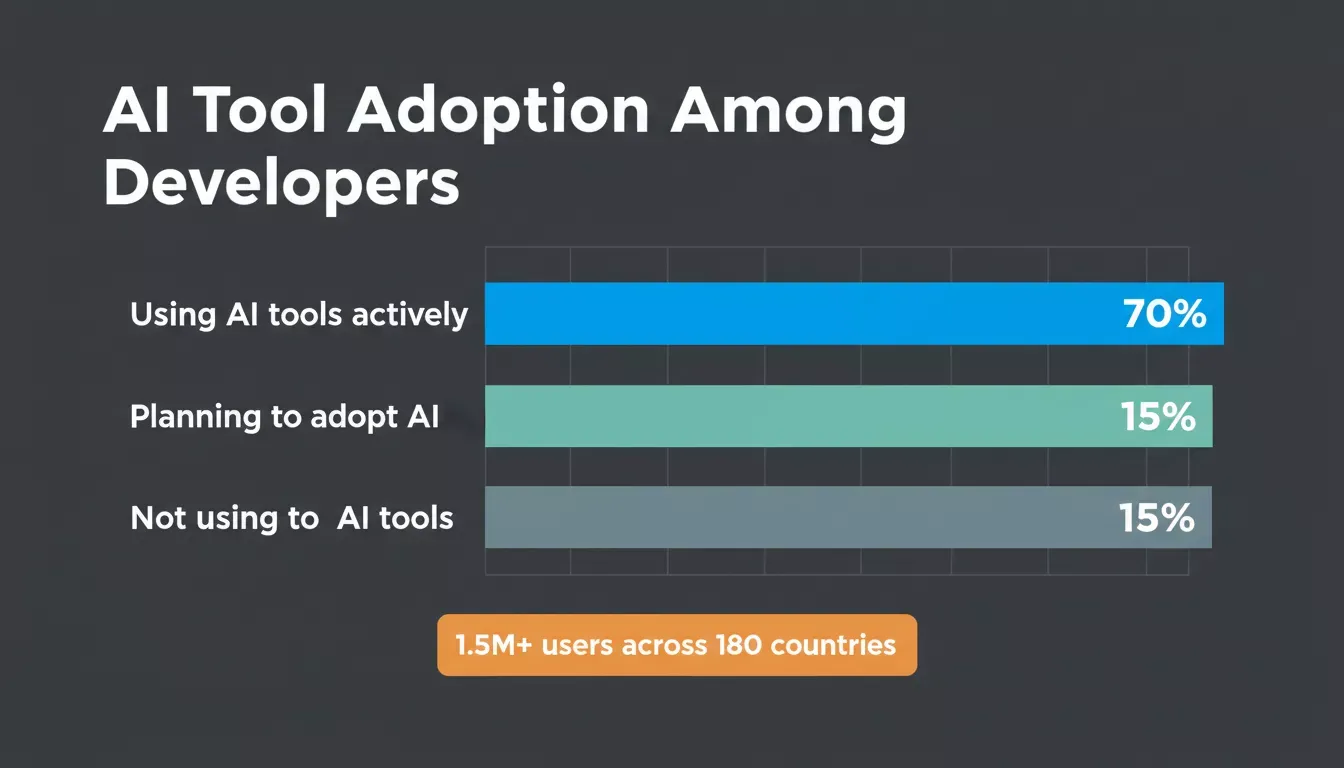
Developer AI tool adoption is accelerating. Vibe solutioning represents the next evolution beyond single-purpose code generators.
A Concrete Example
A startup wants to test a new CRM feature. Without vibe solutioning: the PM Googles competitors, writes a brief from memory, hands it to engineering, and the team builds something that misses the market gap. With vibe solutioning: Solve analyzes the CRM competitive landscape in 60 to 90 minutes, surfaces the specific gap competitors are missing, generates a PRD, and Build turns the team’s desired outcome into a working Next.js prototype from natural language instructions so they can provide feedback and refine that first draft before launch, while Intelligence monitors competitor responses after launch.
The entire loop (research to deployed product to ongoing monitoring) runs in one workspace. According to the Stack Overflow Developer Survey, 70% of developers were using or planning to use AI coding tools. Research from GitHub confirms that developer productivity gains from AI tools are compounding year over year. The trend has gone so far that 25% of startups in 2025 reportedly had codebases that were 95% AI-generated. Vibe solutioning represents the next evolution: AI that covers not just the coding step but the full decision-to-deployment arc.
Teams that start with Solve before building ship more defensible products because the build reflects real market evidence, not assumptions. For product managers specifically, vibe coding workflows are already reshaping how roadmap decisions get made.
Best Practices for Vibe Solutioning
- Start with Solve, not Build. The most common mistake is jumping straight to code generation. Running a Solve task first, even a 15-minute one, surfaces assumptions that would otherwise become expensive bugs.
- Use a Project for everything. Adding files, research, and brand guidelines to a Project once means every subsequent Solve and Build task inherits that context automatically.
- Let Intelligence inform your next Solve. When a competitor makes a move, run a Solve task on what it means before deciding how to respond. Then Build the response.
- Export Solve outputs as PDF or PPTX for stakeholder alignment before the Build begins. This creates a paper trail that keeps teams aligned.
- Iterate Build through chat, not full regeneration. After first generation, change data model, adjust visual hierarchy, add features, or connect integrations, all in context without re-explaining.
- Avoid over-reliance on any single pillar. Vibe solutioning's value compounds when all three pillars are connected. Using Build alone is just vibe coding.
![Quote card: The most expensive mistake in any business is a good execution of the wrong thing]
The founding insight behind vibe solutioning: better decisions before the build begins.
Understanding how vibe solutioning works in practice helps teams apply it more effectively from day one. The vibe solutioning platform itself is designed to make this loop frictionless across all three pillars.
Table of contents
- -What Vibe Solutioning Actually Means with Natural Language Prompts
- -Vibe Solutioning vs. Vibe Coding
- -The Three Pillars: Solve, Build, Intelligence
- -Solve: Decision Intelligence Before You Build
- -Build: AI Assisted Development and Production-Grade App Generation
- -Intelligence: Continuous Competitive Monitoring
- -How the Three Pillars Work Together
- -Real-World Applications of Vibe Solutioning
- -A Concrete Example
- -Best Practices for Vibe Solutioning