
Why are developers choosing Supabase Auth? Learn how it handles sign-in, sessions, and security, why it saves backend time, and how to set it up with clear best practices.
What does Supabase Auth do, and why is it popular?
Supabase Auth helps apps manage user sign-in, sessions, tokens, and security without building your own backend from scratch. It’s part of a broader trend where easier authentication can save hours of coding time.
According to the Stack Overflow Developer Survey, 84% of developers use AI tools in their workflows, underscoring their reliance on tools that handle complex tasks.
That’s where Supabase Auth shines, and this blog breaks down setup, security, and good practices clearly and casually.
What is Supabase Auth?
Let’s keep it simple.
Supabase Auth is a full authentication service that runs within your Supabase project. It handles user creation, login, password resets, tokens, and more.
It works with Supabase JS on both the frontend and the backend. And because it integrates directly with a Supabase database, it can protect your data with intuitive rules.
You can build sign-in screens using magic links, email/password flows, social logins, or even anonymous sign-ins if you want guests to explore before signing up.
Why Authentication Matters?
Building a login system might seem simple, but it secretly has a bunch of moving parts.
Here’s what’s happening behind the scenes:
- A table used to store user profiles: Keeps all user data like name, email, and preferences. Without it, your app won’t know who’s logging in.
- Password hashing and verification: Scrambles the user's password to ensure security. Verification checks login attempts against the hash.
- Session and token handling: Manages session data, access tokens, and refresh tokens to keep users signed in.
- Email or phone sign-in workflows: Let users log in via email, phone, magic link, or social identity providers.
- Security rules for every table: RLS policies ensure each user sees only their own data.
This is before thinking about row-level security (RLS) or identity provider setup. Supabase Auth does most of this heavy lifting. You get all this with a few lines of code. Fast, right?
Setting Up Supabase Auth
Getting started with Supabase Auth is easier than it sounds. A few clicks and lines of code are all it takes to have a working auth instance ready for sign‑ups and logins.
1. Create a Supabase Project
Start from the Supabase dashboard and create a new project. You’ll get your project URL and a primary key. This key is critical, so keep it safe. The primary key enables your app to use Supabase JS to interact securely with the API. You will use this to initialize your client.
Example:
1import { createClient } from '@supabase/supabase-js'
2const supabase = createClient('https://xyz.supabase.co', 'PUBLIC_ANON_KEY')
3That gives you an auth instance to manage sign‑in and sign‑up flows.
2. Configure Auth Settings
Go to Authentication settings in the Supabase dashboard. Configure email templates for sign‑up, magic link, and password reset. You’ll go to the Email template setup and customize them so the emails feel like part of your brand.
Then choose providers like Google, GitHub, or others. This adds social login support via external identity provider services.
3. Implement Authentication in Code
With Supabase JS, you do most tasks with built‑in methods.
Sign up with your email and password
1const { data, error } = await supabase.auth.signUp({
2 email: 'user@example.com',
3 password: 'user password'
4})
5This creates a new user and sends a verification email. The same function also stores the refresh and access tokens in the user’s browser session.
Sign in with email and password
1const { data, error } = await supabase.auth.signInWithPassword({
2 email: 'user@example.com',
3 password: 'user password'
4})
5Or, magic link:
1await supabase.auth.sendMagicLinkEmail('user@example.com')
2That sends a one‑time link to their email so they can log in without a password. That’s great for frictionless signup when all you need is email signups.
Tokens, Session Data, and Security
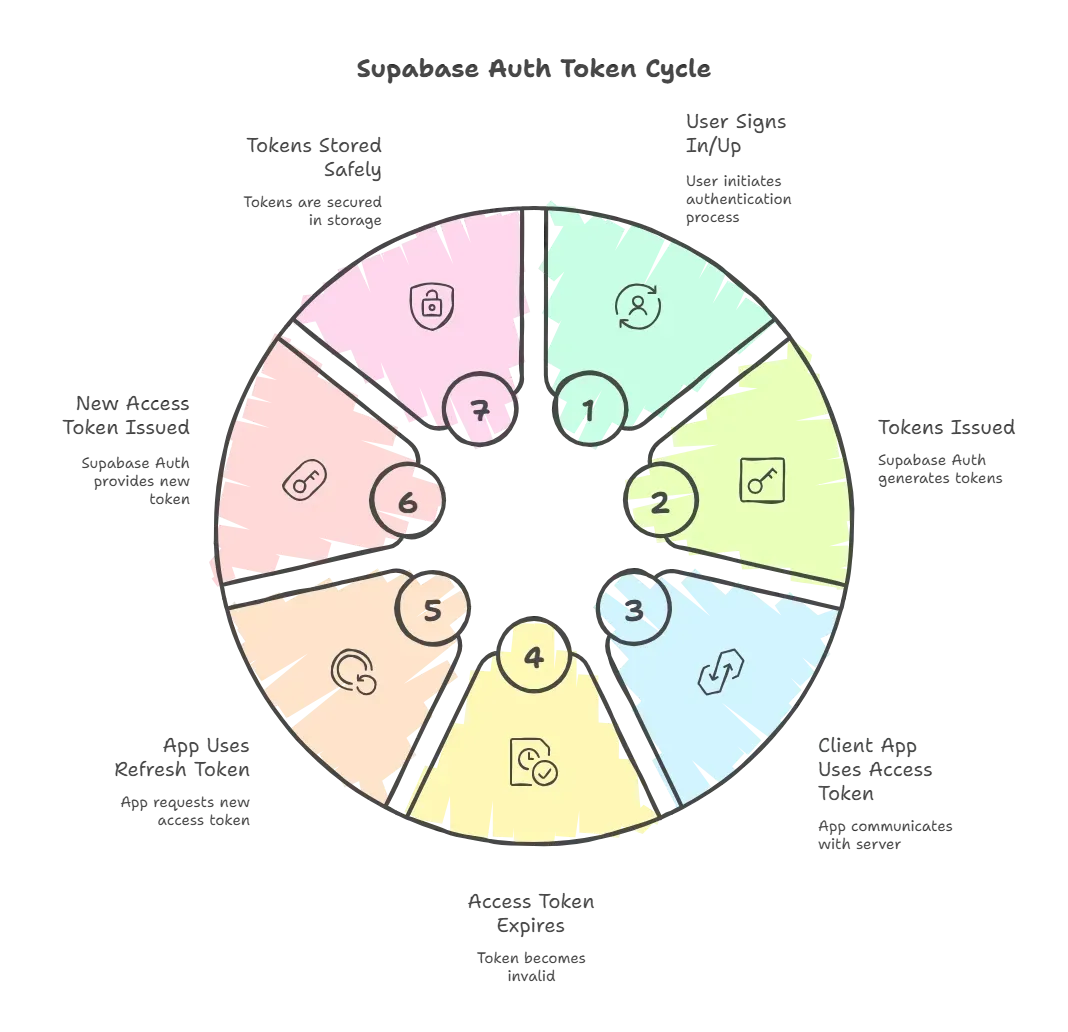
When a user signs in, Supabase Auth returns an access token and a refresh token. The access token lets you access secure parts of your API. The refresh token lets your app keep the session alive without making the user sign in again.
Session data includes the signed-in user and the token expiration time. Your frontend can use this to manage states, such as showing a login button or a user dashboard.
Behind the scenes, Supabase Auth uses JSON Web Tokens (JWT) for authentication, allowing your app server to verify signatures with public keys. Email and password, magic link, social providers, all lead to the same token flows.
Important: Never leak your primary key or refresh token. Treat them like passwords. Misusing them can give attackers access to your project.
Row Level Security (RLS) with Auth
You might wonder why Supabase makes you think about RLS from day one. RLS lets you protect rows in any table based on the user’s identity.
Let’s say you have a table:
| Column | Type |
|---|---|
| id | uuid |
| user_id | uuid |
| content | text |
A simple RLS policy could allow only the user who created a row to read it:
1create policy "Users can view their own rows"
2on table users
3for select
4using (auth.uid() = user_id)
5That verifies the user’s authentication token and returns only rows where the user ID matches. This keeps your data safe on a per‑user basis.
The power of RLS is that you can restrict access without writing tons of server code.
Best Practices for Supabase Auth
Even with Supabase doing most of the work, a few smart moves keep your auth smooth, safe, and a little less “oops”‑prone.
Here’s what devs usually do.
✔ Protect the Primary Key:
Make sure your backend holds your sensitive keys. The frontend needs only a public primary key, not a service role key that can bypass security.
✔ Handle Refresh Tokens Carefully
Store refresh tokens correctly, and rotate them when needed. If stolen, a refresh token can allow long‑term access.
✔ Set RLS Policies Early
If you wait to implement RLS later, you’ll likely inadvertently grant users access to data they shouldn’t see.
✔ Customize Email Template
Make your emails look real. Put your logo and clear language. Users ignore emails that look sketchy.
✔ Use Social Providers
Let users sign in with Google, GitHub, or Apple to reduce friction. Set up is in the dashboard, then call sign‑in methods from supabase.js.
Rocket.new and Supabase Auth
Rocket.new is a vibe solutioning platform that connects with your Supabase backend. It can plug into your existing Supabase project with no extra code.
You don’t need to be a full‑stack developer to get started, and it makes connecting frontend and backend seamless. This lets you focus on designing features rather than writing boilerplate setup.
With Rocket.new you can:
- Connect your Supabase auth and database without writing setup code.
- Build screens that talk to your database and protect routes using the same auth system.
- Let Rocket.new generate UI while the backend logic stays powered by Supabase.
- Configure email templates and social providers via UI without touching code.
It’s great for rapid prototyping or when you want a visual way to build features quickly while keeping secure auth flows.
Key Takeaways on Supabase Auth
Supabase auth offers a clear path to add authentication to apps with minimal setup and solid security controls. You get tokens, sessions, user management, and database access rules in sync. Many developers will enjoy not building auth from scratch while still keeping data safe.
Plus, with features such as magic links, social identity providers, and row-level security, managing users becomes much less of a headache. Whether it’s a new project or an existing Supabase project, Supabase Auth keeps sign-in, signup, and session flows smooth and reliable.
Table of contents
- -What is Supabase Auth?
- -Why Authentication Matters?
- -Setting Up Supabase Auth
- -1. Create a Supabase Project
- -2. Configure Auth Settings
- -3. Implement Authentication in Code
- -Tokens, Session Data, and Security
- -Row Level Security (RLS) with Auth
- -Best Practices for Supabase Auth
- -✔ Protect the Primary Key:
- -✔ Handle Refresh Tokens Carefully
- -✔ Set RLS Policies Early
- -✔ Customize Email Template
- -✔ Use Social Providers
- -Rocket.new and Supabase Auth
- -Key Takeaways on Supabase Auth