
Solve on Rocket.new ensures every output is board-ready from the start by combining structured thinking, clarity, and decision-first formatting, removing the need for revisions and accelerating confident execution.
Is It Possible to Get Board-Ready Output Without Endless Revisions?
Yes, it is. The way Solve on Rocket.new works, it structures thinking from the start, so the output already fits decision-making needs. No messy drafts. No rework loops. Just clean, usable results that teams can quickly review and send.
A report by McKinsey & Company shows that generative AI can increase productivity by 30 to 45 percent in certain functions, highlighting how much time is currently spent on repetitive tasks like drafting, editing, and revising.
In this blog, we'll go through why Solve on Rocket.new delivers board-ready outputs by default and how it helps you work faster with better clarity.
What "Board-Ready" Actually Means
Board-ready output is clear, decision-focused, and structured. It answers the "so what?" question without requiring any extra editing.
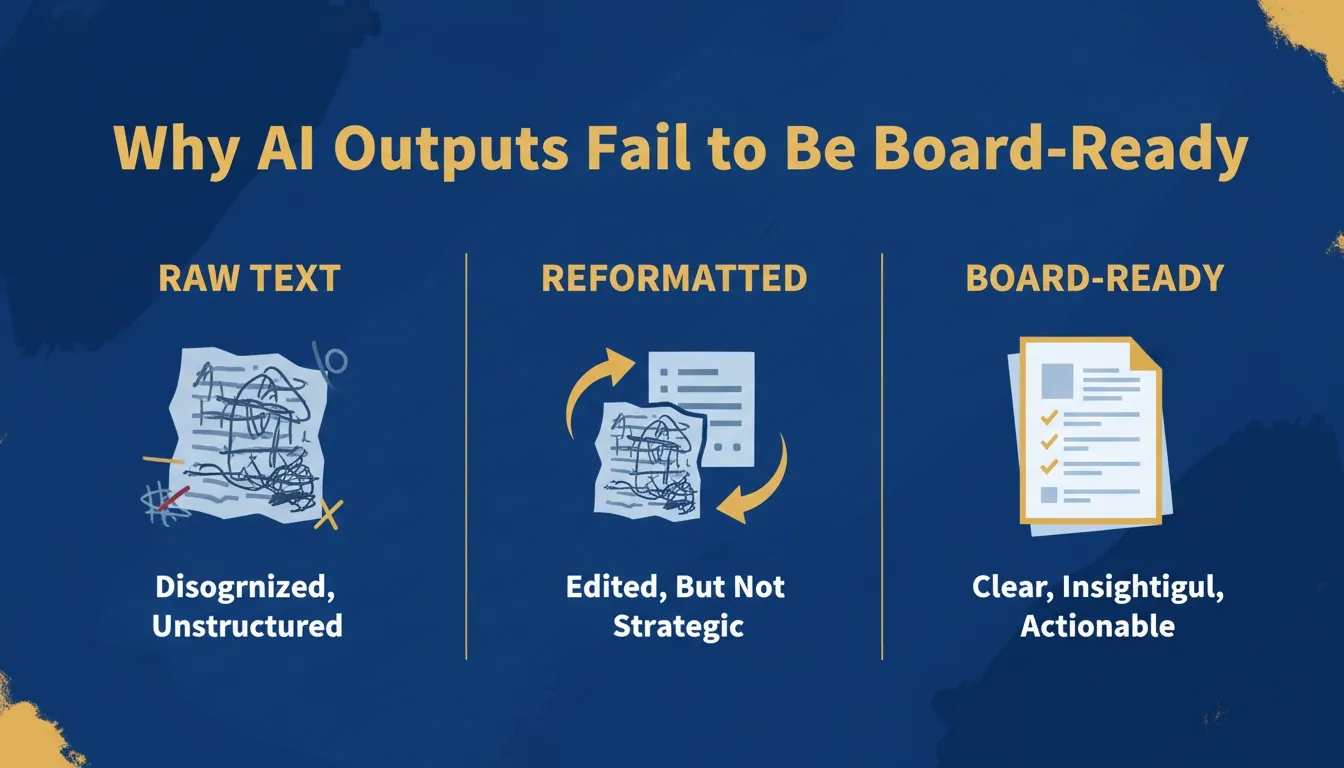
Most AI tools give you raw text. You still need to clean it, format it, and shape it before it becomes useful to anyone. That's where time goes.
With Rocket, things feel different. The system is built around vibe solutioning, which means every output is structured for clarity, not just information. You don't just get answers. You get something you can send.
What Board-Ready Output Includes
| Quality | What It Means |
|---|---|
| Clear and easy to understand | No jargon, no filler, straight to the point |
| Decision-focused | Answers "what should we do?" not just "what is this?" |
| Logically structured | Problem, context, options, recommendation |
| "So what?" answered | Every finding connects to a business implication |
| Ready to send | No reformatting, no editing, no cleanup needed |
Why Most AI Tools Fall Short
Most AI tools are great at generating content. But they struggle with structure and clarity, the two things that make output actually usable in a business context.
Here's what usually happens with a standard AI tool:
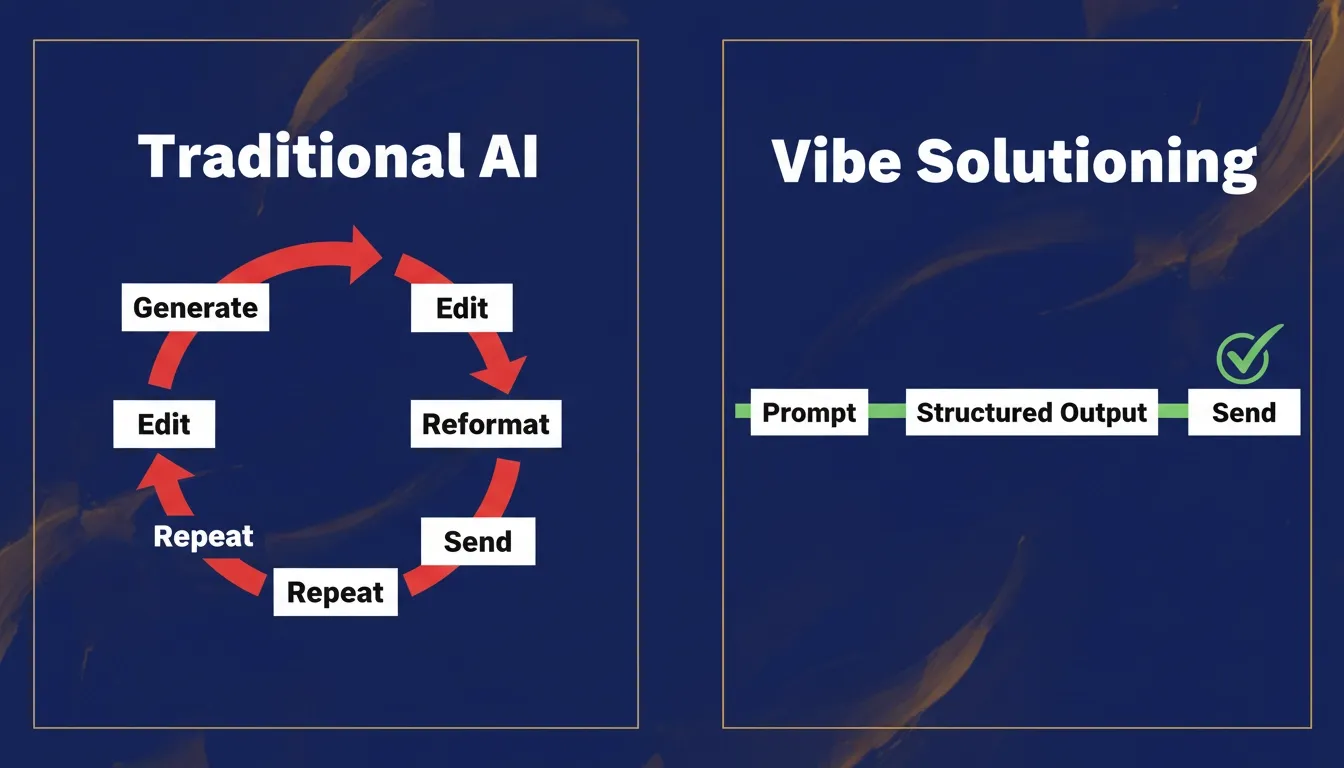
- You start with a prompt
- You get a long, unstructured response
- You edit, reformat, and restructure it
- You finally send it after significant manual work
That cycle repeats every single time. Even the best AI app still leaves you doing work after generation. The output is not ready by default. That's why teams still depend on manual thinking layers, even when using AI-powered tools.
Understanding what inconsistent AI outputs signal for product decisions is the first step toward choosing a platform that eliminates that gap entirely.
How Rocket Changes the Flow
Rocket does not just generate content. It structures thinking from the start, so the output already makes sense for decision-making.
The key difference is in how the flow is designed:
How the Solve Flow Works
- Vibe solutioning: Organizes ideas into structured nodes with clear purpose
- Problem framing: Identifies every dimension before research begins
- 150+ source queries: Runs thousands of queries simultaneously across verified sources
- Structured output: Builds clear, usable results instead of raw text
- Signal tagging: Each finding is tagged HIGH / MEDIUM / LOW by signal strength
- Guided flow: Removes the need for step-by-step manual instructions
It's not just about generating more. It's about generating the right way so you can actually use what you get.
The Core Idea Behind Vibe Solutioning
In an era full of vibe coding platforms, Rocket is the only Vibe Solutioning platform and the distinction matters.
Vibe solutioning is not about fancy words. It's about how thinking flows from input to output. Each Solve output is broken into four parts:
- Problem: What is actually being asked
- Context: What the landscape looks like
- Options: What the realistic paths forward are
- Clear recommendation: What to do and why
This is how boards think. This is how leaders decide. When you use Rocket, the output already matches decision formats, which is exactly why you don't need revision.
Solve takes any business question, prompt, or situation described in plain language and delivers a complete, structured solution, ready to act on, present, or build from.
What Happens Inside Rocket's Solve
The process is straightforward, but the way it structures thinking makes all the difference. Rocket frames the problem before research begins, identifying every dimension: market dynamics, competitive landscape, risks, opportunities, and financial implications.
Inside the Solve Flow
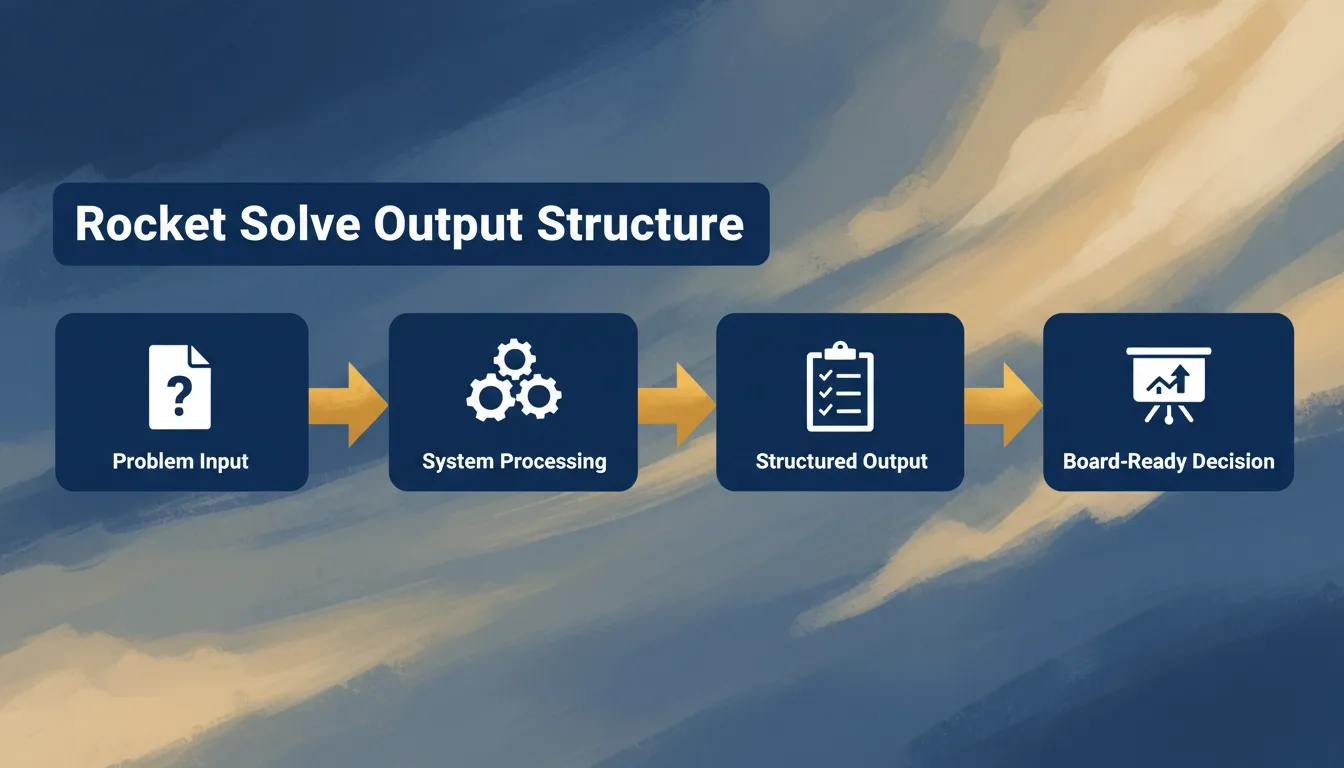
- Problem input: You describe your situation in natural language
- System processing: The platform frames the problem and organizes every dimension
- Structured outputs: Builds clear, usable results with findings tagged by signal strength
- Competitive intelligence: Surfaces relevant insights, including things you didn't ask for but need to know
- Guided flow: Removes the need for step-by-step instructions
You don't need to guide every step. The system understands the flow. This is where most AI tools fail. They don't structure thinking, they just respond to it.
You can also refine any section through follow-up chat, go deeper on a finding, reframe for a different audience, or pressure-test a recommendation. Export as a comprehensive PDF or a full presentation deck via "Generate PPT."
Key Features That Make Solve Different
Here are the core features that make Solve output board-ready by default:
| Feature | What It Does | Why It Matters |
|---|---|---|
| Structured Outputs | Breaks content into verdict, findings, risk matrix, execution path | Easy to scan and act on |
| Signal Strength Tags | Labels each finding HIGH / MEDIUM / LOW | No guessing which insights to trust |
| Connected Thinking | Links ideas logically across sections | No confusion or contradictions |
| Built-in Logic | Handles research framing and source quality | No manual fixing or fact-checking |
| Consistent Format | Same structure every time, regardless of question type | Predictable, reliable deliverables |
| Export Options | PDF and PPT export built in | Share directly without reformatting |
These features make Rocket feel like one platform instead of multiple disconnected tools.
From Idea to Working Output
Let's say you have a strategic question: a market entry decision, a product direction call, or a board presentation to prepare. The usual process with different tools can feel slow and scattered.
With Most AI Tools
- Generate a response
- Write and rewrite supporting docs
- Refine and reformat manually
- Build the presentation separately
With Rocket, it's simpler. You describe the question. The system builds a structured output covering 8 to 12 sections depending on question type. That output can directly guide your next decision, your next build, or your next board meeting.
It works for strategic decisions, product direction, competitive preparation, board and investor materials, M&A assessment, and more. The Solve output does not disappear after export. It becomes the foundation of everything that follows in the project.
Explore how Solve on Rocket connects research directly to build so nothing is lost between thinking and execution.
Where Does This Help the Most?
This approach is useful across many business scenarios. It helps teams stay clear, move faster, and avoid the confusion that comes from working across disconnected tools.
Where Solve Fits Best
- Strategic decisions: Market entry, competitive assessment, pricing strategy
- Product direction: PRD generation, feature scoping, build-vs-buy analysis
- Board and investor materials: Structured deliverables ready to present
- Competitive preparation: Deal briefs, positioning responses, M&A assessment
- Daily operational decisions: Structured updates and recommendations generated quickly
Everything happens in one place, and that's the real benefit. No switching tools. No context loss. No reformatting before you can share.
See how teams that research on Rocket ship better results than teams that rely on prompting alone.
Why Output from Solve on Rocket Is Board-Ready
Teams spend too much time editing outputs instead of making decisions. Most AI tools generate content but do not structure it, which creates confusion, delays, and rework loops.
Rocket changes this by using vibe solutioning to organize thinking from the start, so every output is clear, connected, and ready to use without extra effort. Teams move faster and stay focused on decisions instead of rewriting.
Want outputs your team can share instantly without edits? Try Rocket.new to create board-ready summaries that support faster decisions.
Table of contents
- -What "Board-Ready" Actually Means
- -What Board-Ready Output Includes
- -Why Most AI Tools Fall Short
- -How Rocket Changes the Flow
- -How the Solve Flow Works
- -The Core Idea Behind Vibe Solutioning
- -What Happens Inside Rocket's Solve
- -Inside the Solve Flow
- -Key Features That Make Solve Different
- -From Idea to Working Output
- -With Most AI Tools
- -Where Does This Help the Most?
- -Where Solve Fits Best
- -Why Output from Solve on Rocket Is Board-Ready