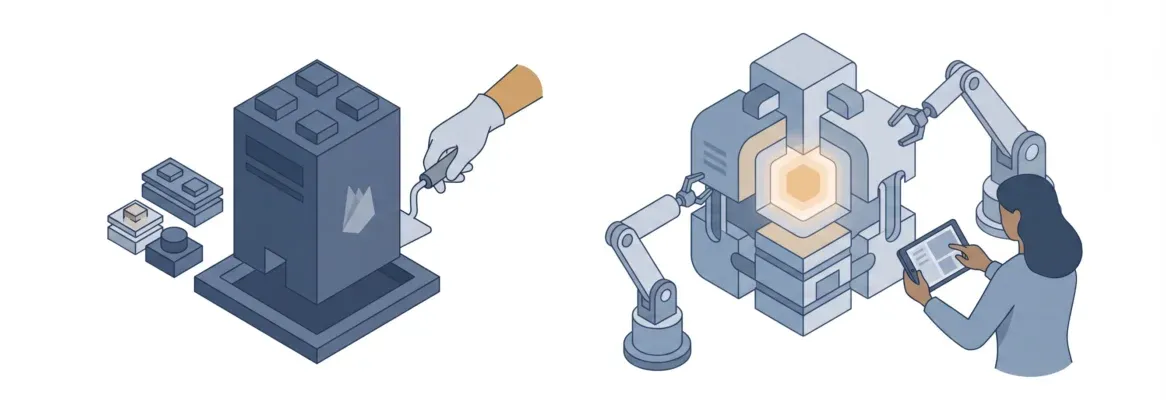
Wix builds websites. Rocket.new builds products. If your project needs user accounts, a database, or a mobile app, Wix hits a structural ceiling fast. Rocket.new generates the full stack from one prompt and gives you code you own.
Rocket.new vs Wix is the defining platform choice for builders in 2026. Wix now has three different products that claim to build apps: its AI editor Harmony, its developer platform Velo/Studio, and its $92M acquisition Base44. Yet none of them talk to each other. Meanwhile, a new category of AI-first builders promises to generate full-stack apps from a single prompt. Here is how to decide which model actually fits what you are building.
The Real Question: Page or Product?
Before comparing features, you need to answer one question: what are you actually building?
A website is a set of pages. Content, layout, maybe a contact form or a product catalog. The goal is presence. The output is something people read and browse.
A web application is a system. It has users who log in, stores and processes data, and runs business logic: booking systems that check availability, dashboards that pull from multiple sources, client portals that show different content to different users.
This distinction matters because website builders and app generation platforms were designed for fundamentally different outcomes. A tool optimized for pages will always hit a ceiling when you need a product. The question is not which platform has more AI features. It is the category of tool that was built for what you are trying to ship.
This is the framing the Website Builders vs Rocket.new 2026 post established: Camp 1 builds pages. Camp 2 builds products. The tool you pick should match the camp your project belongs to.
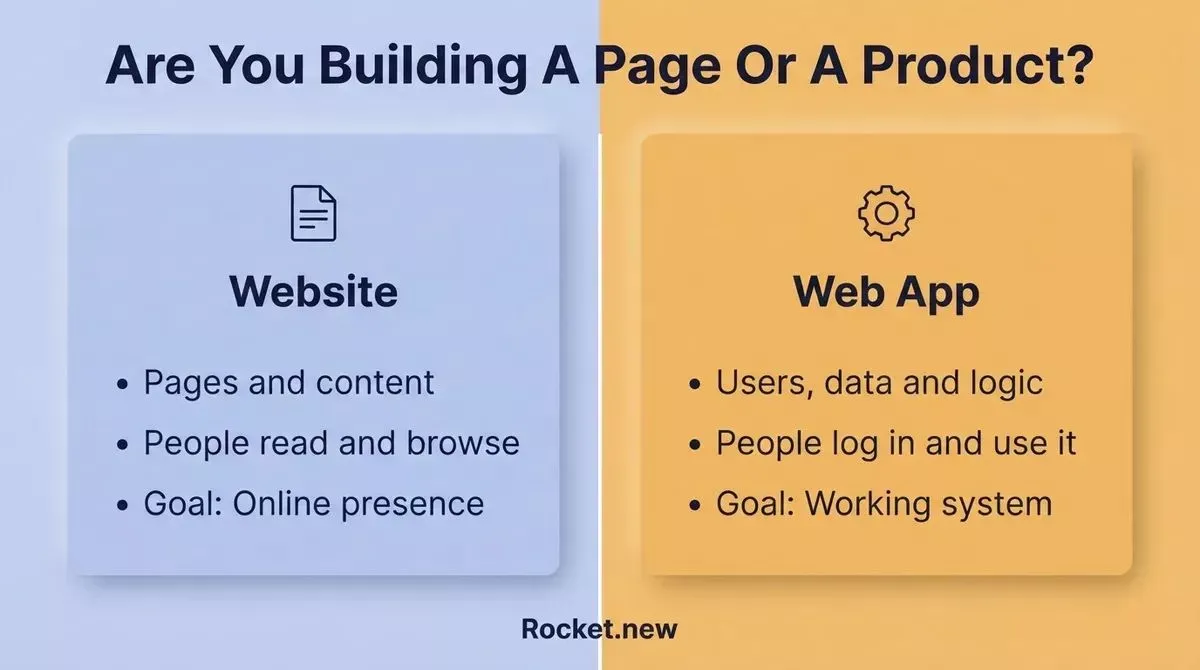 A website and a web application are not the same thing. The tool you pick should match what you are actually building.
Wix's App-Building Story in 2026 (It's More Complicated Than You Think)
How did the company behind 4.2% of all websites globally end up with three different products that all claim to build apps, yet none of them share a backend?
Wix started as a drag-and-drop website builder for small business owners who wanted a site online fast. Templates, layouts, a visual editor, hosting, and a custom domain, all bundled together. For landing pages, portfolios, and simple business websites, that model still works.
But the AI wave forced Wix to react quickly. The company responded by adding layers rather than rethinking the core:
- Wix Harmony (January 2026): An AI-powered website builder that uses an agent called Aria to generate sites from natural language prompts. Users switch between AI generation and manual drag-and-drop editing. It targets non-technical users who want a professional-looking site quickly.
- Velo/Studio: Wix's developer platform for agencies and technical users who require coding knowledge. It lets developers inject custom JavaScript, connect APIs, and write backend logic. Wix Studio was pitched as "a product for agencies" at launch.
- Base44 (acquired June 2025 for $92M): A standalone vibe-coding platform built by solo developer Maor Shlomo that generates full applications from text prompts, complete with databases, user authentication, and storage. It grew to 250,000 users in six months before Wix bought it.
The problem is structural. These three products were built at different times, by different teams, with different architectures. There is no shared data model, no single context layer, and no unified workflow across them.
If you are evaluating Wix for a real app, you are not choosing one product. You are choosing which fragmented layer to start with and hoping the others fill the gaps. That is a fundamentally different proposition from a platform built as a unified system from day one.
How Harmony, Velo, And Base44 Overlap Without Connecting
| Capability | Harmony | Velo/Studio | Base44 |
|---|---|---|---|
| AI site generation | Yes | No | Yes |
| Drag and drop editor | Yes | Yes | No |
| Backend custom code | No | Yes | Yes |
| Database management | No | Limited | Yes |
| User authentication | No | Partial | Yes |
| Mobile app output | No | No | Limited |
| Shared context across layers | No | No | No |
But if you need all three capabilities in one project, you end up managing three separate tools under one brand name. A small business owner starts with landing pages, then needs a booking system, then wants a client portal with user authentication. Each step pushes them into a different Wix product with a different learning curve.
Builders who have hit this ceiling with drag-and-drop builders consistently describe the same pattern: the tool that made starting easy becomes the tool that makes scaling impossible.
What Rocket.new Actually Generates (A Technical Look)
Rocket.new was built from day one as a full-stack app generation platform. Research, building, and competitive monitoring all live in one shared context with no separate products stitched together after the fact.
A typical Rocket.new build from a single prompt produces:
- Next.js frontend with server-side rendering, routing, and API routes, production-grade React, not a prototype
- Supabase backend with a generated database schema, row-level security, and authentication flows
- Stripe integration for payments, connected and configured in the same pass
- Deployment configuration for staging and production environments with version history and one-click rollback
Web apps ship in Next.js. Mobile apps ship in Flutter, generating native iOS and Android builds from a single codebase, ready for app stores. The framework is assigned automatically based on your project type.
This is a fundamentally different technical architecture from Wix. Wix runs on a custom runtime with npm restrictions, meaning third-party JavaScript packages that work everywhere else may not work inside Wix. Rocket.new generates standard Next.js, which runs on any Node.js infrastructure and has no package restrictions.
Before you write a single prompt, Rocket.new's Solve layer lets you run market validation, competitive analysis, and PRD generation. That research carries directly into the build with no handoff and no re-explaining. The competitive signals from Intelligence feed back into product decisions after launch. This is what research-grade intelligence for every team looks like in practice.
You can also build directly from a Figma file without any developer handoff, which is a capability Wix has no equivalent for.
When you need to iterate after the first build, Rocket's Advisor Agent reads your actual codebase to diagnose root causes and resolve error loops automatically. Surgical editing via the dependency graph means changes to one component do not break others, a problem that plagues every vibe-coding tool that edits files blindly.
See how Rocket.new handles your backend automatically - the backend architecture post walks through exactly what gets generated and why.
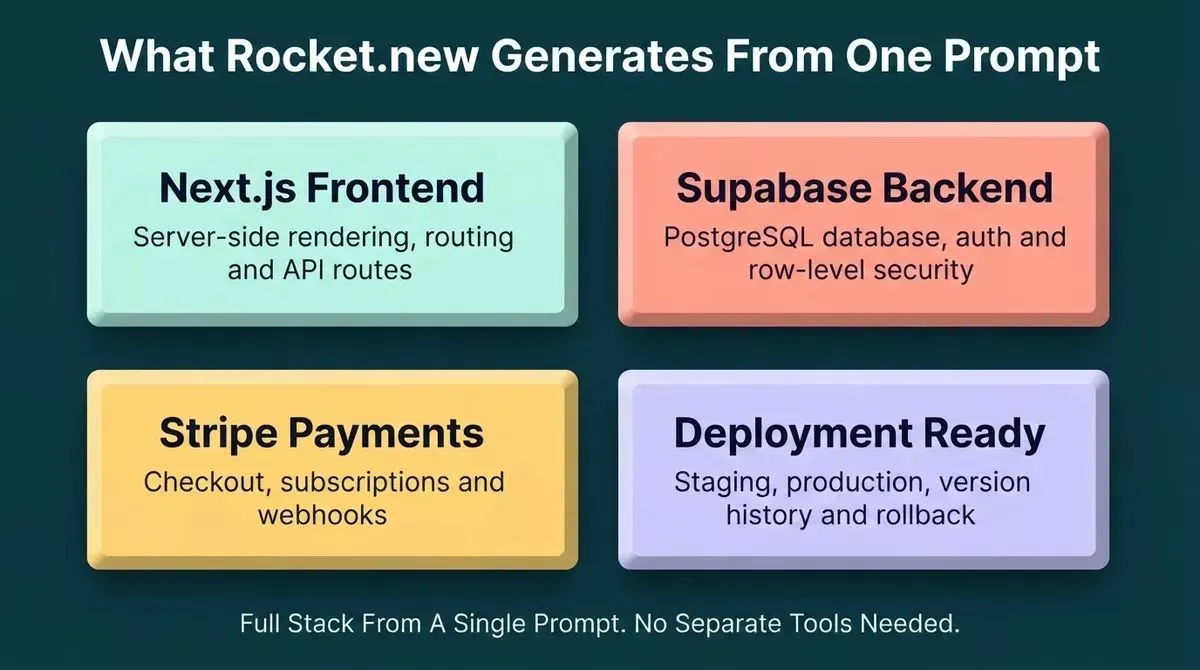 Four production-ready outputs from one prompt: Next.js frontend, Supabase backend, Stripe payments, and deployment configuration.
Feature-By-Feature Comparison
| Feature | Wix | Rocket.new |
|---|---|---|
| App generation from prompt | Harmony (sites only) or Base44 (separate product) | Full-stack: frontend, backend, DB, and auth in one pass |
| Backend and database | Velo (separate layer, requires code) | Supabase (PostgreSQL) included on all plans |
| Mobile apps | None (responsive web only) | Flutter iOS and Android, native builds |
| AI models in-app | Not available | OpenAI, Anthropic, Gemini via connector |
| Design flexibility | 800+ templates, pixel-level drag and drop | AI-generated, production-quality UI from prompt |
| Code ownership | No export, closed ecosystem | Full source download and GitHub sync |
| Integrations | 500-1,000 marketplace apps | 26+ native connectors (Stripe, Supabase, Mailchimp, etc.) |
| Deployment | Wix-hosted only | Staging and production, custom domain, one-click rollback |
| Pre-build research | None | Solve: market validation, PRD, competitor analysis |
| Post-launch intelligence | None | 9-pillar competitive monitoring |
| Collaboration | Per-seat pricing on some tiers | Unlimited team members, no per-seat fees |
| CMS item limits | 1,500 to 20,000 rows depending on plan | PostgreSQL, no artificial row caps |
| Tech stack | Custom Wix runtime, npm restrictions | Next.js (React), production-grade, no restrictions |
| Iteration intelligence | None | Advisor Agent resolves error loops from codebase |
This table tells the structural story: Wix is a website platform with app-building bolted on. Rocket.new is an app generation platform with a website as one of its outputs.
For a hands-on proof of build quality across AI builders, the Lovable vs Bolt vs v0 vs Rocket.new same-app comparison shows exactly what each platform ships when given the same prompt.
For a deeper look at how Rocket.new handles internal tools and admin panels, the use cases go well beyond what any website builder can support.
The Database Ceiling Problem
This is the most important technical argument for anyone building a data-intensive application.
Wix's CMS has hard item limits by plan tier:
| Plan | Monthly Cost | CMS Item Limit |
|---|---|---|
| Free | $0 | 1,500 items |
| Core | $29/mo | 4,000 items |
| Business | $39/mo | 20,000 items |
| Business Elite | $159/mo | 10,000,000 items |
If you are building a marketplace, a booking platform, or any app where users generate data, you will hit these limits. The "real app builder" price point on Wix is $159 per month, and that is before you factor in the separate cost of Base44 if you need actual app generation.
Rocket.new uses Supabase (PostgreSQL) as its database layer. PostgreSQL is a production-grade relational database with no artificial row caps. The same database that powers your 100-user MVP scales to your 100,000-user product without a plan upgrade or a migration.
Wix's CMS was designed for content: blog posts, product listings, portfolio items. It was not designed for relational data with foreign keys, complex queries, and multi-tenant access control. Supabase was.
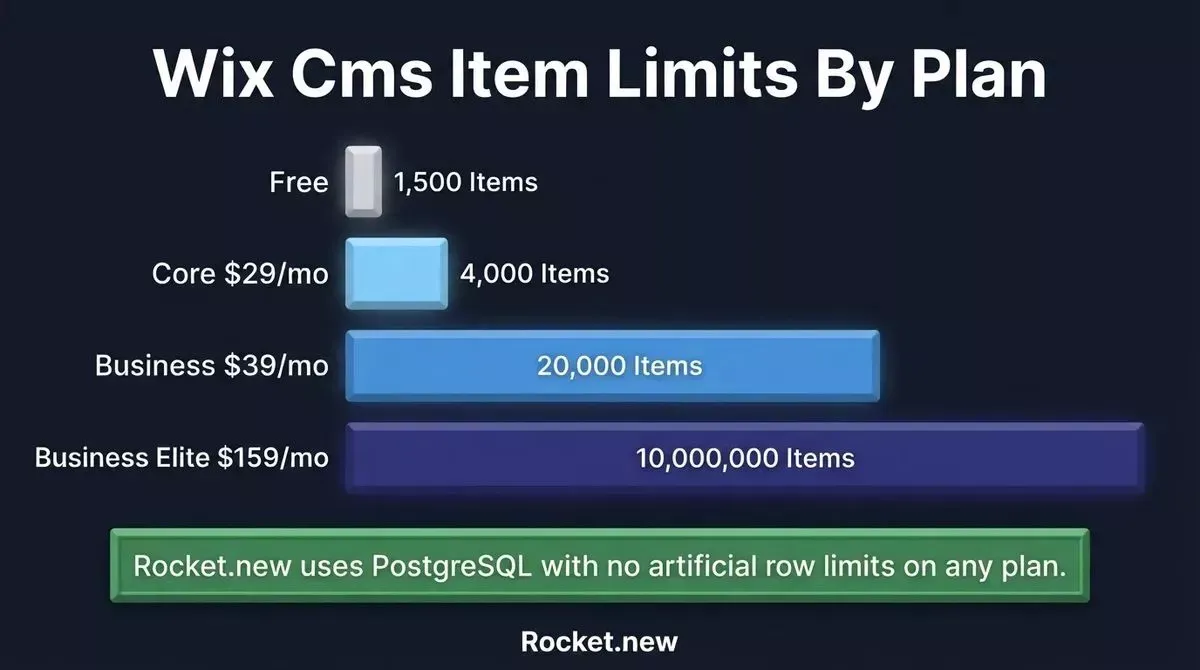
Wix CMS item caps by plan tier. Rocket.new uses PostgreSQL with no artificial row limits on any plan.
See how Rocket.new handles your backend automatically - the backend architecture post walks through exactly what gets generated and why.
Pricing: What You Actually Pay To Build An App
The pricing models reflect the fundamental difference between these two categories of tools.
Wix pricing:
- Light: $17/month (no e-commerce)
- Core: $29/month (4,000 CMS items)
- Business: $39/month (20,000 CMS items)
- Business Elite: $159/month (10M CMS items, real app tier)
- Base44 (Wix's actual app builder): from $16/month additional
Rocket.new pricing:
- Free: 20 credits to start
- Build: $25/month (100 credits, unlimited team members)
- Launch: $250/month (adds Solve research)
- Scale: $350/month (adds Intelligence monitoring)
- Credits never expire. No per-seat fees.
| Factor | Wix | Rocket.new |
|---|---|---|
| Starting price | $17/month (Light) | $25/month (Build) |
| Real app builder tier | $159/month (Elite) plus Base44 | $25/month, backend included on all plans |
| Free plan | Yes, with ads and Wix branding | Yes, 20 credits |
| Mobile app support | None | Flutter native apps included |
| Backend and databases | Not included below Elite | Included on all plans |
| Per-seat cost | Some tiers charge extra | No per-seat fees |
| Code export | No export, locked | Full export on paid plans |
| Team of 3, 50K+ DB records | $159/month minimum plus Base44 | $25/month |
The hidden cost with Wix is the stack of third-party services you need once your project outgrows the website builder. Each external service adds its own pricing, its own login, and its own learning curve. With Rocket.new, the cost is the platform fee plus credits for generation. Backend, database, hosting, and deployment are all included in that price.
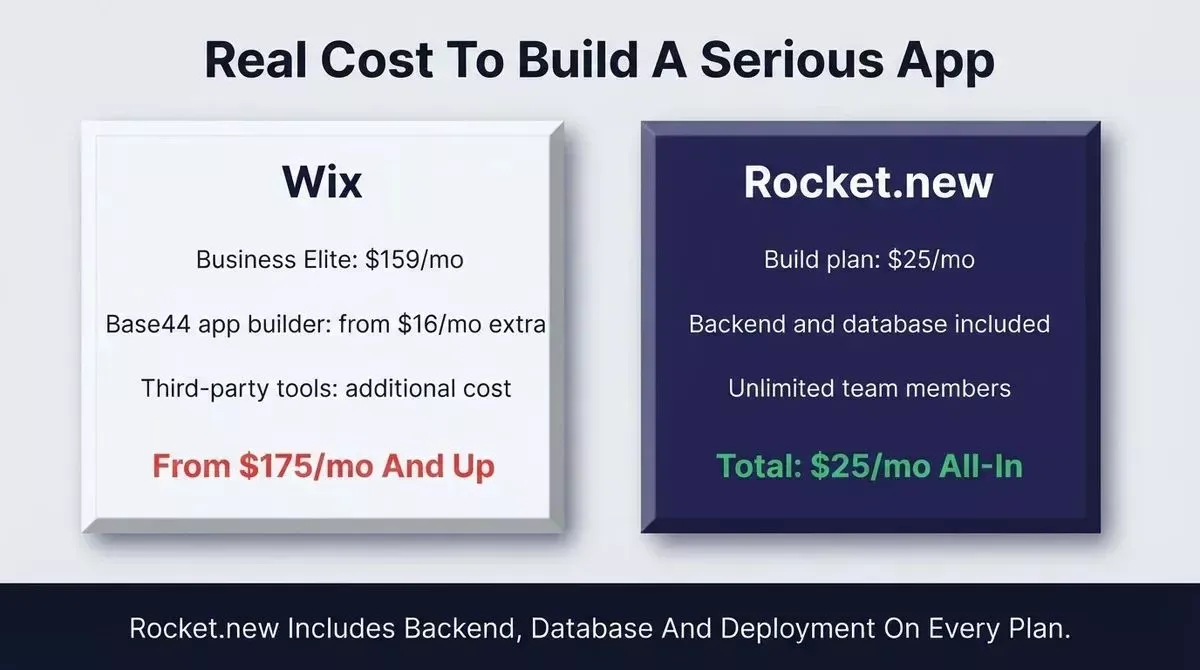
Wix's serious app tier starts at $159/month before Base44. Rocket.new includes backend, database, and unlimited team members from $25/month.
Where Wix Still Wins (And When You Should Choose It)
Wix is not going anywhere. It powers millions of websites, has over 260 million users, and generates $1.76 billion in annual revenue. For its core use case, it still delivers exceptionally well.
Where Wix is genuinely the better choice:
- Design precision: 800+ templates, pixel-level drag-and-drop, Harmony's AI plus manual fine-tuning. If visual design control matters more than backend capability, Wix is hard to beat.
- Built-in business operations: Booking, CRM, email marketing, e-commerce, events, and blog, all native and wired together. Wix runs businesses. Rocket.new builds apps.
- App marketplace ecosystem: 500-1,000 marketplace apps covering every common business need. The ecosystem is mature and well-integrated.
- SEO tooling maturity: Structured data, bulk 301 redirects, sitemap control, and Google Business Profile integration, battle-tested at scale with 15+ years of refinement.
- Hosting track record: 99.99% uptime, 258M+ users, a trust layer built over more than a decade. Rocket.new is a 2026 platform with a growing but small footprint.
- Content-focused websites: For portfolios, blogs, restaurant sites, and marketing pages, Wix is the more natural fit. Rocket.new is overengineered for these use cases.
If you are building a content site, Wix might genuinely be your best option. But if you are building a product, start building with Rocket.new for free and see the difference in the first build.
For small business owners specifically, the website builder for small business comparison covers the Wix vs Rocket.new decision in the context of SMB use cases, including booking, CRM, and e-commerce.
The Lock-In Question
This is a long-term strategic decision that most builders underweight at the start.
Wix: No code export. Your application lives on Wix's infrastructure, runs on Wix's runtime, and cannot be moved. If Wix changes its pricing, discontinues a feature, or gets acquired, you have no exit path. This is an architectural philosophy, not an oversight.
Rocket.new: Full source code download on paid plans. GitHub sync is built in. The code Rocket.new generates is standard Next.js and Flutter, maintainable by any developer, and deployable to any infrastructure. You own what you build.
For a marketing site, lock-in is a minor concern. For a product that represents your business, your customer data, and your competitive differentiation, it is a fundamental risk. The question to ask before you start: "If I needed to move this in two years, could I?"
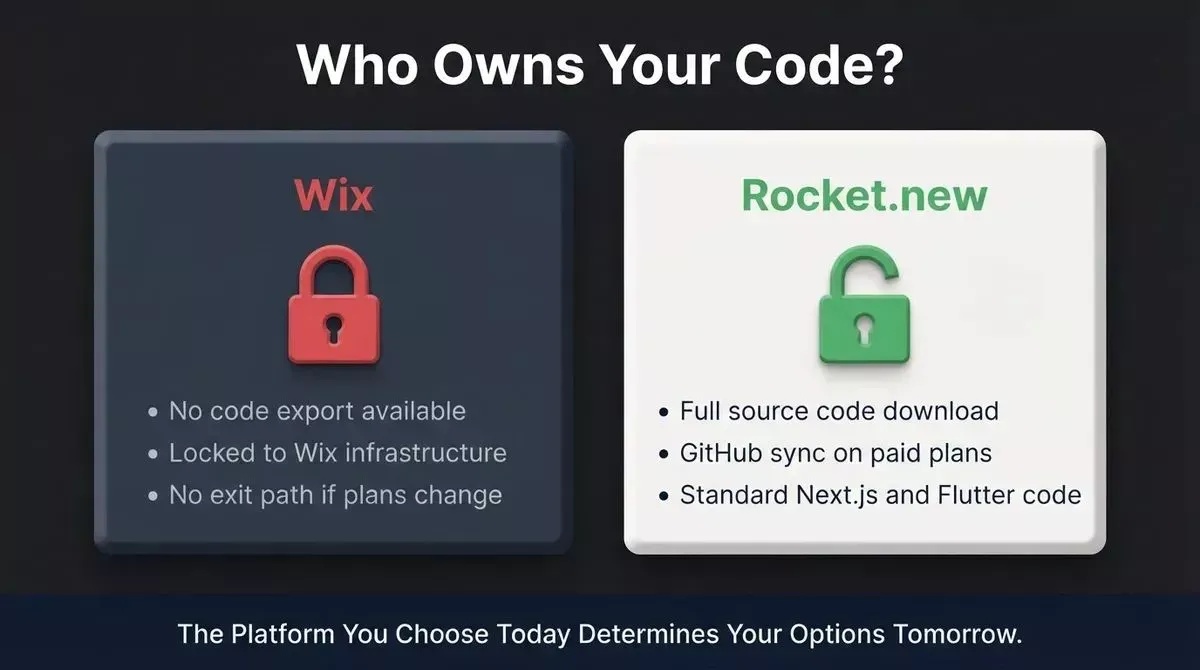
Wix locks your code to its infrastructure with no export path. Rocket.new gives you full source download and GitHub sync on paid plans.
Who Should Choose Which (Decision Matrix)
| If you are building... | Choose |
|---|---|
| Portfolio, blog, or marketing site | Wix |
| Restaurant website with booking | Wix |
| SaaS MVP with user accounts and data | Rocket.new |
| Marketplace with buyer and seller roles | Rocket.new |
| Client portal with custom dashboards | Rocket.new |
| Internal tool for your team | Rocket.new |
| E-commerce store (basic catalog) | Wix |
| E-commerce with custom logic and inventory | Rocket.new |
| Mobile app (iOS and Android) | Rocket.new |
| Content site with email marketing | Wix |
| B2B SaaS product | Rocket.new |
| Small business website (no backend) | Wix |
The pattern is consistent: Wix for presence, Rocket.new for function.
For founders specifically, the Rocket.new vs Base44 comparison is worth reading, since Base44 is now Wix's own app-building acquisition and the most direct head-to-head. If you are still deciding whether Rocket.new is the right fit for your specific use case, the who should choose Rocket.new guide maps the decision by role and project type.
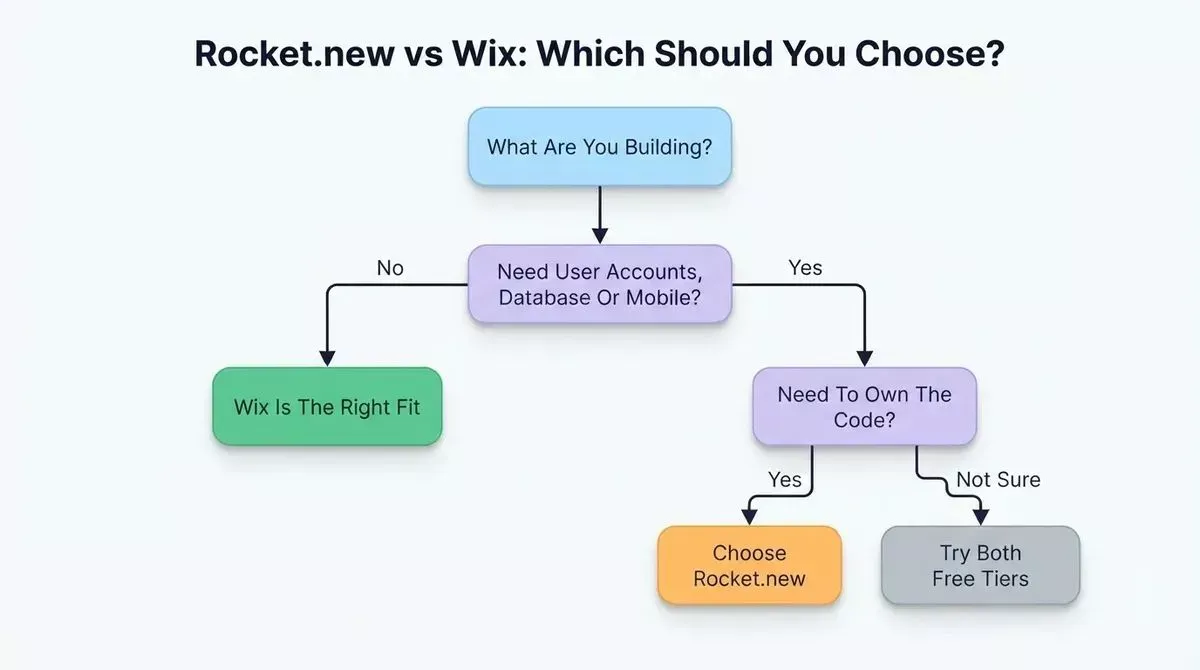
Use this decision tree before you start building. The database and code ownership questions resolve the choice faster than any feature list.
Wix builds websites. Rocket.new builds products.
Both do their job well. Wix is the right choice for content sites, business operations platforms, and non-technical teams who need booking, CRM, and e-commerce out of the box. Its design tooling, template library, and app marketplace are genuinely strong.
Rocket.new is the right choice for web applications, mobile apps, and teams who want to own their code. The database architecture scales without artificial limits. The full-stack generation removes the biggest bottleneck between an idea and a working app. And the research-to-build-to-intelligence loop means the context you build up in Rocket.new compounds over time rather than getting lost between tools.
If your next project involves real functionality, not just content, the tool you pick should match that ambition from day one.
If you are building something with real backend logic, user accounts, and mobile access, start building with Rocket.new, free, no credit card required. Describe your idea and ship a production-ready app with no templates, no code, and no separate tools to manage.
Table of contents
- -The Real Question: Page or Product?
- -Wix's App-Building Story in 2026 (It's More Complicated Than You Think)
- -How Harmony, Velo, And Base44 Overlap Without Connecting
- -What Rocket.new Actually Generates (A Technical Look)
- -Feature-By-Feature Comparison
- -The Database Ceiling Problem
- -Pricing: What You Actually Pay To Build An App
- -Where Wix Still Wins (And When You Should Choose It)
- -The Lock-In Question
- -Who Should Choose Which (Decision Matrix)
- -Wix builds websites. Rocket.new builds products.