
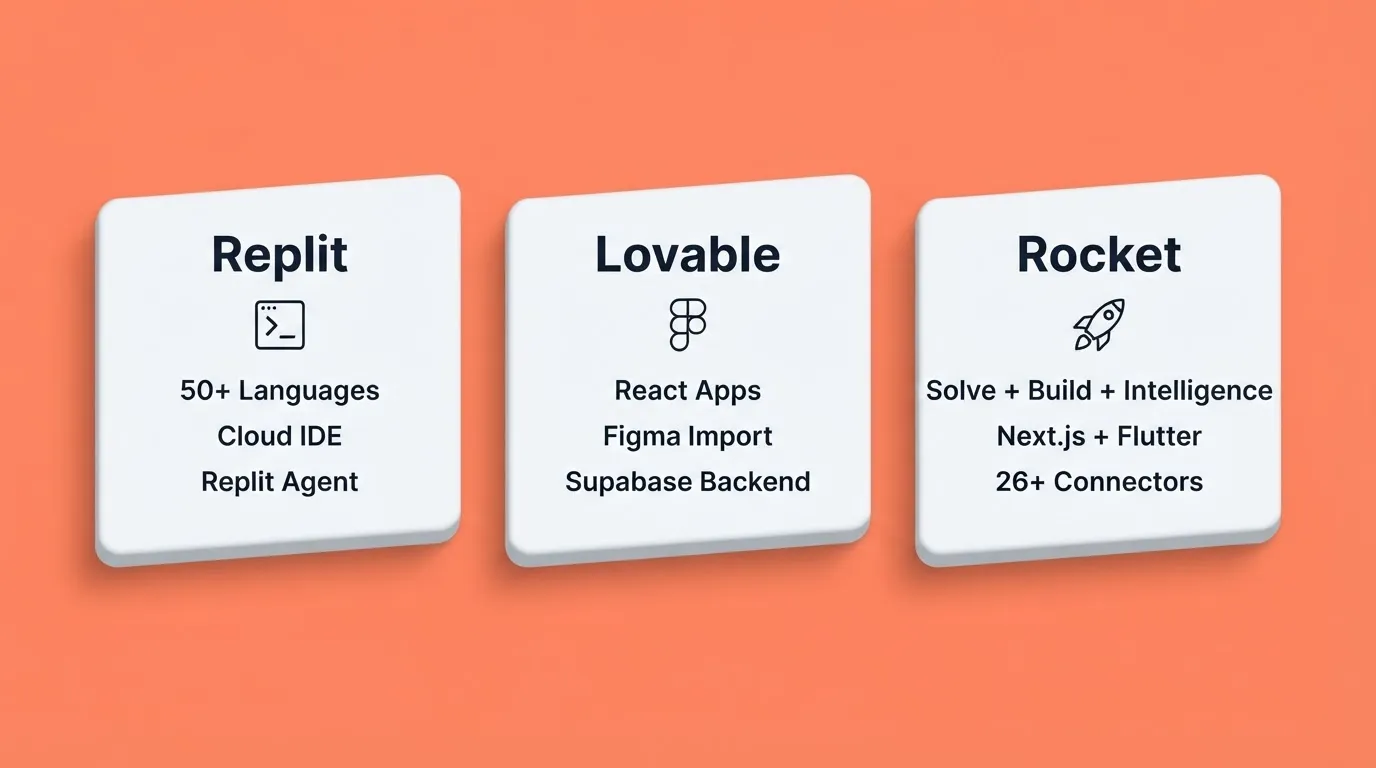
Replit gives developers coding control across 50+ languages. Lovable turns prompts and Figma files into polished React UIs. Rocket combines market research, AI app building, and competitor monitoring in one platform with a shared credit balance.
Which platform fits your workflow: Replit, Lovable, or Rocket.new?
This blog compares all three on AI capabilities, tech stack, pricing, deployment, and real use cases. Whether you are a developer who wants hands-on control, a product team chasing a fast UI, or a founder who needs to research, build, and monitor competitors without switching tools, the answer is here.
What Each Platform Is
Replit is a cloud-based IDE and AI coding assistant. It lets developers write, run, and deploy code in a browser across 50+ programming languages. Its Replit Agent generates and edits code from natural-language prompts inside a full development environment.
Lovable is an AI-powered app builder focused on UI and front-end generation. It produces React applications from prompts or Figma imports and includes a built-in Supabase backend. It targets non-developers and product teams who want polished interfaces quickly.
Rocket is a vibe solutioning platform that combines strategic research, AI app building, and competitive intelligence into a single product. Validate your idea, build the product, and track your competitors without switching tools. 1.5 million people have tried Rocket across 180 countries.
Why This Comparison Matters in 2026
Not all AI app builders are created equal. Picking the wrong platform can slow you down, create extra work, or limit your project's potential. Some tools are code-heavy, others focus on UI and design, and a few combine AI-powered automation with fast deployment.
With 92% of developers now using AI tools for coding or app development, knowing which platform fits your workflow matters more than ever. The right platform saves hours of setup, simplifies collaboration, and lets you focus on building, testing, and launching apps.
The three platforms in this comparison represent three distinct philosophies. Replit bets on developer control. Lovable bets on design speed. Rocket bets on the full journey, from idea validation to shipped product to market awareness.
Feature Comparison: Replit vs Lovable vs Rocket.new
| Feature | Rocket | Replit | Lovable |
|---|---|---|---|
| Primary use case | Research + Build + Intelligence | Cloud IDE + AI coding | AI UI/app builder |
| Web app output | Next.js (React/TypeScript) | Any language/framework | React |
| Mobile app output | Flutter (iOS + Android) | Limited | Limited |
| Built-in backend | Supabase (Postgres, auth, storage, edge functions) | Bring your own | Supabase |
| Connectors | 26+ (Stripe, OpenAI, Notion, GitHub, Supabase, etc.) | Broad via code | Limited |
| Figma import | Yes, pixel-accurate to Next.js or Flutter | No | Yes |
| Start from GitHub repo | Yes | Yes | Limited |
| Start from URL (Redesign) | Yes | No | No |
| GitHub integration | Two-way sync (Next.js/TypeScript projects) | Yes | Limited |
| Code export | Yes, full source + GitHub sync | Yes | Yes |
| One-click deployment | Yes (Netlify, custom domain) | Yes | Yes |
| Templates | 25,000+ | Limited | Limited |
| Competitor monitoring | Yes (9 pillars, 50,000+ companies) | No | No |
| Market research reports | Yes (Solve: PDF/PPT/HTML/PRD export) | No | No |
| Advisor Agent | Yes (Claude Opus, read-only, invoked after 2+ failed attempts) | No | No |
| Team collaboration | Yes (unlimited members on all paid plans) | Limited | Yes |
Getting to Know the Contenders
Rocket
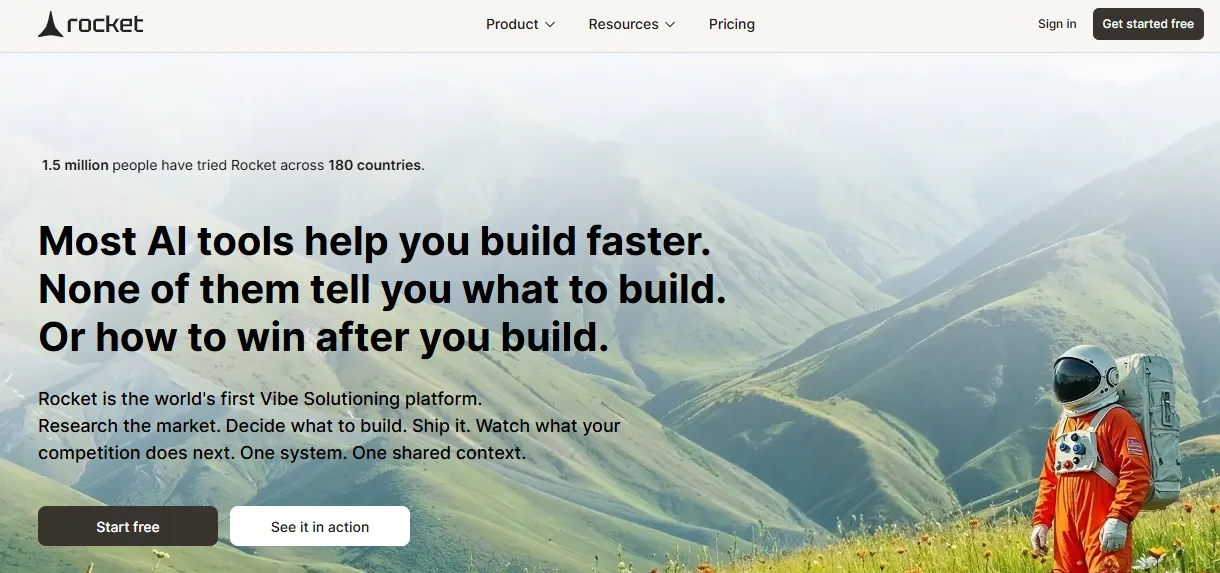 Rocket is a vibe solutioning platform that combines three distinct capabilities under one credit balance. It is built for founders and teams who need to research a market, build a production app, and monitor competitors without switching tools.
**Solve is Rocket's research engine.** It has two modes: Light Solve for fast, conversational research (available on all plans) and Full Solve for deeper, consultant-grade analysis. Full Solve is available on Rocket and Booster plans and is auto-routed with no manual selector. It uses prompt intelligence to clarify ambiguous questions before research begins. It then decomposes the query into parallel research streams and delivers a structured report. The report includes an executive summary, supporting evidence, and actionable recommendations. Full Solve typically takes about 45 minutes. Reports export as PDF, PPT, HTML, or PRD.
**Build generates production-ready apps** from a single prompt, a Figma file, a GitHub repo, an uploaded document, or a URL you want to redesign. Web apps are built in Next.js (React/TypeScript) and mobile apps in Flutter. The platform connects to 26+ services from a single chat prompt. These include Stripe, Supabase, OpenAI, Anthropic, Notion, Linear, HubSpot, Resend, Mixpanel, and Netlify.
A built-in Advisor Agent acts as a senior architect sub-agent. It runs on Claude Opus in read-only mode. The Advisor is invoked when the coding agent fails to fix a bug after two or more attempts. Rather than repeating the same failed approach, it identifies root causes and returns structured analysis. It also provides numbered implementation steps, trade-off tables, and handles architectural decisions and large-scale refactoring.
**Intelligence monitors competitors** across nine signal pillars: website, social media, news, GTM, product and technology, people and hiring, business and finance, reviews and community, and traffic. It surfaces personalized Intel cards in ranked feeds. It detects not just what changed, but what the change means for your business. The Discover tab lets you browse and follow over 50,000 companies. Intelligence is currently in Beta.
Key features at a glance:
- Prompt to app from plain language, Figma, GitHub, URL redesign, or file uploads
- Supabase backend (Postgres, auth, storage, edge functions) scaffolded from chat
- 26+ connectors across payments, AI models, email, analytics, CRM, and databases
- 25,000+ remixable templates (browsing costs zero credits)
- Two-way GitHub sync for Next.js/TypeScript projects
- Custom domain with automatic HTTPS, built-in SEO, WCAG accessibility, and GDPR compliance
- Solve research reports (PDF, PPT, HTML, PRD) for market and competitive analysis
- Intelligence competitor monitoring across 9 pillars and 50,000+ companies (Beta)
Best for: Founders and teams who need to research, build, and monitor competitors from a single platform.
Replit
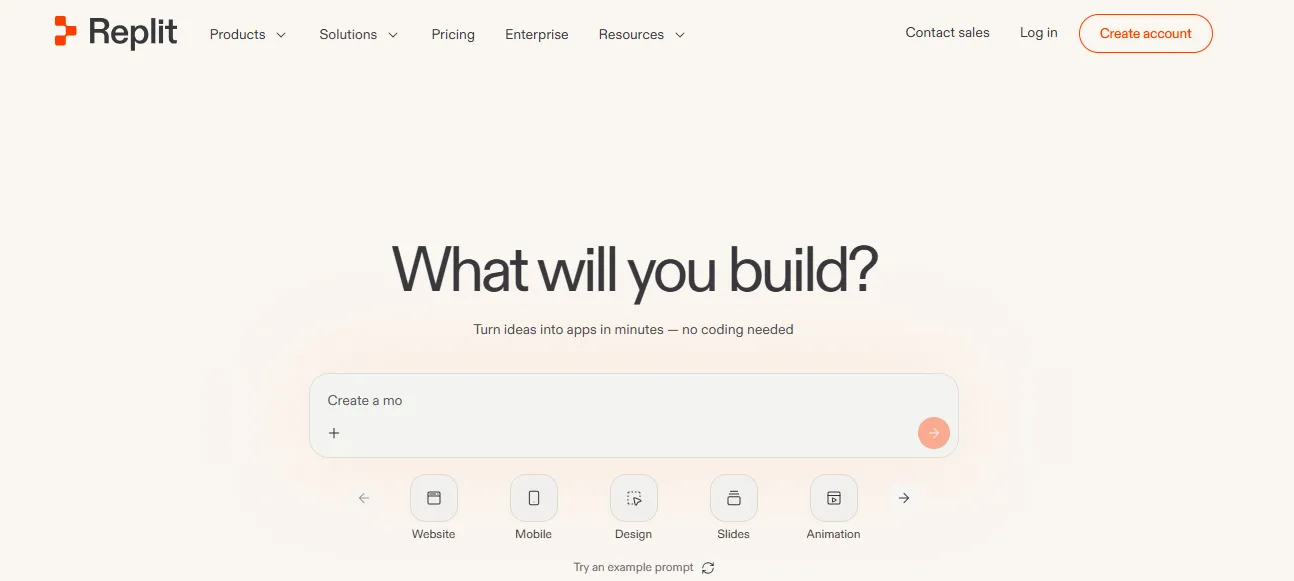 Replit is a cloud-based code editor and AI app builder. It supports 50+ programming languages and lets developers write, run, and deploy code from a browser without local setup. Replit Agent generates and edits code from natural-language prompts inside a full development environment. This makes it a strong choice for developers who want hands-on coding control.
Key features:
- Multi-language support (Python, JavaScript, TypeScript, Go, Rust, and more)
- GitHub integration and version control
- Full development environment in the browser
- One-click deployment
- Replit Agent for AI-assisted code generation
Best for: Developers who want full coding control, multi-language flexibility, and a browser-based IDE without local setup.
Lovable
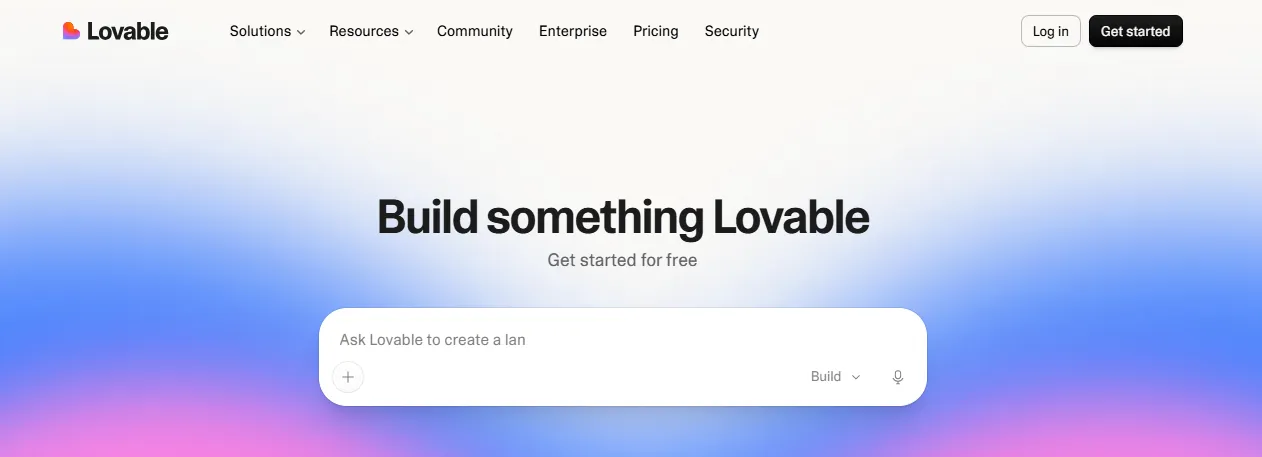 Lovable is an AI-powered app builder that focuses on UI experience and front-end generation. It produces React applications from prompts or Figma imports and includes a built-in Supabase backend. Its clean interface and collaborative features make it popular with product teams and non-developers who prioritize polished interfaces.
Key features:
- React app generation from prompts or Figma
- Built-in Supabase backend
- Collaborative features for teams
- Figma import support
- Responsive design output
Best for: Teams and non-developers who prioritize beautiful, responsive interfaces and want a straightforward path from design to deployed app.
Who Each Platform Is For
Understanding which platform fits your profile saves time and avoids costly rebuilds later.
Choose Replit if you are:
- A developer who wants to code in Python, Go, Rust, or any language beyond Next.js and Flutter
- Someone who wants a traditional browser-based IDE with AI assistance layered on top
- A learner or hobbyist who wants to experiment across many languages
Choose Lovable if you are:
- A designer or product manager who wants to go from Figma to a live React app quickly
- A non-developer who needs a polished, responsive front-end without touching code
- A team that already uses Supabase and wants smooth integration
Choose Rocket if you are:
- A founder who needs to validate an idea, build the product, and track competitors without three separate tools
- A product team that needs consultant-grade market research before committing to a build
- A startup shipping a production Next.js web app or Flutter mobile app fast
How Each Platform Handles the Build Workflow
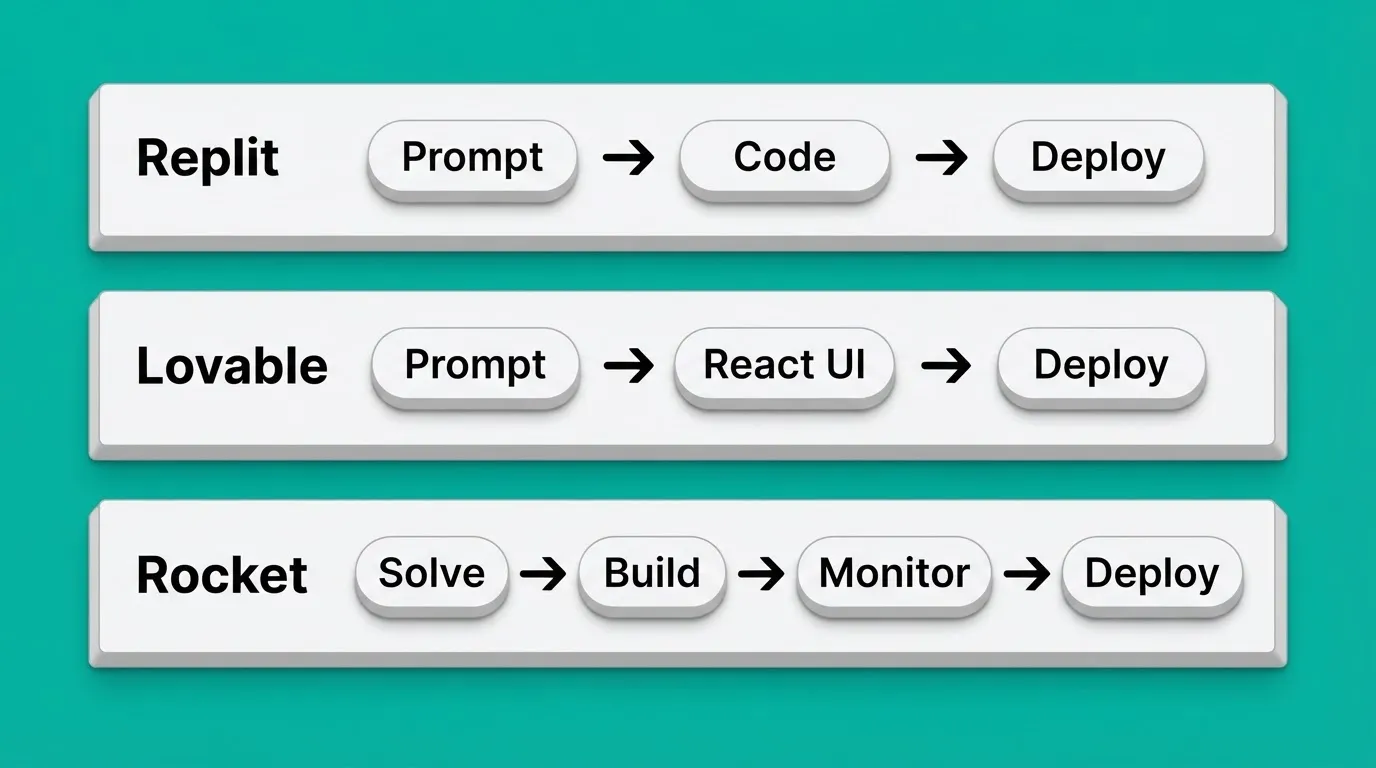
Each platform takes a different path from idea to deployed app.
Pricing Comparison
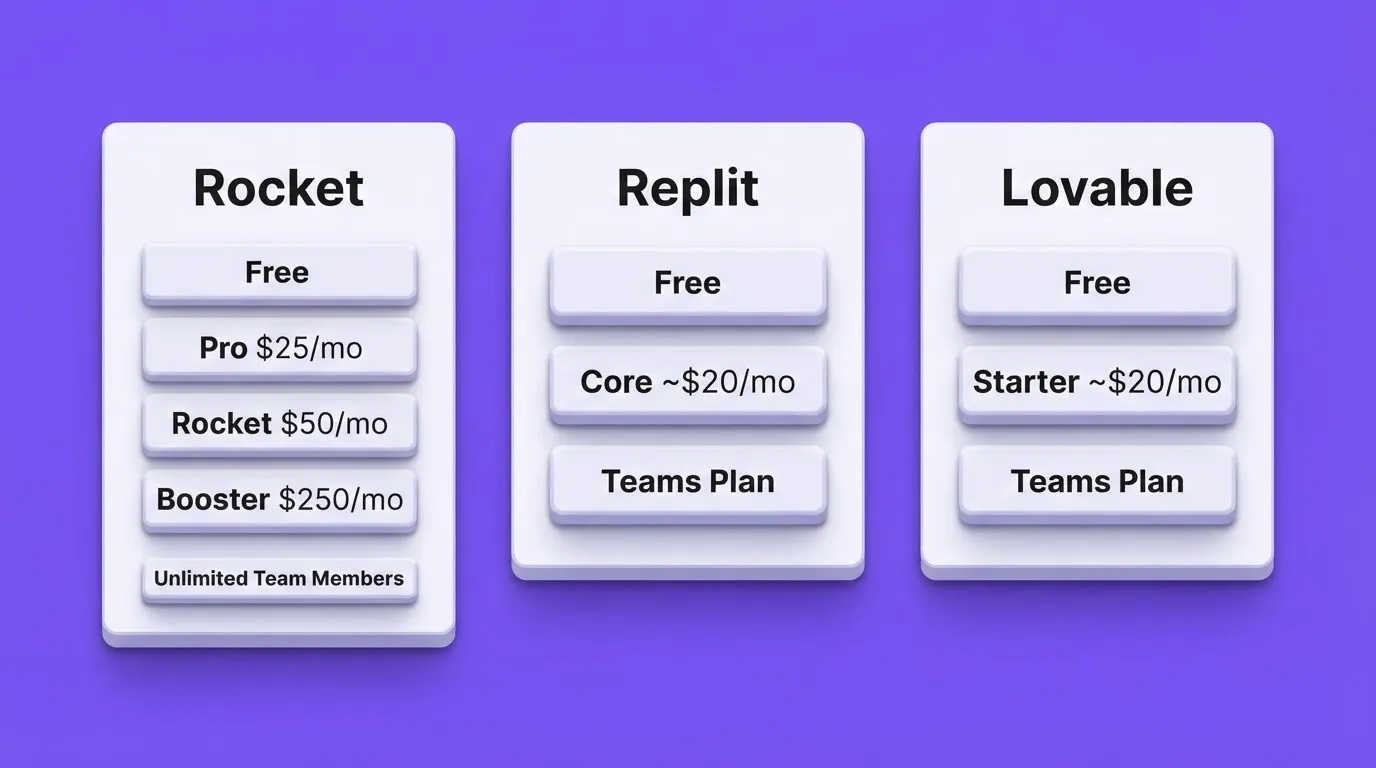
| Plan | Rocket | Replit | Lovable |
|---|---|---|---|
| Free | 20 credits (one-time), Build + Light Solve | Free tier available | Free tier available |
| Entry paid | Pro: $25/mo, 100 credits/mo, Build + Light Solve | ~$20/mo | ~$20/mo |
| Mid tier | Rocket: $50/mo, 250 credits/mo, Build + Full Solve (auto-routed) + Intelligence | Higher tiers available | Higher tiers available |
| Power tier | Booster: $250/mo, 1,500 credits/mo, full suite + premium support | Team/enterprise plans | Team/enterprise plans |
| Team members | Unlimited on all paid plans | Varies | Varies |
| Credit model | One balance covers Build, Solve, and Intelligence | Token/cycle-based | Credit-based |
| Annual discount | 20% off | Varies | Varies |
Rocket's credit model is a genuine differentiator. A single balance powers all three pillars. So you are not paying separately for a research tool, a builder, and a monitoring dashboard. The Pro plan does not include Full Solve or Intelligence. Those require the Rocket plan ($50/mo) or above.
Use Case Walkthrough: Building an Internal Admin Tool
To make the comparison concrete, here is how each platform handles a common task. The task is building an internal admin dashboard connected to a database.
With Replit: You open a new Repl and choose your stack, such as Node.js and React. Then you write or prompt the code. Replit Agent can scaffold components, but you manage database setup, auth, and deployment configuration manually or through code.
With Lovable: You describe the dashboard in a prompt. Lovable generates a React UI and connects it to Supabase for data storage and auth. The interface is polished out of the box, but you have less control over the underlying code structure.
With Rocket: You describe the dashboard in a prompt or import a Figma design. Rocket generates a Next.js app and scaffolds a complete Supabase backend from the same chat. It also connects any of 26+ services you need. The Advisor Agent handles architectural decisions if the build hits a complexity wall. It reads the project structure, identifies root causes rather than symptoms, and returns a structured fix plan. You can sync the full source to GitHub, export the code, or deploy to Netlify with one click.
Rocket also integrates with Supabase at a deeper level than most builders. This gives you row-level security, edge functions, and storage buckets, all configured from a single chat session. Teams building internal tools or full-stack apps consistently report faster time-to-deploy compared to traditional setups.
Solve vs Intelligence: Understanding Rocket's Research Layer
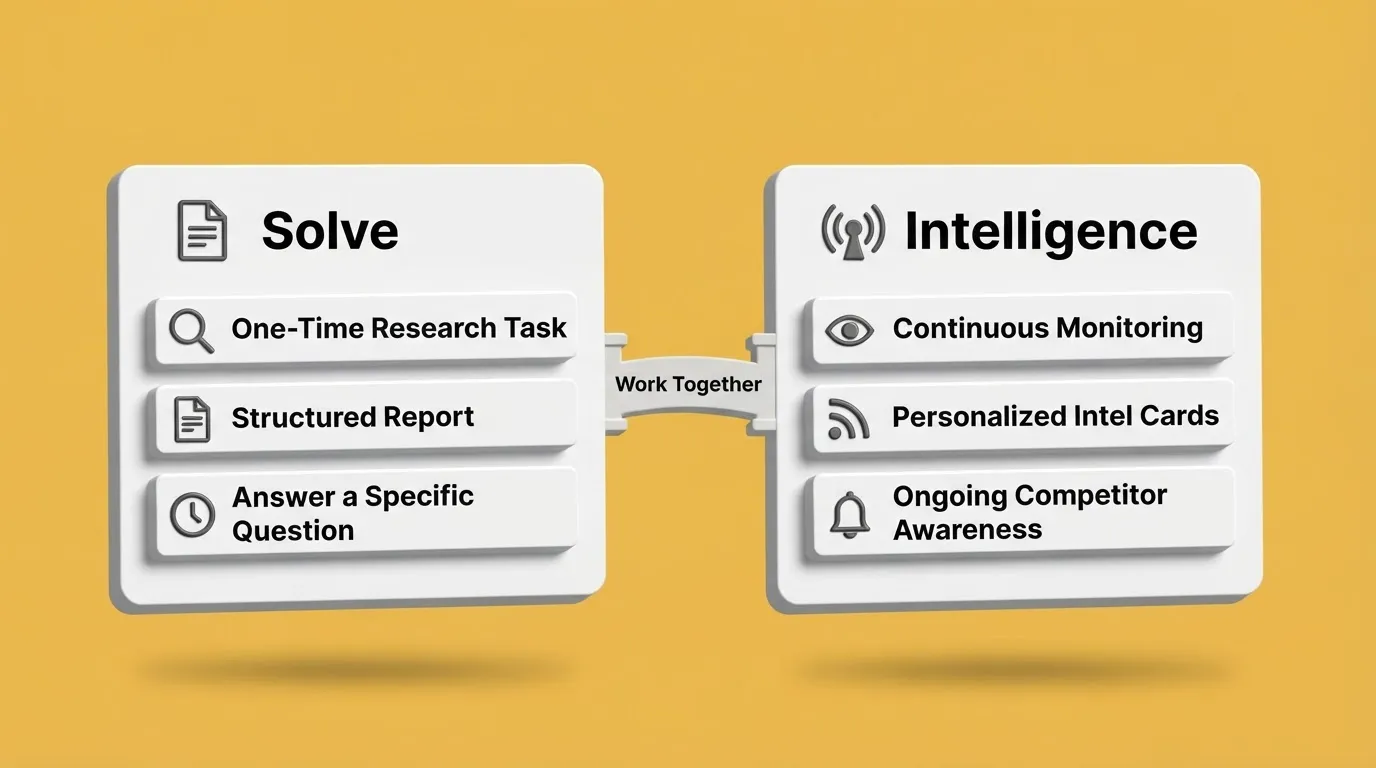
One of Rocket's most distinctive advantages is having two complementary research capabilities. Neither Replit nor Lovable offers anything similar.
| Solve | Intelligence | |
|---|---|---|
| When to use | You have a specific question right now | You want ongoing awareness of changes |
| How it works | One-time research task, structured report | Continuous monitoring, live dashboard |
| Output | Executive summary, analysis, evidence, recommendations | Ranked Intel cards, personalized feeds |
| Example | "What is Stripe's current pricing model?" | "Alert me when a competitor changes their pricing page" |
| Plans | Light Solve: all plans. Full Solve: Rocket + Booster | Rocket + Booster (Beta) |
Use Solve before you build to validate your idea and scope the market. Then use Intelligence after you launch to stay ahead of competitor moves. The two feed into each other. An Intelligence signal can trigger a new Solve question, and a Solve report can define what you monitor.
Where Each Platform Falls Short
Replit is not ideal if you need a no-code or low-code experience. It also falls short if you want AI to handle the full stack automatically, need built-in competitor monitoring or market research, or want Flutter mobile apps.
Lovable is not ideal if you need multi-language support. It also has limits if you want deep control over the generated code architecture, need a Flutter mobile app, require built-in market research and competitive intelligence, or want to start from a GitHub repo or URL.
Rocket is not ideal if you need to write in a specific language outside Next.js or Flutter. It also may not suit you if you want a traditional IDE experience with manual code editing as the primary workflow. In addition, it may not fit highly specialized builds that require a custom tech stack the platform does not generate. Note that Intelligence is currently in Beta. Full Solve is only available on the Rocket plan ($50/mo) and above.
How to Get Started on Each Platform
Getting started with Replit:
- Go to replit.com and create an account
- Click "Create Repl" and choose a language or template
- Describe what you want to build in the Replit Agent chat
- Review and iterate on the generated code
- Click "Deploy" to publish your app
Getting started with Lovable:
- Sign up at lovable.dev
- Start a new project and describe your app in the prompt
- Optionally import a Figma design for pixel-accurate output
- Connect Supabase for backend functionality
- Deploy with one click
Getting started with Rocket:
- Sign up at rocket.new, no credit card required, 20 credits included
- Optionally run a Solve task first to validate your idea and size the market
- Start a Build task from a prompt, Figma file, GitHub repo, URL, or document
- Connect services such as Stripe, Supabase, and OpenAI from the chat interface
- Deploy to Netlify with a custom domain, or export the full source to GitHub
- Set up Intelligence to monitor competitors automatically (Rocket plan and above)
Community Insight
On Reddit, one person shared their experience trying out Rocket for building apps:
"Rocket is surprisingly smooth for creating internal tools. The AI agent setup saves me hours of boilerplate work and the vibe coding interface is pretty addictive."
Developers comparing Replit vs lovable vs rocket.new for production projects frequently highlight Rocket's all-in-one deployment experience as the deciding factor. The combination of research, build, and intelligence in a single credit balance removes the coordination overhead that slows most teams down.
Final Verdict: Which Platform Should You Choose?
The comparison between Replit vs Lovable vs Rocket.new comes down to what you need beyond a code generator.
Replit gives you the most coding flexibility and the widest language support. It is the right choice if you are a developer who wants a browser-based IDE. It works best when you do not need the platform to handle research or architecture for you.
Lovable gives you the fastest path to a polished React UI. It is the right choice if design quality and speed from Figma to deployed app is your top priority.
Rocket gives you a research layer, a production app builder, and a competitor monitoring dashboard, all sharing one credit balance. It is the right choice if you are a founder or product team that needs to validate before building, ship production-grade apps in Next.js or Flutter, and stay ahead of market moves after launch.
The Right Tool Starts With the Right Question
The Replit vs Lovable vs Rocket.new decision is not just about features. It is about where you are in the build journey. As AI platforms mature, the gap between tools that only generate code and platforms that cover the full arc will widen. That arc runs from research to deployment to market intelligence.
Rocket is built for that full arc. You type the problem, Rocket researches it, builds from it, and keeps you ahead of what comes next. Start with what you want to figure out. Sign up at Rocket.new and your first 20 credits are waiting.
Table of contents
- -What Each Platform Is
- -Why This Comparison Matters in 2026
- -Feature Comparison: Replit vs Lovable vs Rocket.new
- -Getting to Know the Contenders
- -Rocket
- -Replit
- -Lovable
- -Who Each Platform Is For
- -How Each Platform Handles the Build Workflow
- -Pricing Comparison
- -Use Case Walkthrough: Building an Internal Admin Tool
- -Solve vs Intelligence: Understanding Rocket's Research Layer
- -Where Each Platform Falls Short
- -How to Get Started on Each Platform
- -Community Insight
- -Final Verdict: Which Platform Should You Choose?
- -The Right Tool Starts With the Right Question