
Revenue teams that track the right metrics set better prices and protect margins. This guide covers three core analytics types, the metrics that matter most, and how Rocket Intelligence automates the competitive data gap, so your team acts on current market signals, not guesswork.
What if your prices are costing you revenue, and you already have the data to correct them?
Pricing analysis is the practice of using data to understand how prices affect revenue, profit margins, and customer demand. Teams that master it can set optimal prices, predict how price changes land across customer segments, and guide their pricing decisions with real evidence. According to Vendavo, price optimization efforts can raise profit margins by 2–7% within 12 months, with returns between 200–350% on the investment.
The discipline connects economics, data science, and market strategy in ways that directly improve outcomes. This guide covers the core analytics types, key metrics, and methods every revenue team needs to sharpen their pricing strategies.
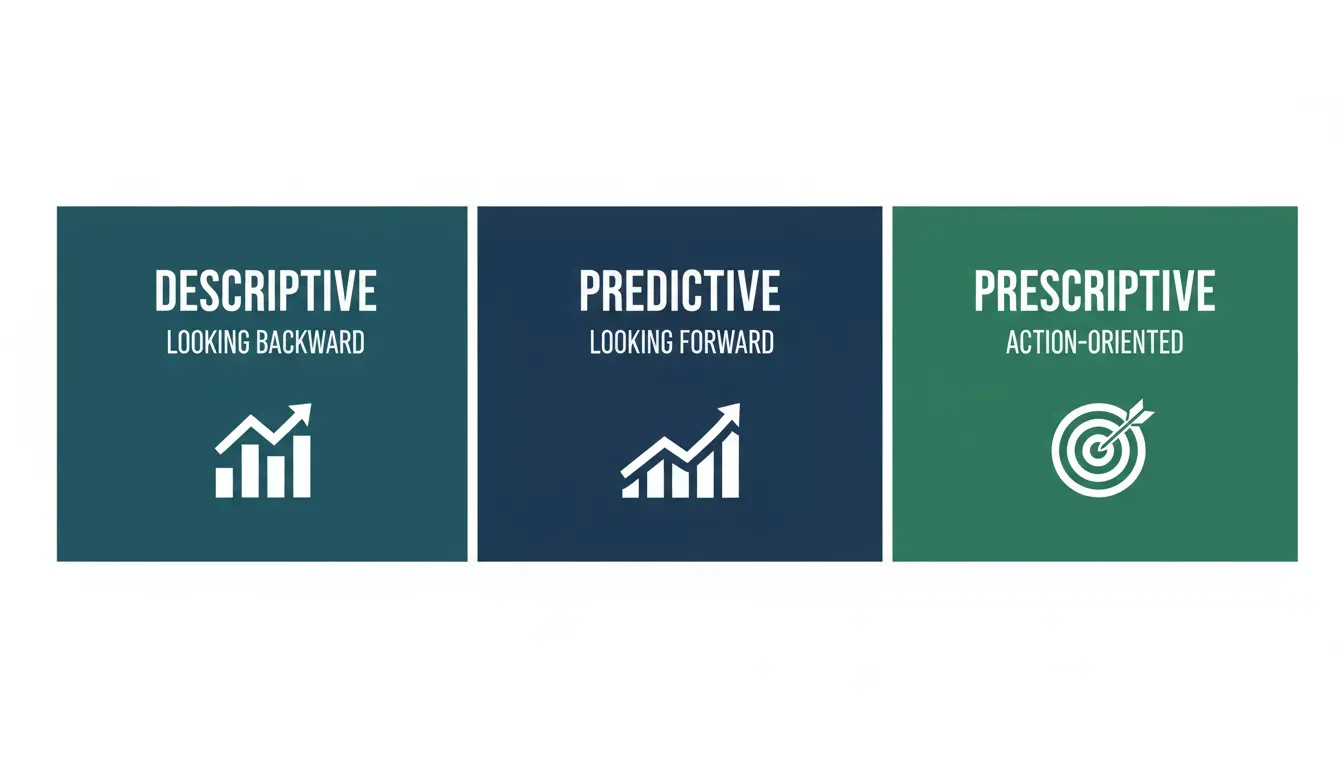
The three analytical layers every revenue team needs: Descriptive, Predictive, and Prescriptive.
What the Discipline Actually Covers
The term "pricing analysis" covers more ground than most teams realize. It spans three distinct analytical layers, each answering a different kind of question about your revenue model.
- Descriptive layer: looks backward, using historical data to tell you what happened with your prices and why
- Predictive layer: looks forward, projecting how future price changes will affect demand and revenue across customer segments
- Prescriptive layer: tells you what to do next, recommending specific actions based on current pricing models and real market conditions
The most effective teams treat these not as separate projects but as a continuous loop, forming the backbone of sound pricing strategies. Skipping a layer typically means either reacting without context or planning without current data.
Descriptive Analytics: Learning from Past Prices
Most pricing conversations start with a simple question: What happened?
Descriptive pricing analytics provides the answer by organizing historical data into patterns that teams can act on.
- Historical sales data records revenue, volume, and margin by product, region, channel, and time period
- Historical pricing data tracks how prices shifted over time and what outcomes followed each change
- Descriptive analytics tools transform raw transaction records into readable summaries that non-technical stakeholders can act on
Descriptive analytics gives revenue teams the context they need before changing anything. Without it, price changes happen without reference points, and learning from outcomes becomes far harder.
Predictive Models and What They Reveal
Once teams know what happened, the next question is what will happen. Predictive analytics models take historical data and apply statistical methods to generate forward-looking forecasts.
- Demand forecasts predict how volume will respond to specific price changes across customer groups
- Scenario projections show revenue and margin outcomes for multiple pricing paths before you commit to one
- Churn models flag customer segments at risk of leaving when prices cross certain thresholds
This layer gives revenue teams a cleaner view of the consequences of their choices. The output is not certainty, but a sharper probability estimate for each pricing path under consideration.
Prescriptive Analytics: What to Do Next
Prescriptive pricing analytics closes the loop by turning analysis into action. Where descriptive insights show what happened and predictive tools project what might, prescriptive analytics tells you what to do.
- Price recommendations suggest optimal prices for specific customer segments or products based on current and historical evidence
- Discount guardrails define the floor and ceiling for price changes, protecting profit margins while giving sales teams negotiating room
- Pricing scenarios can be tested against historical baselines to estimate the probability of success before any live change goes through
When used alongside descriptive and predictive tools, prescriptive analytics builds out specific pricing strategies backed by structured, evidence-driven options.
Which Pricing Metrics Should Revenue Teams Track?
Knowing which analytics type to use is one skill. Knowing which metrics to track is another — and pricing metrics fall into a few families that the most effective pricing teams monitor together.
| Metric | What It Measures | Why It Matters for Pricing |
|---|---|---|
| Average Revenue per User (ARPU) | Revenue generated per customer over a set period | Shows whether price changes improve or erode average customer value |
| Gross Profit Margin | Revenue minus cost of goods sold as a percentage | Reveals how much pricing pressure margins can absorb |
| Sales Volume by Tier | Units or subscriptions sold per pricing tier | Links specific price points to demand levels |
| Price Realization Rate | Actual price received versus list price | Exposes discount leakage from sales negotiations |
| LTV: CAC Ratio | Customer lifetime value divided by acquisition cost | Determines whether a pricing tier is financially sustainable |
| Price Elasticity of Demand | How volume changes when the price moves | Identifies products where price increases carry low risk |
A data visualization dashboard helps revenue teams surface these metrics in real time and connect pricing decisions to outcomes.
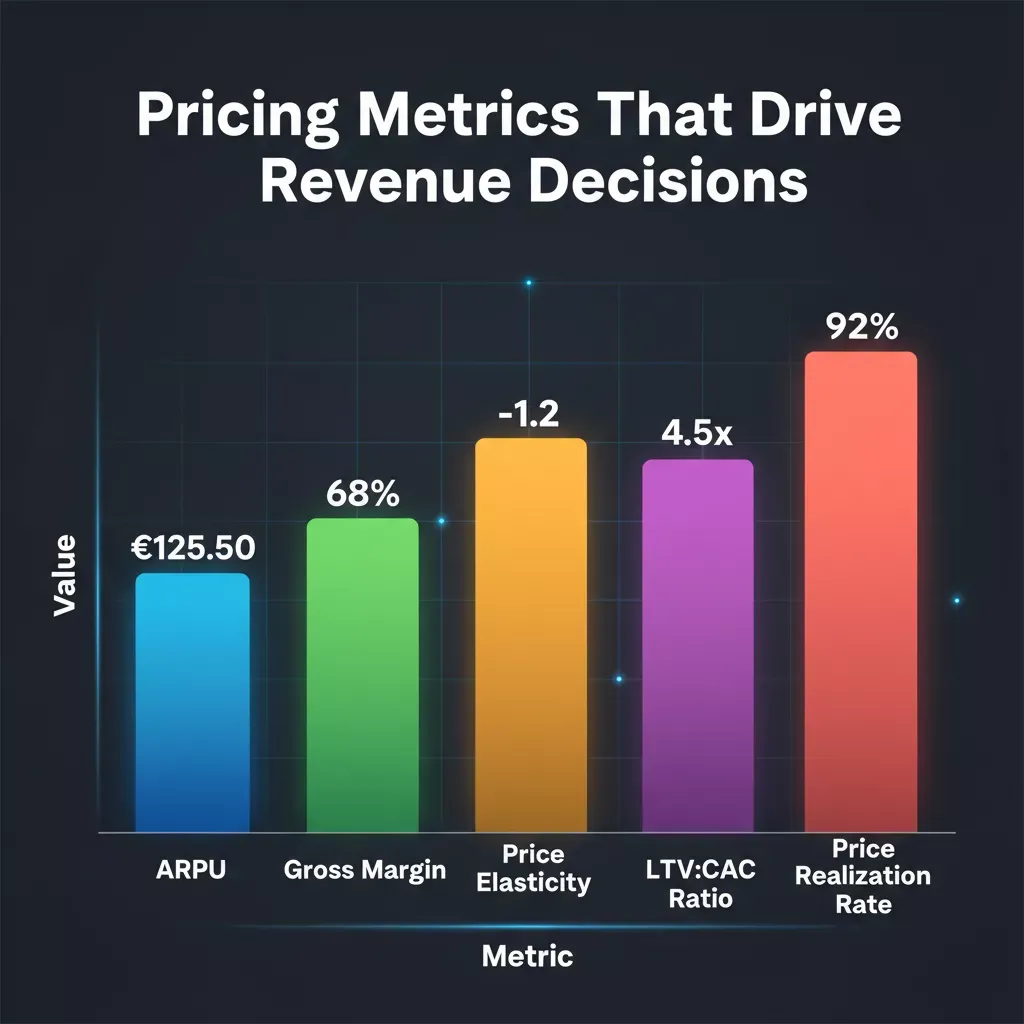
Data-driven view of the pricing metrics that matter most for revenue teams.
Customer Lifetime Value and Acquisition Cost
Pricing is not just about today's transaction. It affects whether customers stay, grow, and generate referrals, which is why customer lifetime value and customer acquisition cost sit at the center of long-term revenue thinking.
- Customer lifetime value (CLV) measures the total revenue expected from a customer relationship; it anchors long-run profitability thinking
- Customer acquisition cost (CAC) sets the ceiling on what you can pay to win a customer at any given price point
- LTV: CAC ratio above three to one is a common benchmark for sustainable growth
Research from Chargebee found that 80% of companies take a full quarter or more just to test a pricing change, a delay that compounds when foundational metrics like CLV are missing. The teams that tie customer lifetime value data directly to pricing tier design close that lag faster.
Core Pricing Analysis Methods
Revenue teams that understand these methods choose the right approach for each question they face, then build better pricing strategies around the output.
Pricing signal response workflow, from detection to action.
How Price Elasticity Shapes Your Strategy
Price elasticity is the most useful single concept in revenue pricing. It tells you, in quantitative terms, how sensitive customer demand is to a change in price.
- Own price elasticity measures how demand for your product responds to your price changes; a value below -1 means demand is elastic
- Price sensitivity at the product level differs from price sensitivity at the bundle level — teams that track both avoid overly broad conclusions
- Willingness to pay thresholds revealed by price elasticity analysis frequently surprise teams: customers often tolerate larger price increases than internal models predicted
When revenue teams model several price elasticity scenarios side by side, they see clearly where the risk actually sits. Revisiting elasticity after any major market shift is good practice.
Conjoint Analysis and Willingness-to-Pay Research
Not all pricing questions can be answered with sales data alone. Conjoint analysis and willingness-to-pay research fill that gap by surfacing customer preferences directly from the source.
- Conjoint analysis presents customers with trade-off scenarios between feature combinations and price points, revealing what they value most
- Willingness to pay surveys ask customers to define a fair price, a high price, and a prohibitively high price. The zone of overlap defines the optimal pricing band
- Customer preferences revealed through conjoint frequently surface features with high perceived value sitting in a lower-priced tier, flagging mispricing opportunities
As pricing practitioner Matthew Knaggs noted in a Zilliant industry analysis: "Without data, every increase feels risky, like flying blind." Willingness-to-pay research replaces that uncertainty with customer-validated, specific price points.
Building a strong competitive intelligence program alongside these methods ensures your pricing decisions are grounded in both internal data and live market signals.
Where Does Competitive Pricing Data Come In?
Setting prices without knowing where competitors sit is like navigating without a map. Competitor pricing data fills in what internal metrics cannot: how your market position compares to what buyers can actually choose instead.
- Competitor pricing positions determine whether buyers perceive your product as the budget option, the premium tier, or the mid-market choice
- Price gaps and overlaps signal where you have room to raise prices and where discounting pressure will be strongest
- Timing of competitor price changes reveals pricing cycles, launch strategies, and reactions to market trends
Most revenue teams underinvest in this area. When competitor pricing data is sparse, teams default to internal benchmarks alone, and that tends to leave revenue on the table.
Learning how to track competitor prices systematically is one of the highest-leverage investments a pricing team can make.
Why Manual Monitoring Falls Short
Manually tracking competitor prices through spreadsheets and ad hoc scrapes has real limitations. Pricing teams that rely on it tend to find out about competitor price changes days or weeks after they happen.
- Latency risk: By the time a manual process catches a competitor price change, sales teams may have already lost deals
- Coverage gaps: Manual monitoring typically watches only a handful of competitors, missing broader market movement
- No alerting: Without automation, teams are not notified when a meaningful price shift occurs
Manual processes cannot deliver current, consistent, and accessible data at the speed modern pricing decisions demand. This is where purpose-built intelligence tools change the equation.
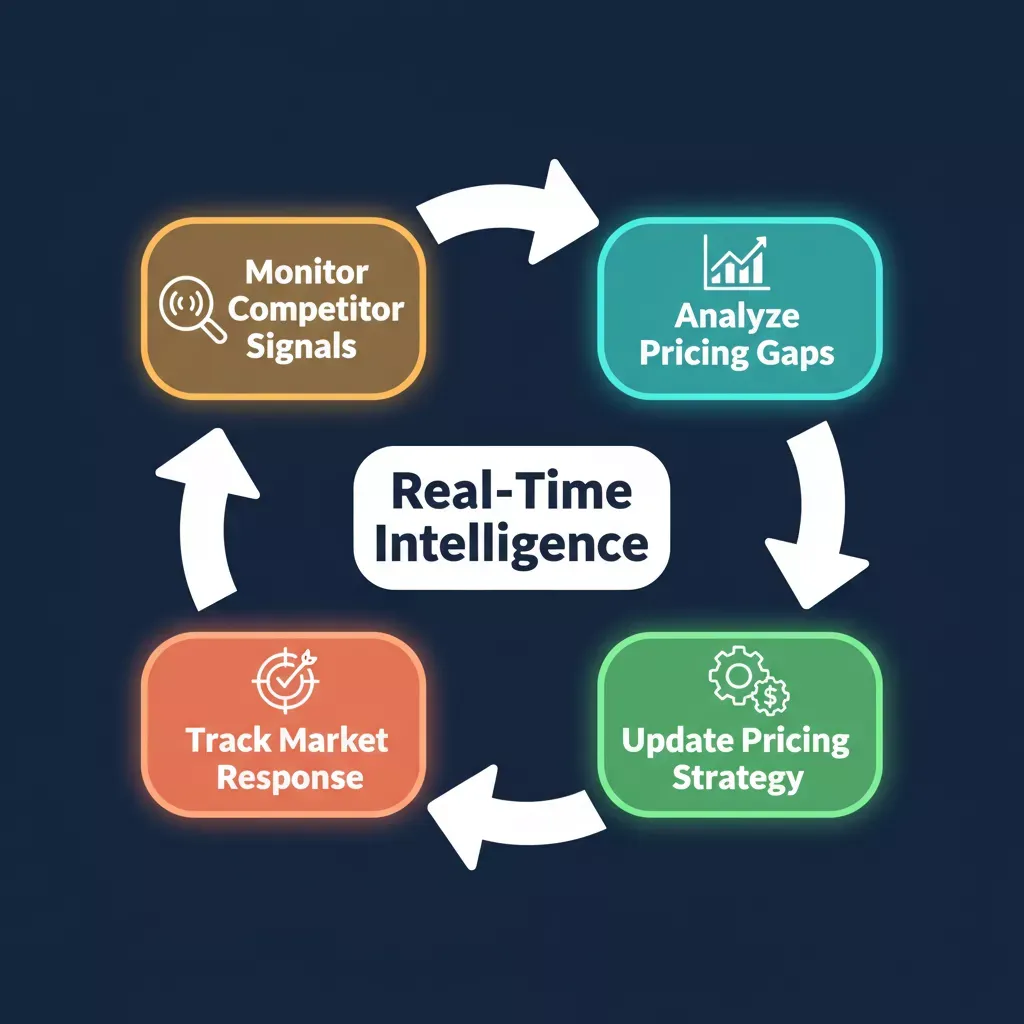
How real-time competitive intelligence feeds directly into pricing strategy decisions.
How Rocket Intelligence Puts Competitive Pricing Data to Work
Real-time competitive intelligence does not have to be a manual job. Rocket Intelligence goes where most pricing analytics tools stop: it monitors the companies your team follows continuously and helps teams optimize pricing strategies based on live market signals, not stale snapshots.
- Automated entity tracking watches competitor price changes, product updates, and hiring signals simultaneously
- Pricing signal detection flags when a followed company alters its pricing page, updates a pricing tier, or changes product packaging
- Nine signal types span pricing, hiring, product, press, and market data, far broader than conventional pricing analytics tools
- Structured Intel delivery surfaces what matters through the Rocket app, Slack, and email, so pricing analysts stay current without monitoring multiple dashboards
Rocket Intelligence serves as a live pricing analytics platform that feeds continuous market data into your team's daily workflow.
A well-designed competitor pricing strategy response framework combined with Rocket's real-time signals means your team can act on market moves within hours, not weeks.
What Rocket Tracks Across Competitor Entities
Rocket Intelligence tracks the entities you follow across nine signal types, turning public market activity into structured pricing analytics your team can act on.
- Public pricing page changes are detected within hours when a competitor updates their pricing structure or feature bundles
- Hiring signal analysis identifies when a competitor is building a team in a specific function, often a leading indicator of a pricing strategy shift
- Predictive pricing analytics becomes practical when signal patterns from multiple entities are analyzed together
Unlike static reports or one-time audits, the continuous pricing analytics solutions that Rocket delivers produce the market intelligence revenue teams need for confident, real-time pricing decisions. Teams building a financial reporting dashboard alongside Rocket's intelligence layer get the full picture, internal metrics, and external signals in one workflow.
What Questions Should Pricing Teams Ask Their Data?
Having the right data is only half the challenge. Pricing teams that know which questions to ask get far more value from their data.
- Revenue questions: "Which price points generate the most total revenue across segments?"
- Margin questions: "Which pricing tiers produce the healthiest profit margins at volume?"
- Demand questions: "How do price changes affect volume by segment?"
- Competitive questions: "Where do our prices deviate most from competitor patterns?"
The goal is not to analyze data for its own sake but to work toward better pricing strategies for specific customer segments and the business overall.
Questions That Drive Segment-Level Strategy
Segment-level pricing is where most of the untapped revenue lives. Pricing teams that ask the right questions about different customer groups consistently find opportunities that aggregate-level analysis misses.
- "What are the optimal prices for each major customer segment, based on their willingness to pay and switching cost?"
- "Which customer segments show the highest price sensitivity and lowest customer loyalty?"
- "Can we justify premium pricing for a top tier by demonstrating measurably higher outcomes for that customer group?"
The teams that track customer segments, pricing tiers, and demand responses together make better pricing decisions with a much sharper view of where value is created and where it leaks.
Stop leaving revenue on the table. Rocket gives your team live competitor pricing signals, automated tracking across nine signal types, and structured Intel delivered straight to your workflow.
Sign up and start your first competitor track today; your pricing strategy will thank you.
Table of contents
- -What the Discipline Actually Covers
- -Descriptive Analytics: Learning from Past Prices
- -Predictive Models and What They Reveal
- -Prescriptive Analytics: What to Do Next
- -Which Pricing Metrics Should Revenue Teams Track?
- -Customer Lifetime Value and Acquisition Cost
- -Core Pricing Analysis Methods
- -How Price Elasticity Shapes Your Strategy
- -Conjoint Analysis and Willingness-to-Pay Research
- -Where Does Competitive Pricing Data Come In?
- -Why Manual Monitoring Falls Short
- -How Rocket Intelligence Puts Competitive Pricing Data to Work
- -What Rocket Tracks Across Competitor Entities
- -What Questions Should Pricing Teams Ask Their Data?
- -Questions That Drive Segment-Level Strategy