
How do startup apps generate revenue successfully? This blog explores proven monetization strategies, from freemium to subscriptions and ads, helping founders choose scalable models that drive sustainable growth.
How can startup founders build smart Monetization for apps?
Choose the right app monetization strategy for your target audience, test it early, and refine it using real user behavior data. When done right, app monetization supports growth instead of blocking it.
Now let’s zoom out for a second. The mobile app industry continues to grow rapidly. According to Statista, global mobile app revenue is projected to surpass $ 600 billion in the coming years.
So yes, the opportunity is real. But money does not come automatically. Your monetization strategy must align with your user base, app category, and long-term vision.
Let’s walk through it step by step.
What is App Monetization?
App monetization is how a mobile app makes money. It simply means generating revenue from your app through different methods.
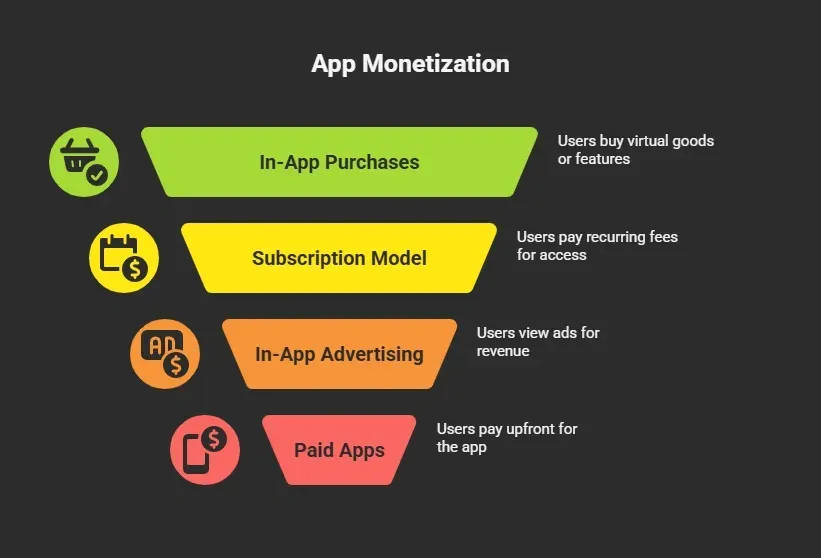
This can include in-app purchases, a subscription model, in-app advertising, or even paid apps where users pay upfront. Each method offers a different way to earn from your user base.
In short, app monetization defines how your app business turns users into revenue.
Why App Monetization Matters More Than You Think?
You can build a beautiful mobile app. You can get solid app downloads. But if it does not generate revenue, the business struggles.
Many app developers focus heavily on user acquisition. That is good. Growth matters. But without a working app monetization strategy, growth alone does not pay bills.
Your monetization strategy affects:
- User engagement
- Retention
- Active users
- Total app revenue
- Long term stability
When done right, mobile app monetization generates predictable, recurring revenue. That gives founders breathing room to build properly.
The Main App Monetization Models
Now let’s break down the most common monetization models. Each one fits different user segments and app categories.
1. Paid Apps
With paid apps, users pay upfront before downloading from the app store.
At first glance, this sounds simple. You release a paid version and collect money per download. Some premium apps and niche productivity apps use this model successfully.
But here’s the catch. Many users search for free apps first, especially in the Apple App Store and Google Play Store. That reduces paid app downloads.
Pros:
- Immediate revenue per download
- Clear structure
Cons:
- Smaller user base
- Slower growth
A paid version works best when your value is obvious and your target audience trusts your brand.
2. Freemium Apps
Now we move to freemium apps. This is one of the most popular mobile app monetization strategies.
You offer a free version with basic functionality. Then you charge for premium features through a paid version or paid subscription.
Free apps attract more users. That grows your user base quickly. Then power users upgrade.
This model works well for:
- Productivity apps
- Health and fitness apps
- Fitness apps
The key is balance. Your free version must be useful. At the same time, premium features must feel worth the upgrade. When executed properly, this app monetization strategy generates steady revenue while maintaining strong growth.
3. In App Purchases
Let’s talk about in-app purchases. These are extremely common in mobile games and in the structure of gaming apps.
Users download free apps. Then they make an app purchase inside the mobile app.
There are different types:
- Consumable in-app purchases like coins or extra lives
- Permanent upgrades
- Feature unlocks
Many mobile games rely heavily on in-app purchases. A small percentage of active users often drives most of the app's total revenue.
To offer in-app purchases, you need proper in-app purchase infrastructure. Both the Apple App Store and Google Play Store provide tools for this.
This app monetization method works best when user engagement is high. If users come back daily, app purchase opportunities increase naturally.
4. Subscription Model
Next comes the subscription model. Instead of one time app purchase, users pay monthly or yearly through a subscription plan.
This creates recurring revenue and predictable revenue. That is powerful for startup founders.
It works especially well for:
- Productivity apps
- Fitness apps
- Health and fitness apps
Free trials often help convert users. Many free apps offer limited access before pushing a paid subscription.
A strong subscription model helps retain users. When your app becomes part of someone’s routine, steady revenue follows.
5. In App Advertising
Now let’s discuss in-app advertising. Free apps often rely on app advertising to generate revenue without charging users directly.
There are multiple ad formats:
- Banner ads
- Interstitial ads
- Native ads
- Video ads
- Rewarded video ads
Banner ads are common but basic. Interstitial ads appear between screens. Native ads blend into content. Video ads and rewarded video ads are popular in mobile games and gaming app ecosystems.
Ad networks connect app publishers with advertisers. Google Ads powers many ad campaigns within free apps.
Ad revenue depends on:
- Size of your user base
- Active users
- App category
- Ad formats used
Still, balance matters. Too many in-app ads hurt user engagement. A thoughtful app monetization strategy avoids that mistake.
Quick Comparison
Here’s a simplified view of key monetization models:
| Monetization Model | Best For | Revenue Style | Risk |
|---|---|---|---|
| Paid Apps | Niche tools | One time app purchase | Slower growth |
| Freemium Apps | Productivity apps | Upgrade to paid version | Low conversion |
| In App Purchases | Mobile games | Repeated app purchase | Design complexity |
| Subscription Model | Fitness apps | Recurring revenue | Churn risk |
| In App Advertising | Free apps | Ad revenue | User fatigue |
Each monetization model fits different user segments and business goals.
How to Choose the Right Monetization Model?
So how do you choose?
Start with your target audience. Study user behavior carefully.
Ask yourself:
- Do users search for free tools first?
- Are they open to a paid subscription?
- Will they pay for premium features?
Segment your user base. Casual users may stay in the free version. Power users may prefer a paid version or subscription plan.
In many cases, hybrid monetization models work best. For example, free apps may combine in-app purchases with in-app advertising.
App monetization companies often recommend testing multiple monetization methods before scaling aggressively. An effective monetization strategy evolves. It adapts to real data.
Community Insight
A founder on Reddit shared this experience:
“We switched from paid apps to freemium with in app purchases and saw strong user growth and more revenue stability.”
This highlights something important. Your first app monetization strategy does not have to be permanent. Adjusting your monetization model can reshape your user base and total app revenue.
Rocket.new: Build and Monetize Faster
Rocket.new uses AI to let anyone build real, ready-to-use apps simply by describing what they need. No coding skills are required. It manages research, design, and deployment, turning ideas into functional applications quickly and making app creation accessible to everyone, not
If you are building your own app, speed matters. Testing monetization early matters even more. Rocket.new helps founders build a mobile app quickly using visual tools and backend workflows.
Top features include:
- Prompt to App Creation: Builds apps directly from single prompts
- Figma Import: Converts design files into live, editable layouts
- AI-Powered Backend: Automatically handles logic, data, and workflows
- Custom Domain Support: Publishes projects with a branded domain
- Code Export: Allows developers to extend or customize later
- Live Preview: Shows instant updates while editing
Rocket.new allows startup founders to validate mobile app monetization strategies before committing major development resources.
Common Mistakes Founders Make
In app monetization, small mistakes can lead to significant revenue losses. Many founders rush into decisions without fully understanding their user base or long-term goals. A little clarity here can save months of frustration later.
Here are some common mistakes:
- Choosing monetization models without analyzing user segments
- Treating all users the same instead of studying different user segments
- Overloading free apps with banner ads and interstitial ads
- Ignoring analytics around app purchase behavior
- Focusing only on app downloads instead of revenue generation
- Launching a paid version without validating demand
- Copying another app monetization strategy without testing
Each of these mistakes affects user engagement and limits growth potential.
Ultimately, the right monetization model depends on your user base, app category, and long-term vision. Guesswork rarely works. Clear data, thoughtful testing, and steady refinement lead to better results.
A Smarter Approach to Monetization for Apps
Many founders launch free apps without a clear monetization strategy. They focus on app downloads and growth but overlook building a solid revenue structure. The smarter move is to choose monetization models based on your target audience and app category. Test in-app purchases, subscription model options, and in-app advertising carefully. Then study user behavior and adjust as real data comes in.
Monetization for apps works best when it aligns with your user base and long-term vision. Keep basic functionality strong in the free version, and offer meaningful premium features or paid subscription plans for those who want more. Stay flexible, track your numbers, and refine your app monetization step by step. That steady approach builds reliable revenue and long-term stability for the app business.
Table of contents
- -What is App Monetization?
- -Why App Monetization Matters More Than You Think?
- -The Main App Monetization Models
- -1. Paid Apps
- -2. Freemium Apps
- -3. In App Purchases
- -4. Subscription Model
- -5. In App Advertising
- -Quick Comparison
- -How to Choose the Right Monetization Model?
- -Community Insight
- -Rocket.new: Build and Monetize Faster
- -Common Mistakes Founders Make
- -A Smarter Approach to Monetization for Apps