
Spot new competitors before they reach your pipeline. Set up automated monitoring, brief your sales teams, audit SEO, and use Rocket.new's Intelligence feature to connect signals across nine pillars into one daily brief with recommended responses.
Knowing how to track competitors entering your market before they reach your customers is the difference between a reactive scramble and a controlled strategic response.
This guide walks through a complete system from automated monitoring to frontline sales intelligence to structured competitive analysis, and shows how Rocket's Intelligence feature handles the heavy lifting so your team can focus on responding, not watching.
What is Competitive Intelligence and Why Does it Matter?
Competitive intelligence is the practice of collecting data on rivals, comparing performance metrics, and analyzing the broader market landscape to inform decisions. It is not just awareness. It is a system that transforms raw data into actionable insights, allowing businesses to track competitors across industries and monitor competitive signals in real time.
The difference between watching and acting is the gap between knowing something happened and knowing what to do about it. Effective competitive intelligence systems enable organizations to act before competitors make their moves, improving control over deals, pricing, and customer conversations.
Acting early in response to new competitors leads to winning more deals, protecting market share, and improving customer experience. That is not a nice-to-have. That is a business outcome.
What are the Key Signals That New Competitors are Entering Your Market?
New competitors rarely appear from nowhere. They signal their arrival through specific public actions before they fully launch their products. The job is to catch those signals early.
The seven most reliable early-warning signals that a new competitor is entering your market.
Here are the most common early-warning signals to watch:
- Website launch or major update: A domain goes live with positioning language aimed at your target market
- LinkedIn activity: New company pages, enterprise-focused posts, or senior hires in sales and marketing
- Press coverage: Announcements in trade publications, product blogs, or news articles covering their funding, partnerships, or launch
- Job postings: A spike in hiring for sales, customer success, or engineering roles in your category
- Pricing page changes: A new tier added, a plan removed, or aggressive free-tier pricing designed to pull customers away
- Review platform activity: Early responses on G2 or Trustpilot defending their product or responding to comparisons
- SEO presence: New content ranking for keywords that overlap with your target audience
Effective tracking involves monitoring these signals across all channels simultaneously. When four signals appear at once, that is not four separate events. That is one coordinated move.
How to Track Competitors Entering Your Market: A Step-by-Step System
Tracking new competitors requires a combination of automated digital monitoring and direct market feedback. Here is how to build that system.
A six-step system for tracking new competitors before they reach your pipeline.
Step 1: Set Up Automated Digital Monitoring
Automated monitoring is the foundation. Without it, you are relying on luck and accidental discovery. Automated digital monitoring involves using tools like Google Alerts for real-time notifications when industry-related terms are mentioned online.
Set up alerts for your primary product category keywords, competitor brand names as you discover them, adjacent problem terms that new entrants might target, and funding and acquisition language in your industry. Setting up automated alerts for new company mentions helps identify threats in the competitive landscape before they reach your pipeline.
Step 2: Brief Your Sales Teams as Your Early Warning System
Your sales teams are the most underused source of competitive intelligence. Sales teams can identify new competitors by probing deeper into mentions of unfamiliar names during customer interactions, as these competitors may already be part of the decision-making process.
When a sales rep hears a name they do not recognize during a discovery call, that is a signal. Train your team to ask follow-up questions: "How did you find them?" "What are they offering?" "Where are you in that evaluation?" These interactions reveal more about the competitive landscape than any report.
Sales teams should prepare better background information and adjust their strategies proactively to respond to new competitors before they impact sales. That means having battlecards, objection responses, and positioning clarity ready before a competitor's name shows up in deals.
Step 3: Monitor Press Releases and Industry Reports
Monitoring press releases and news articles helps track competitors' marketing strategies, partnerships, and product launches, especially for emerging competitors entering new verticals. This is where you find the structured public announcements: funding rounds, new product lines, partnership deals, executive hires.
Set a weekly cadence for reviewing industry news publications in your category, startup databases and funding announcements, and partner ecosystem updates from platforms you both operate on. Missing a funding announcement is missing a 90-day countdown to a new sales team calling your accounts.
Step 4: Review Customer Sentiment Platforms
Customer sentiment can be gauged by reviewing platforms like G2 or Trustpilot to identify what early adopters like or dislike about competitors. This gives you two things: whether a competitor is gaining traction, and their actual strengths and weaknesses from real users.
Look for patterns in reviews: what customers praise tells you how competitors are positioning, and what customers complain about tells you where your differentiation should live. This is more reliable than reading their marketing copy.
Step 5: Run Regular SEO Audits
Conducting regular SEO audits helps understand competitors' positioning and targeting efforts. When a new competitor starts ranking for keywords your target audience searches, it is a clear sign they are investing in your market segment.
Watch for new domains appearing in organic results for your core terms. Track who is running paid search against your branded keywords. These are signals that a new player has decided your market is worth spending money on.
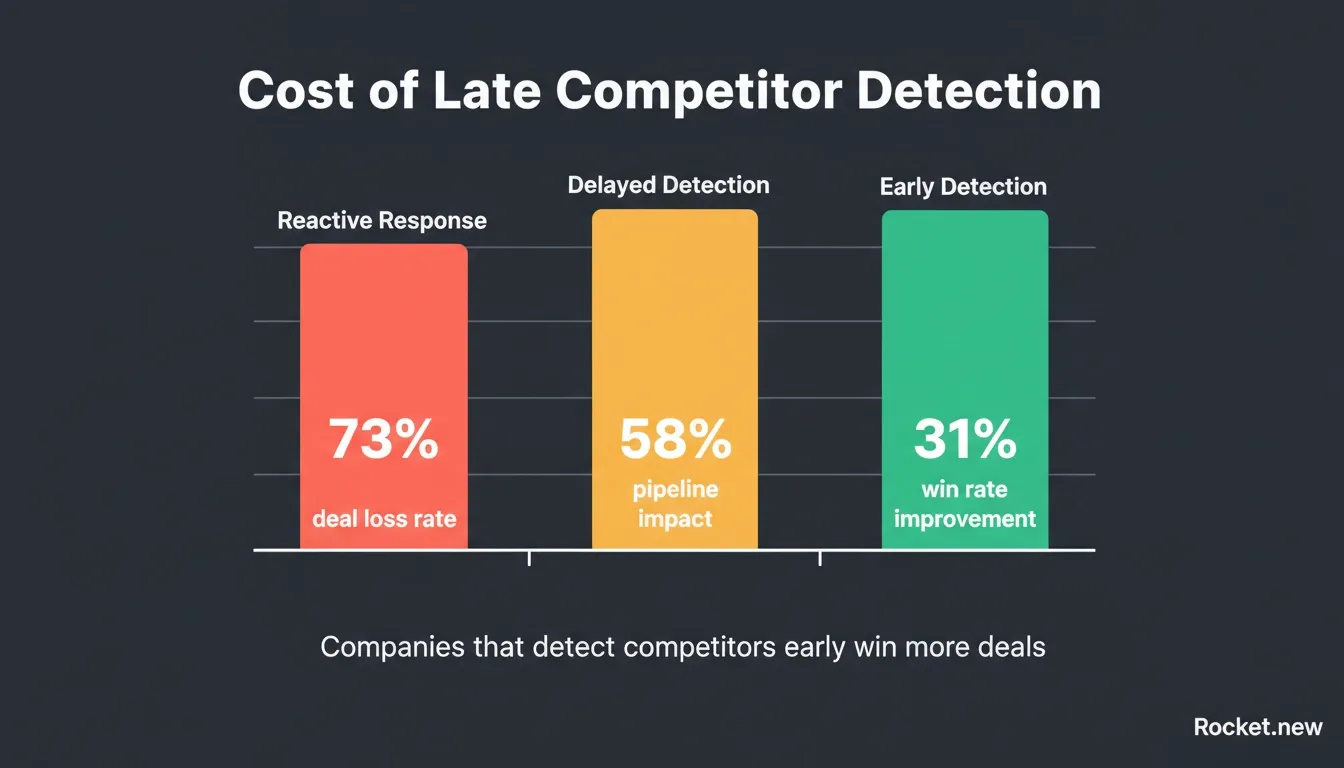 Companies that detect competitors early consistently outperform those that react late. Research shows that early competitive response improves win rates significantly.
Step 6: Conduct a Competitive Analysis
A competitive analysis is a strategic evaluation of competitors in the marketplace, assessing their strengths and weaknesses relative to your own business. Once you have identified a new entrant, run a structured analysis.
SWOT analysis can visualize how the entry of new competitors changes your market position by mapping your strengths, weaknesses, opportunities, and threats in response to their arrival. This gives your product teams and sales teams a shared framework for how to respond.
Conducting a competitive analysis helps businesses identify market opportunities by understanding competitors' strengths and weaknesses, allowing for differentiation. Primary competitors require continuous monitoring, while secondary players can be reviewed quarterly.
What Are the 4 P's of Competitor Analysis?
The 4 P's of competitor analysis map to the core dimensions you need to understand about any competitor. Together, these four dimensions give you a comprehensive competitive analysis that connects market positioning to pricing models.
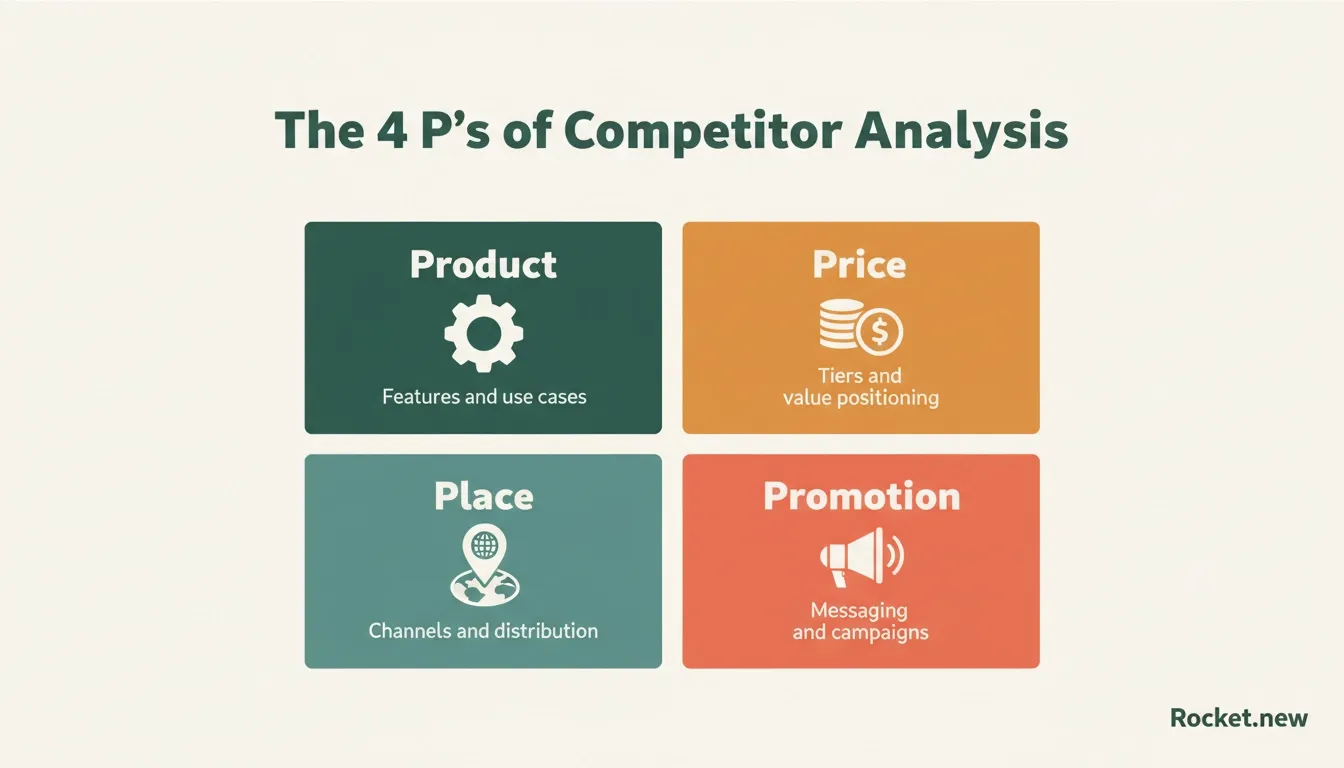 The four dimensions every competitive analysis must cover to give sales and product teams a complete picture.
| Dimension | What to Analyze | What It Tells You |
|---|---|---|
| Product | Features, quality, use cases, differentiators | Where they compete directly vs. differently |
| Price | Pricing strategy, tiers, free vs. paid model | How they are positioning on value |
| Place | Channels, distribution, market segment focus | Where they are acquiring customers |
| Promotion | Marketing strategies, messaging, campaigns | How they are telling their story |
They show you how competitors are targeting the same audience you serve, and where the gaps in their approach create openings for you.
How Do You Capture Market Share from Competitors?
Capturing market from direct competitors comes down to knowing their weaknesses before your prospects do. Here is how to use your competitive intelligence to win.
Identify the gaps they leave open. New competitors often arrive with narrow solutions. Market gaps exist where customer needs are not fully met, and your job is to find those gaps and own them.
Arm your sales teams with specifics. Vague differentiation does not win deals. Your sales teams need to know what this competitor offers, what they do not offer, and where customers feel the difference most.
Update your value proposition in response. When a new competitor enters your market, your messaging may need to be sharpened. Continuous market research and competitive intelligence are what keep your value proposition relevant as the competitive landscape shifts.
Move fast. The window between a competitor's first signal and their first sale is where you have the most leverage. Acting early is the strategy.
Goal-to-Action Table: What to Do Based on What You Find
| What You Discover | Recommended Action | Why It Works |
|---|---|---|
| New competitor website launched | Run competitive analysis via Rocket Solve | Get a structured view of their positioning before they reach your deals |
| Competitor hiring enterprise sales reps | Brief sales teams immediately | They will start calling your accounts within 60-90 days |
| New pricing tier targeting your segment | Review your pricing strategy | Ensure your pricing models match customer preferences |
| Negative reviews on G2 about a competitor | Update battle cards with their weaknesses | Give sales teams specific language to use in competitive deals |
| Competitor appearing in SEO for your keywords | Strengthen content around those terms | Protect your market share in organic search |
| Customer mentions an unfamiliar name on a call | Log it, research it, brief the team | These emerging competitors may already be in your pipeline |
Can ChatGPT Do a Competitor Analysis?
ChatGPT can help structure a competitor analysis if you give it the data. It can produce comparison tables, summarize publicly available information, and draft sections of a competitive brief. What it cannot do is monitor competitors continuously, surface real-time signals across web, social, hiring, and customer platforms, or connect multiple signals into a single interpretation.
That is the difference between a one-time snapshot and a living competitive intelligence system. Using AI-powered tools for competitor tracking allows businesses to automate data collection and analysis, making it easier to spot competitors early and act on insights quickly. ChatGPT is useful for structured thinking. A purpose-built system like Rocket's Intelligence feature is what handles the ongoing monitoring.
For product managers who want to go deeper on structured analysis, Rocket's Solve feature turns complex business questions into structured, evidence-backed reports with market data, competitive analysis, and recommendations in one place.
How Rocket Handles Competitor Tracking Before Your First Sales Rep Makes a Call
Rocket is built for the full arc of thinking and building, not just one piece of it. The Intelligence feature is where competitor tracking lives, and it covers nine signal pillars across every competitor you add.
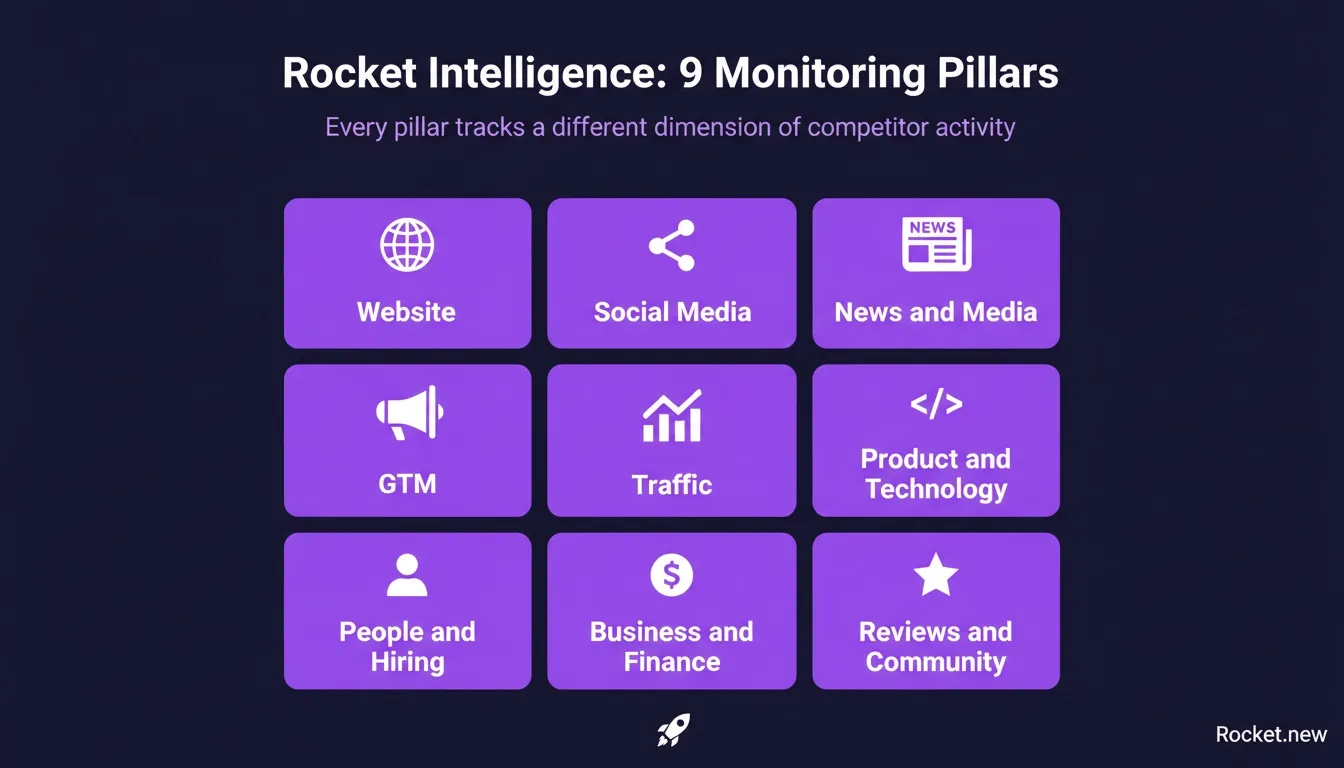 Rocket Intelligence monitors nine distinct pillars of competitor activity, updated continuously.
What Rocket Intelligence monitors across nine pillars:
- Website: Messaging changes, pricing updates, new feature pages
- Social Media: Company and executive posts, engagement patterns
- News and Media: Third-party press coverage and editorial narrative
- GTM: Paid campaigns, creator partnerships, developer marketing
- Traffic: Visit volumes, source mix, and growth model signals
- Product and Technology: Feature releases, engineering velocity, API changes
- People and Hiring: Who is joining or leaving, what hiring patterns imply
- Business and Finance: Funding rounds, revenue signals, partnerships
- Reviews and Community: G2 ratings, Reddit discussions, app store reviews
Here is how to configure it using the Intelligence setup wizard:
- Open the Intelligence setup wizard from your Rocket workspace
- Add the competitors you want to track by name and website URL
- Select the signal categories that matter most to you, such as Pricing and packaging, or Product updates
- Set frequency to Daily for fast-moving markets or Weekly for a consistent rhythm
- Let Intelligence run and surface signals to your dashboard automatically
What you get is a live dashboard where multiple signals combine into a single interpreted insight. A pricing page update, plus enterprise LinkedIn posts, plus new senior AE job postings, are not three separate events. Rocket Intelligence reads it as one coordinated enterprise push and tells you what it means.
The competitive response workflow inside Rocket connects Intelligence to Solve to Build. A signal surfaces. You run a Solve analysis. If the response requires a product or messaging update, Build handles it. One platform, shared context, no reset between steps.
For teams who want to understand how this workflow runs end to end, the competitive response workflow shows exactly how detection, analysis, and response connect in a single session.
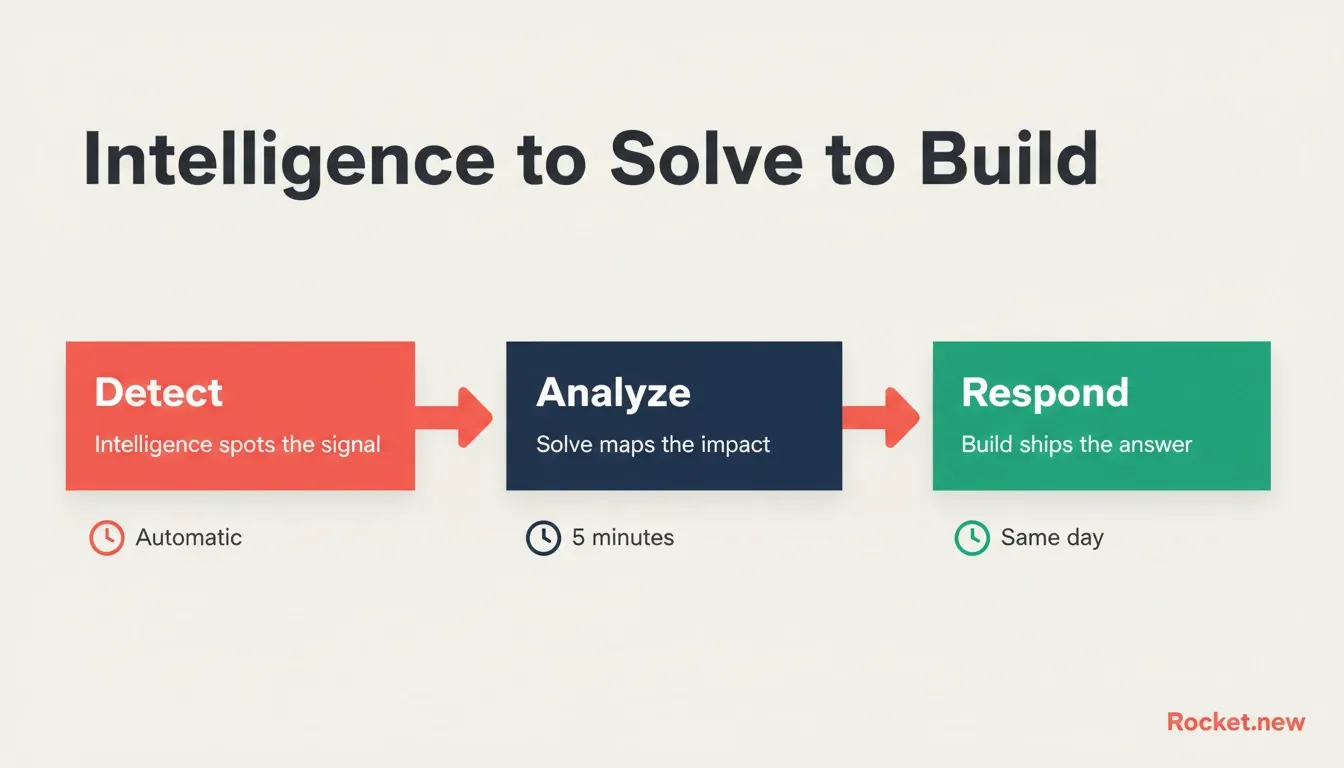 Rocket's three-phase competitive response workflow: detect with Intelligence, analyze with Solve, respond with Build.
For product teams running structured competitive analysis, Rocket's Solve feature produces full research reports with gap analysis, strategic options, and recommendations. You type the situation in plain language, and it returns a structured report you can share directly with sales teams, marketing teams, and leadership.
Rocket also supports 26+ integrations including Notion, Jira, HubSpot, and Linear, so competitive intelligence flows directly into the tools your team already uses. And with built-in SEO and performance defaults, anything you build in response ships already optimized.
Track Competitors Before They Track You
Knowing how to track competitors entering your market is not about watching what everyone else is doing. It is about building a system that catches the signals early, translates them into action, and keeps your sales teams and product teams a step ahead of the next move.
Rocket's Intelligence feature gives you that system. Set it up once, and you will know what your competitors are doing, what it means, and what to do next, before their first sales rep ever calls one of your accounts.
Start tracking competitor signals early with Rocket.new and stay ahead before your next deal is at risk.
Table of contents
- -What is Competitive Intelligence and Why Does it Matter?
- -What are the Key Signals That New Competitors are Entering Your Market?
- -How to Track Competitors Entering Your Market: A Step-by-Step System
- -Step 1: Set Up Automated Digital Monitoring
- -Step 2: Brief Your Sales Teams as Your Early Warning System
- -Step 3: Monitor Press Releases and Industry Reports
- -Step 4: Review Customer Sentiment Platforms
- -Step 5: Run Regular SEO Audits
- -Step 6: Conduct a Competitive Analysis
- -What Are the 4 P's of Competitor Analysis?
- -How Do You Capture Market Share from Competitors?
- -Goal-to-Action Table: What to Do Based on What You Find
- -Can ChatGPT Do a Competitor Analysis?
- -How Rocket Handles Competitor Tracking Before Your First Sales Rep Makes a Call
- -Track Competitors Before They Track You