
How does AI generate code from natural language? Modern models parse intent, map patterns, and produce functional software, explaining why over 70% of developers rely on AI coding tools today.
How does AI really turn everyday language into working software?
A 2024 Stack Overflow Developer Survey reports that over 70% of professional developers now use AI tools for writing or assisting with code.
These systems no longer rely solely on templates. They analyze natural language, infer intent, and generate code that fits real development contexts.
Requests sound human. Responses arrive as structured, usable code.
Let's break down how this translation actually works, step by step, without drifting into theory-heavy explanations.
The Big Idea: Translating Language Into Logic
So, how does AI generate code from natural language in real-world development?
The answer sits at the intersection of artificial intelligence, linguistics, and software engineering.
Natural language programming allows developers to specify what they want rather than writing every line by hand. The system reads natural language, understands intent, and generates code that matches common patterns in software development.
This approach does not replace programming languages. It works alongside them. The AI becomes a translator between human language and formal code structures.
Step 1: Reading and Interpreting Language
Everything begins with natural language processing.
When a developer types a request, NLP systems break the text into tokens, phrases, and relationships.
This step includes:
- Identifying actions and objects
- Detecting constraints and scope
- Interpreting tone or priority using sentiment analysis
Entity recognition helps pinpoint things like file names, APIs, or database tables. These details shape the output in subtle but meaningful ways.
NLP models learn this behavior during training on vast datasets that mix documentation, tutorials, and human-written code.
Step 2: Understanding Context and Intent
Next comes context.
AI models do not just read a sentence in isolation. They look at surrounding text, existing code, and comments.
This is where natural language descriptions become powerful. A short phrase like “add caching to this function” makes sense only when the model understands the current file.
NLP techniques allow the system to understand context and track intent across longer interactions. That context awareness improves code suggestions and reduces irrelevant output.
Step 3: Predicting Code Structures
Then the AI code generator gets to work.
It predicts the next token, token by token.
Machine learning models analyze probability. Given a prompt and context, the system predicts which code syntax is most likely to follow. Over time, this leads to surprisingly accurate results.
This process supports multiple programming languages within a single project. The same prompt may produce JavaScript, Python, or Java, depending on the context.
Step 4: Producing Generated Code
Now the visible part appears.
The system produces generated code that may include functions, loops, imports, and variable names.
Some outputs are small and focused. Others form larger blocks of functional code. In many cases, the result is executable code that runs with minimal changes.
AI-generated code often includes boilerplate code for setup tasks. That saves time on repetitive coding tasks and repetitive tasks that add little creative value.
Step 5: Feedback and Improvement
After that, learning continues.
Reinforcement learning helps refine future outputs using human feedback.
Human developers accept, edit, or reject suggestions. That feedback feeds into the training process. Over time, models learn what works and what causes issues.
This loop helps improve code quality and reduce common mistakes.
Where Code Completion Shines
Code completion remains one of the most practical features.
As developers type, AI provides real-time code suggestions tailored to the current context.
These suggestions help with:
- Repetitive tasks
- Common patterns
- Consistent formatting
Real-time suggestions reduce cognitive load and support faster development cycles.
From Prompt to Program
| Stage | What Happens | Result |
|---|---|---|
| Prompt | Natural language prompts | Parsed intent |
| Analysis | NLP models process text | Structured meaning |
| Generation | AI models predict output | Generated code |
| Review | Human oversight | Improved reliability |
Working With Existing Code
AI-powered code performs best with context.
Existing code provides structure, style, and naming clues.
When models are trained on surrounding source code, they produce code that blends naturally. This improves readability and reduces cleanup work.
This matters in large software development projects, where consistency is as important as correctness.
Handling Complex and Realistic Scenarios
AI-powered tools now assist with complex problems.
They help with data pipelines, backend logic, and, in limited cases, code optimization.
For example, Python code generation for data analysis works well because patterns repeat across projects. The same applies to API handlers and validation logic.
Still, complex code requires careful review. Models predict patterns. They do not reason about edge cases.
Code Quality and Risk Awareness
Generated code is not flawless.
Security vulnerabilities may appear when models repeat unsafe examples from training data.
Human oversight remains necessary during code development and deployment. This review step protects against logic flaws and security gaps.
Ethical considerations also matter. Questions about data sources and licensing continue to shape how AI-powered tools evolve.
Rocket.new and Language Driven Development
Rocket.new connects directly to natural language programming ideas. It focuses on early-stage project setup using AI-powered tools.
Rocket.new supports developers by:
- Converting natural language descriptions into project scaffolds
- Supporting code generation across different programming languages
- Reducing repetitive tasks during early software development
- Offering clean starting points for further code development
This approach pairs well with AI-generated code and human feedback.
Practical Use Cases in Daily Work
Natural language programming already supports many coding tasks.
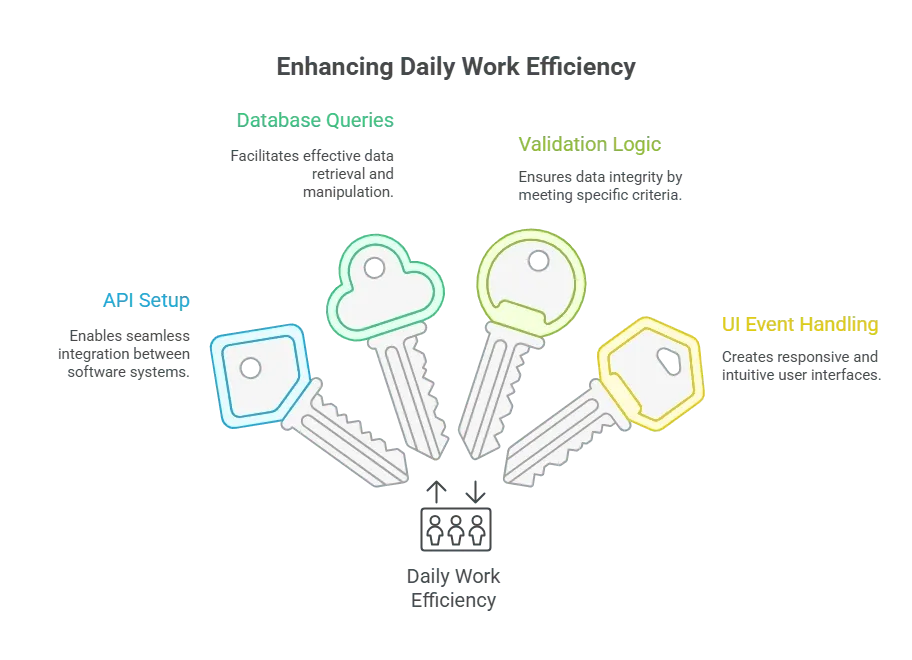 These tools help produce code faster while allowing developers to focus on problem-solving and design.
Known Limits and Tradeoffs
AI still has limits.
AI models lack true understanding. They predict based on probability.
That limitation becomes apparent in complex tasks or unfamiliar domains. Human developers remain responsible for architecture and final decisions.
The best results come from collaboration between humans and machines.
How Does AI Generate Code from Natural Language?
In real-world software development, natural-language programming reduces friction. It shortens setup time, simplifies repetitive coding tasks, and improves flow. Used thoughtfully, it supports better outcomes without replacing human judgment or creativity.
Table of contents
- -The Big Idea: Translating Language Into Logic
- -Step 1: Reading and Interpreting Language
- -Step 2: Understanding Context and Intent
- -Step 3: Predicting Code Structures
- -Step 4: Producing Generated Code
- -Step 5: Feedback and Improvement
- -Where Code Completion Shines
- -From Prompt to Program
- -Working With Existing Code
- -Handling Complex and Realistic Scenarios
- -Code Quality and Risk Awareness
- -Rocket.new and Language Driven Development
- -Practical Use Cases in Daily Work
- -Known Limits and Tradeoffs
- -How Does AI Generate Code from Natural Language?