
Rocket.new surfaces competitor deal moves weeks before traditional monitoring catches them. Teams that act on early signals prepare better, adjust faster, and win more deals. Intelligence, research, and app building live in one platform.
Rocket gives sales and product teams a decisive timing advantage by surfacing competitor deal activity up to six weeks before traditional monitoring catches it. When the competitor move on Rocket.new connects intelligence to execution in one platform; teams stop reacting and start winning.
Why Late Signals Kill Deals
Deals rarely fall apart in the final meeting. Most of the damage happens much earlier, when small signals go unnoticed, and teams don't act in time.
Here's what typically happens behind the scenes:
- A competitor updates their pricing page quietly
- Messaging changes without any announcement
- New landing pages go live for testing
- You don't catch these shifts early
- The prospect brings it up before you do
That moment hits hard. You realize you are already behind. Most product teams face this problem because they rely on scattered tools and wait for updates instead of spotting patterns early. Even strong teams miss signals when the system is not built for speed.
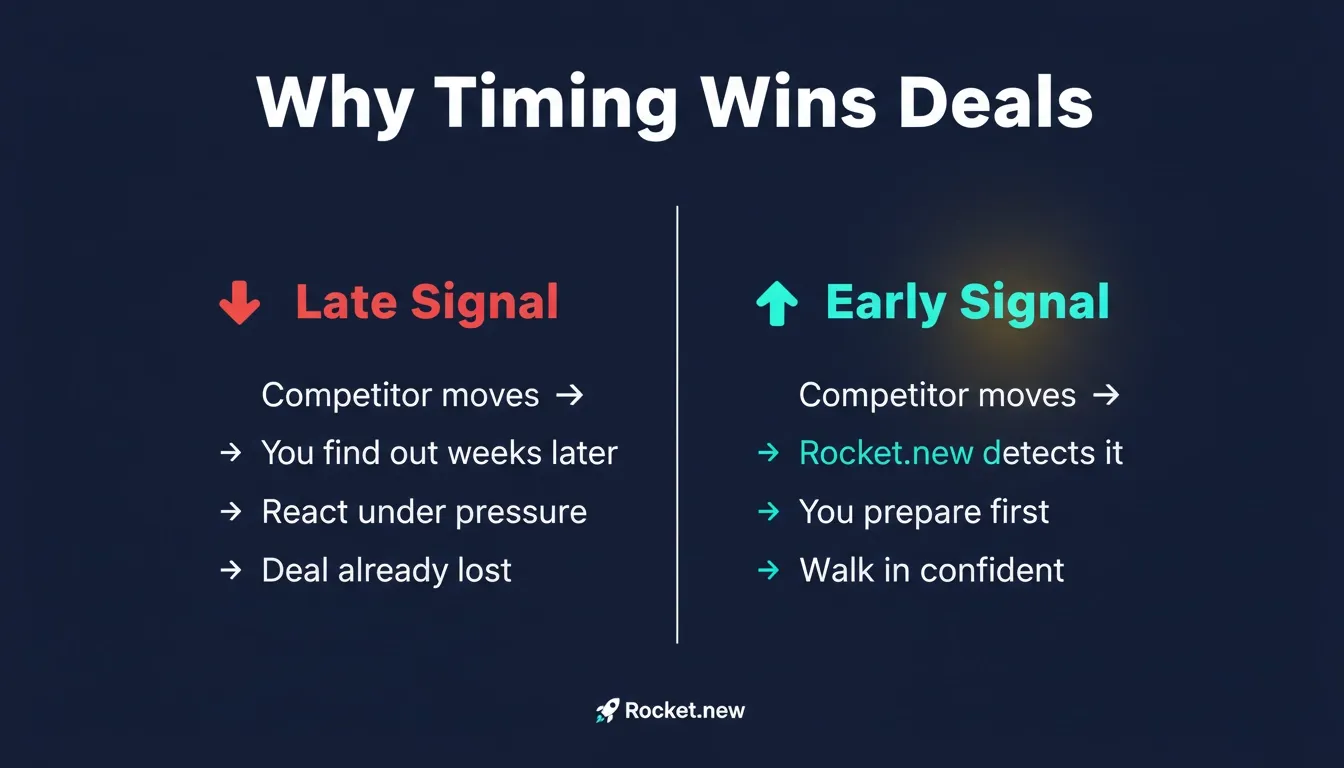 Early signal access changes how teams enter every deal conversation.
What Changes When Signals Come Early
When you start seeing competitor activity earlier, the entire approach to deals and product decisions begins to shift.
Here's what changes practically:
- You prepare your pitch with better context before the first conversation
- You adjust strategy before the meeting happens, not during it
- You build apps and messaging that reflect current market expectations
- You stop relying on guesswork and assumptions about competitor direction
- You respond with clarity instead of reacting under pressure
This is where the competitor moves on Rocket.new starts to matter. It is not just about tracking competitors; it is about timing and how quickly you can act on what you see. When signals, insights, and execution stay connected in one platform, teams move differently.
How Rocket Turns Early Signals into Action
Rocket is not just another monitoring tool. It is one system where intelligence and execution stay connected.
Rocket Intelligence focuses on collecting signals across ten intelligence pillars, structuring them, and turning them into usable context for teams. Instead of jumping between a monitoring dashboard, a Slack channel, a spreadsheet, and a build tool, teams stay in one platform and act faster.
The key difference is what happens after a signal is detected. In most setups, a competitor pricing change gets noticed by one person, shared in a thread, discussed in a meeting, and eventually acted on days or weeks later. With Rocket, the signal flows directly into a structured brief that the team can act on immediately.
From Signals to Working Apps
The old workflow looked like this: note the change, discuss it internally, plan next steps, assign owners, and build later, often weeks after the signal first appeared.
The new workflow with Rocket: see the signal early, convert it into a structured brief using natural language prompts, and start app generation or content updates immediately. This shift removes delays and helps teams move faster, turning insights into a working app while the opportunity is still fresh.
This flow works across web apps, mobile apps, and internal tools. Teams that previously needed a week to respond to a competitor's pricing change can now respond the same day.
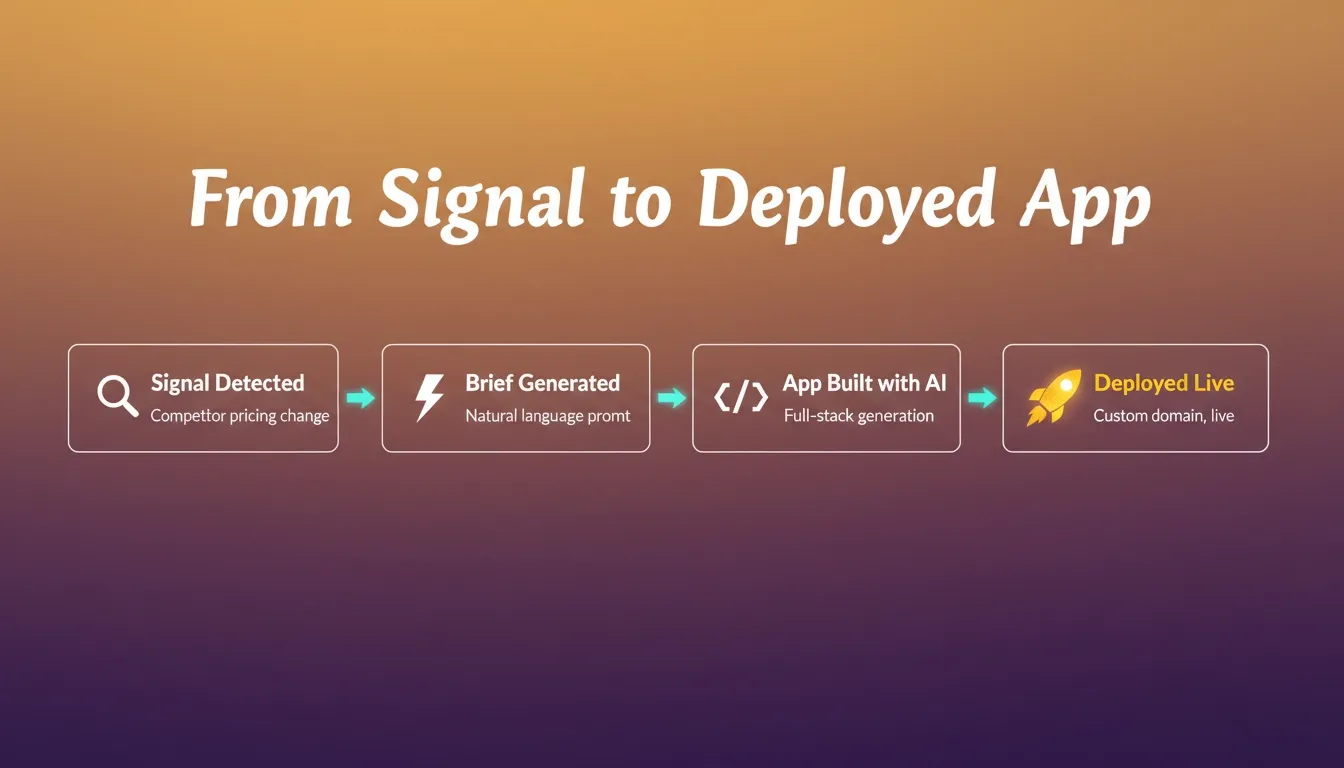 Rocket.new compresses the signal-to-deployment cycle into a single session.
How Rocket Works in Real Scenarios
The signal-to-action flow applies consistently across different competitive situations:
| Step | What Happens | Outcome |
|---|---|---|
| Signal | Competitor updates pricing or launches a feature | Detected within hours |
| Insight | Rocket organizes the signal into a structured context | No manual research needed |
| Brief | The team generates a competitive response via a prompt | Ready in minutes |
| Build | AI-powered app generation or content update begins | Same session as detection |
| Output | Production-ready apps or updated messaging | Deployed before the competitor gains traction |
This flow removes delays and works across web apps, mobile apps, and internal tools. The competitive advantage is not just speed; it is the elimination of the handoff gaps that slow every traditional workflow.
Features That Actually Help Teams Move Faster
When tools reduce friction instead of adding to it, teams naturally move faster and stay focused on what matters.
AI-Driven App Building
Rocket uses an AI engine for full-stack app generation. Teams can generate code using natural language, which means less dependency on heavy coding knowledge and faster iteration when market conditions change. When a competitor launches a new feature, teams can build a competitive response app the same day using Rocket's Build capability.
Code Editing and Version Control
You still get full editable code. Code editing is straightforward: you keep code control without losing speed. Version control and GitHub integration help teams track changes easily, so every competitive response is documented and reversible.
Backend and Data Handling
Rocket supports backend logic, database handling, and full app logic. Full-stack app building covers everything from the frontend interface to the data layer, so teams are not blocked by technical gaps when they need to move quickly. Rocket connects to Supabase for database and auth, giving teams a complete backend scaffolded from a single prompt.
Deployment and Sharing
Deploying web applications is smooth with built-in deployment workflows. Custom domain support and private sharing with access controls help teams manage visibility. All of this keeps everything in one place, helping teams move quickly without losing clarity or control.
Rocket Intelligence: Ten Pillars of Competitive Awareness
Rocket Intelligence tracks ten distinct dimensions of competitor activity, giving teams a complete picture rather than isolated data points.
Each pillar monitors a different layer of what competitors are doing:
- Product and Technology tracks feature releases, engineering velocity, and API changes
- Website Intelligence monitors messaging shifts, pricing updates, and new landing pages
- GTM Signals follows paid campaigns, creator partnerships, and PR motions
- People and Hiring reveals strategy through job postings and leadership changes
- Business and Finance tracks funding, partnerships, and commercial moves
- Reviews and Community surface what customers say on G2, forums, and review platforms
- Social Media monitors what executives and brand accounts post publicly
- News and Media captures third-party press coverage and editorial narratives
- Traffic tracks visit volumes, source mix, and growth model signals
- For You Feed surfaces Intel from companies outside your tracked universe when signals match your interests
Ten intelligence pillars give teams a complete competitive picture, not just surface-level alerts.
Pricing Structure and Plans
Rocket offers flexible pricing that works at different stages of team growth. One credit balance covers Solve, Build, and Intelligence, so teams are not managing separate budgets for research, building, and monitoring.
- A free plan for individuals and early-stage teams
- Paid plans with expanded features and higher usage limits
- Centralized billing for teams managing multiple projects
- Credit-based usage that scales with actual demand
For teams that want flexibility, this structure works well. Casual users can stay on the free plan. Growing teams that need faster competitive response cycles can move to paid plans and unlock the full intelligence-to-execution workflow. You can review the full breakdown on the Rocket.new pricing page.
Why Product Teams Prefer This Setup
Product teams deal with constant pressure: they need speed, clarity, and alignment across sales, product, and marketing. Scattered tools break that alignment. A single platform that connects intelligence to execution restores it.
Rocket helps by keeping competitive intelligence and app building in one system, which means the insight that triggers a decision and the tool that acts on it are never separated. Supporting internal tools, web apps, and mobile apps from the same environment means teams don't switch contexts when priorities shift.
Even non-technical users can build apps using AI tools, which means competitive responses are no longer blocked by waiting for engineering capacity. This is a meaningful shift for non-technical builders who need to act on market intelligence without depending on a developer queue.
When Early Signals Start Winning Deals
When you look at deals closely, the difference often comes down to how early you act on signals.
Before Rocket, competitors' moves surprised teams, reactions came late, and deals slipped to better-prepared competitors. Now, signals arrive weeks earlier, teams prepare better, and they adjust pricing pages, messaging, and apps in time.
That shift improves positioning and helps teams walk into deals with confidence instead of catching up. The timing advantage reflects the gap between when Rocket's continuous competitive monitoring detects a signal and when that same signal would surface through weekly analyst briefs or manual competitor checks.
According to research on competitive intelligence practices, companies that act on competitive signals within 24 hours are significantly more likely to protect deal outcomes than those that wait for formal reporting cycles. Teams that previously relied on bi-weekly reports now act on the same intelligence the same day it appears.
How AI App Builders Change the Way Teams Build
AI app builders are changing how teams approach building and decision-making. The shift is not just about speed; it is about connecting context to output.
Rocket stands out because it combines competitive intelligence, app building, and execution in one platform. This setup keeps everything connected instead of scattered across tools. It is not just code generation; it brings market context and execution together in one flow, which is why teams that want speed and clarity prefer this approach over point solutions that only solve one part of the problem.
Studies on AI-assisted development show that AI-powered tools can reduce development time significantly, and when that speed is paired with real-time competitive intelligence, the compounding effect on deal outcomes is substantial.
Breaking Down Rocket's Technical Capabilities
When you look at the technical setup, it is designed to support speed without losing control.
Rocket supports modern frameworks including Next.js and Flutter, which means generated apps are production-ready rather than prototype-quality. Full-stack generation covers frontend, backend, and database layers in a single build session. GitHub integration enables collaboration and version history across the team. Code download gives teams full ownership and flexibility to extend or migrate their builds.
You can build apps, test them, and launch a live app quickly, all within the same environment. Rocket also connects to 26+ third-party services, including Stripe, Supabase, HubSpot, and Airtable, all wired up from a single prompt. This matters for competitive response because the time from signal to deployed product is measured in hours, not sprints.
The complete Rocket.new competitive response cycle, from signal detection to live deployment.
Who Benefits the Most
The teams that get the most from Rocket's intelligence-to-execution approach share a few characteristics:
- Sales teams that need pre-call intelligence before enterprise deals
- Product managers who want competitive teardowns and feature gap analysis
- Founders validating market positioning against active competitors
- Non-technical builders who need to act on intelligence without engineering support
- Marketing teams tracking competitor messaging and GTM shifts
- Scaling startups that want advanced security and dedicated support as they grow
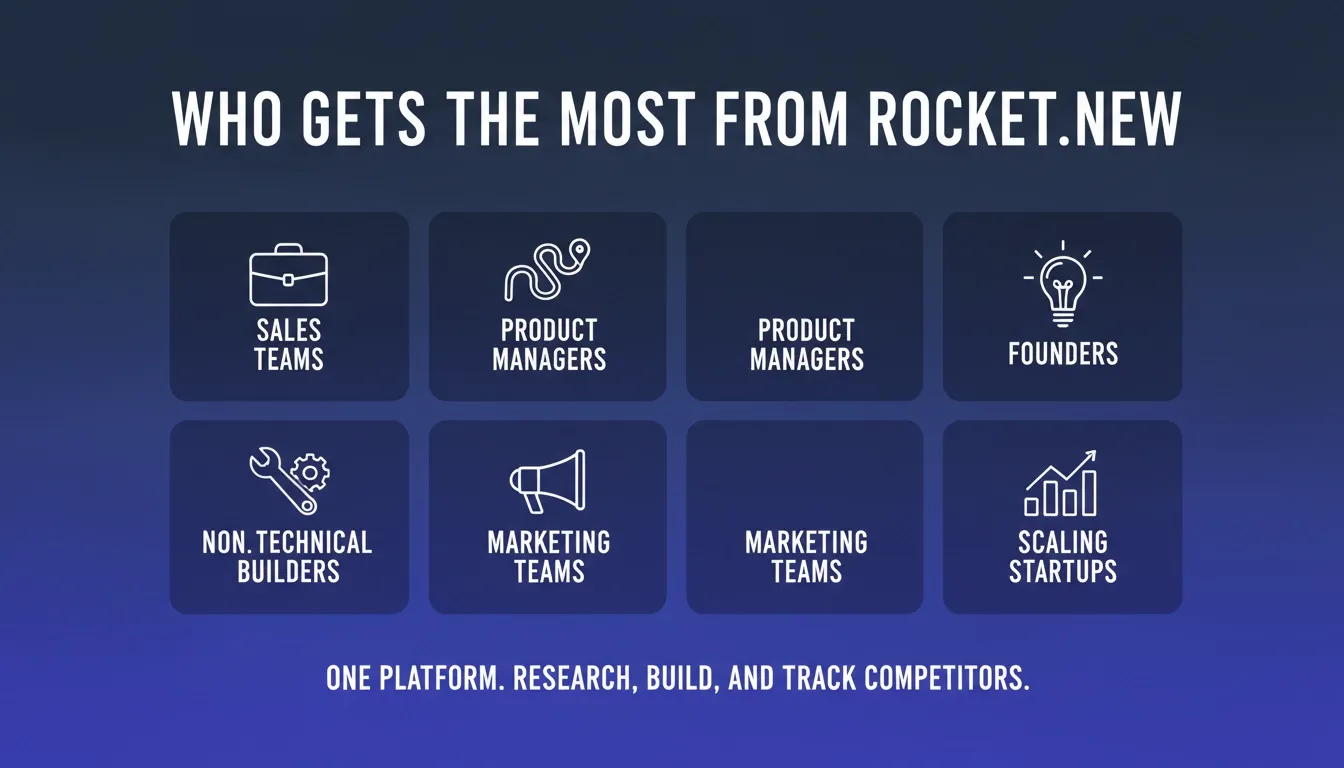 Rocket.new serves teams across roles, not just developers.
Why The Competitor Move on Rocket.new Changes Everything
Teams often miss early signals, and competitor changes reach them too late. That delay leads to slow reactions, weaker positioning, and lost deals. Workflows stay scattered, and app building drifts away from real market needs.
Rocket changes this by bringing intelligence, app building, and execution into one platform. Signals turn into action quickly, helping teams use AI-powered workflows, generate code, and build production-ready apps without delay. When signals arrive earlier, decisions improve, and teams move with clarity.
According to competitive intelligence research, teams with structured competitive intelligence programs win more deals and see higher win rates against named competitors. The real difference shows up in how prepared teams are before conversations even begin.
If you want to stay ahead of competitor moves and act faster in deals, Rocket.new is worth trying for your workflow. The platform connects the intelligence you need with the execution tools to act on it, all in one place, without the delays that cost deals.
Table of contents
- -Why Late Signals Kill Deals
- -What Changes When Signals Come Early
- -How Rocket Turns Early Signals into Action
- -From Signals to Working Apps
- -How Rocket Works in Real Scenarios
- -Features That Actually Help Teams Move Faster
- -AI-Driven App Building
- -Code Editing and Version Control
- -Backend and Data Handling
- -Deployment and Sharing
- -Rocket Intelligence: Ten Pillars of Competitive Awareness
- -Pricing Structure and Plans
- -Why Product Teams Prefer This Setup
- -When Early Signals Start Winning Deals
- -How AI App Builders Change the Way Teams Build
- -Breaking Down Rocket's Technical Capabilities
- -Who Benefits the Most
- -Why The Competitor Move on Rocket.new Changes Everything