
AI cuts M&A due diligence time by 30-50%. Use tools like Rocket.new Solve to run market sizing, competitive teardowns, and risk assessments in minutes. This guide covers the full step-by-step workflow.
Learning how to run a preliminary M&A assessment with AI gives growth teams a smarter, faster way to evaluate potential deals, cut through data overload, and surface key risks before committing to deeper diligence.
In this guide: What AI-powered M&A assessment means, a step-by-step workflow, how generative AI fits into the deal lifecycle, and how Rocket's Solve engine turns a plain-language business question into a structured, evidence-backed assessment report exportable as PDF, PPT, HTML, or PRD.
Why AI Is Changing The Early M&A Game
M&A used to mean long nights, messy spreadsheets, and endless document review. Deal teams had to go through large volumes of legal documents, financial statements, and operational data manually. It took significant time and effort to move even a single deal forward.
Now, AI tools are stepping in and changing how this early work gets done.
With artificial intelligence, deal teams can analyze vast amounts of data in minutes. This includes financial documents, market trends, and even unstructured documents like emails or contracts. Early-stage due diligence is no longer about getting everything perfect. It's about getting the right direction quickly.
AI shortens M&A due diligence by automating document review, flagging risk patterns, and synthesizing market data into structured findings, freeing analysts to focus on judgment rather than data gathering.
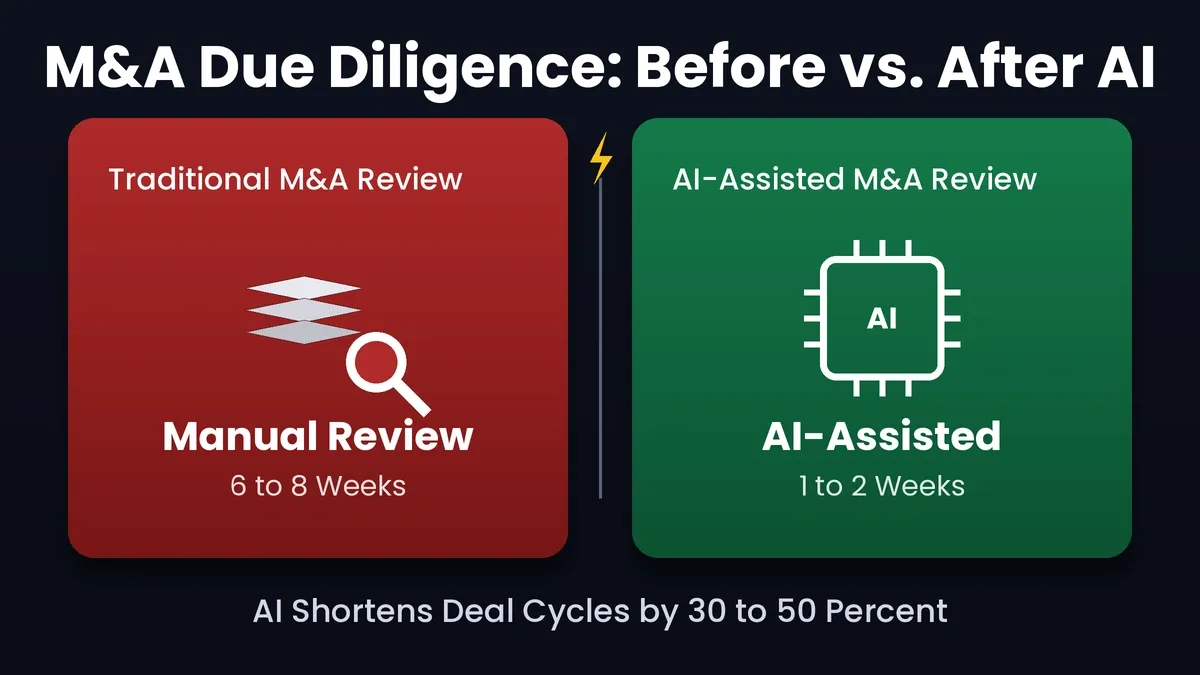
Traditional M&A review takes 6-8 weeks. AI-assisted workflows compress the same process to 1-2 weeks.
According to McKinsey & Company, 40% of respondents using generative AI in M&A said it shortened deal cycles by 30 to 50%.
This shift is making the entire deal lifecycle faster, clearer, and easier to manage for modern deal teams.
Step-By-Step: Running A Preliminary Assessment With AI
Running a preliminary M&A assessment can feel heavy at first, but AI makes the process much more manageable. It breaks the work into clear steps and helps deal teams move faster without losing direction.
1. Start With Data Collection
AI-powered M&A assessment begins with structured data ingestion, not manual gathering. You need financial statements, legal documents, operational data, and current market conditions.
Most of this sits in virtual data rooms. AI tools can pull and organize this quickly, handling large volumes without slowing down. This is where diligence AI starts helping right away.
2. Automate The Diligence Process
Next, you move into the diligence process. Traditionally, this meant manual review. Now, AI-powered tools scan documents, flag issues, and build summaries.
You can generate due diligence request lists, risk assessment summaries, and initial findings reports in a fraction of the time. AI-powered systems highlight potential risks like missing clauses, unusual financial patterns, and legal inconsistencies, giving deal teams a clear starting point.
3. Analyze Data For Insights
AI and machine learning models review historical data and current deal context. They help in analyzing historical data to compare trends. This is where predictive analytics comes in.
You start seeing potential synergies, risk exposure, and market dynamics that humans might miss in early reviews. Still, legal judgment and human oversight matter. AI is fast, but people understand nuance.
4. Identify Red Flags And Key Risks
AI helps with risk detection by scanning for key provisions in contracts, financial inconsistencies, and legal issues. This step is critical for any deal.
AI-powered systems highlight key risks so deal teams can decide whether to move forward or pause. The ability to surface red flags early is one of the highest-value applications of AI in the M&A process.
5. Build Preliminary Reports
Finally, you compile findings. AI generates structured summaries and initial drafts covering financial health, legal risks, and market position.
This saves time and helps deal teams stay aligned. By following these steps, deal teams can move through early-stage diligence with more clarity and less stress. AI does the heavy lifting, while teams stay focused on making smart decisions.
Where AI Fits In The Deal Lifecycle
Here's a breakdown of how AI transforms each stage of the M&A deal lifecycle and what changes when teams move from manual to AI-assisted workflows:
| Stage | Traditional Approach | With AI | Est. Time Saved |
|---|---|---|---|
| Data Collection | Manual gathering | Automated extraction | 60-70% |
| Document Review | Manual review | AI powered document review | 50-65% |
| Risk Detection | Time-consuming | Faster risk detection | 40-55% |
| Reporting | Manual reports | Structured summaries | 50-60% |
| Decision Making | Slower, fragmented | Data driven decisions | 30-40% |
AI supports the deal lifecycle from start to post-close stages, enabling teams to move with greater speed and confidence at every phase.
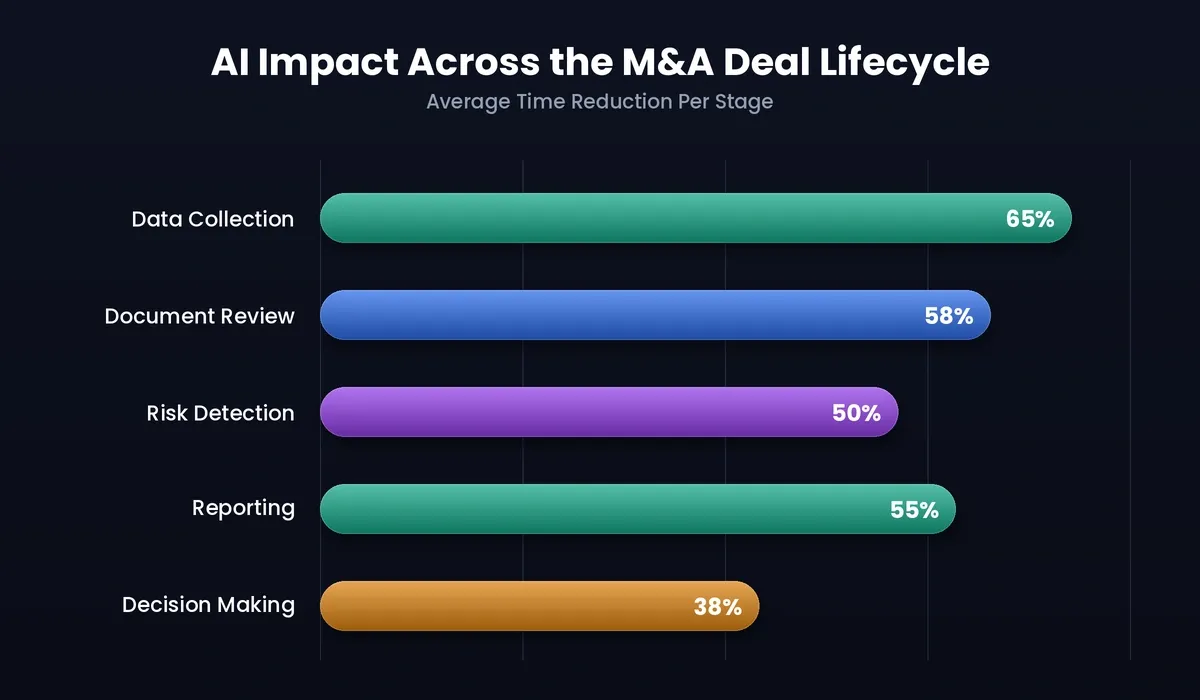
Data show consistent 30-65% time reductions across every stage of the M&A process when AI is applied.
The Role Of Generative AI In M&A
Generative AI is changing how daily work gets done in M&A. Instead of spending hours on repetitive tasks, teams can now move faster and stay focused on what really matters.
It can draft reports, summarize findings, and create structured research outputs that would previously take analysts days to compile. Generative AI also helps law firms and legal teams handle large volumes of data without getting overwhelmed.
It takes care of routine tasks like document review and basic summaries, which usually take up a lot of time. That means deal teams can spend more time thinking about strategy, deal context, and the bigger picture.
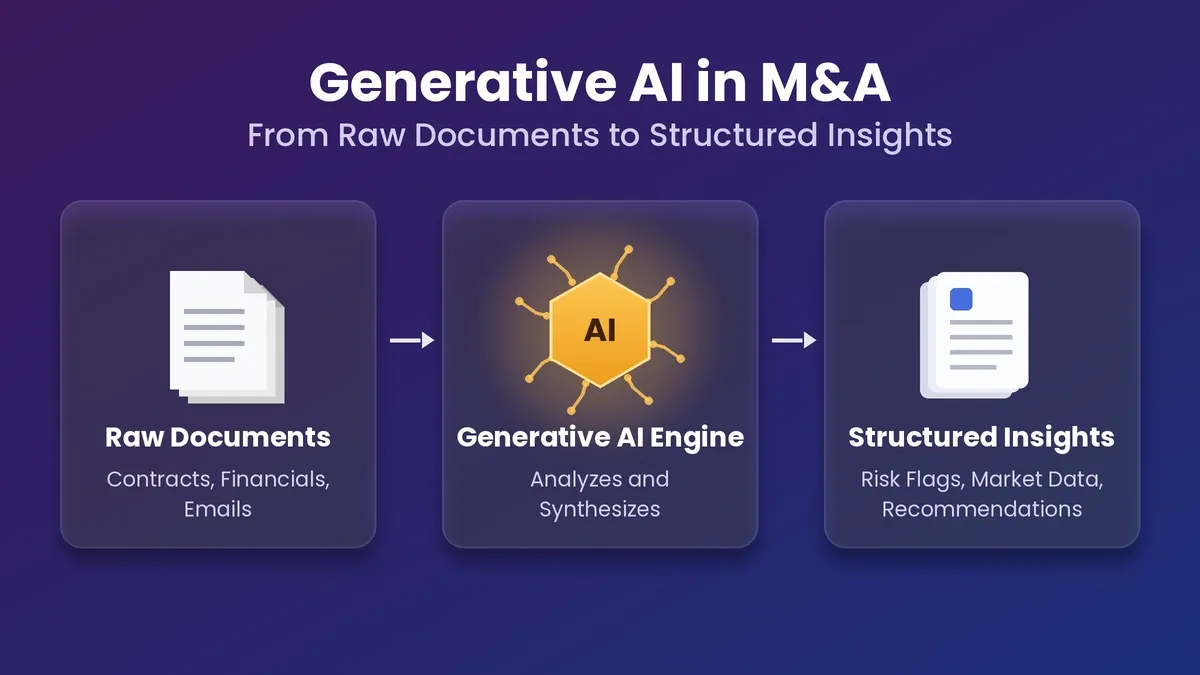
Generative AI processes unstructured documents and outputs structured, decision-ready intelligence for M&A teams.
That shift alone is making a noticeable difference in how M&A workflows work today. Teams that adopt AI-assisted workflows report faster cycle times and fewer missed risk signals during early-stage assessment.
How AI-Powered M&A Assessment Works: A Process Flow
The diagram below shows how a modern AI research engine decomposes a business question into parallel research streams and delivers a decision-ready M&A assessment report.
Rocket's Solve engine decomposes a business question into parallel research streams and delivers a decision-ready M&A assessment report.
Rocket Solve: What It Does For M&A Assessment With AI
Solve is Rocket's research engine, one of three pillars inside the Rocket platform alongside Build and Intelligence. It is built specifically for turning complex business questions into structured, evidence-backed reports with market data, competitive analysis, and recommendations in one place.
For M&A assessments, this matters because deal teams often need fast, structured answers to specific questions such as market sizing, competitive positioning, investment analysis, and business case evaluation before committing resources to deeper diligence.
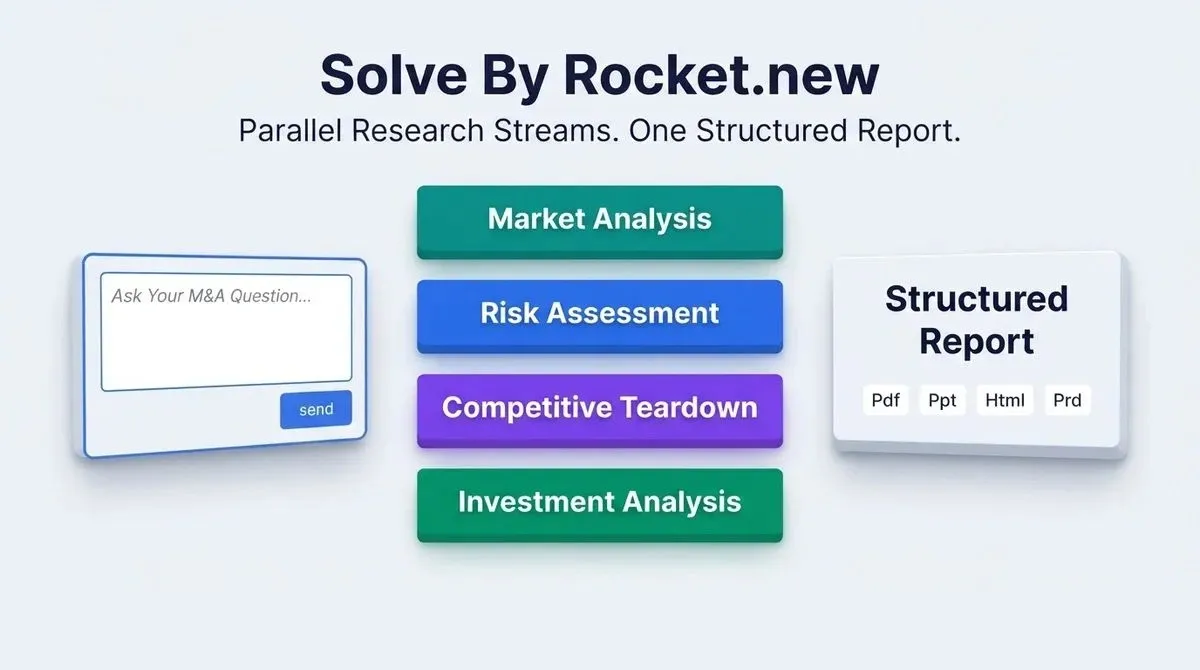
Rocket.new Solve runs multiple research streams simultaneously and delivers a structured report exportable as PDF, PPT, HTML, or PRD.
How It Works
Solve works through a structured pipeline from question to finished report. You type your business question in plain language from the Solve input.
For ambiguous questions, Solve asks clarifying questions before starting to sharpen the scope. Solve breaks the question into its component dimensions. Each becomes an independent research stream running simultaneously through parallel agents, not in sequence.
Each agent identifies what it researched, which tools it used, and how it assessed the findings. All findings merge into a structured report with an executive summary, detailed analysis, supporting evidence, and actionable recommendations. After the report is delivered, Solve suggests smart follow-up questions so you can drill deeper without reframing from scratch.
Key Features
| Feature | What It Does |
|---|---|
| Natural Language Input | Ask any business question without technical framing |
| Query Decomposition | Your question is broken into dimensions, each researched by a separate agent simultaneously |
| Structured Reports | Every task produces an executive summary, detailed analysis, supporting evidence, and recommendations |
| Investment Analysis | Build business cases, run due diligence research, and evaluate opportunities |
| Market Analysis | Size markets, identify trends, and assess opportunities relevant to a target |
| Competitive Teardowns | Compare features, analyze positioning, and run SWOT frameworks |
| Follow-Up Questions | Drill into specific findings after the report without starting over |
| Export Formats | PDF, PPT, HTML, and PRD shareable inside or outside Rocket |
It is built for growth teams who need structured, evidence-backed research to inform deal decisions quickly.
How Rocket Connects To M&A Assessments
Solve fits into early-stage assessment work where deal teams need structured answers fast. It helps deal teams ask specific business questions about a target market and get structured reports back.
Teams can run investment analysis to build business cases, analyze competitive positioning through competitive teardown research, and benchmark pricing models, all from a single plain-language input. Reports live inside your project, so findings stay accessible as the deal moves forward.
This makes it easier to move from early research to informed decision-making without losing context or repeating work. For teams already using Rocket.new's intelligence layer, Solve integrates naturally into the broader research and monitoring workflow.
Teams running competitive intelligence programs can use Solve to go deeper on any signal that Intelligence surfaces, turning a competitor alert into a full structured analysis within minutes.
Why Growth Teams Are Using AI For M&A Assessment
Growth teams today need speed and clarity. They deal with multiple potential targets, changing market conditions, and complex deal structures simultaneously.
AI tools help them save time during early analysis, reduce manual research across scattered sources, and make better data-driven decisions. Research from Deloitte shows the majority of dealmakers now consider AI-powered research tools essential to their early-stage assessment workflow.
Harvard Business Review further confirms that AI-assisted due diligence reduces the time to preliminary assessment significantly, freeing deal teams to focus on strategic judgment rather than data gathering. Teams that use AI are moving faster, staying organized, and handling deals with more confidence.
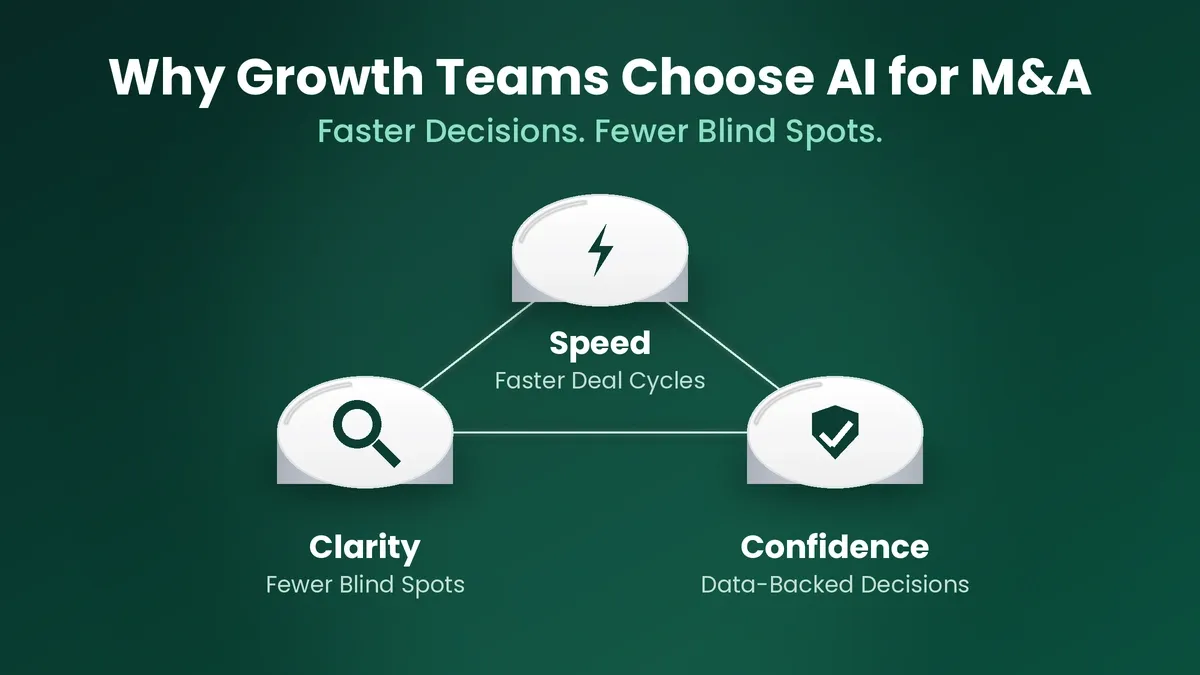
Speed, clarity, and confidence: the three pillars driving AI adoption among growth teams running M&A assessments.
Growth teams that combine AI-powered market research with structured diligence workflows are consistently outpacing competitors who rely on manual processes.
Bringing It All Together
M&A assessments are often slow and complex, with large volumes of data to review. Early-stage due diligence can take weeks and still miss red flags. This makes it hard for deal teams to move quickly and stay confident in their decisions, especially when handling multiple deals at once.
AI, especially generative AI and machine learning, helps deal teams process data faster, identify key risks, and build reports with greater clarity. Learning how to run a preliminary M&A assessment with AI gives growth teams a smarter way to approach deals while keeping human oversight and legal judgment in control.
Rocket makes running a preliminary M&A assessment with AI faster and more structured than any manual process. With Solve, your deal team gets evidence-backed reports, competitive teardowns, and investment analysis in minutes, not weeks. Start your free assessment on Rocket.new and move your next deal forward with confidence.
Table of contents
- -Why AI Is Changing The Early M&A Game
- -Step-By-Step: Running A Preliminary Assessment With AI
- -1. Start With Data Collection
- -2. Automate The Diligence Process
- -3. Analyze Data For Insights
- -4. Identify Red Flags And Key Risks
- -5. Build Preliminary Reports
- -Where AI Fits In The Deal Lifecycle
- -The Role Of Generative AI In M&A
- -How AI-Powered M&A Assessment Works: A Process Flow
- -Rocket Solve: What It Does For M&A Assessment With AI
- -How It Works
- -Key Features
- -How Rocket Connects To M&A Assessments
- -Why Growth Teams Are Using AI For M&A Assessment
- -Bringing It All Together