
AI-powered business research tool on Rocket.new that produces consistent, structured outputs, helping teams analyze data faster, reduce manual work, and make informed decisions with clarity and efficiency.
What if one tool could handle your research and give clean output every time?
That's exactly what this AI-powered system on Rocket.new does. It turns messy inputs, scattered data, and complex business questions into structured summaries you can actually use. Everything stays in one place, so the process feels smoother and easier.
According to McKinsey & Company, generative AI can substantially increase labor productivity across the economy. That's a clear shift in how teams work today.
In this blog, we will go through how this system works, what makes it different, and how you can use it to simplify your research process and get better results faster.
Why Research Feels Slow and Messy Today
Most market research still depends on manual work. People collect data from different online sources, move between tools, and try to connect everything afterward. That creates friction right from the start.
What Makes the Process Feel Broken
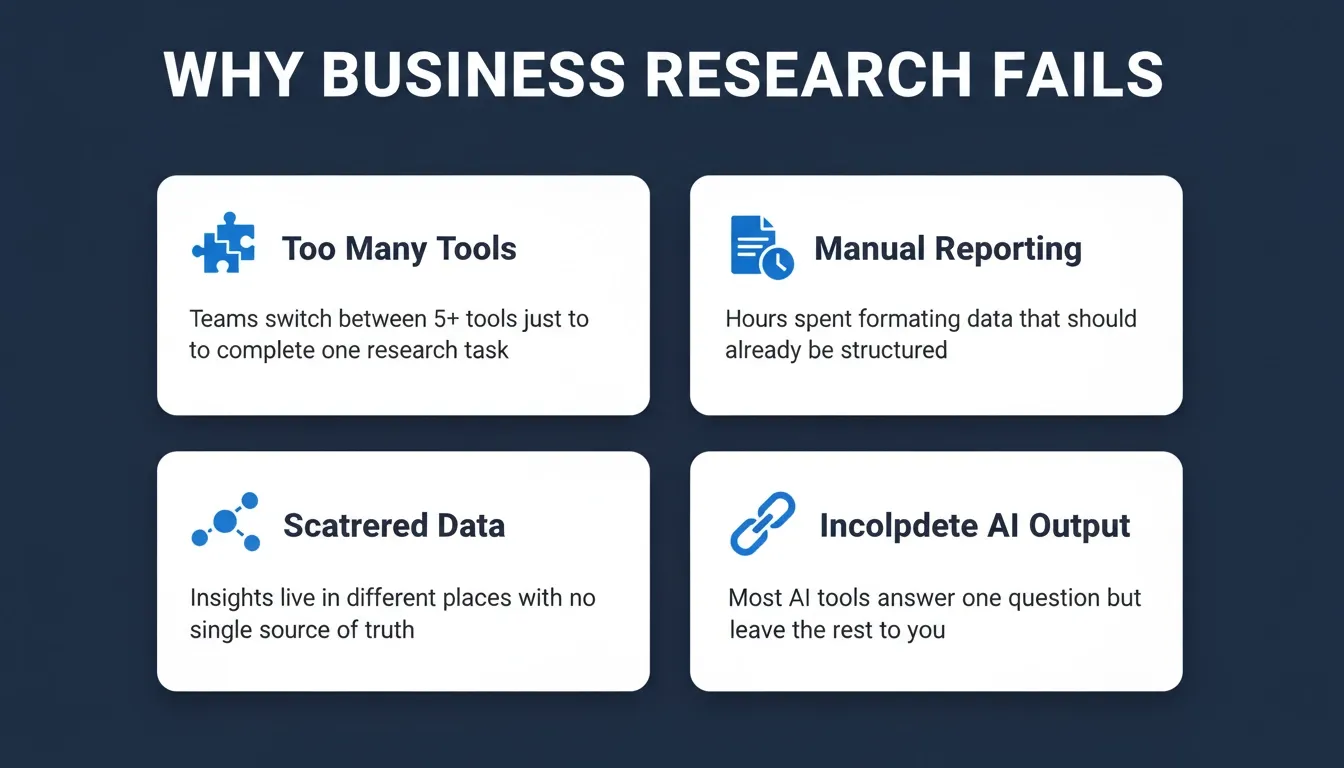
- Too many tabs, too many steps: A basic research task can turn into opening tab after tab, checking sources, copying data, and saving notes in different places. By the time you start the actual analysis, your energy is already spent.
- Tools do not work together well: One tool helps with data collection. Another helps with data analysis. A third is used for reporting. The whole process gets split across different tools, which makes the workflow feel disconnected.
- Final reporting still takes manual effort: Even after gathering the right data, the work is not done. You still need to analyze the information, structure it, and create a final report that others can understand and use.
- AI tools do not always solve the whole problem: A lot of AI tools help with one part of the job, like summarizing text or generating a few ideas. The output is often incomplete. You still have to edit, organize, and finish the work yourself.
So the real issue is bigger than slow research alone. It is the lack of a complete system that can take a research objective, work through the process, and turn it into a structured deliverable without all the usual mess in the middle.
Why Is This Tool Different from Other AI Tools for Business Research?
This is where things change. Not every AI tool is built to handle business research from start to finish. Many help in small ways, but very few support the full process.
This tool is not just another assistant that gives quick answers. It works as a complete system built for business research, with a clear focus on structure and usable output.
Teams that want to automate business workflows with AI will find this system fits naturally into how they already operate.
Where the Difference Shows
- Most AI tools help with small tasks like writing snippets, summarizing documents, or doing quick analysis. That only solves a small part of the overall process.
- This system supports the full research journey, taking you from the first question to the final output.
- Research, analysis, and output all stay in one place. You don't have to switch between different tools, which reduces gaps and confusion.
- The output is not just raw data or rough notes. You get structured summaries, useful insights, and clear recommendations that are easier to understand and share.
- It works with live data, so the findings stay relevant and up to date for real business decisions.
That's the real difference. Most AI tools support parts of the process, but this system is designed to handle everything from start to finish, which makes the final result much more complete and useful.
How the Research Process Actually Works
So how does everything actually come together? The process is designed to stay simple from the start. You begin with a basic idea, and the system takes it step by step until you have a complete, structured output.
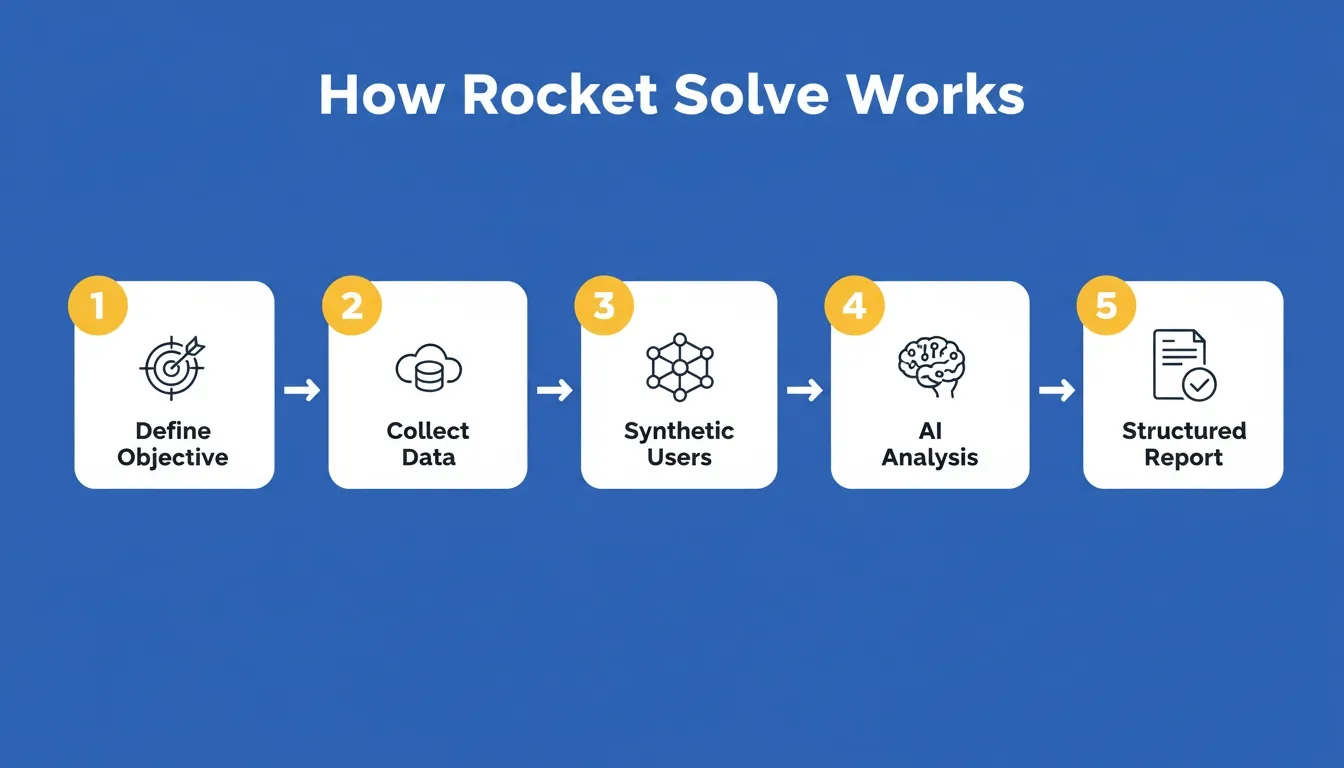
Step 1: Define Your Research Objective
Everything starts with clarity. The better your input, the better the output.
- Start with a simple input
- Describe your idea or business questions in plain language
- No complex setup or forms needed
- The system uses this to set the context
This step sets the direction for the entire process, so keeping it clear and focused makes everything smoother later.
Step 2: Collect and Organize Data
Once the direction is clear, the system moves into gathering the right information.
- Pulls data from online sources automatically
- Lets you upload PDFs for custom input
- Connect Google Drive to bring in existing files
- Organizes everything in one place
- Includes secondary research and structured data points
Instead of scattered inputs, everything is now structured and ready for deeper work.
Step 3: Use Synthetic Users and Digital Twins
Now the process goes beyond just collecting data and starts testing ideas.
- Uses synthetic users to simulate real behavior
- Creates digital twins to test assumptions
- Generates findings based on realistic scenarios
- Works like a virtual research panel
- Adds depth to your market analysis
This step adds a layer of realism, helping you move from guesses to more informed findings.
Step 4: AI Analysis and Structured Output
With all the data and context in place, the system moves into analysis.
- Processes all collected data using AI analysis
- Runs analysis tasks automatically
- Builds structured summaries from raw inputs
- Provides key findings and insights
- Gives clear recommendations in one place
This is where raw data turns into something meaningful and easy to understand.
Step 5: Final Deliverable
Now everything comes together into a usable output.
- Produces a complete report
- No need to rewrite or restructure
- Output is clean and ready to use
- Easy to share with teams
- Designed for real decision-making
You end up with a structured deliverable that's ready to use, without extra effort. The whole process flows in one direction. You start with a question and end with a structured report. No jumping between tools, no messy steps in between.
Key Features of Rocket for Business Research
Let's look at some features that make this tool useful. Understanding what inconsistent AI outputs signal for product decisions makes it clear why structured output matters so much.
| Feature | What It Does | Why It Matters |
|---|---|---|
| Structured summaries | Turns raw data into readable output | Saves time on manual reporting |
| Synthetic users | Simulates real user behavior | Delivers more realistic insights |
| Live data | Uses current information | Keeps findings accurate and relevant |
| Google Drive support | Pulls your existing files | Fits into your current workflow |
| Upload PDFs | Add your own research documents | Adds custom context to analysis |
| AI powered analysis | Automates the full analysis process | Reduces repetitive manual work |
These key features help solve the real problem of scattered research and disconnected workflows.
Rocket Solve: The System That Actually Connects Everything
So what's really powering this whole experience? It's not just a feature or a tool. It's a full system designed to connect every step of research, from input to final output, without breaking the flow.
What Rocket Solve Is Built For
- Research workflows that follow a clear structure
- Structured outputs that are ready to use
- AI powered insights that support decision-making
- Team collaboration within the same system
Rocket Solve runs queries across 150+ sources simultaneously and delivers a complete, structured solution typically covering 8 to 12 sections depending on the question type. Each finding is tagged by signal strength so you know exactly what to act on first.
Exploring the AI tools database for smarter workflows shows how Rocket Solve fits into a broader stack for teams that need research and execution in one place.
That's why it works well as a research partner. Instead of handling just one part of the process, it supports the full journey in a connected way.
How Rocket Gives Structured Output Every Time
Now let's connect this to the main idea. How does this system actually deliver a fully structured output every single time?
What Makes the Flow Consistent
- Removes gaps between research, analysis, and reporting
- Keeps everything inside one platform instead of multiple tools
- Starts with a clear research objective
- Automatically connects data collection with analysis
- Builds the output based on a continuous process
How the Process Stays Connected
- You define your research objective
- The system gathers and organizes data
- It runs analysis based on the given context
- It generates a structured output without manual fixes
Because every step is linked, the output feels consistent, structured, and ready to use every time.
Who Benefits from This System?
This is not just for one type of user. Different teams use it in different ways, depending on what they need.
Product Teams
- Test new ideas before building
- Analyze market trends quickly
- Validate features using synthetic users
- Help product managers make better decisions
This helps product teams move faster with more clarity and less guesswork.
Sales Leaders
- Understand market shifts and customer behavior
- Get strategic insights for planning
- Use data-backed findings for decision-making
This gives sales leaders a clearer view of the market and helps them plan with more confidence.
Solo Founders
- Run market research without large research teams
- Test ideas before investing time or money
- Access structured insights without extra tools
For solo founders, it works like having a full research setup without needing a big team.
Rocket Compared with Other AI Tools
There are many tools available today. Some are useful, but most don't connect the full process. According to Gartner, by 2026, more than 80% of enterprises will have used generative AI APIs or deployed generative AI-enabled applications.
Where Most Tools Fall Short
- Focus only on writing or summarizing
- Help with partial data analysis
- Require switching between different tools
- Do not produce complete structured outputs
Example: Notebook LM
- Good for academic research and document summaries
- Helps create structured summaries from existing content
- Does not manage the full research process
Quick Comparison
| Tool | What It Does | Coverage |
|---|---|---|
| Rocket Solve | End-to-end research workflow | Full structured output |
| Notebook LM | Summarizes documents | Limited workflow scope |
| Free tools | Basic tasks only | No full structure |
| Other AI tools | Single use cases | Fragmented process |
So while many tools can help in small ways, this system stands out because it connects everything. That's what makes the output more reliable and easier to use.
Why Structured Output Matters So Much
Let's slow down for a second. Getting data is easy today. The real challenge is turning that data into something clear, useful, and connected to your decisions.
The gap isn't access to data. It's the ability to turn data into a decision-ready deliverable. Teams that apply the right AI integration strategies consistently produce better research outcomes than teams relying on fragmented tools.
Why It Actually Matters
- Raw data on its own is hard to use
- Without context, data feels scattered and confusing
- You need insights that connect directly to your strategy
- Findings should answer real business questions
- Clear structure makes information easier to read and share
- Decision-making becomes faster when everything is organized
- Most AI research tools give information but not enough clarity
- Outputs often feel incomplete or unstructured
- You still need to organize and interpret the data yourself
That's the real difference. It's not just about collecting data, but about making sense of it. When the output is structured and clear, it becomes much easier to turn insights into action.
Understanding Rocket Solve's question mapping shows exactly how the system breaks down complex business questions into research dimensions before a single query runs.
Bringing Clarity to Research with One Connected System
Market research today often feels scattered and time consuming. Teams rely on many tools, move between steps, and still struggle to create structured outputs. The lack of clarity in the process makes it harder to connect data, analysis, and real insights. This leads to slower decisions and extra effort that could be avoided.
The AI Business Research Tool on Rocket.new brings everything into one platform. It connects research, analysis, and reporting into one smooth process. This helps teams save time, get clearer insights, and build stronger strategy without dealing with messy workflows.
Want to simplify your research and get structured outputs faster? Try the AI business research tool on Rocket.new and move from scattered data to clear decisions in one place.
Table of contents
- -Why Research Feels Slow and Messy Today
- -What Makes the Process Feel Broken
- -Why Is This Tool Different from Other AI Tools for Business Research?
- -Where the Difference Shows
- -How the Research Process Actually Works
- -Step 1: Define Your Research Objective
- -Step 2: Collect and Organize Data
- -Step 3: Use Synthetic Users and Digital Twins
- -Step 4: AI Analysis and Structured Output
- -Step 5: Final Deliverable
- -Key Features of Rocket for Business Research
- -Rocket Solve: The System That Actually Connects Everything
- -What Rocket Solve Is Built For
- -How Rocket Gives Structured Output Every Time
- -What Makes the Flow Consistent
- -How the Process Stays Connected
- -Who Benefits from This System?
- -Product Teams
- -Sales Leaders
- -Solo Founders
- -Rocket Compared with Other AI Tools
- -Where Most Tools Fall Short
- -Example: Notebook LM
- -Quick Comparison
- -Why Structured Output Matters So Much
- -Why It Actually Matters
- -Bringing Clarity to Research with One Connected System