Wrench - Reliable Handyman Landing Page Template
Wrench is a sidebar-companion landing page template built for independent San Francisco handyman services targeting property managers and real estate operators. It uses a dark editorial layout, a persistent sidebar with a pinned contract call to action, and a FAQ-driven scroll structure that answers every operational objection before the intake form appears. The result is a page that earns B2B trust and moves visitors toward signing a maintenance contract.
by Rocket studio
Quick summary
Wrench is a single-page handyman landing page template designed for B2B conversion in the property management space. It pairs a moody, high-contrast editorial layout with a persistent sidebar, a FAQ-anchored scroll flow, and a short intake form. Every section is built to answer the questions property managers ask before they commit to a maintenance partner.
Who this template is for
This template is built for sole-operator or small-crew handyman businesses that want to win recurring contracts, not one-off calls. It speaks directly to the decision-makers who vet vendors before signing anything.
- Independent handyman operators serving multi-unit residential or commercial properties
- Trade professionals targeting property management companies, boutique real estate firms, or coworking operators
- Service providers who need a credibility-first page that closes B2B deals, not just collects quote requests
What problem this template solves
Most handyman pages are built for homeowners looking for a quick fix. They list services, show a phone number, and stop there. That approach fails completely when your buyer is a property manager juggling forty-plus units who needs proof of insurance, a clear response time, and confidence that you can handle a punch list across multiple buildings in one week.
- Property managers need operational answers before they engage, and most service pages do not provide them
- Generic layouts bury trust signals and leave professional buyers with unanswered objections
- A single call to action with no intake logic does not qualify leads or reflect the complexity of a retainer relationship
What you get with this template
You get a fully structured, editorially designed landing page that walks a professional buyer from initial skepticism to a signed maintenance contract. The layout is opinionated and purposeful, with nothing decorative that does not also work.
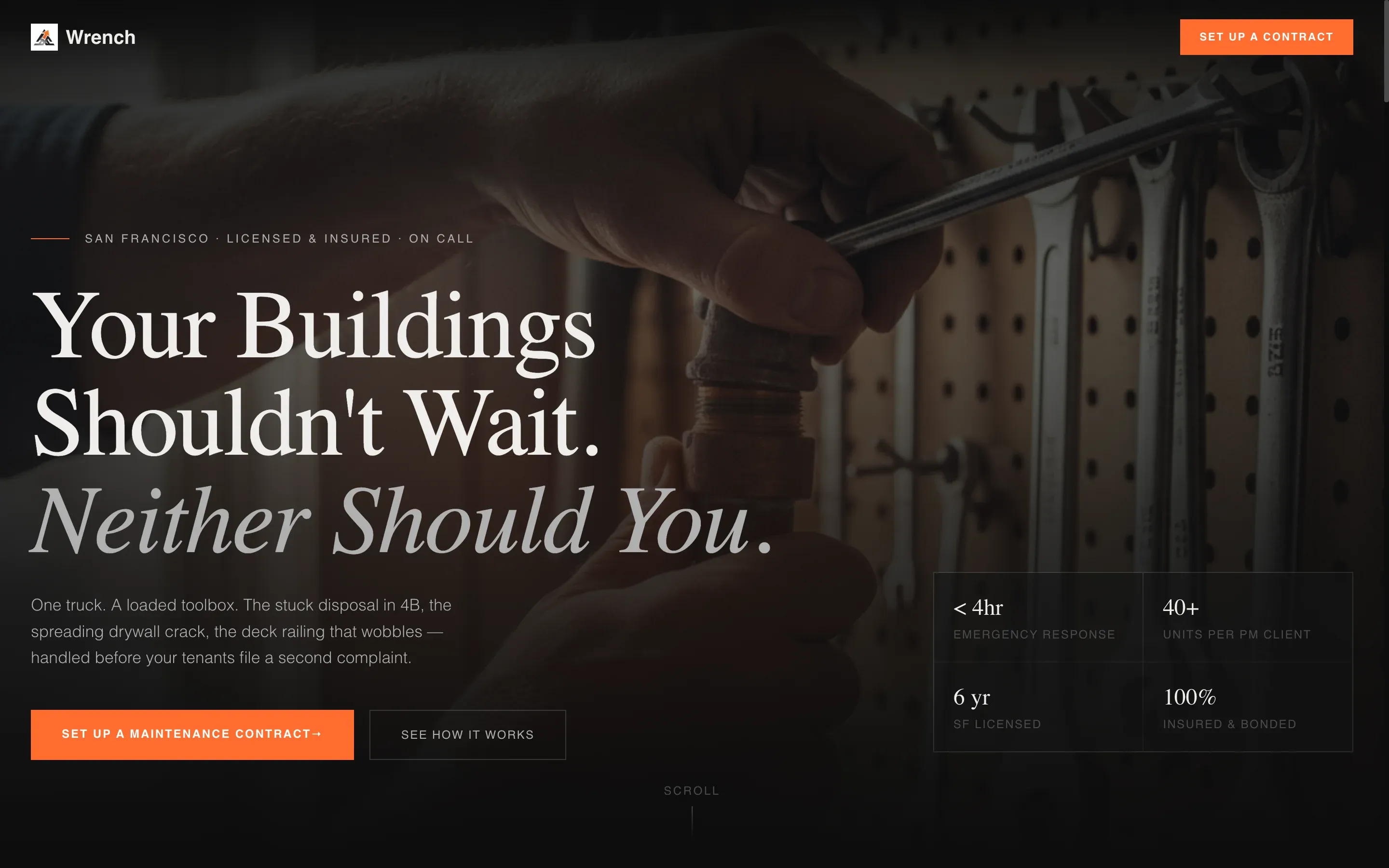
- A dark full-bleed header with a cinematic work-light photograph and a large serif editorial headline
- A persistent sidebar carrying the primary call to action and a scrolling table of contents that tracks section progress
- A FAQ-driven content flow with named testimonial slots, completed-work photo placements, and concrete metric callouts
- A two-path conversion zone: a primary "Set Up a Maintenance Contract" intake form and a secondary "Request a Single-Property Walkthrough" option
Feature list
This template is built around a set of purposeful components. Each one earns its place by serving the B2B buyer journey directly.
Dark Full-Bleed Header with Editorial Headline
The header opens with a high-contrast photograph of hands mid-repair under a clamped work light. The glow cuts through a pure-black background. A large serif headline, "Your Buildings Shouldn't Wait. Neither Should You.", sets tone and stakes immediately.
Persistent Sidebar with Pinned call to action
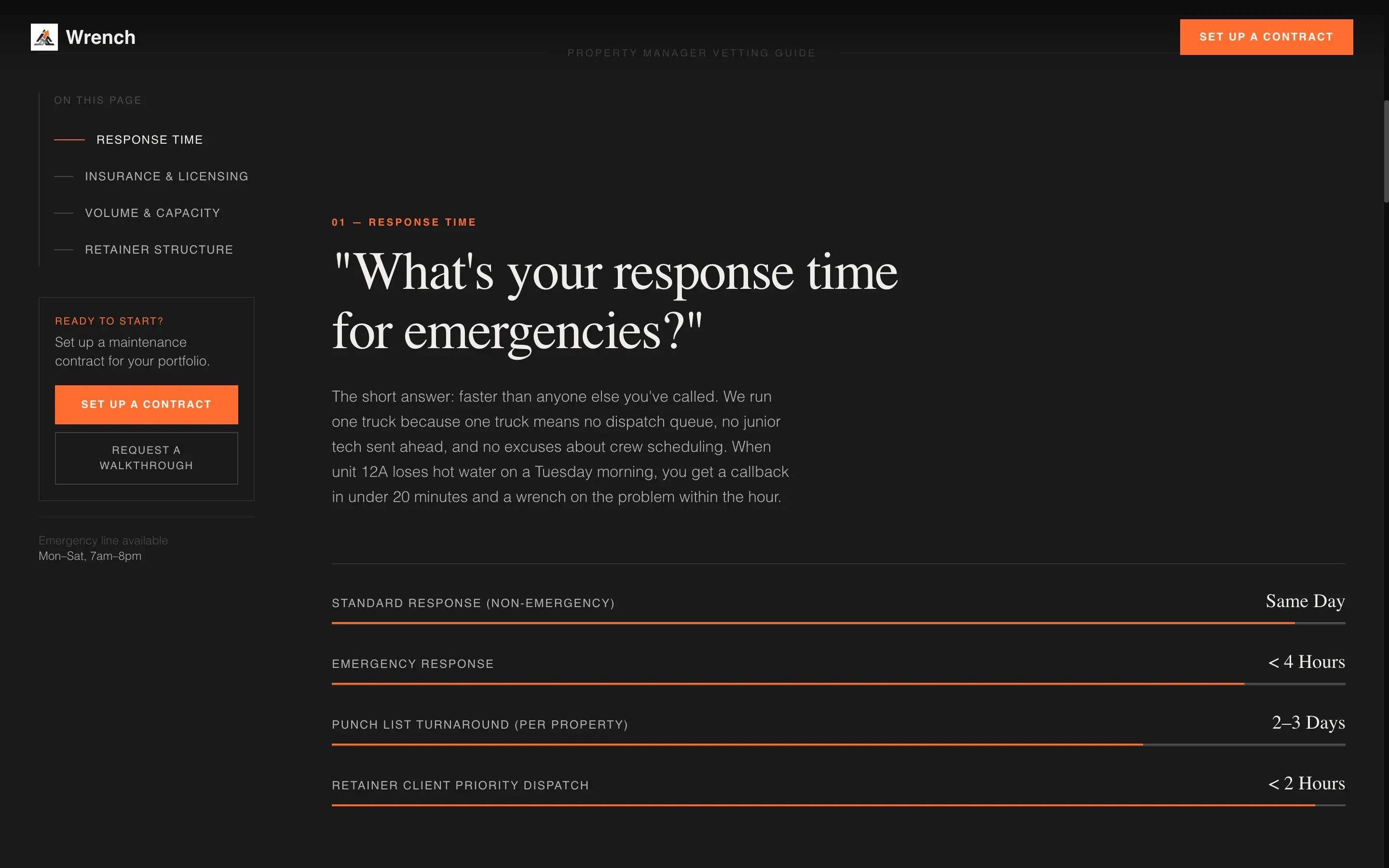
A narrow sidebar column runs the full length of the page. It holds the primary "Set Up a Maintenance Contract" call to action at all times. It also carries a scrolling table of contents so visitors can jump directly to the section answering their most pressing objection.
FAQ-Driven Section Architecture
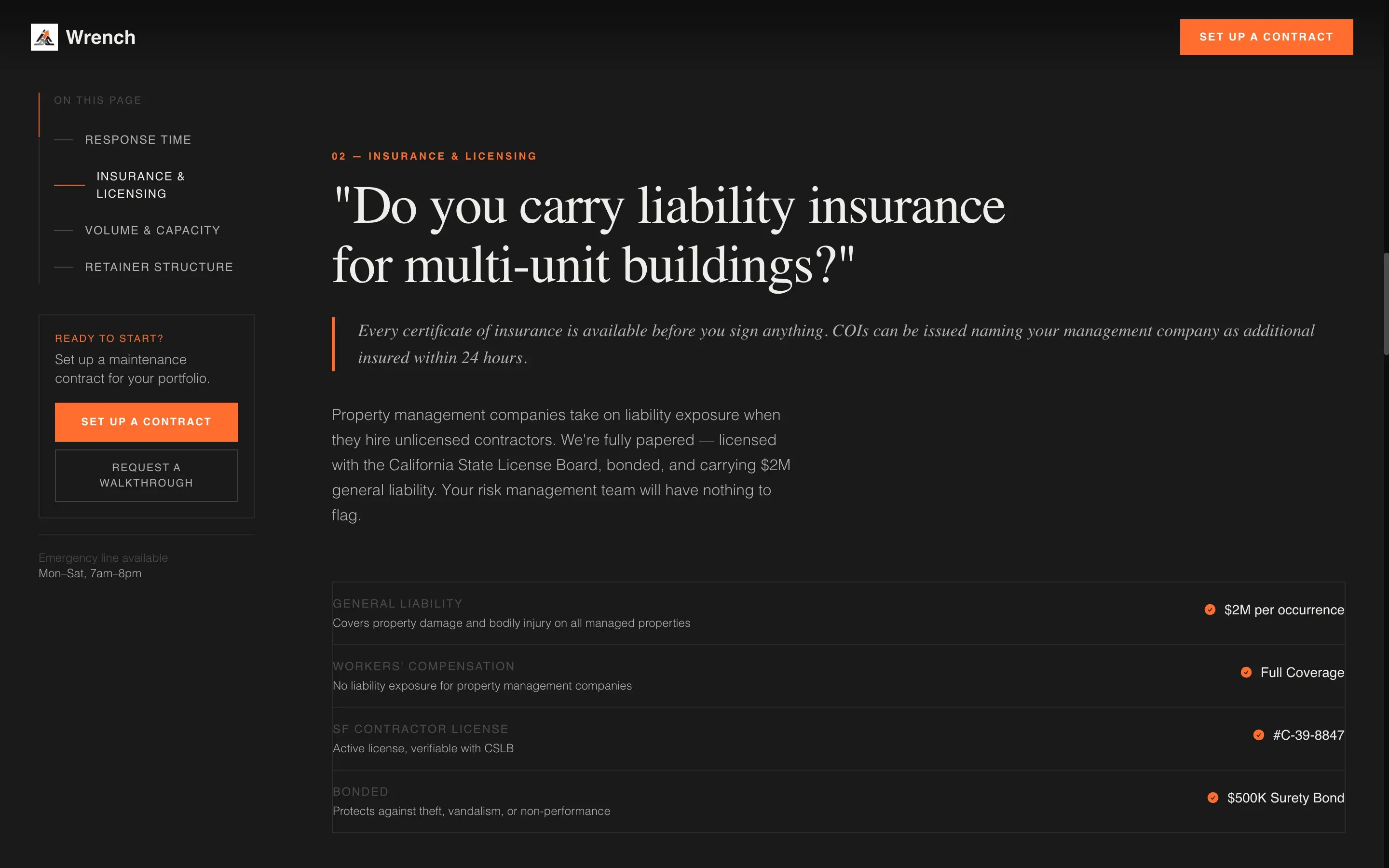
Each major scroll section is anchored by a real property manager question. Response time, liability insurance for multi-unit buildings, and punch-list capacity are each treated as full editorial sections. Every answer is followed by a proof element: a work photograph, a named testimonial from a named firm, or a concrete metric.
Two-Path Conversion Zone
The page closes with two clear options. The primary path leads to a short-form intake capturing company name, number of managed units, most common repair types via checkboxes, and preferred contact method. The secondary path offers a lower-commitment "Request a Single-Property Walkthrough" for buyers who need a trial before signing.
Monochrome Steel Visual System
The color palette uses forge black, brushed gunmetal, fog gray, and a single safety-orange accent. Orange appears only on calls to action and pull-quote borders, functioning as a visual cue that directs attention exactly where action is needed.
Objection-to-Conversion Scroll Flow
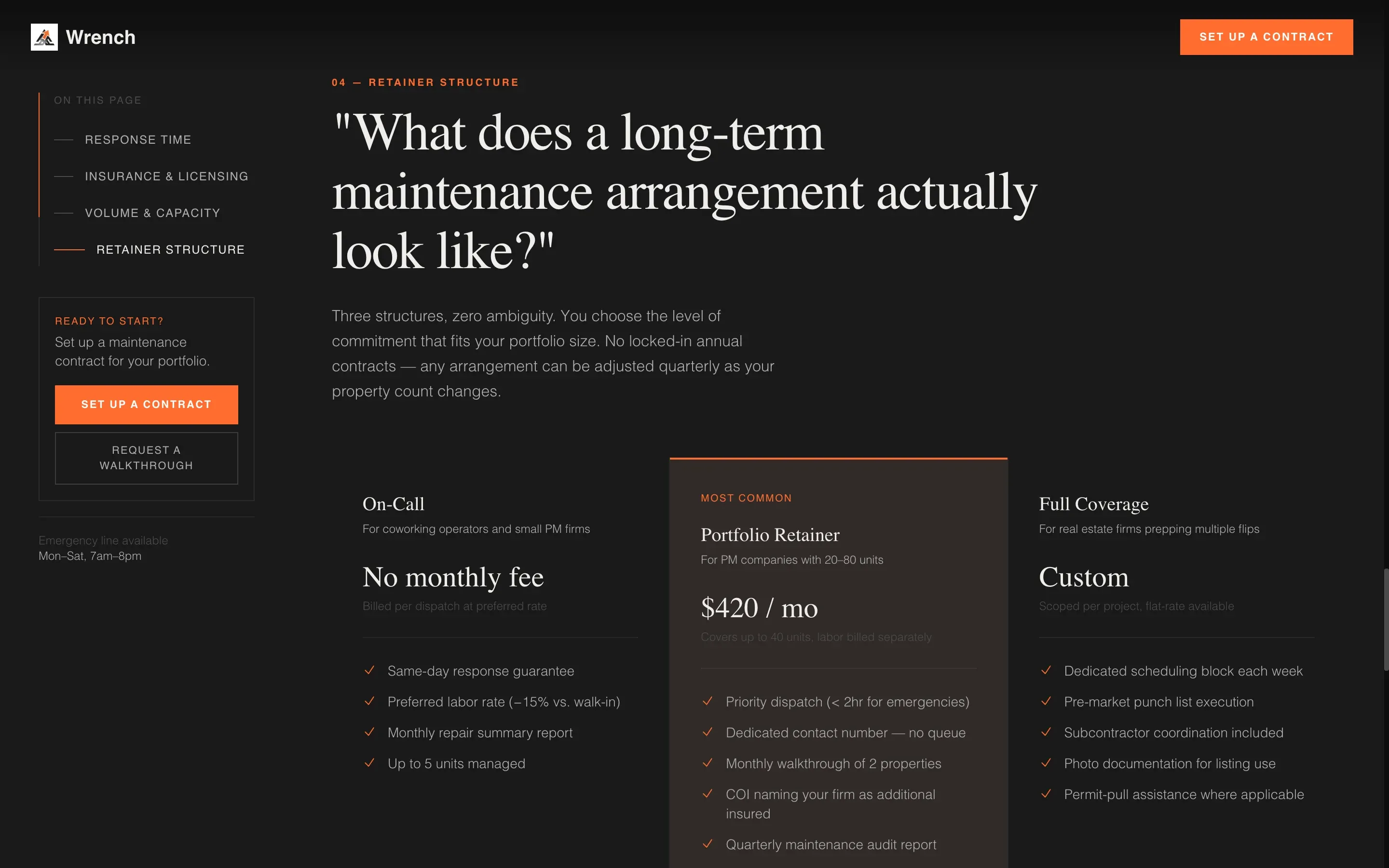
The page sequences trust signals deliberately. Logistics come first, then insurance and licensing, then the retainer structure. By the time a visitor reaches the intake form, every standard operational objection has already been addressed in order.
Page sections overview
| Section | Purpose |
|---|---|
| Full-Bleed Header | Set editorial tone and introduce the headline proposition |
| Persistent Sidebar | Pin the primary call to action and track scroll progress with contents |
| Response Time Section | Answer urgency and availability objections with proof |
| Insurance and Licensing Section | Address liability and compliance questions for multi-unit properties |
| Punch List Capacity Section | Demonstrate scale and multi-property handling capability |
| Retainer Structure Section | Explain long-term partnership terms and ongoing availability |
| Two-Path Conversion Zone | Offer contract intake or walkthrough request to match buyer readiness |
Design & branding system
The visual identity follows an Editorial Magazine theme executed through a Monochrome Steel color system. Every design choice prioritizes function and credibility over decoration.
- Color palette: forge black (#1A1A1A) for backgrounds, brushed gunmetal (#4A4A4A) for secondary surfaces, fog gray (#B0B0B0) for body text, and safety orange (#FF6D2E) reserved exclusively for calls to action and pull-quote borders
- Typography uses large serif type for headlines to reinforce the editorial magazine aesthetic, with clean supporting type for body copy and section anchors
- The overall feel references a matte-finish tool catalog shot in a converted SoMa garage, with no decorative warmth and every surface assigned a functional role
Mobile & speed optimization
The sidebar-companion layout adapts cleanly for smaller screens without losing its conversion logic. The persistent sidebar collapses appropriately so the pinned call to action remains accessible at every scroll depth.
- The sidebar call to action remains reachable on mobile so the primary conversion path is never buried
- FAQ section anchors and the scrolling table of contents preserve jump-navigation behavior across device sizes
- The intake form fields, including the repair-type checkboxes, are laid out for easy tap interaction on touch screens
How this template helps you convert
The page is structured to remove friction at every stage of a professional buyer's decision process. It does not rely on a single call to action and hope for the best.
- The FAQ-driven scroll flow answers logistics, compliance, and capacity questions in the exact order property managers raise them, so objections are resolved before the form appears.
- The persistent sidebar keeps "Set Up a Maintenance Contract" visible at all times, reducing the effort required to act once a visitor is ready.
- The two-path conversion zone matches buyer readiness: a full contract intake for those ready to commit, and a low-stakes walkthrough request for those who need one more step of proof.
Other information about this template
This template is categorized under Professional Services and San Francisco Local Services, making it a strong fit for handyman and property maintenance operators in competitive urban markets.
- The template style follows a sidebar-companion layout with an editorial single-column content flow alongside the persistent column
- Creative direction is FAQ-driven, which aligns with how B2B service buyers research and vet vendors before reaching out
- The intake form is designed for lead qualification, not just lead capture, by collecting unit count and repair type data upfront
- This template works well for operators in dense urban markets where property managers prioritize reliability, licensing, and response time over price alone
- The page can support use cases beyond San Francisco, including any urban handyman or property maintenance service targeting commercial or multi-unit residential clients
Theme
Legal Shield
Creative direction
Case Study Narrative
Color system
Slate & Sky
Style
Single Column Flow
Direction
Lead Generation
Page Sections
Dark Full-bleed Editorial Header
Persistent Sidebar with Pinned Call to Action
Faq-driven Scroll Architecture
Two-path Conversion Zone
Monochrome Steel Color System
Related questions
Can I use this template if I am not based in San Francisco?
Does the sidebar stay visible while scrolling on desktop?
What information does the intake form collect?
Is this template suited for solo operators or only larger businesses?
Can I add my own testimonials and work photos?