Engineering Consulting Reviews Website Template
Verdict is a forensic engineering landing page template built for firms that turn structural failures into courtroom-ready documentation. It uses a zigzag alternating layout, a testimonial card header, and a logo wall authority section to build credibility fast. The design is clean, evidence-forward, and structured to earn trust before asking for a case submission.
by Rocket studio
Quick summary
Verdict is a single-page forensic engineering template designed for firms that investigate structural failures and produce expert reports. It pairs an oversized attorney testimonial at the top with an alternating case-type layout below, stacking proof of competence before the first call to action appears. The page earns trust through structure, not salesmanship.
Who this template is for
This template is built for forensic engineering firms that serve high-stakes professional clients. If your work involves translating physical evidence into legally defensible documentation, Verdict fits your practice.
- Insurance adjusters managing large-scale property claims who need a firm they can refer on short notice
- Litigation attorneys preparing for depositions who need a credible expert report they can defend under cross-examination
- Municipal engineers responding to structural complaints who need qualified third-party analysis fast
What problem this template solves
Most professional services pages describe what a firm does without demonstrating that it has done it. For forensic engineers, that gap is particularly damaging. Potential clients arrive with urgent timelines and reputational stakes. They need evidence of competence before they pick up the phone.
- A generic firm page gives no proof of casework volume, failure type coverage, or report quality
- Clients in litigation contexts need peer-level credibility signals, not stock photography and taglines
- Without a structured intake path, even interested visitors leave without converting into a case inquiry
What you get with this template
Verdict delivers a fully structured landing page built around the visual logic of a case file. Every section is positioned to move a skeptical professional reader toward submitting a case for review.
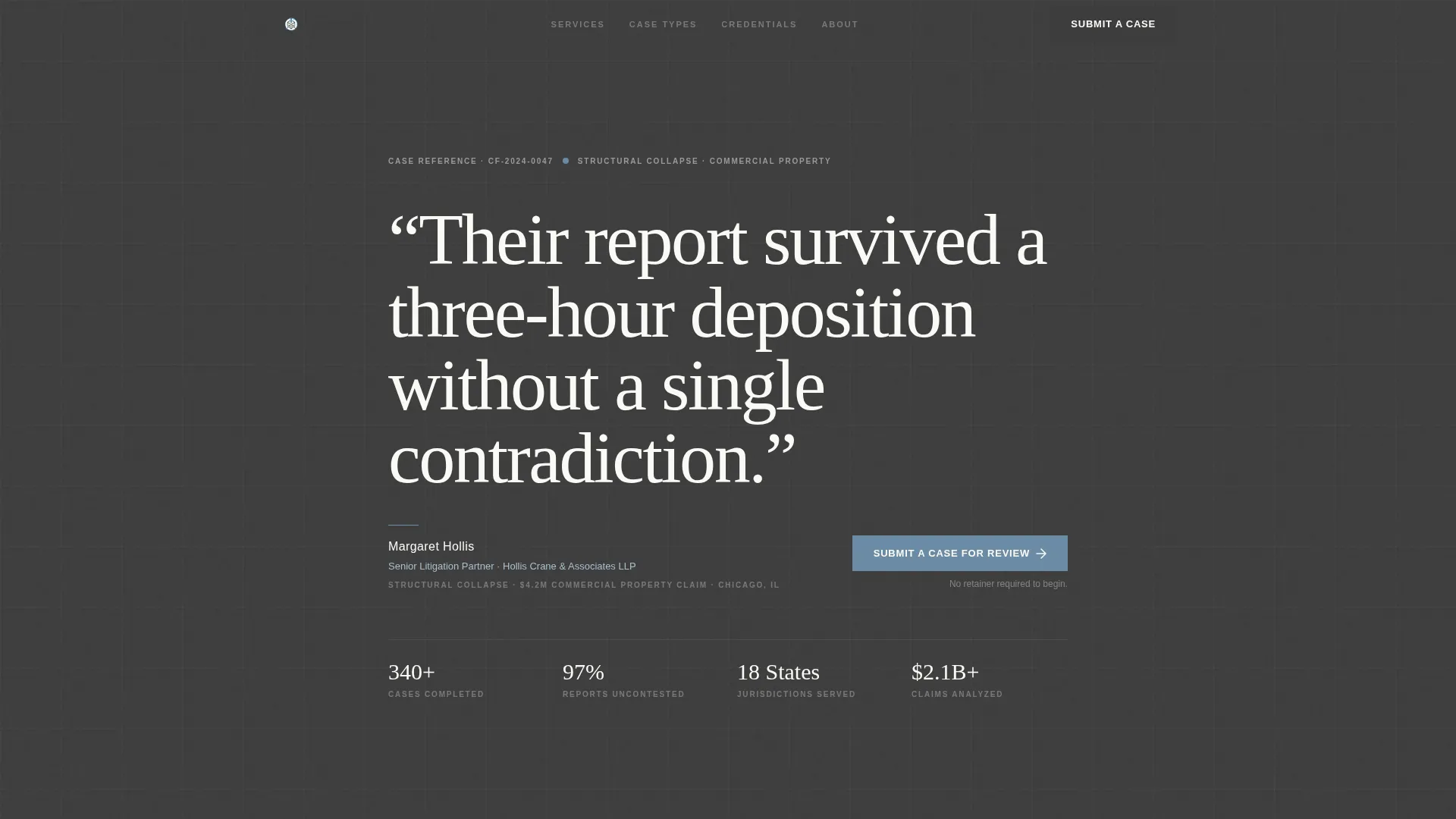
- A testimonial card header featuring an oversized quote from a named litigation partner, displayed in white type on a graphite background
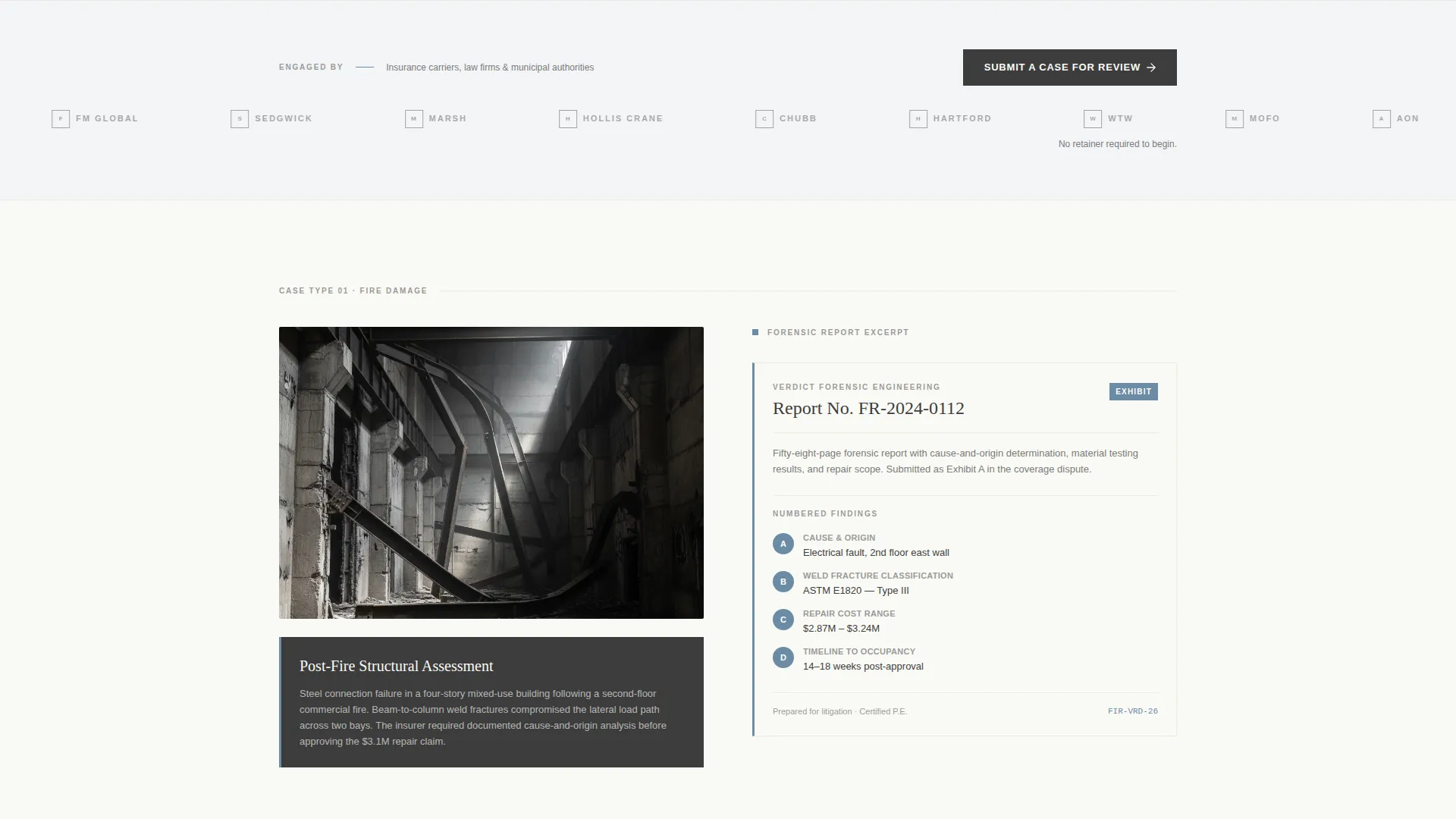
- A logo wall section showing insurance carrier and law firm credentials in desaturated grayscale, positioned immediately after the header
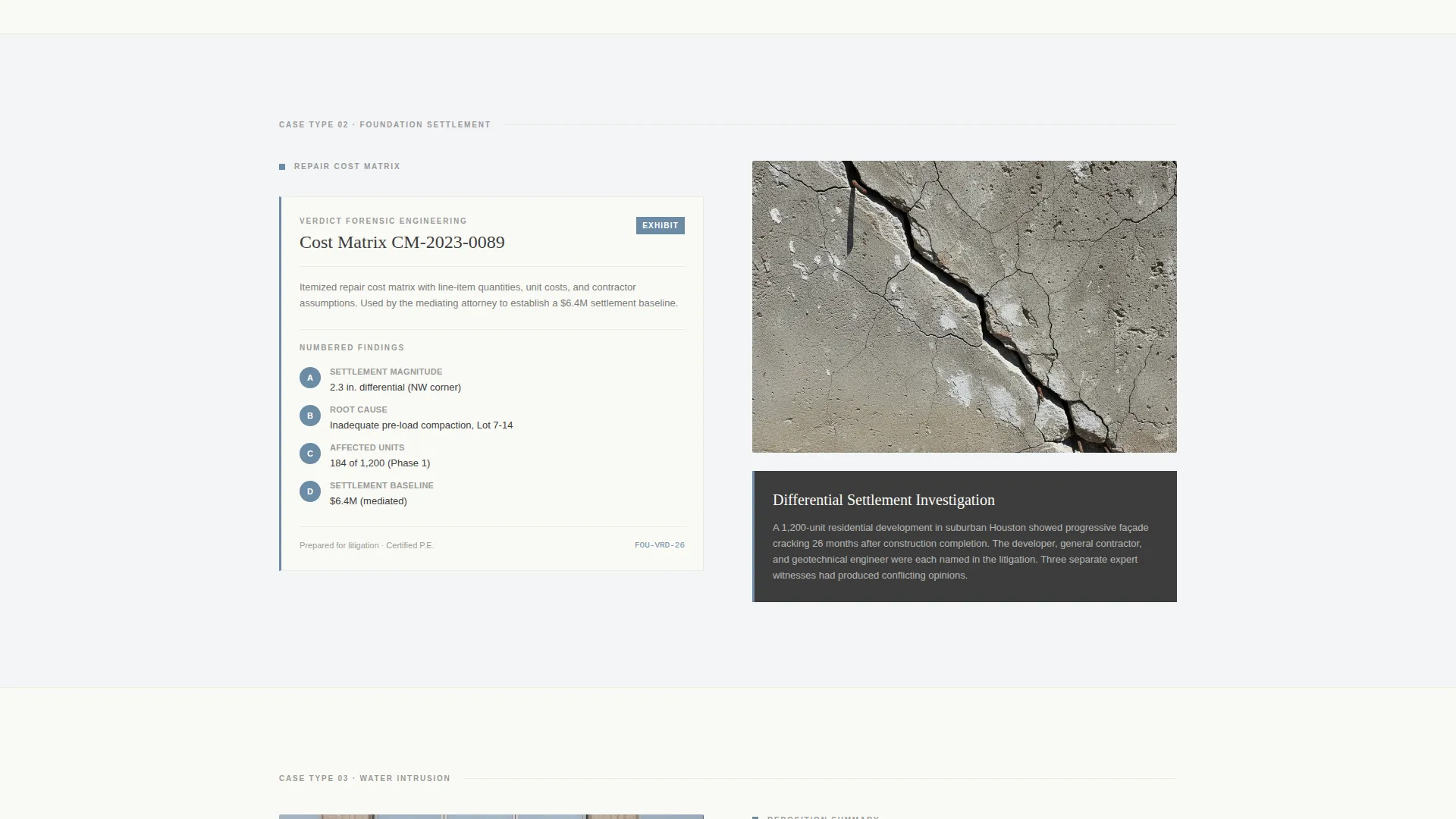
- An alternating zigzag layout pairing failure types with their corresponding deliverables across multiple content rows
- Three strategically placed calls to action, each labeled "Submit a Case for Review" with secondary text reading "No retainer required to begin"
Feature list
This section describes the core built-in components and layout decisions that define Verdict as a template.
Testimonial Card Header
The page opens with a single oversized quote card from a named litigation partner. The card uses white serif type on a graphite background. It includes the attorney's name, firm affiliation, and case type, giving the testimonial the weight of a peer recommendation rather than a marketing claim.
Logo Wall Authority Band
Immediately below the testimonial, a horizontal band displays insurance carrier logos and law firm insignia. All logos are rendered in desaturated grayscale so they read as professional credentials rather than promotional endorsements. This section establishes institutional reach before the service offering is introduced.
Zigzag Alternating Case Sections
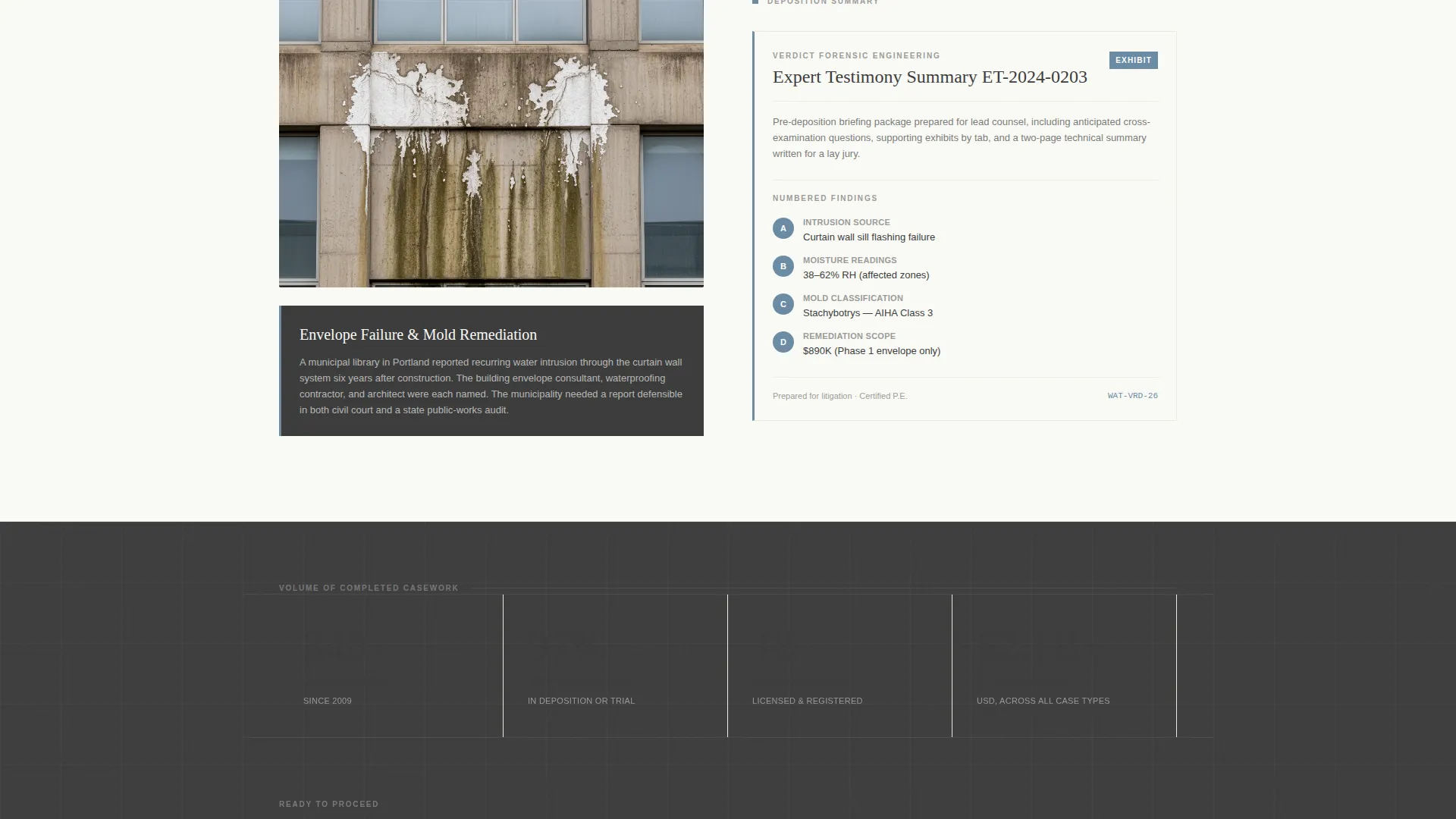
Each content row pairs a failure type on one side with its corresponding deliverable on the other. Rows alternate between image-left/text-right and image-right/text-left layouts. The alternating structure keeps the eye moving and builds a catalog of completed casework as the reader scrolls.
Three-Position Call to Action
The primary call to action button appears three times: below the testimonial card, after the logo wall, and at the bottom of the page. Each instance links to a detailed intake form on a second page. Secondary text beneath every button reads "No retainer required to begin," removing a common hesitation point.
Cloud Canvas Color System
The palette uses soft overcast white, report-paper cream, graphite notation gray, and muted steel blue. These colors evoke a freshly printed expert report under office lighting. Steel blue is reserved for links, buttons, and callout borders to guide attention without adding visual noise.
Service Utility Layout Theme
The overall theme prioritizes clarity and functional structure over decorative design. There is no hero image and no stock photography. Every visual element serves an informational purpose, which reinforces the firm's positioning as a rigorous, evidence-based practice.
Page sections overview
| Section | Purpose |
|---|---|
| Testimonial Card Header | Opens with peer credibility from a named litigation attorney |
| Logo Wall Band | Displays institutional credentials in desaturated grayscale |
| Failure Type Row 1 | Pairs fire damage case type with forensic report deliverable |
| Failure Type Row 2 | Pairs water intrusion with deposition summary deliverable |
| Failure Type Row 3 | Pairs foundation settlement with repair cost matrix deliverable |
| Mid-Page Call to Action | Reinforces case submission after logo wall section |
| Bottom Call to Action | Final conversion prompt before page end |
Design & branding system
The visual identity follows a Service Utility theme built entirely around the Cloud Canvas color system. Every color choice references the physical materials of forensic practice: printed reports, annotated drawings, and office-lit documentation.
- Soft overcast white (#F4F5F7) and report-paper cream (#FAFAF6) form the page background, giving the layout the feel of a clean professional document
- Graphite notation gray (#3D3D3D) handles all primary text and structural elements, keeping contrast firm without resorting to pure black
- Muted steel blue (#6B8BA4) is used exclusively for links, buttons, and callout borders, creating a consistent visual anchor for interactive elements
Mobile & speed optimization
The template is structured to remain clear and scannable on smaller screens. The zigzag alternating layout stacks cleanly into single-column flow on mobile, preserving the logical order of failure type followed by deliverable.
- The testimonial card scales to full width on mobile, keeping the opening credential prominent without requiring horizontal scrolling
- Logo wall imagery uses grayscale rendering, which keeps file weight low and avoids color rendering inconsistencies across devices
How this template helps you convert
Verdict is built around a specific conversion logic: demonstrate volume and variety of completed casework before asking for any commitment. The page structure earns the click rather than demanding it.
- The testimonial card at the top establishes credibility within the first few seconds of arrival, so skeptical professional visitors do not leave before reaching the service content
- The logo wall and alternating case rows accumulate proof across the scroll, so by the time a visitor reaches the final call to action, they have already seen multiple relevant failure types and their corresponding deliverables
- The phrase "No retainer required to begin" beneath every button directly addresses the hesitation most litigation clients feel before engaging a new expert firm
Other information about this template
Verdict is designed as a single landing page with a linked second page for the case intake form. The template suits firms working across failure types including cracked foundations, collapsed roofs, and fire-damaged steel structures. It is particularly well matched for practices that serve insurance adjusters, litigation attorneys, and municipal engineers simultaneously.
- The numbered exhibit and expert witness testimony framing described in the prompt supports use cases where report credibility must hold up under deposition conditions
- The absence of stock photography is a deliberate design choice that reflects the Service Utility theme and keeps the page from looking like a generic professional services site
- This template can support a firm that needs to present both its investigative range and its documentation discipline within a single scrollable page
Theme
Service Utility
Creative direction
Logo Wall Authority
Color system
Cloud Canvas
Style
Zigzag/Alternating
Direction
Click-Through
Page Sections
Testimonial Card Header
Logo Wall Authority Band
Zigzag Alternating Case Layout
Three-position Call to Action
Cloud Canvas Color System
No-photography Service Utility Design
Related questions
What type of firm is Verdict designed for?
Does the template include the intake form on the second page?
Can the testimonial card be updated with a different quote?
How many calls to action does the page include?
Is this template suitable for a firm that handles only one failure type?