Insurance PPC Agency Landing Page Template
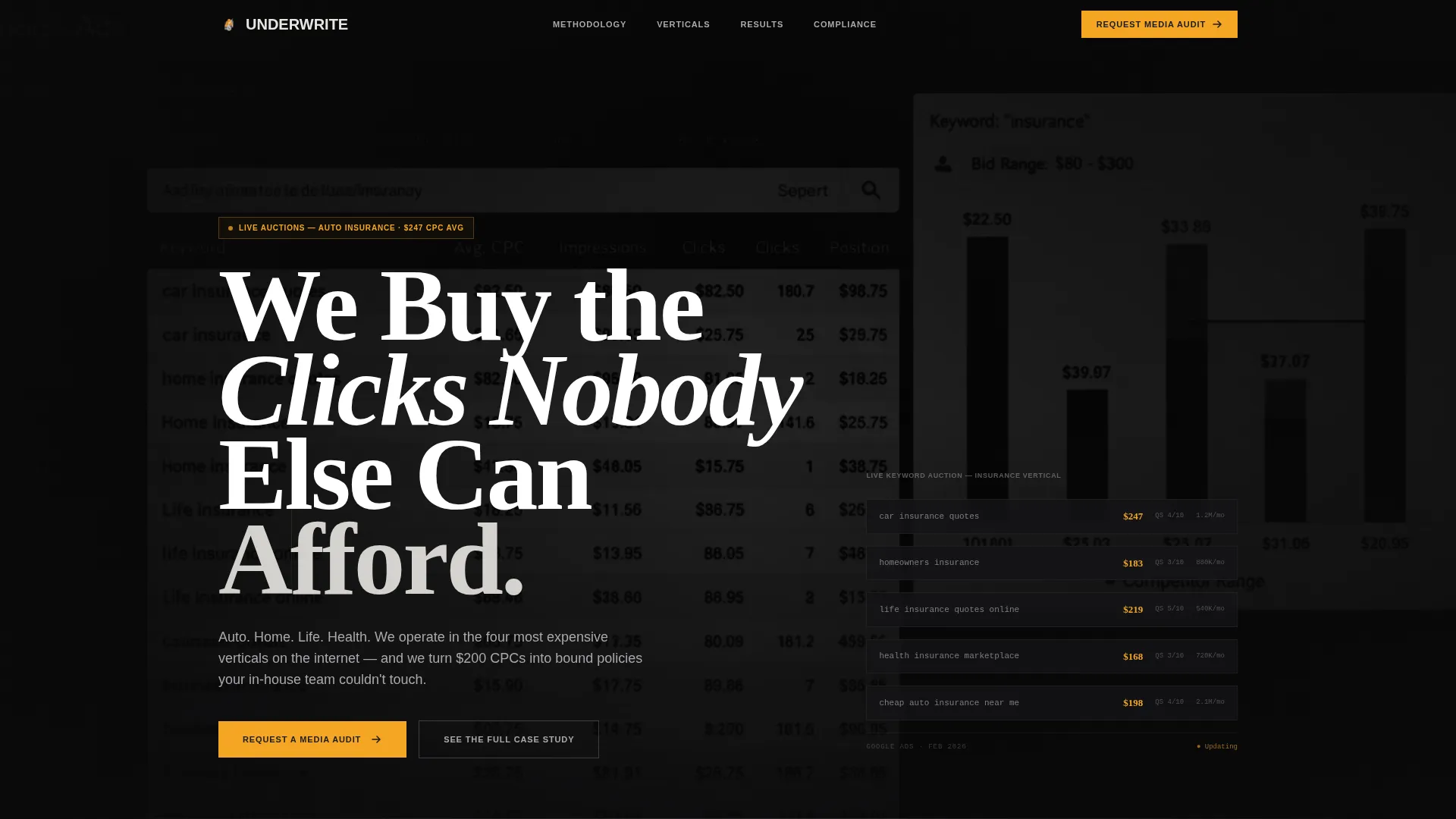
Underwrite is a bold brutalist landing page template built for insurance PPC agencies. It uses an asymmetric 60/40 grid, a monochrome steel palette, and a gallery-walk layout to present hard performance data with undeniable clarity. The primary call to action, "Request a Media Audit," drives B2B conversion from VP-level buyers at carriers and managing general agents.
by Rocket studio
Quick summary
Underwrite is a single-page, high-performance landing page template designed for insurance pay-per-click agencies. It pairs a bold brutalist visual identity with a gallery-walk layout to move serious buyers through a data-room-style evidence sequence. Every section builds a case before the form appears, so prospects arrive at the call to action already convinced.
Who this template is for
This template is built for performance-driven B2B agencies operating in the most competitive paid search verticals. It speaks directly to sophisticated buyers who measure success in cost-per-bind ratios, not click-through rates.
- Insurance PPC agencies pitching VP-level growth leads at mid-market carriers
- Managing general agents (MGAs) tired of watching high cost-per-click budgets produce weak bind rates
- Aggregator platforms that need a partner fluent in both regulatory compliance and paid media efficiency
What problem this template solves
Most agency landing pages look like brochures. They list services, show stock photography, and ask for a demo before earning any trust. In the insurance PPC space, where a single click can cost $200 or more, that approach destroys credibility before a conversation starts.
- Buyers arrive skeptical and need to see real auction economics, not promises
- Generic agency pages fail to communicate the difference between media spend and actual bound policy outcomes
- There is no natural pacing that guides a serious buyer from cold awareness to a qualified form submission
What you get with this template
You get a fully structured, single-page layout designed around sequential proof delivery. The template gives you every structural piece needed to present your agency as the only rational choice for high-stakes insurance paid media.
- A massive header with oversized slab-serif type colliding directly with a high-contrast Google Ads auction screenshot
- A 60/40 asymmetric grid that pairs oversized visual artifacts with tight explanatory copy and amber-highlighted live data points
- A two-screen progressive form capturing spend range and line of business first, then contact details second
Feature list
This template includes deliberate structural decisions that serve one goal: converting serious insurance media buyers into booked audit requests.
Asymmetric 60/40 Gallery Grid
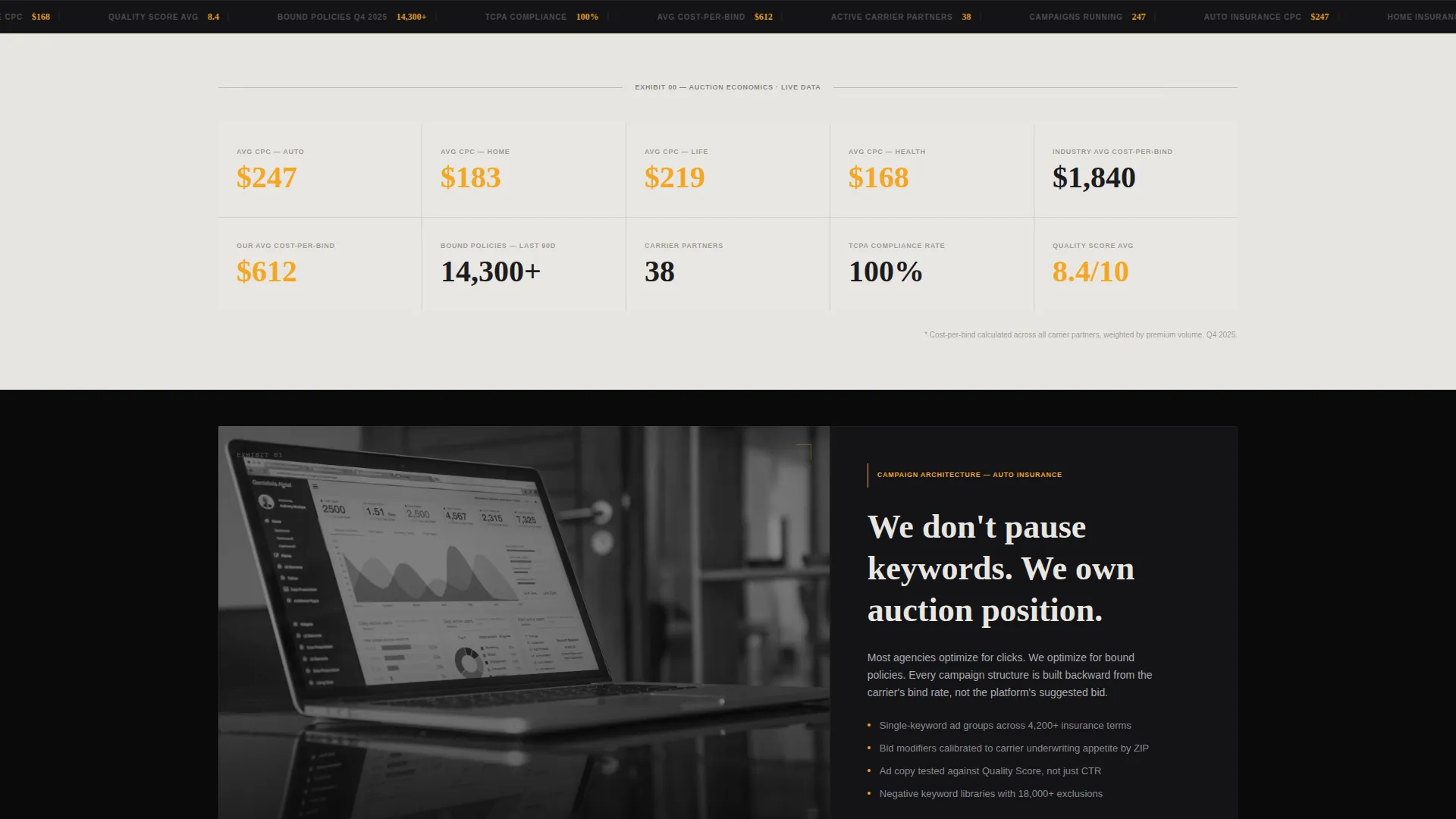
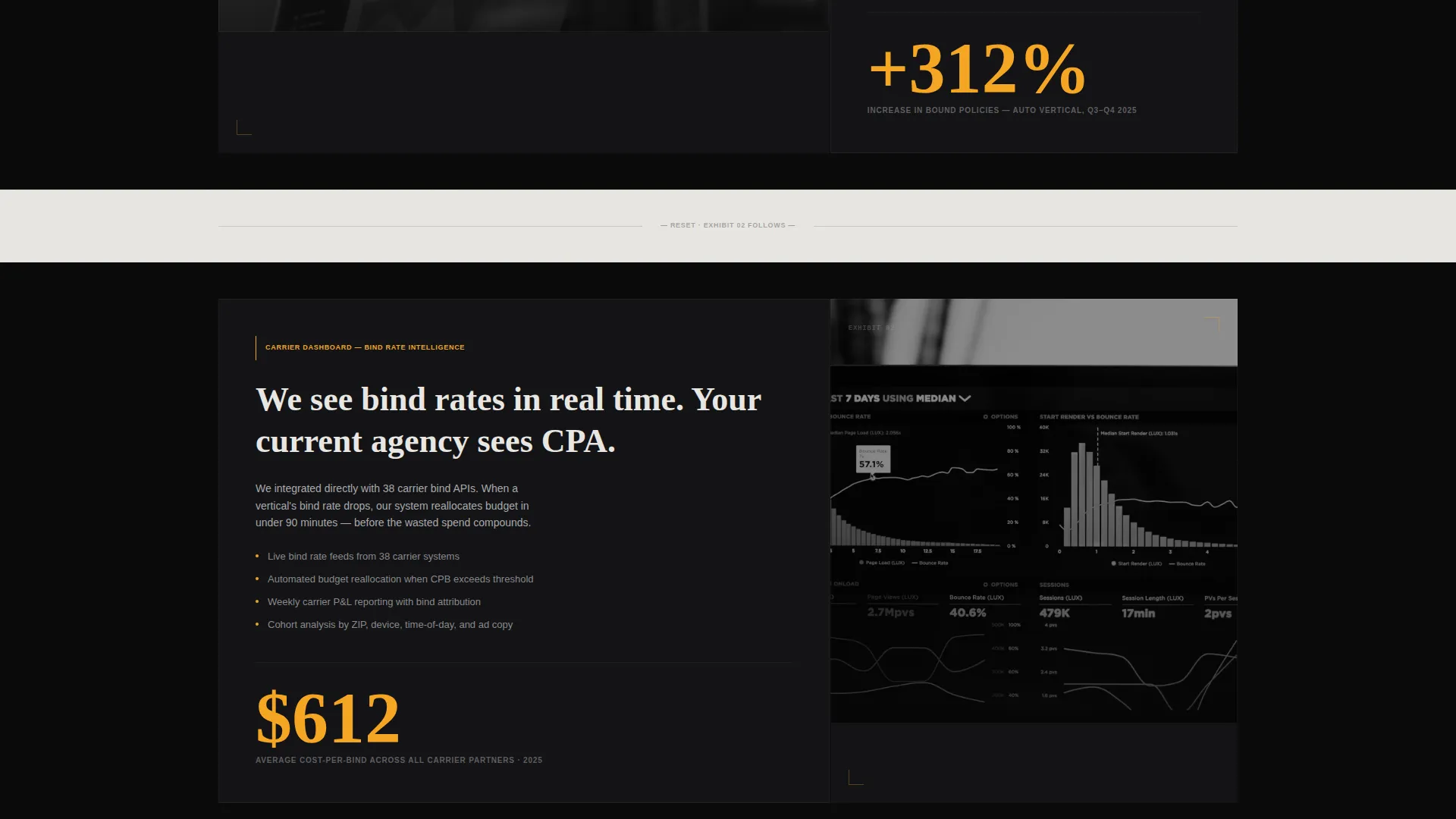
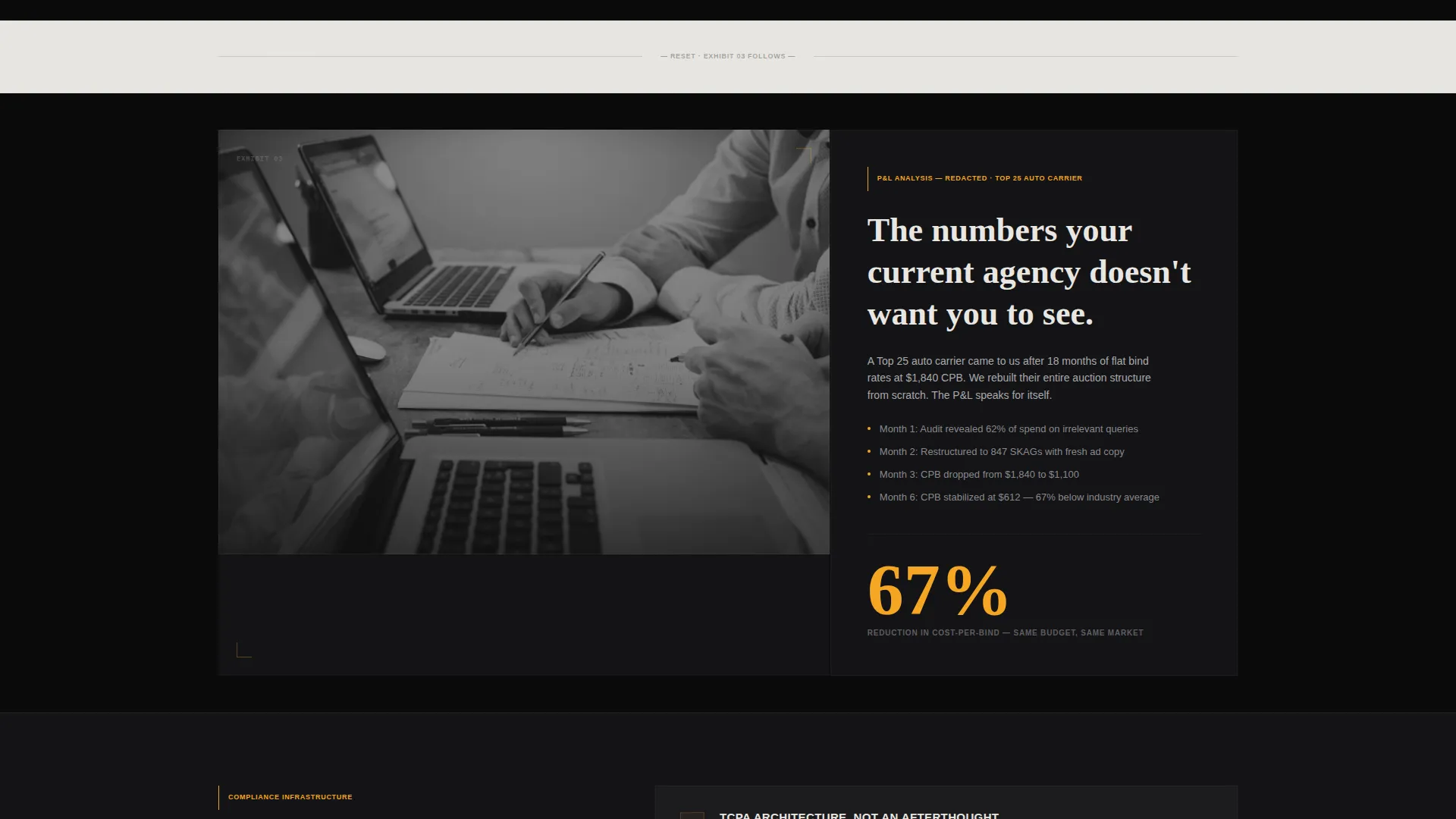
The layout divides each scroll section into a 60-column artifact side and a 40-column copy side. Campaign screenshots, carrier dashboards, and redacted cost-per-bind figures sit on the wide side. Tight, specific copy and a single oversized amber stat anchor the narrow side.
Progressive Two-Screen Form
The primary conversion form opens with a low-friction first screen asking only for monthly PPC spend range and primary line of business. The second screen captures name, carrier or MGA name, and email. This sequence qualifies leads before asking for any identifying information.
Secondary PDF Gate Path
A "See the Full Case Study" option gives cautious prospects a lower-commitment entry point. It gates a detailed carrier performance PDF behind an email-only capture, widening the funnel without diluting the primary conversion path.
Sticky Audit Request Bar
After the third gallery exhibit, a sticky bar anchors the "Request a Media Audit" call to action at the bottom of the viewport. It appears exactly when cumulative proof has built enough weight to prompt action.
Concrete Divider Pacing System
Full-bleed concrete-colored dividers separate each gallery exhibit. They force a visual pause and a mental reset between data points, controlling the rhythm of the proof sequence the way a curator spaces works in a gallery.
Bold Brutalist Type-Over-Image Header
The hero section sets a 120-pixel-plus slab-serif headline in white directly over a desaturated, high-contrast image of a live Google Ads insurance auction. The type partially obscures bid amounts in the $80 to $300 range, asserting visual dominance from the first frame.
Page sections overview
| Section | Purpose |
|---|---|
| Hero Header | Establishes authority with type-over-image auction visual |
| Exhibit One | First proof artifact with cost-per-bind stat |
| Concrete Divider | Pacing reset between evidence blocks |
| Exhibit Two | Second artifact with carrier dashboard screenshot |
| Concrete Divider | Visual pause before third data point |
| Exhibit Three | Redacted P&L artifact with amber data callout |
| Sticky Audit Bar | Persistent call-to-action anchored after third exhibit |
| Audit Request Form | Progressive two-screen primary conversion form |
| Case Study Gate | Secondary email-capture path for PDF download |
Design & branding system
The visual identity is built on a monochrome steel color system that communicates raw infrastructure rather than warmth. Every design decision reinforces the message that this agency operates at a level where decoration is waste.
- Core palette: slab charcoal (#1C1C1E), mill-finish aluminum (#A8A9AD), and poured concrete off-white (#E8E6E1) carry all layout, type, and background work
- Accent rule: caution-tape amber (#F5A623) is reserved exclusively for calls to action and live data point callouts, making it impossible to miss and impossible to ignore
- Typography is set in a heavy slab-serif at large scale, with generous gutters and no decorative elements, keeping the focus entirely on numbers and evidence
Mobile & speed optimization
The template is structured for fast, focused delivery on any screen size. A landing page built for $200-per-click traffic cannot afford slow loads or broken layouts on mobile.
- The asymmetric 60/40 grid is designed to reflow cleanly into a single-column vertical stack on smaller screens
- No animations, no video, and no decorative assets are included, keeping the page lean and load-time-friendly by design
- The sticky audit bar adapts to mobile viewports so the primary call to action remains accessible throughout the scroll
How this template helps you convert
The entire page is sequenced to earn the conversion rather than demand it. By the time a visitor reaches the form, they have walked through a full data-room argument and done the math themselves.
- The hero header immediately signals that this is not a general digital marketing agency. The auction image and headline lock in a specific, expensive context that self-selects the right buyer within seconds.
- The gallery walk builds cumulative proof through three sequential exhibits, each pairing a visual artifact with a single hard number, so the case for switching agencies assembles itself without a sales call.
- The progressive form reduces abandonment by asking only for spend range and line of business first, making the first step feel like a categorization rather than a commitment.
Other information about this template
This template is categorized under Portfolio and Agency, with a specific focus on insurance marketing and agency use cases. It is designed to serve a niche where cost-per-click rates routinely exceed $100 and where the difference between a good agency and a great one is measured in bound policies, not impressions.
- The template covers the four major insurance PPC verticals: auto, home, life, and health
- It is built for a Partnership and B2B conversion direction, meaning every layout decision prioritizes qualified lead capture over broad audience reach
- The bold brutalist theme and monochrome steel color system are intentional signals to a buyer audience that values performance data over aesthetics
- The gallery-walk creative direction borrows from investor data-room conventions, making it familiar and credible to VP-level and C-suite buyers
Theme
Bold Brutalist
Creative direction
Gallery Walk
Color system
Monochrome Steel
Style
Asymmetric Grid (60/40)
Direction
Partnership/B2B
Page Sections
Asymmetric 60/40 Gallery Grid
Progressive Two-screen Form
Secondary PDF Case Study Gate
Sticky Audit Request Bar
Bold Type-over-image Hero
Concrete Divider Pacing System
Related questions
Who is the primary audience for this landing page template?
What does the Request a Media Audit form collect?
Is there a secondary conversion path for less ready prospects?
Can the color system be adapted to match a different brand?
What insurance verticals does this template address?