Synchronize — Intelligent Distributed Learning Landing Page Template
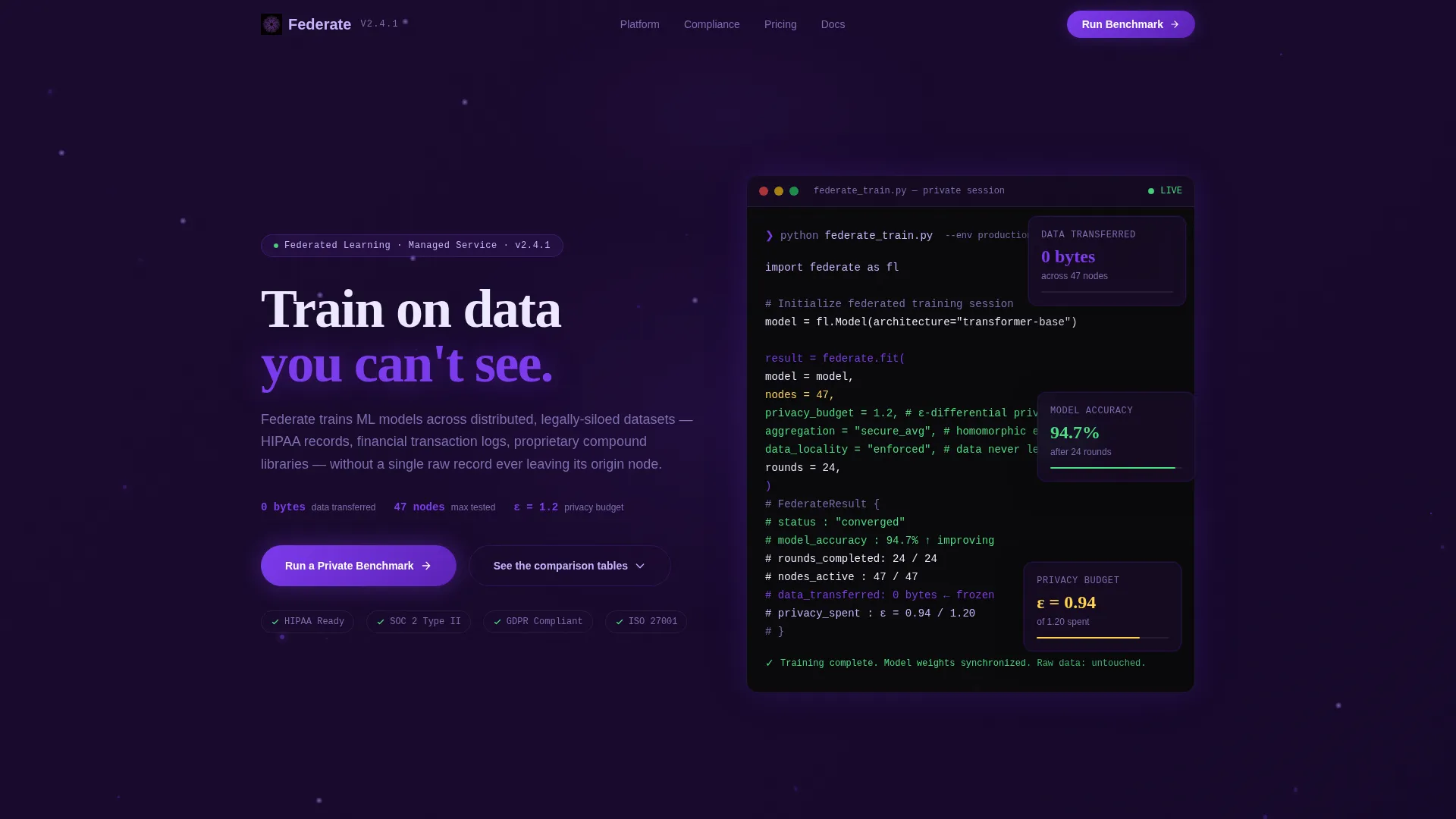
Federate is a single-page comparison landing page template built for a federated learning managed service. It opens with a full-viewport dark terminal showing a live `federate.fit()` call, then stacks bold stats and structured comparison tables to make the build-versus-buy argument feel inevitable. Designed for technical and regulated-industry audiences, it guides visitors from curiosity to a benchmark request.
by Rocket studio
Quick summary
Federate is a comparison-table landing page template for a federated learning managed service. A full-viewport terminal header demonstrates the product's core promise in six lines of code. Bold stat blocks and multi-row comparison tables then build a structured, evidence-based case, one scroll at a time, until the primary call to action feels like a logical next step rather than a sales push.
Who this template is for
This template is built for technical teams and product marketers promoting a managed federated learning service to regulated industries. The audience already understands the compliance pain. They need a page that speaks in their language, code, benchmarks, and audit-ready evidence.
- Healthcare AI teams blocked from centralizing patient records under privacy regulations
- Financial institutions running anti-fraud models across subsidiaries that cannot legally share transaction data
- Pharmaceutical companies building collaborative drug-discovery models with partners who guard proprietary compound libraries
What problem this template solves
Regulated organizations cannot centralize raw data, yet they still need machine learning models that improve over time. Standard ML sales pages describe features. This template shows a working system, convergence metrics climbing while a data_transferred: 0 bytes counter stays frozen at zero.
- Visitors arrive skeptical of "privacy-preserving" claims and need proof before reading a single marketing paragraph
- Internal build-versus-buy debates stall decisions; a structured comparison table across multiple dimensions resolves the argument visually
- Compliance teams need whitepaper access alongside the benchmark form, not buried in a footer
What you get with this template
The template delivers a tightly sequenced single-page layout that moves from terminal demonstration to stat impact to structured comparison, then closes with two distinct conversion paths.
- Full-viewport auto-typing terminal header showing a real
federate.fit()call with convergence output and a frozendata_transferred: 0 bytescounter - Three comparison tables pitting the service against centralized pipelines, raw-data-sharing consortiums, and open-source federated frameworks across compliance, speed, drift handling, and audit readiness
- Dual conversion paths: a "Run a Private Benchmark" form with ML framework, data silo count, and regulated industry inputs, plus a "Download the Compliance Whitepaper" gate behind a work email field
Feature list
This section covers the core functional and design components delivered inside the template.
Auto-Typing Terminal Header
A full-viewport dark terminal opens the page and types the federate.fit() call line by line. Arguments include nodes=47, privacy_budget=1.2, aggregation="secure_avg", and data_locality="enforced". A response object renders below showing model accuracy reaching 94.7% while data_transferred stays at zero. The contrast is the entire product pitch.
Stats-First Impact Block
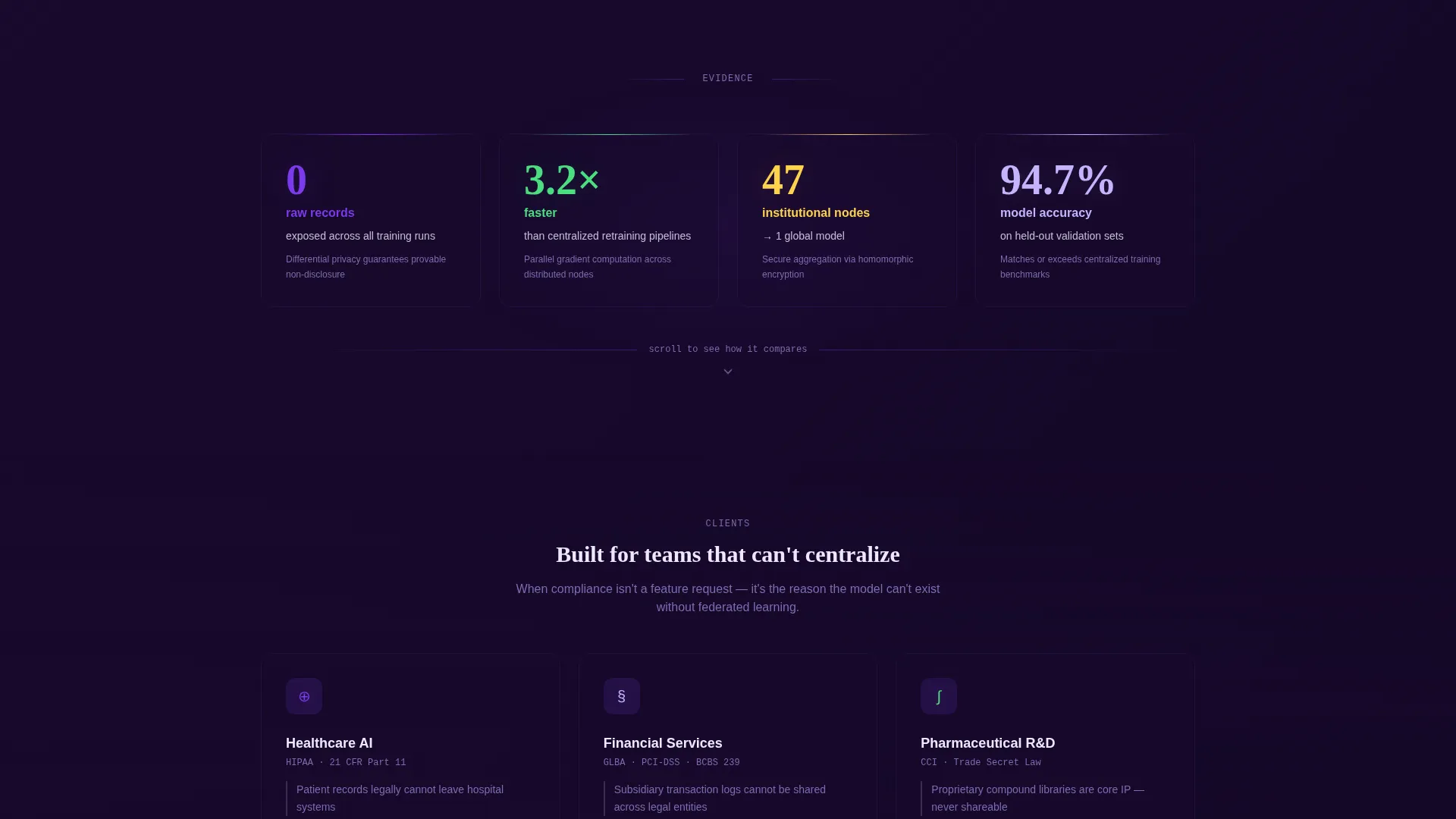
Three bold violet numerals appear immediately below the terminal: "0 raw records exposed," "3.2× faster than centralized retraining," and "47 institutional nodes, 1 global model." Each stat anchors a row in the comparison tables that follow, so every number has a structural payoff as the visitor scrolls.
Multi-Dimension Comparison Tables
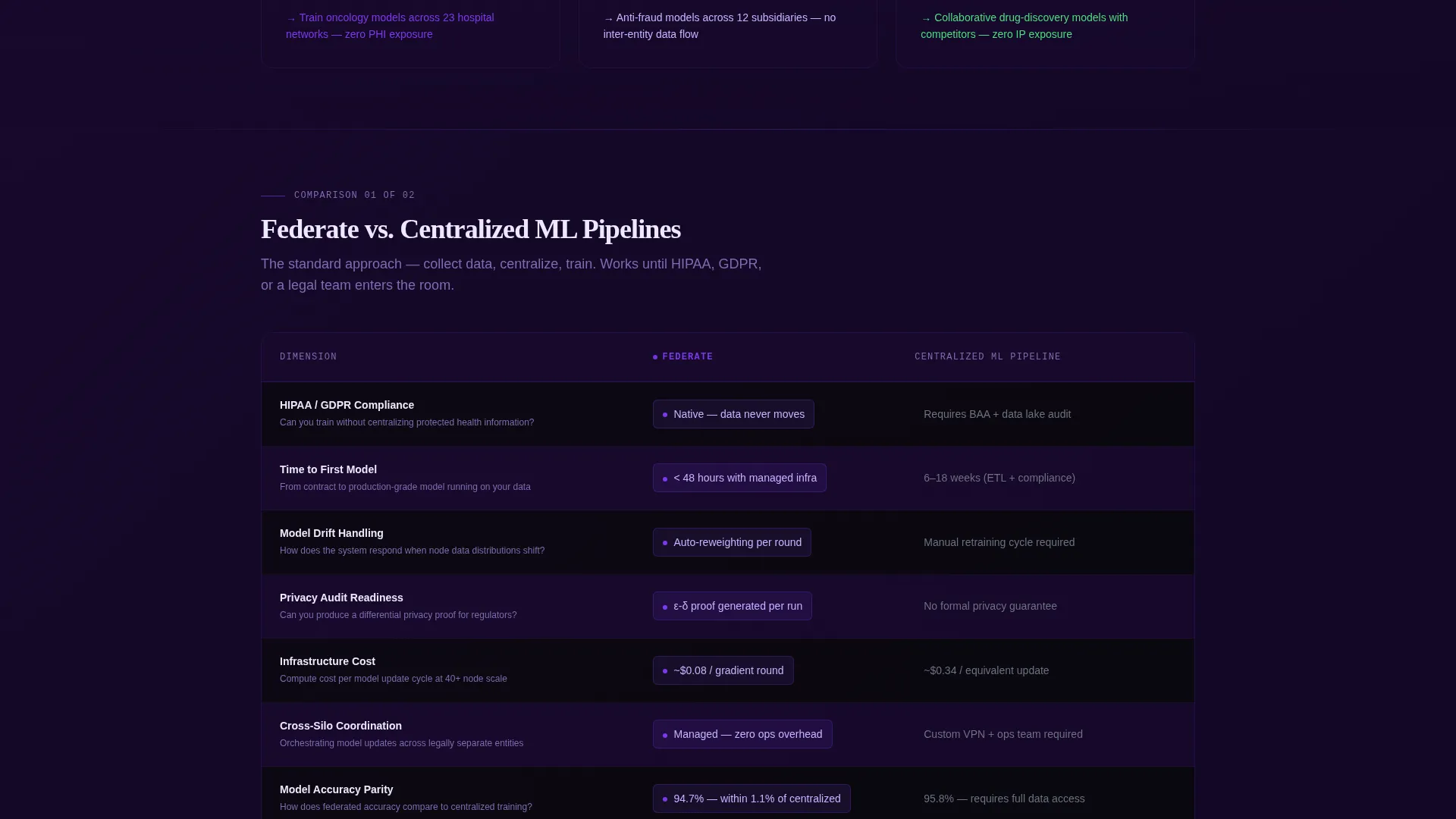
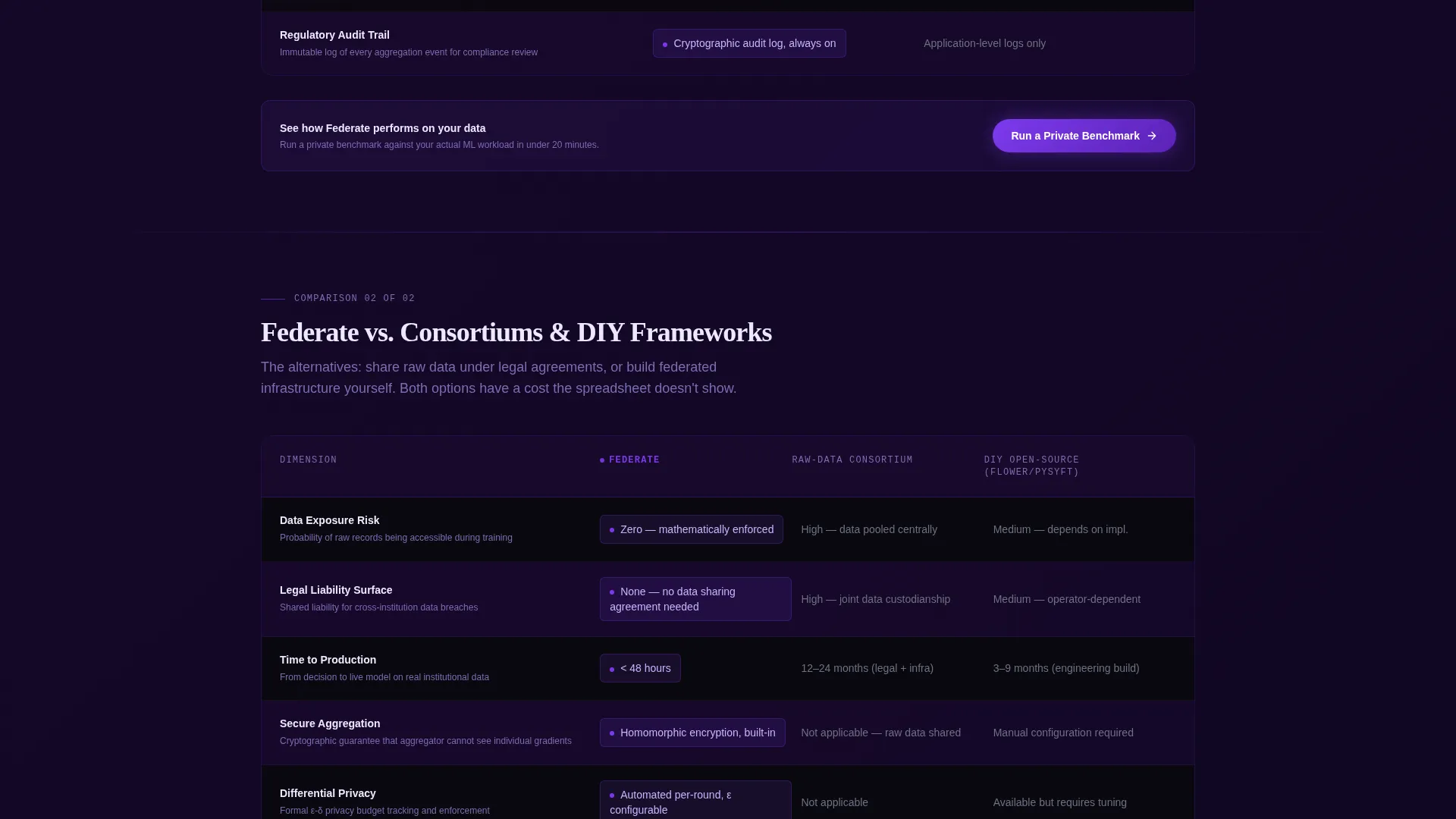
Three structured tables compare the service against centralized machine learning pipelines, raw-data-sharing consortiums, and open-source federated frameworks. Dimensions include compliance overhead, time-to-production, model drift handling, and privacy audit readiness. Rows alternate between void black and deep purple, with violet cell highlights on every column where the service wins.
Sticky Benchmark Call to Action
A sticky bar appears after the visitor scrolls past the first comparison table. It surfaces the primary "Run a Private Benchmark" call to action without interrupting the reading flow. The benchmark form collects ML framework preference (PyTorch, TensorFlow, or JAX), number of data silos, and a regulated industry toggle.
Dual Conversion Form System
The page supports two parallel conversion paths. The primary path is a benchmark request form at the table footer. The secondary path offers the compliance whitepaper gated behind a work email field. Both paths serve the same visitor at different levels of buying readiness.
Void and Violet Visual System
The color palette uses absolute void black (#09090B) as the base, deep interstellar purple (#1A0A2E) for section alternation, electric violet (#7C3AED) for interactive elements and table win highlights, and phosphor lilac (#C4B5FD) for secondary text and grid lines. The result reads like a live terminal where every violet pulse signals a completed aggregation round.
Page sections overview
| Section | Purpose |
|---|---|
| Terminal Hero Header | Demonstrates the core privacy promise through a live-typed federate.fit() code block with convergence output |
| Stats Impact Block | Anchors the argument with three bold numerals before any paragraph copy |
| Comparison Table One | Benchmarks against centralized machine learning pipelines across compliance and speed dimensions |
| Comparison Table Two | Benchmarks against raw-data-sharing consortiums on legal risk and audit readiness |
| Comparison Table Three | Benchmarks against open-source federated frameworks on drift handling and time-to-production |
| Sticky call to action Bar | Surfaces the benchmark form after the first table scroll without blocking the page |
| Benchmark Request Form | Primary conversion form collecting framework, silo count, and industry |
| Whitepaper Download Gate | Secondary conversion path for visitors who want compliance documentation first |
Design & branding system
The visual identity follows a Directory and Discovery theme expressed entirely through the Void and Violet color system. The palette is designed to feel like a live terminal environment where data moves in the dark and only the computations themselves emit light.
- Absolute void black (#09090B) as the dominant background, reinforced by deep interstellar purple (#1A0A2E) for alternating table rows and section backgrounds
- Electric violet (#7C3AED) reserved for interactive elements, table win-state highlights, and call-to-action components to draw the eye without breaking the dark environment
- Phosphor lilac (#C4B5FD) used for secondary text, grid lines, and supporting labels to maintain legibility without competing with primary content
Mobile & speed optimization
The layout is built as a single-page, section-led flow, which keeps the structure compact and scroll-friendly on smaller screens. The terminal animation and comparison tables are the primary layout considerations for mobile rendering.
- The auto-typing terminal header is designed for full-viewport display, scaling to fit narrower screens without losing the code-output contrast that drives the opening message
- Comparison tables are structured for horizontal readability, with the win-highlight system maintained across viewport sizes so the visual argument stays intact on mobile
How this template helps you convert
The page is engineered around a Comparison and Versus conversion strategy. Every design and copy decision works to collapse the visitor's internal objection before the call to action appears.
- The terminal header does the first persuasion job: it shows the product working, with a frozen zero-bytes counter, before the visitor reads a single claim. Trust is established through demonstration, not assertion.
- The stats block and comparison tables stack evidence across three competitor categories. By the time the visitor reaches the form, the build-versus-buy debate has already been argued and closed through structured data rather than narrative copy.
Other information about this template
This template is purpose-built for the federated learning managed service category within the broader federated learning technology space. It is designed to serve a technical sales motion where proof comes before persuasion.
- The template style is a Comparison Table layout, suited to the Comparison and Versus landing page direction where structured evidence replaces traditional narrative selling
- The Stats-First Impact creative direction is a deliberate choice for audiences who distrust marketing language and respond to reproducible numbers before reading body copy
- The Code Snippet header concept reflects the Directory and Discovery theme by letting the product architecture reveal itself through its own syntax rather than through product descriptions
- The regulated industry toggle in the benchmark form (healthcare, finance, pharma, and other) signals that the service understands vertical compliance differences, which is a meaningful trust signal for buyers in those sectors
- The dual conversion path design acknowledges that some visitors need a compliance artifact before they can start an internal procurement process, making the whitepaper gate a sales-qualified lead path in its own right
Theme
Directory & Discovery
Creative direction
Stats-First Impact
Color system
Void & Violet
Style
Comparison Table
Direction
Comparison/Versus
Page Sections
Auto-typing Terminal Hero Header
Stats-first Impact Block
Multi-dimension Comparison Tables
Sticky Benchmark Call to Action
Dual Conversion Form System
Related questions
Who is this landing page template designed for?
Can I adapt the comparison table rows to match my own competitive dimensions?
What does the benchmark request form collect from visitors?
Is the compliance whitepaper download a separate conversion path?
Does the sticky call-to-action bar appear immediately on page load?