Software & SaaS Professional Website Template
Sync is a scroll-reveal landing page template built for a real-time design collaboration tool. It opens with a live metrics dashboard showing active teams, cursor counts, and a 14ms sync latency figure. Each section progressively discloses performance benchmarks, conflict resolution comparisons, and a permission feature matrix, building toward a conversion-focused call to action grounded in hard numbers.
by Rocket studio
Quick summary
Sync is a single-page, scroll-reveal landing page template for a real-time design collaboration tool. It leads with live telemetry data instead of a hero image, then walks visitors through a precise spec-sheet layout comparing latency, conflict handling, and permission controls. The page closes with a personalized migration report call to action that earns the click before it asks for anything.
Who this template is for
This template is built for founders, design leads, and agency directors who need to communicate hard technical advantages to a skeptical professional audience. It suits teams that compete on performance metrics rather than brand storytelling.
- Product design leads managing distributed teams across multiple time zones
- Brand agency creative directors running overlapping client accounts who need clear tool comparisons
- Startup founders who design solo and hand off work to engineers in different time zones
What problem this template solves
Design collaboration tools often get evaluated on feel and features lists. This template solves the challenge of converting a technically savvy buyer who trusts numbers over marketing language. It removes the gap between "we're fast" and "here is the millisecond proof."
- Visitors abandon pages that lead with claims before showing evidence
- Distributed teams need to see concrete latency and conflict resolution data before switching tools
- Generic hero-image layouts signal low technical credibility to engineering-adjacent design leads
What you get with this template
You get a fully structured, scroll-reveal landing page with five distinct content sections and a machined industrial visual identity. Every section is purpose-built to present a specific proof point before the next one loads.
- A live metrics dashboard header with cursor count, latency display, and a world map hotspot visualization
- A progressive scroll-reveal layout with counter animations, pulsing indicators, and comparison table hover states
- A conversion-optimized call to action section with a single-field tool input, a team size selector, and a personalized report flow
Feature list
A concise overview of what makes this template work in practice.
Live Metrics Dashboard Header
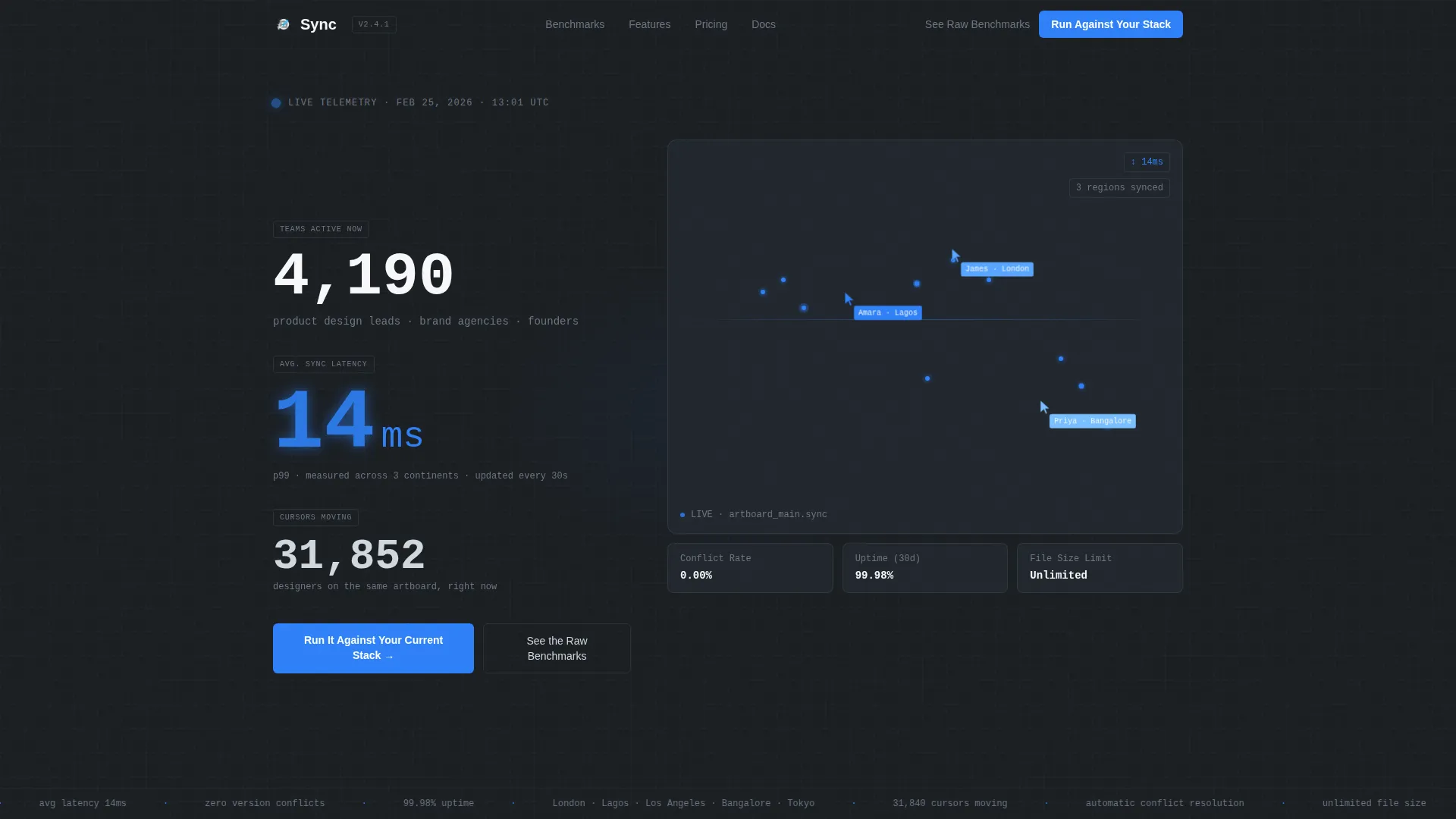
The header opens on a dark gunmetal canvas displaying "4,217 teams designing right now," a ticking cursor count, and a 14ms sync latency figure in oversized monospace type. A world map shows faint blue hotspot clusters. No hero image is used; the product's own live data serves as the visual centerpiece.
Scroll-Linked Progressive Reveal
Each section animates into view as the visitor scrolls. Counter animations, a pulsing latency indicator, and cursor simulations create a sense of live activity. The progressive reveal structure means every proof point is earned before the next one appears, matching the spec-sheet creative direction.
Side-by-Side Latency Comparison Table
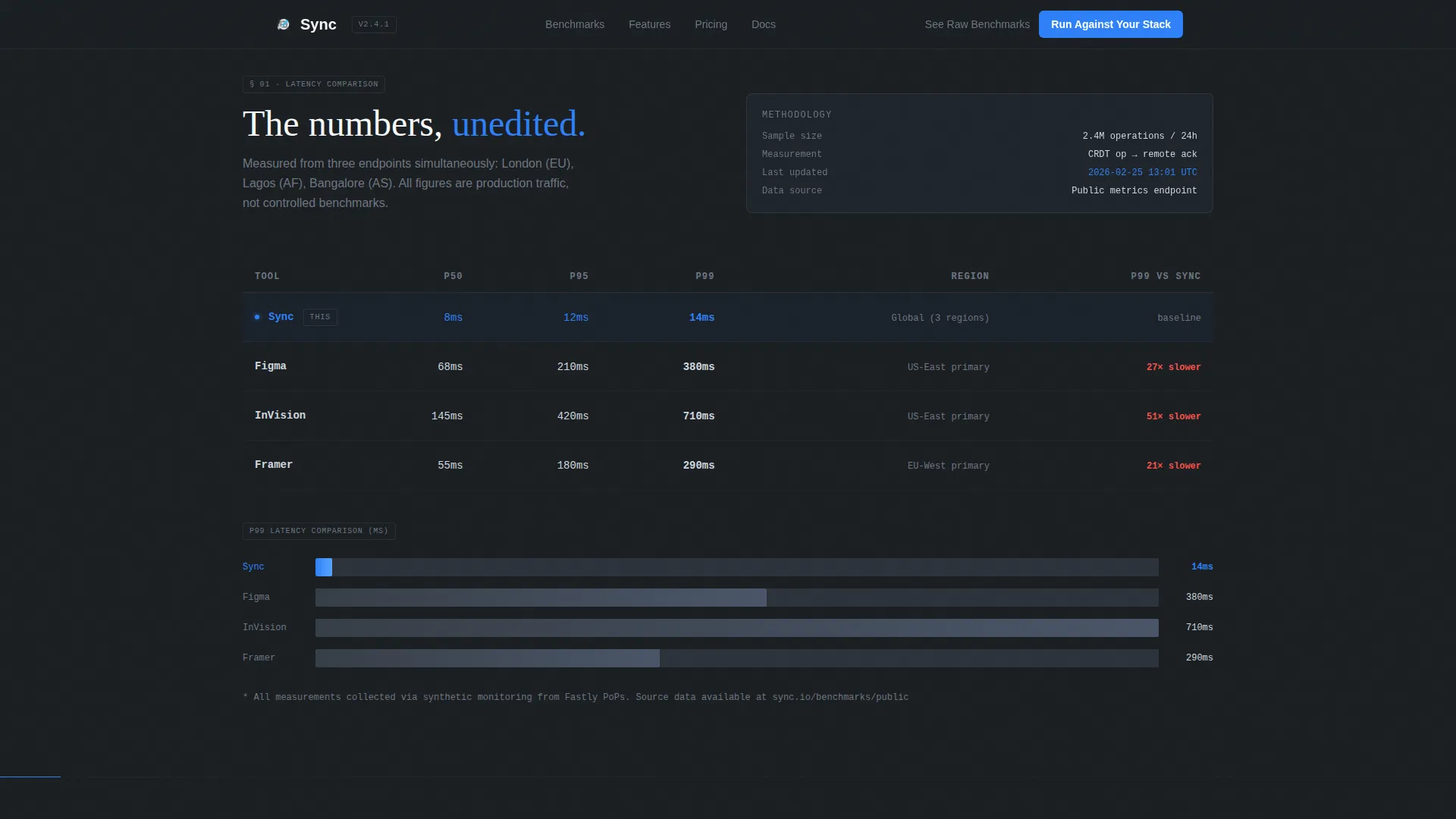
Section one presents a latency table in monospace type with millisecond values across multiple tools. Hover states on the comparison table add interactivity. The data-first layout lets the numbers carry the argument without any additional marketing copy.
Conflict Resolution Comparison Section
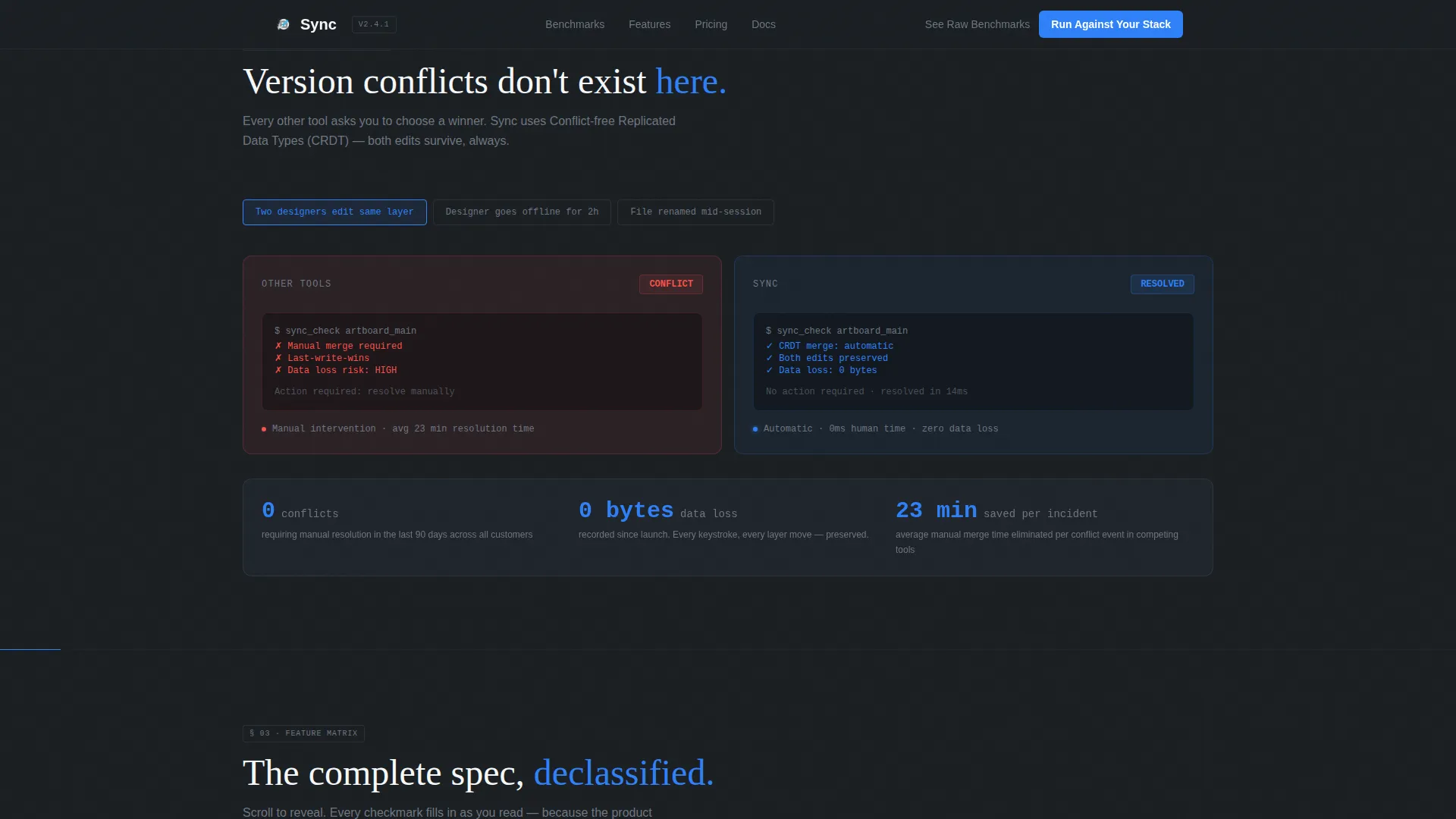
Section two contrasts manual file merge workflows with the automatic zero-loss approach. Visual proof elements accompany the comparison. This section is designed to resonate directly with anyone who has encountered "final_final_v3" file naming in a shared drive.
Progressive Permission Feature Matrix
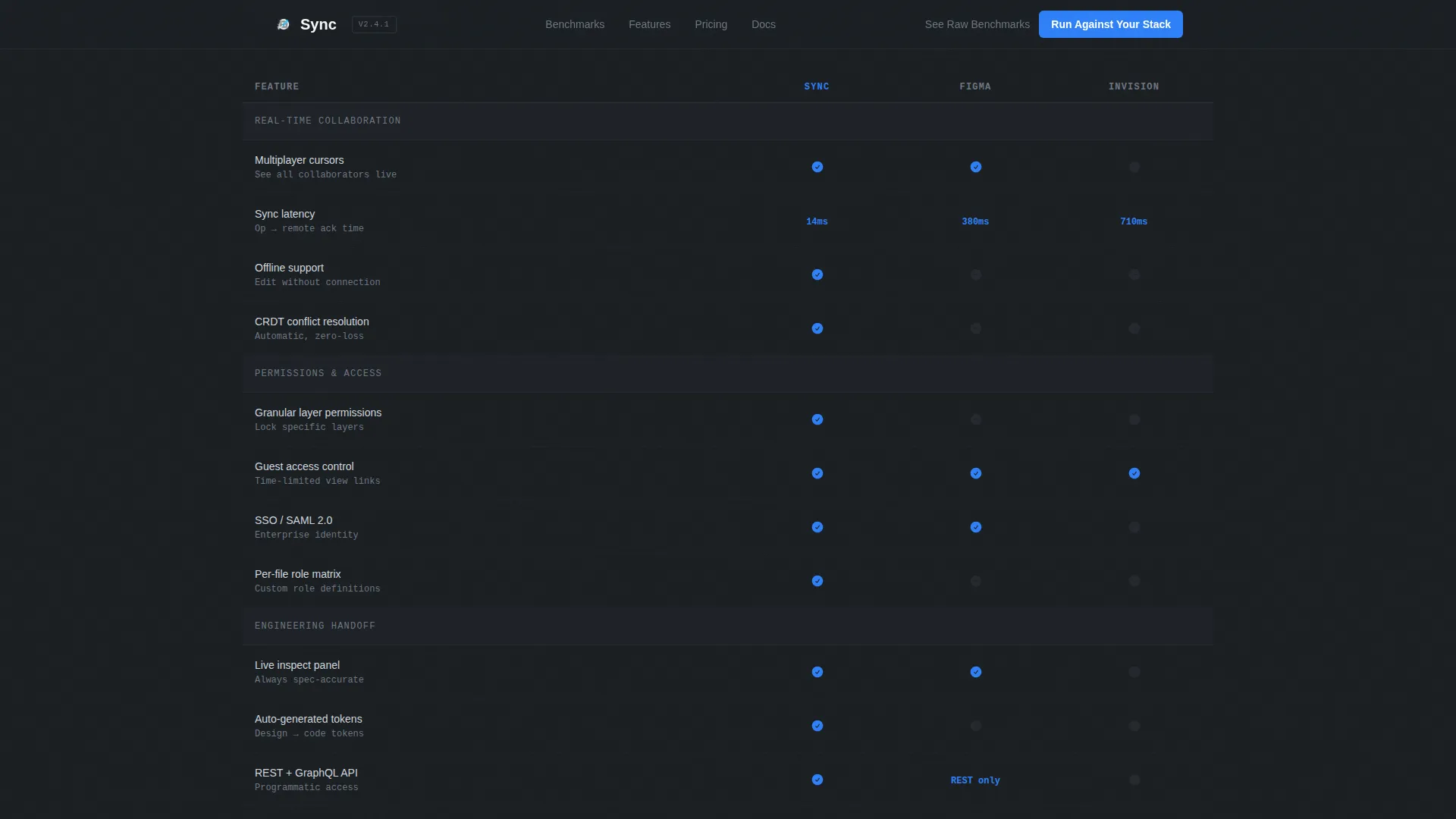
Section three uses a feature matrix that fills in progressively as the visitor scrolls. Checkmarks reveal column by column, giving the layout a declassification effect that rewards careful reading and keeps attention moving downward.
Personalized Migration call to action
The primary call to action prompts visitors to enter their current tool and select a team size from three brackets: 2 to 10, 11 to 50, or 50 and above. Submitting the form generates a personalized migration report delivered by email in under a minute. A secondary call to action links to a public performance benchmark page for skeptics who want more raw data before committing.
Page sections overview
| Section | Purpose |
|---|---|
| Live Metrics Header | Opens with real-time cursor count, 14ms latency, and world map hotspots |
| Latency Comparison Table | Side-by-side millisecond data across tools in monospace type |
| Conflict Resolution Proof | Contrasts manual merge with automatic zero-loss file handling |
| Permission Feature Matrix | Progressive scroll reveal filling checkmarks across permission features |
| Migration call to action | Tool input and team size selector triggering a personalized email report |
| Developer Minimal Footer | Minimal footer following the GitHub Developer pattern |
Design & branding system
The visual identity uses a Monochrome Steel color system that feels machined and precise. Every color decision serves function over decoration, and the single accent color is reserved strictly for interactive elements and live data.
- Core palette: deep gunmetal (#1B1F23), brushed chrome (#6E7681), bright aluminum (#D0D7DE), and cold white (#F6F8FA)
- Electric blue (#2F81F7) appears only on interactive elements and pulsing live data, such as the latency heartbeat indicator
- Typography combines JetBrains Mono for all data and numbers, DM Sans for body copy, and Fraunces for accent headings
Mobile & speed optimization
The template is built desktop-first to match the primary audience of design leads working on large screens. A mobile fallback layout is included to ensure the page remains functional and readable across devices.
- Desktop-first layout with responsive fallback for smaller screens
- Server Components handle static content for faster initial load; Client Components handle animations and interactivity
- High-animation sections use scroll-linked reveals and counter animations that load progressively rather than all at once
How this template helps you convert
This template is structured around a Comparison/Versus conversion strategy. It shows every proof point before asking for anything, so the call to action arrives after the visitor has already formed a confident opinion.
- The live metrics header establishes credibility in the first three seconds by displaying real numbers at scale, removing the need for brand trust to carry the opening moment.
- Each scrolled section adds a new proof layer, moving from latency benchmarks to conflict handling to permission granularity, so the visitor's confidence compounds before the call to action appears.
- The personalized migration report call to action converts interest into a direct action tied to the visitor's specific tool and team size, making the offer feel tailored rather than generic.
Other information about this template
This template is part of the Startup Velocity theme collection and uses the Spec Sheet creative direction paired with a Stats/Metrics header concept. It is categorized under Technology, Software and SaaS, and is specifically matched to the design collaboration tool niche.
- The template style is Scroll Reveal (Progressive), meaning sections animate into view as the visitor moves down the page
- The landing page direction is Comparison/Versus, built for audiences actively evaluating tool alternatives
- The footer follows a GitHub Developer Minimal pattern, keeping the bottom of the page as clean and information-dense as the rest
- The world map in the header uses faint blue dots to represent real-time geographic activity clusters across regions such as London, Lagos, and Los Angeles
- The intersection match score for this template's niche and category pairing is 13, indicating a high-relevance fit between the design and the target use case
Theme
Startup Velocity
Creative direction
Spec Sheet
Color system
Monochrome Steel
Style
Scroll Reveal (Progressive)
Direction
Comparison/Versus
Page Sections
Live Metrics Dashboard Header
Scroll-linked Progressive Reveal
Side-by-side Latency Comparison Table
Conflict Resolution Comparison
Progressive Permission Feature Matrix
Personalized Migration Call to Action
Related questions
What kind of product is this template designed to showcase?
Can I change the live metrics numbers in the header?
Does the call to action form send emails out of the box?
Is this template suitable for a mobile audience?
How long does it take to customize this template for a new brand?