Curated Data Science Newsletter Landing Page Template
Signal is an editorial landing page template built for a curated data science newsletter. It combines a cinematic dark visual identity with a newspaper masthead header, a timestamped day-in-the-life scroll narrative, and a proof-first click-through strategy. The design is spare, deliberate, and shaped for mid-career data scientists who value quality over volume.
by Rocket studio
Quick summary
Signal is a single-page editorial template for a curated data science links newsletter. It leads with a bold publication masthead, proves its value with a real annotated issue excerpt, then walks visitors through a timestamped Tuesday workday. Every section earns the final click to a sample issue rather than asking for an email upfront.
Who this template is for
This template is built for newsletter creators who publish curated content for technical professional audiences. It suits anyone running a data science or machine learning newsletter who wants to convert skeptical readers with quality proof, not promises.
- Data science newsletter operators who publish weekly curated link digests
- ML engineers and analytics content creators building a professional subscriber base
- Indie publishers and editorial teams targeting a technical, high-signal readership
What problem this template solves
Data science professionals are overwhelmed by algorithmic feeds, arxiv alert floods, and Hacker News noise. A generic newsletter landing page cannot speak to that frustration or prove it has the answer. This template addresses the credibility gap directly.
- It shows a real annotated link excerpt before asking for anything, letting the product speak first
- It maps the newsletter into a recognizable Tuesday workday, making the value concrete and personal
- It replaces vague benefit claims with specific, timestamped proof that curation beats the algorithm
What you get with this template
You get a fully structured editorial landing page with five purpose-built scroll sections, a cinematic dark visual identity, and a click-through conversion strategy that routes visitors to a hosted sample issue. Every component is included and ready to customize.
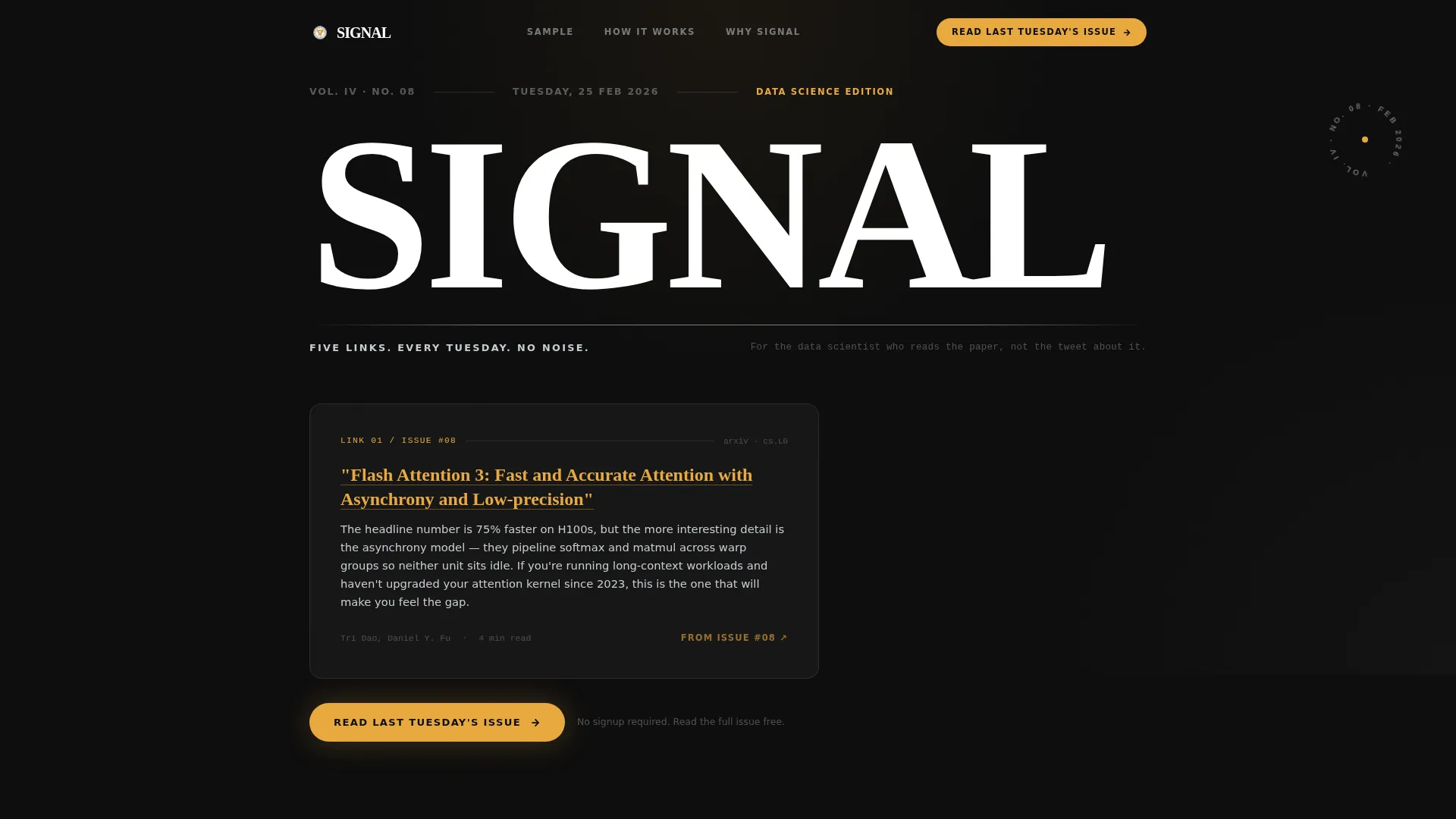
- A newspaper-style hero masthead with large serif display type, volume number, date, and a subhead in small caps
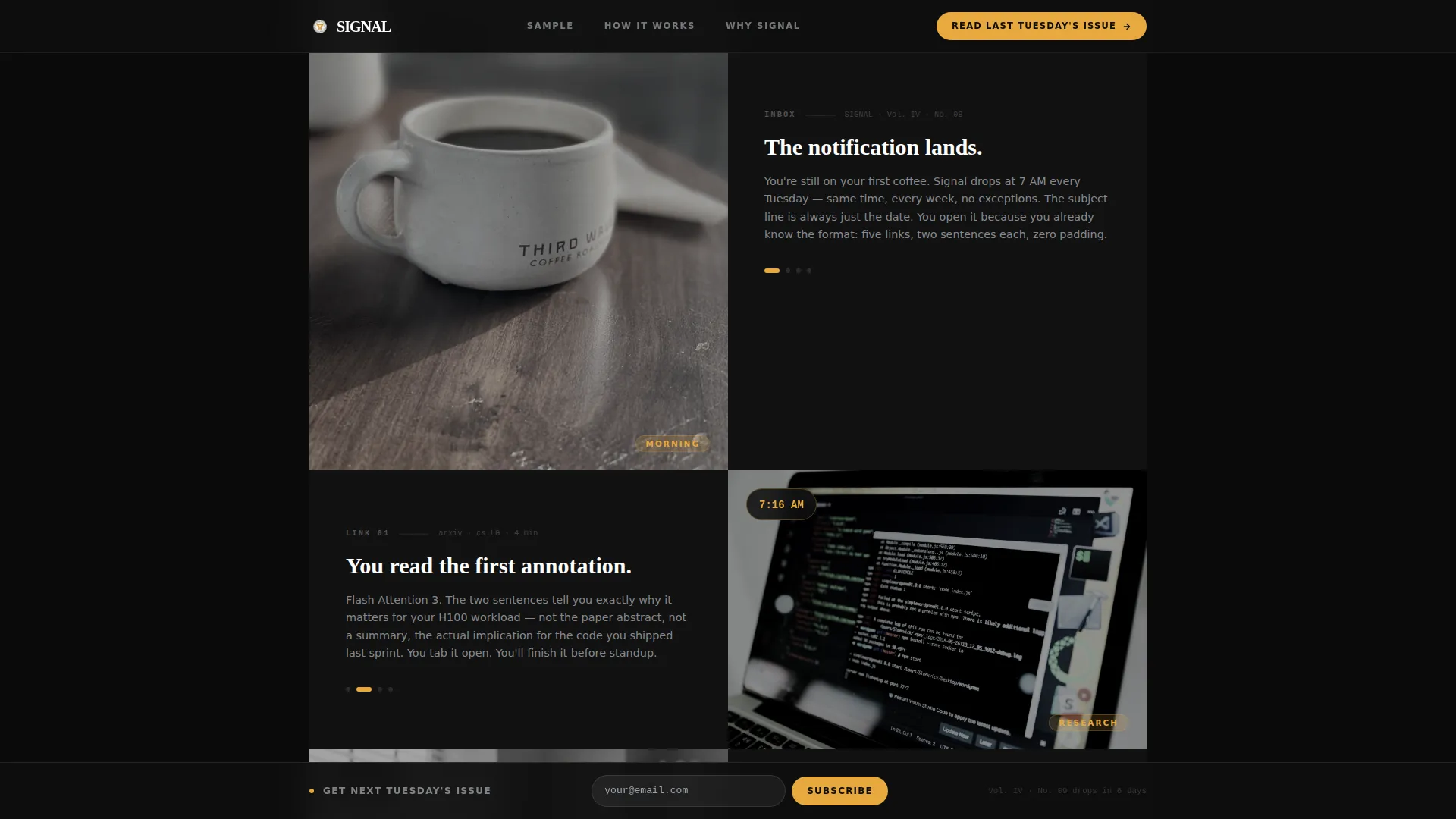
- A Tuesday timeline scroll narrative with four timestamped moments from 7:14 AM to 3:00 PM
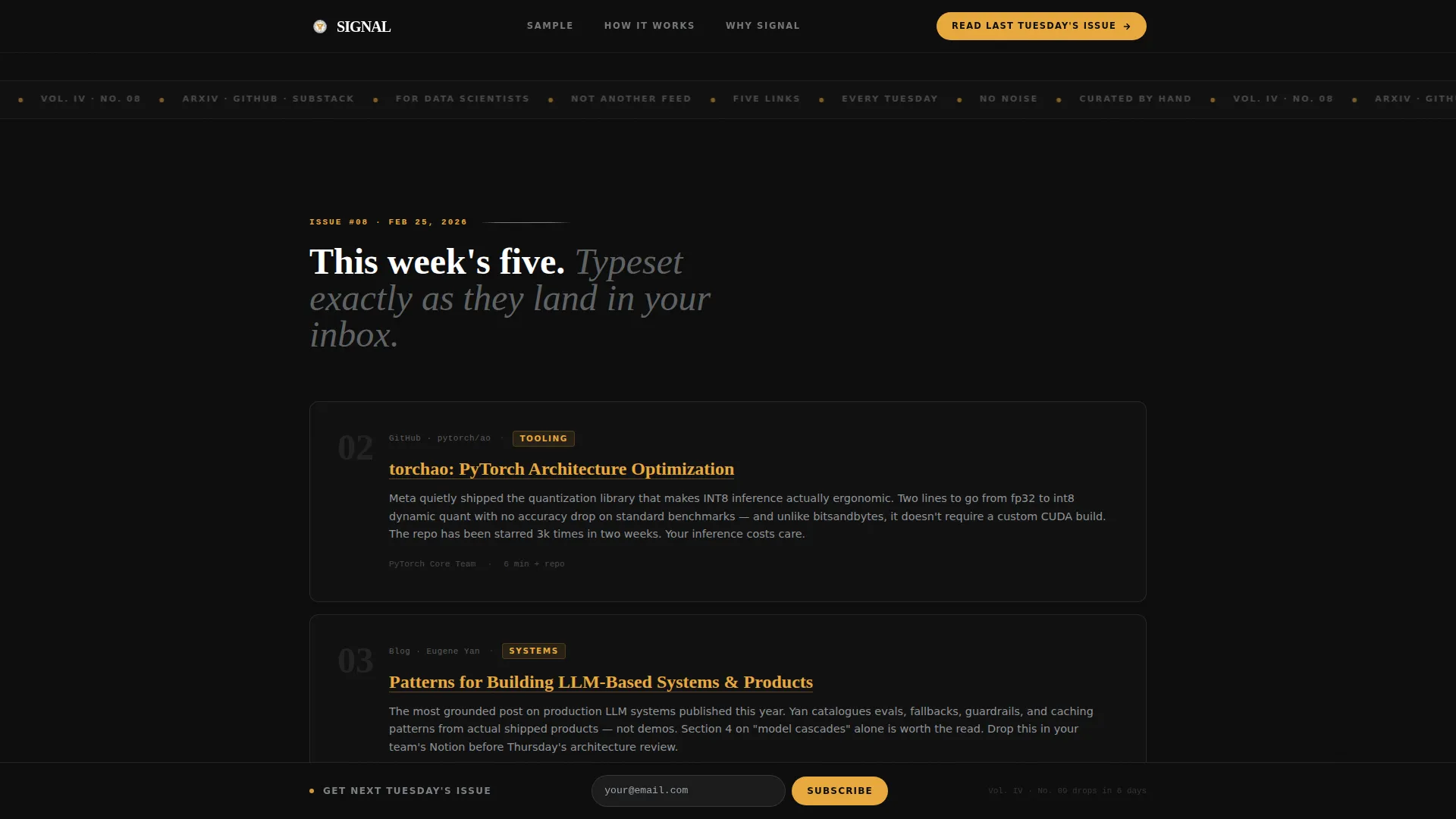
- A persistent bottom bar with a single email field for visitors already ready to subscribe
Feature list
This template is built around a focused set of editorial and conversion components drawn directly from the project brief.
Newspaper Publication Masthead
The hero presents the word SIGNAL at enormous scale in a refined serif typeface, spanning the full viewport width. Beneath it sits a thin horizontal rule, a volume number, a publication date, and the subhead "Five links. Every Tuesday. No noise." in small caps. A rotating editorial badge and a floating sample card complete the masthead zone.
Live Issue Excerpt Block
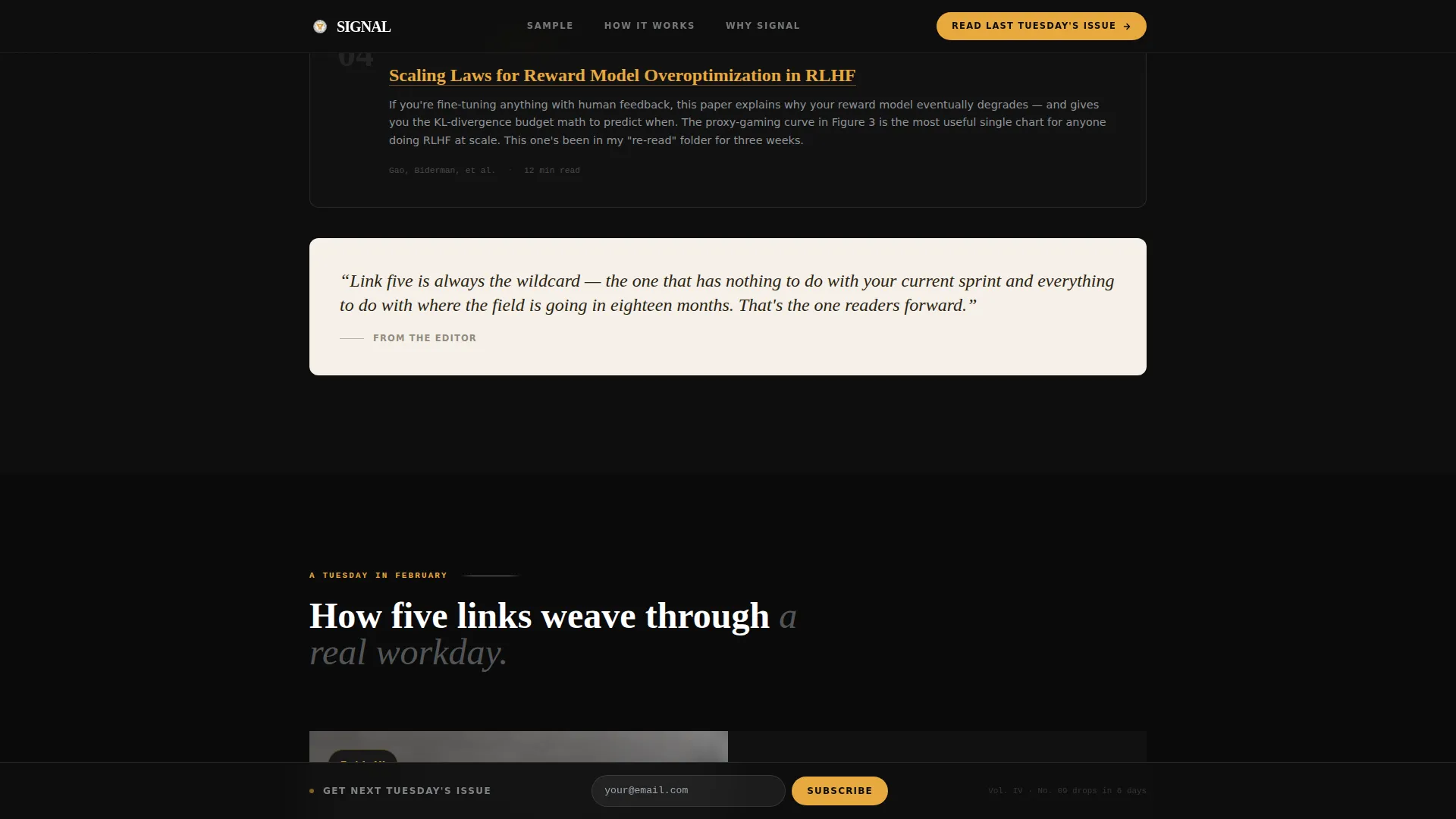
Immediately below the hero, a real annotated link is typeset exactly as it appears in the email. The two-sentence commentary is visible without scrolling past the fold line. This section functions as proof of product, showing the curation quality before any conversion ask.
Timestamped Tuesday Timeline
Four scroll sections trace a data scientist's Tuesday from 7:14 AM to 3:00 PM. Each section is anchored to a specific timestamp and a concrete action, such as skimming a link over coffee or dropping a repo into a Slack channel. The rhythm shifts from contemplative in the morning to action-oriented in the afternoon.
Algorithm Noise versus. Signal Contrast Panel
An asymmetric bento-style section contrasts the chaos of algorithmic feeds with the deliberate quality of Signal curation. This section gives skeptical visitors a clear reason to prefer a human-curated digest over automated aggregators.
Dual Call-to-Action System
The primary call to action, "Read Last Tuesday's Issue," appears twice: once beneath the masthead excerpt and once after the final timestamp section. Both route to a hosted archive page. A quieter persistent bottom bar floats throughout the page with a single email field for visitors who are already convinced.
Cinematic Animation Layer
The template includes staggered fade-up entrance animations, a marquee ticker, a rotating editorial badge, and scroll-linked section reveals. These motion elements reinforce the editorial pacing without adding visual noise.
Page sections overview
| Section | Purpose |
|---|---|
| Hero Masthead | Establishes publication identity at scale |
| Issue Excerpt Block | Proves curation quality with a real annotated link |
| Tuesday Timeline | Maps newsletter value to a real workday |
| Contrast Panel | Positions Signal against algorithmic feed noise |
| Final Call to Action | Drives the click to the full sample issue |
| Persistent Bottom Bar | Captures email from visitors already ready to subscribe |
Design & branding system
The template uses a Luxe Minimal editorial aesthetic inspired by film credit sequences. Type rolls over darkness, whitespace does the heavy lifting, and every color choice is intentional. The palette and typography are tightly constrained to maintain the high-signal feel.
- Color system: deep projection-room black (#0D0D0D) for backgrounds, soft silver (#C8CDD3) for body text, warm parchment (#F5F0E8) for pull-quote cards, and amber (#E8A83E) reserved exclusively for links and the subscribe button
- Typography: Fraunces serif for display headings and DM Sans for body text, creating a strong editorial contrast between editorial weight and functional clarity
- Visual tone: generous whitespace, no decorative elements, and a film-credits rhythm where each element earns its place on screen
Mobile & speed optimization
The template is designed desktop-first to match the primary audience of data scientists working at workstations, while maintaining solid layout integrity on smaller screens. Performance considerations are built into the technical approach.
- Server components handle all static sections, keeping client-side JavaScript minimal
- Animations use staggered fade-ups and scroll-linked reveals that are lightweight by design
- The persistent bottom bar adapts to mobile viewports without disrupting the reading flow
How this template helps you convert
Signal is built around a proof-first click-through strategy rather than a traditional email-capture funnel. Every design and copy decision pushes toward one outcome: getting the right visitor to read a full sample issue.
- The live issue excerpt shows real annotation quality before any ask, building trust in the first scroll
- The Tuesday timeline makes the newsletter's daily impact concrete, turning abstract curation into a recognized personal experience
- The dual placement of "Read Last Tuesday's Issue" gives visitors two clear moments to act, while the persistent bottom bar catches late converters without interrupting the narrative
Other information about this template
This template belongs to the Blog and Editorial category with a Data Science Newsletter subcategory focus. It is built specifically for the data science curated links newsletter niche, where credibility and proof of quality drive conversion more than promotional copy.
- Template style: Editorial and Magazine, combining publication design conventions with modern web interaction
- The footer follows a horizontal flow pattern suited to minimal editorial layouts
- The page is localized in English and designed for a global professional audience
- The template is structured for a single-page landing flow, not a multi-page site
Theme
Luxe Minimal
Creative direction
Day-in-the-Life
Color system
Cinematic Dark
Style
Editorial/Magazine
Direction
Click-Through
Page Sections
Newspaper Publication Masthead
Live Issue Excerpt Block
Timestamped Tuesday Timeline
Algorithm Noise Versus. Signal Contrast Panel
Dual Call-to-action System
Cinematic Animation Layer
Related questions
Does this template include email capture functionality?
Can I replace the sample link excerpt with my own newsletter content?
Who is the intended audience for a newsletter built with this template?
Is this template suited for a newsletter that publishes on a schedule other than weekly?
What typography and colors come with this template?