Shift - Brutalist Hospitality Landing Page Template
Shift is a bold brutalist hospitality job board landing page built for operators who need to hire fast. Dark glass panels display live market data up front, card grids inventory job categories and employer listings, and two parallel lead-generation forms serve both hiring managers and job seekers. Everything is structured, immediate, and built for the back-of-house mindset.
by Rocket studio
Quick summary
Shift is a single-page hospitality job board landing page template built around a bold brutalist design system. It leads with live data panels, delivers job category and employer cards in a modular grid, and drives two conversion paths simultaneously. The layout is cold, clear, and purposeful, built for hospitality operators who need to hire now.
Who this template is for
This template is designed for founders, operators, and product teams building digital hiring tools for the hospitality industry. It speaks directly to the people on both sides of that market.
- Hotel general managers, restaurant group operations managers, and resort human resources directors who need to post open roles and fill them quickly
- Line cooks, night auditors, banquet captains, and other hospitality professionals actively searching for their next position
- Hospitality technology startups or job board builders who need a conversion-ready landing page from day one
What problem this template solves
Hospitality hiring moves faster than most industries. A generic job board template does not communicate urgency, scale, or credibility to operators who live inside that pace.
- Employers landing on a typical page see no proof that active candidates are waiting, so they leave before posting a role
- Job seekers see no evidence of real open positions and feel no reason to upload their resume
- Most templates bury the call to action before showing any proof of marketplace activity
What you get with this template
You get a fully structured, single-page layout that earns trust through visible data before it asks for anything. The template is modular and card-driven throughout.
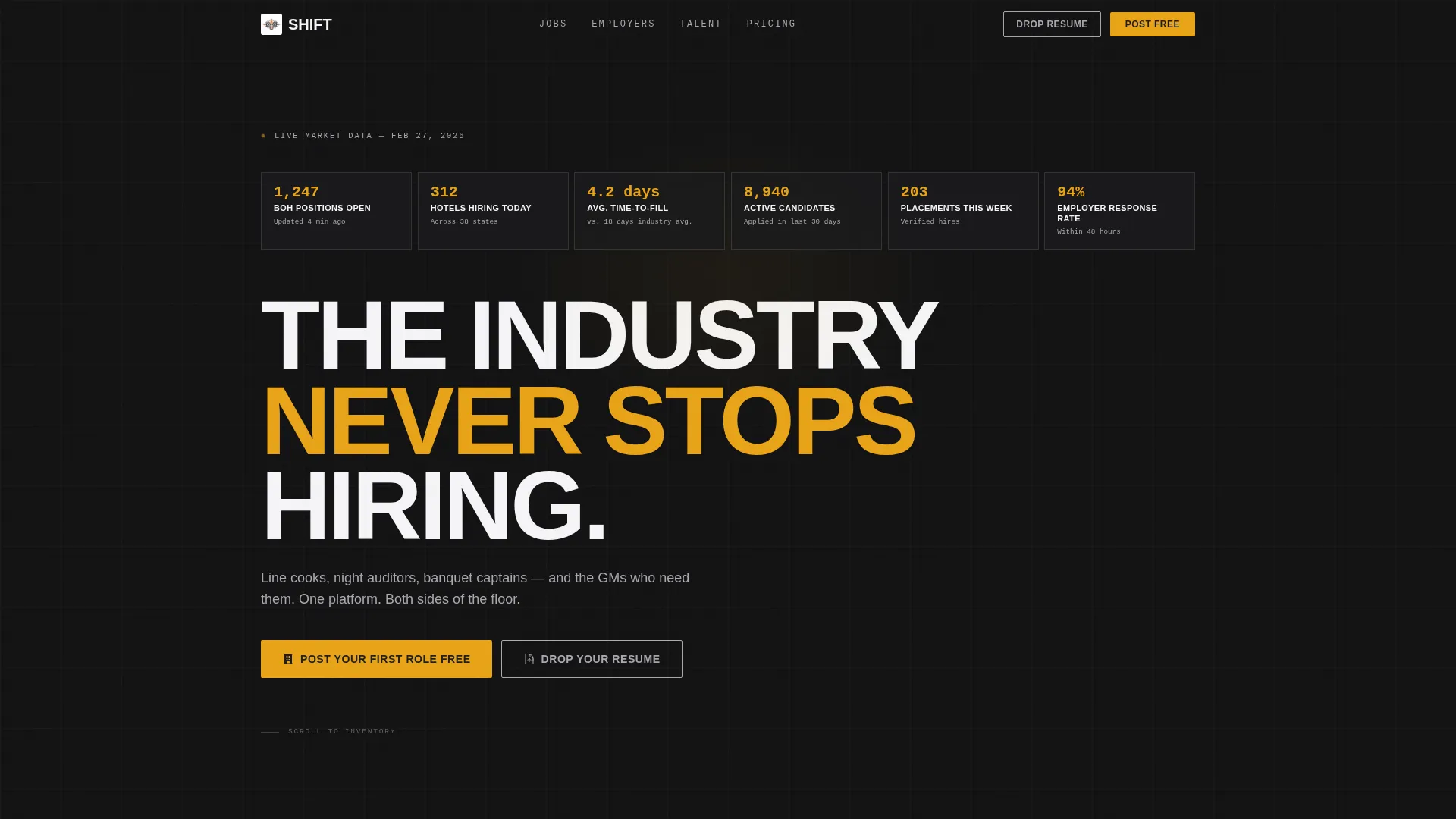
- A dark glass panel header showing live-data statistics such as open position counts and average time-to-fill figures
- Three modular card grid rows covering job categories, employer listings, and candidate statistics
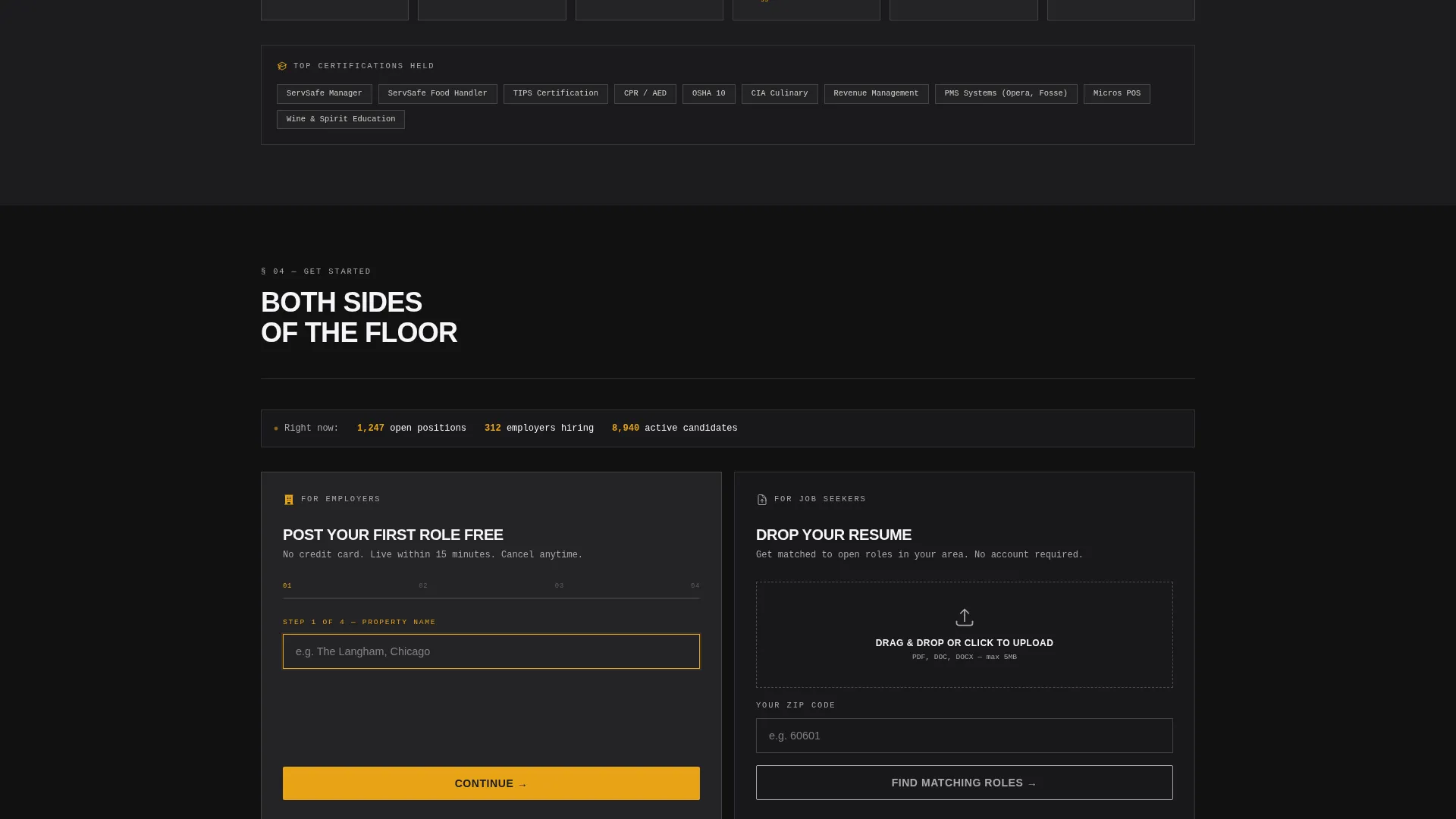
- Two parallel lead-generation forms: one for employers posting roles, one for job seekers uploading resumes
Feature list
This template is built around a tight set of deliberate, functional components. Every element has a clear job to do.
Dark Glass Panel Header
The header grid displays live data points inside translucent, smoke-tinted rectangular panels over a near-black background. Each panel holds a single statistic rendered in signal-white type. A single oversized brutalist sans-serif headline anchors the center of the layout.
Modular Job Category Cards
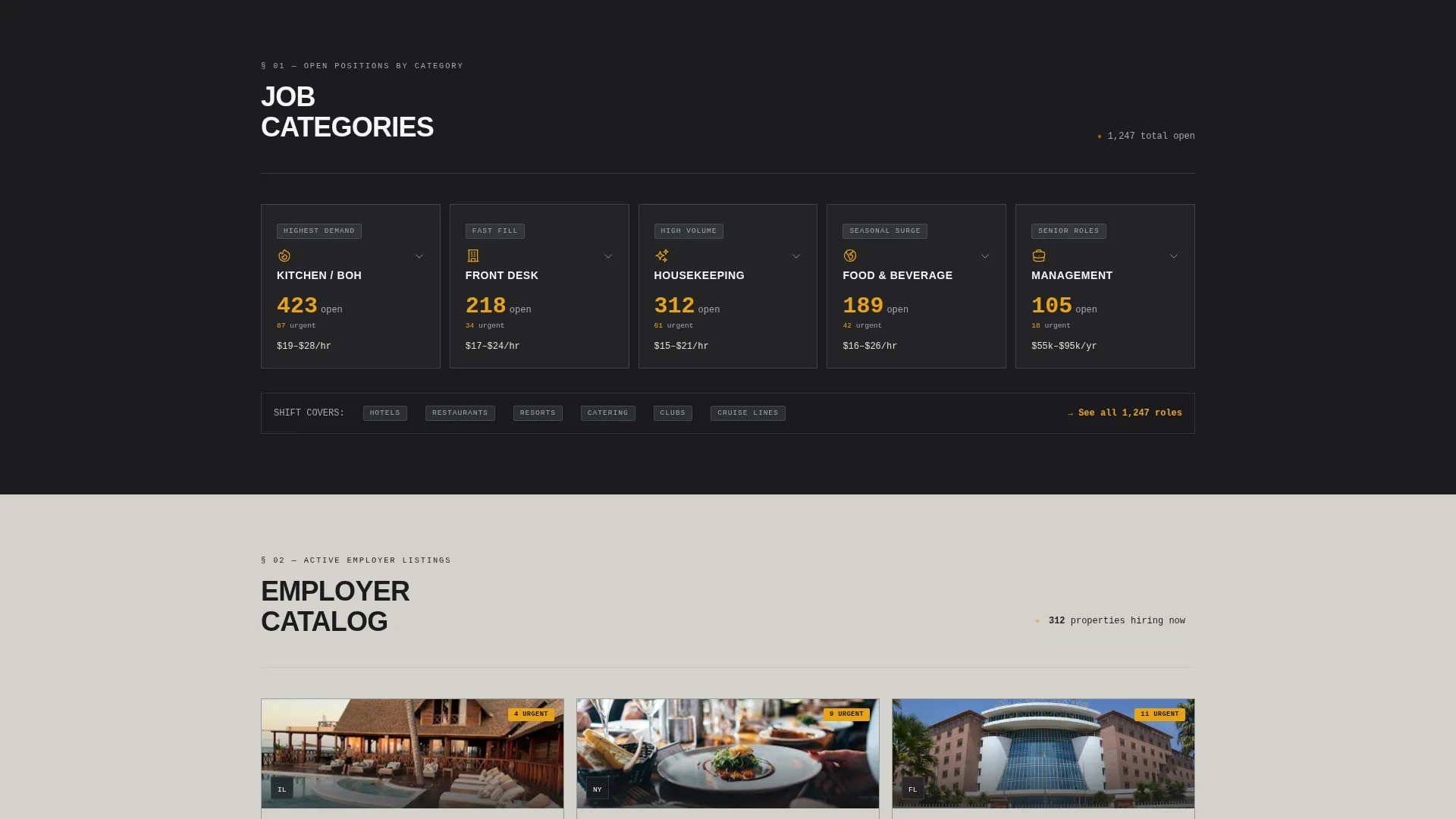
The first card row presents job categories including Front Desk, Kitchen, Housekeeping, Food and Beverage, and Management. Each card shows a live open-position count and is designed to be clickable and expandable, behaving like pulling a drawer from a filing cabinet.
Employer Listing Grid
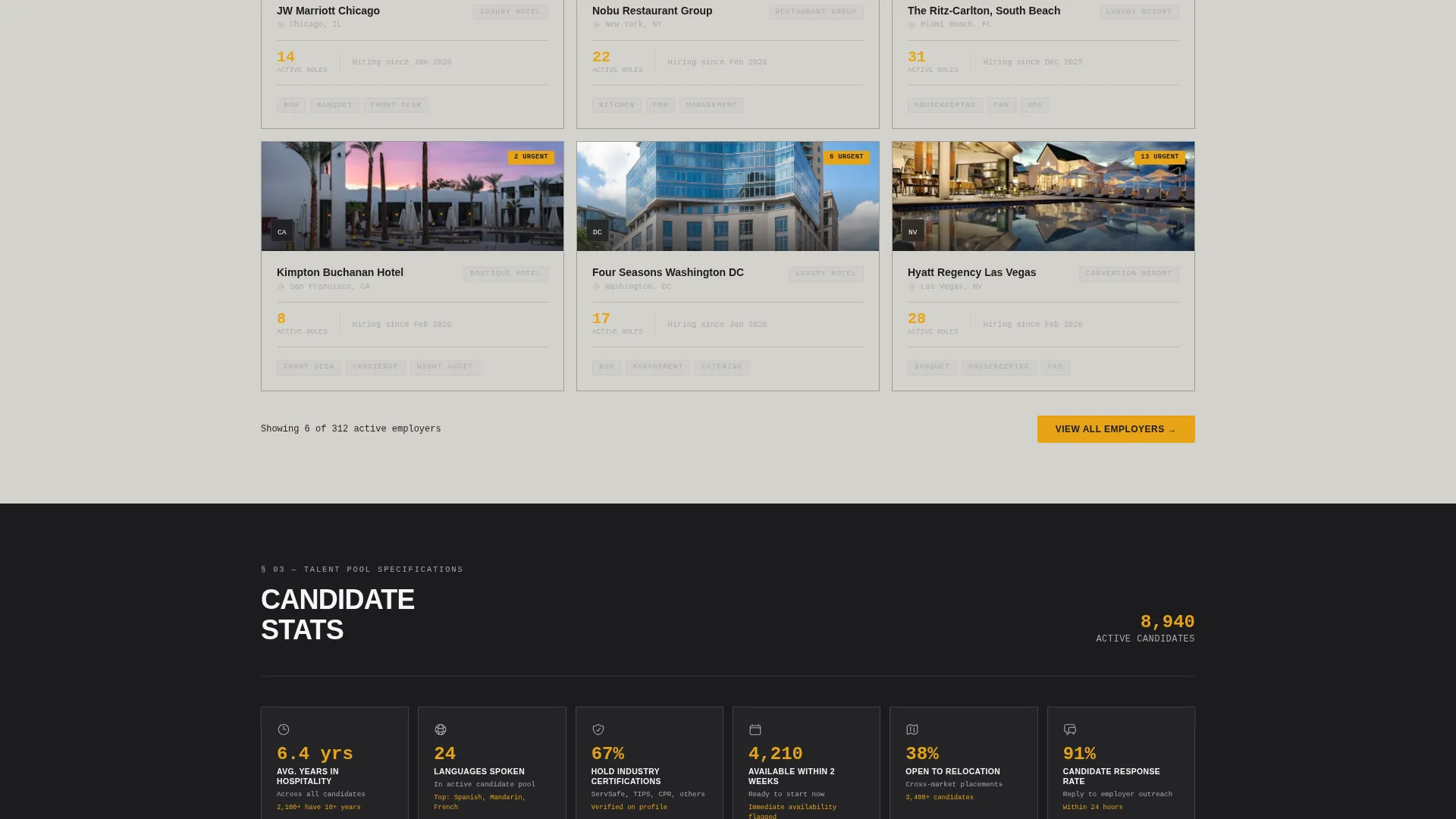
The second card row displays employer cards arranged like a parts catalog. Each card shows the property name, location, and number of active listings. The format gives both job seekers and employers immediate proof of marketplace scale.
Candidate Statistics Row
The third card row surfaces aggregated candidate data: average years of experience in the pool, languages spoken, and certifications held. This row builds employer confidence through hard numbers rather than marketing language.
Progressive Employer Lead Form
The employer conversion path uses a card-style inline form that reveals one field at a time. Fields collect property name, property type, number of open positions, and work email in sequence. Each field appears only after the previous one is completed.
Job Seeker Resume Drop
A secondary call to action in the header area gives job seekers a direct entry point. It accepts a single file upload and a zip code. The friction is minimal by design.
Page sections overview
| Section | Purpose |
|---|---|
| Dark Glass Header | Display live market data and primary headline |
| Job Category Cards | Inventory open roles by department |
| Employer Listing Grid | Show active hiring properties at a glance |
| Candidate Statistics Row | Prove talent pool depth to employers |
| Employer Lead Form | Capture property details and work email |
| Resume Drop call to action | Collect job seeker file and location |
Design & branding system
The visual identity follows a bold brutalist direction built on a monochrome steel palette. Nothing in the layout decorates; every element functions.
- Colors: structural charcoal (#1C1C1E) and poured concrete (#D4D2CC) alternate as backgrounds; brushed stainless (#A8A9AD) handles secondary surfaces; signal-white (#F5F5F7) is used for text and active states; hard industrial amber (#E8A317) is reserved exclusively for calls to action and live counters
- Cards sit inside steel-framed containers with 1-pixel borders, evoking the back-of-house corridor of a high-end hotel with exposed ductwork and stainless prep surfaces
- Typography is oversized brutalist sans-serif at headline scale, dropping to clean functional type for data labels and form fields
Mobile & speed optimization
The card grid layout is modular by design, which means it adapts naturally to narrower viewports without breaking the information hierarchy.
- Cards reflow into single-column stacks on smaller screens while preserving the steel-frame structure and data-forward layout
- The minimal asset approach, no hero photography, no decorative imagery, keeps the page visually lean and fast to render
- Form fields in the progressive employer form remain touch-friendly at mobile scale due to their full-width card treatment
How this template helps you convert
The page is structured to show proof of activity before asking for any commitment. Conversion is earned through visible scale, not persuasion copy.
- Visitors see live data in the header panels immediately on arrival, establishing marketplace credibility before any form is visible
- Three rows of data cards build confidence incrementally as the visitor scrolls, making the volume of open roles and active employers undeniable
- Two separate conversion forms appear only after the inventory is visible, so both employers and job seekers arrive at the form already convinced the other side is active and waiting
Other information about this template
This template is a strong fit for hospitality technology products competing in the job board and staffing platform space. A few additional details worth noting:
- The template style is a card grid (modular), making individual sections easy to reorder or extend without breaking the layout system
- The bold brutalist theme and monochrome steel color system give the page a distinctive look that stands apart from softer, lifestyle-driven hospitality designs
- The spec sheet creative direction means the page communicates entirely through data and structure, which suits operators and hiring managers who distrust marketing language
- Builders using platforms such as Webflow, Framer, or similar visual development tools will find the modular card structure straightforward to implement and customize
- The amber accent color (#E8A317) is used sparingly, which means calls to action remain visually dominant even in a dense, data-heavy layout
Theme
Bold Brutalist
Creative direction
Spec Sheet
Color system
Monochrome Steel
Style
Card Grid (Modular)
Direction
Lead Generation
Page Sections
Dark Glass Panel Data Header
Modular Job Category Card Grid
Employer Property Listings
Candidate Statistics Cards
Progressive Employer Lead Form
One-step Resume Drop
Related questions
Can this template support both employer and job seeker flows on the same page?
Does the template include real live data, or are the counters placeholder values?
How customizable are the job category cards?
Is this template only suitable for a job board, or can it work for other hospitality hiring products?
What makes this template different from a generic job board design?