Professional Sabbatical Planning Landing Page Template
The Sabbatical Score Your Readiness Sabbatical Program Manager landing page template is built for People Ops leaders who need more than a policy document. It combines a comparison table, real case study narratives, an interactive return-on-investment calculator, and a seven-question readiness diagnostic to turn hesitant executives into committed program builders.
by Rocket studio
Quick summary
This template gives VP-level People Ops leaders a structured, persuasive landing page that makes the case for managed sabbatical programs over ad-hoc policies. It leads with data, moves through three real company stories, and closes with a diagnostic quiz that converts curiosity into a booked program design call. The design is purposeful, dark, and momentum-driven throughout.
Who this template is for
People Ops and Human Resources leaders at growth-stage and public tech companies need a clear, credible way to present sabbatical leave as a strategic retention tool rather than a soft benefit. This template was built specifically for that conversation. It speaks directly to decision-makers who have seen senior engineers and directors quietly disengage and leave, and who understand that a four-week sabbatical leave policy PDF sitting in a shared drive is not a functioning sabbatical program.
This template is the right fit for:
- VP People Ops, Chief People Officers, and HR Directors at Series C through public tech companies with 200 to 5,000 employees
- Total Rewards leads responsible for building retention strategies that address burnout and long-term service commitments
- People Ops teams who want to present a business case for paid sabbaticals to their leadership board with real data, case studies, and a readiness assessment built into the page
What problem this template solves
Senior employees burn out quietly. Signs of burnout include persistent fatigue, reduced patience, and feeling disconnected from work. By the time those signals are visible, the resignation letter is often already written. Most organizations respond with a sabbatical leave policy that covers eligibility criteria and compensation on paper, but leaves managers without training, teams without coverage plans, and HR without a structured approach to managing sabbatical requests end to end. The gap between policy and program is where companies lose their best people.
This template solves the presentation and conversion problem for teams running a managed sabbatical program service. It makes the gap undeniable, the solution credible, and the next step obvious.
Specific problems it addresses:
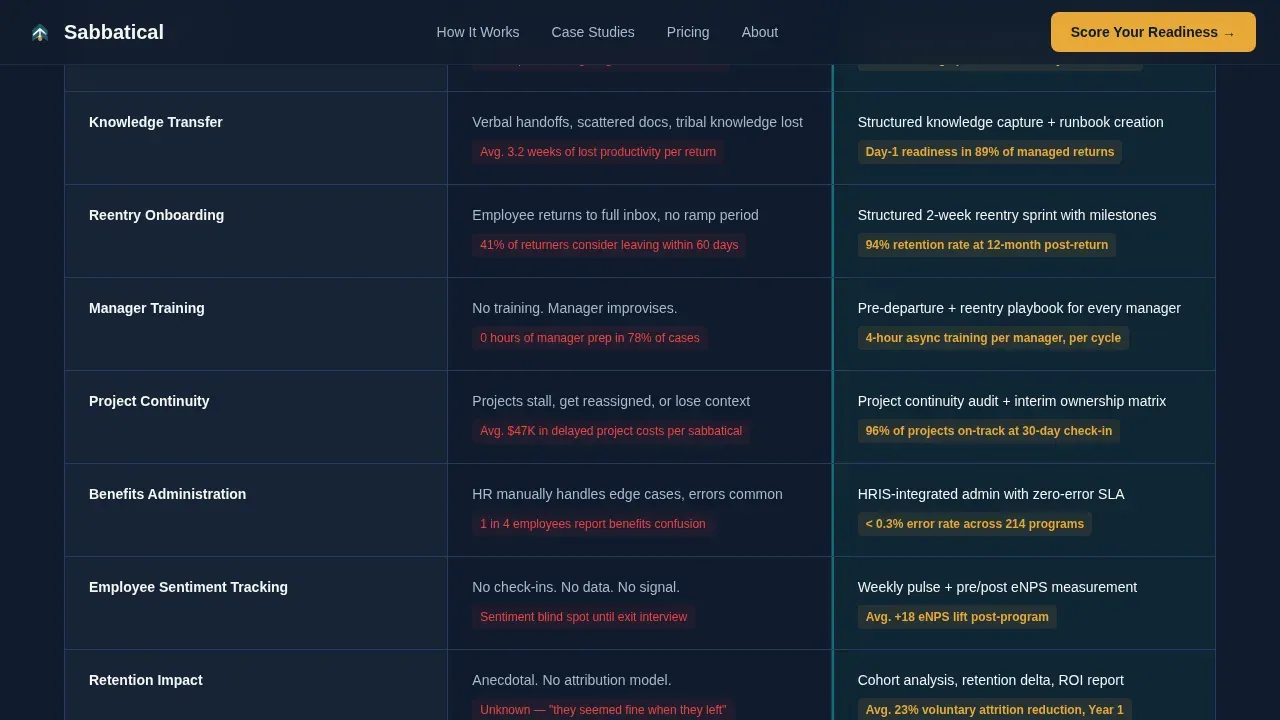
- The absence of a clear, data-backed comparison between ad-hoc sabbatical leave policy execution and a fully managed sabbatical program across eight operational dimensions
- The difficulty of showing VP-level decision-makers concrete retention impact, eNPS shifts, and coverage outcomes without a structured narrative format
- The lack of a self-qualifying diagnostic tool that helps eligible employees, managers, and People Ops leaders assess sabbatical readiness before a sales conversation begins
What you get with this template
This is a single-page, high-conversion landing page built around three acts of persuasion: comparison, proof, and self-assessment. Every section serves the same goal: move a skeptical VP People Ops leader from recognition to action without a single wasted scroll.
The template includes:
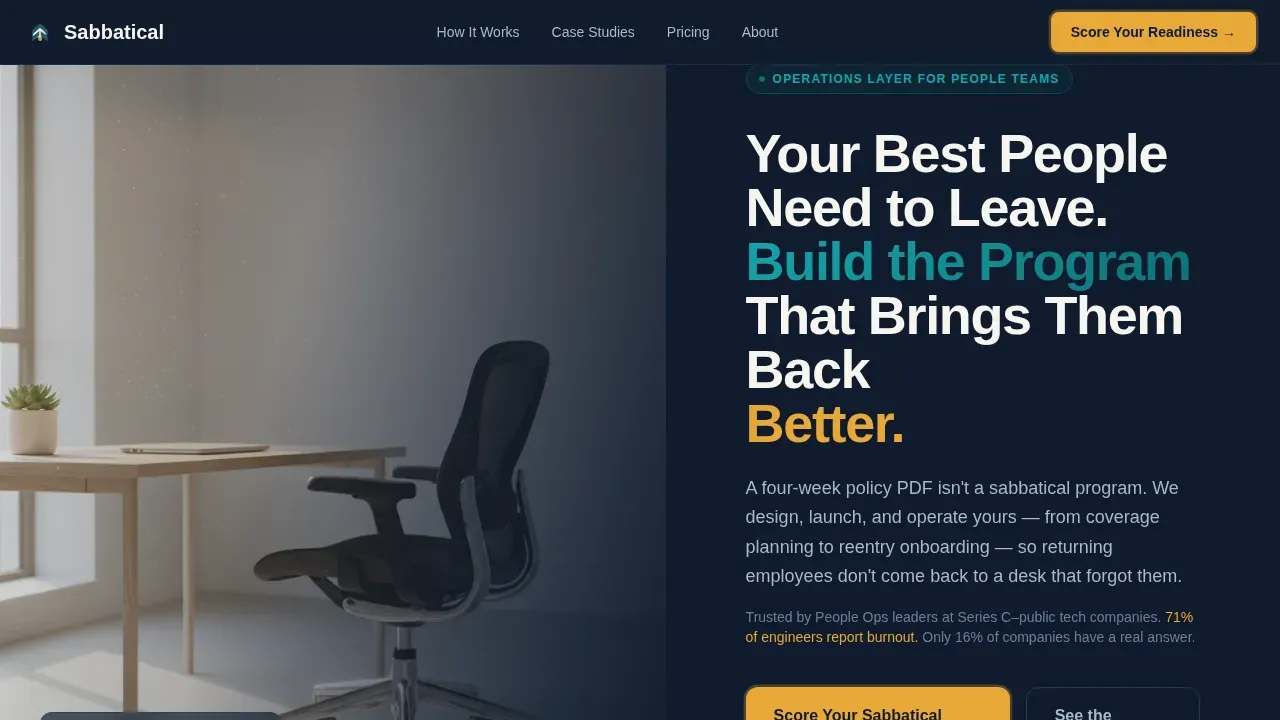
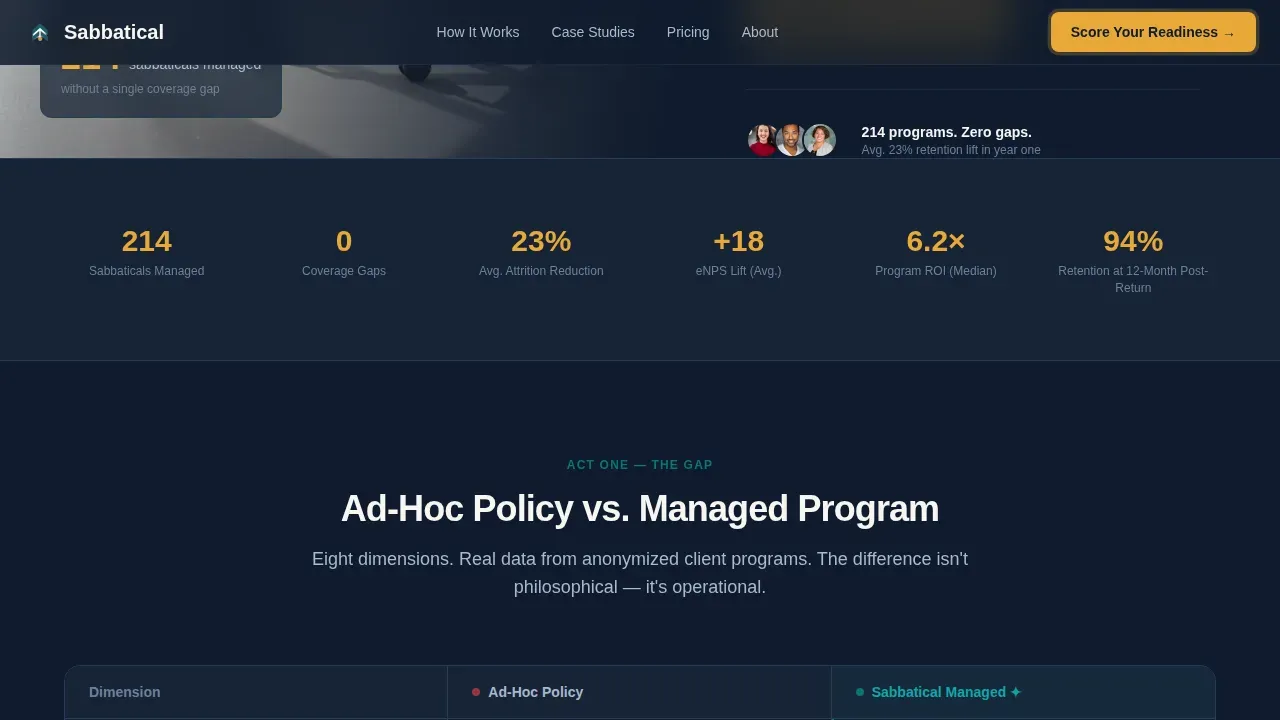
- A half-page photo and text hero section with an editorial photograph, a bold mission headline, and a live counter showing 214 sabbaticals managed without a coverage gap
- A three-act scroll structure covering an eight-dimension comparison table, three sequential before-during-after case studies, and an interactive build-versus-buy return-on-investment calculator
- A seven-question sabbatical readiness quiz with teal progress bar, amber highlights, letter-grade results (A through D), a personalized gap summary, and a Calendly embed pre-filtered to 30-minute program design calls
Feature list
This template is packed with functional, persuasive components designed for VP-level decision-makers evaluating a managed sabbatical program service.
Eight-Dimension Comparison Table
The comparison table is the anchor of Act One. It places ad-hoc sabbatical leave policy execution side by side against a fully managed sabbatical program across eight dimensions: coverage planning, knowledge transfer, reentry onboarding, manager training, project continuity, benefits administration, employee feedback tracking, and retention impact. Numbers drawn from anonymized client data populate the managed-program column, with amber highlights acting as scorecard markers. This section makes the operational cost of an unmanaged sabbatical process undeniable and sets up the case studies that follow.
Sequential Case Study Narratives
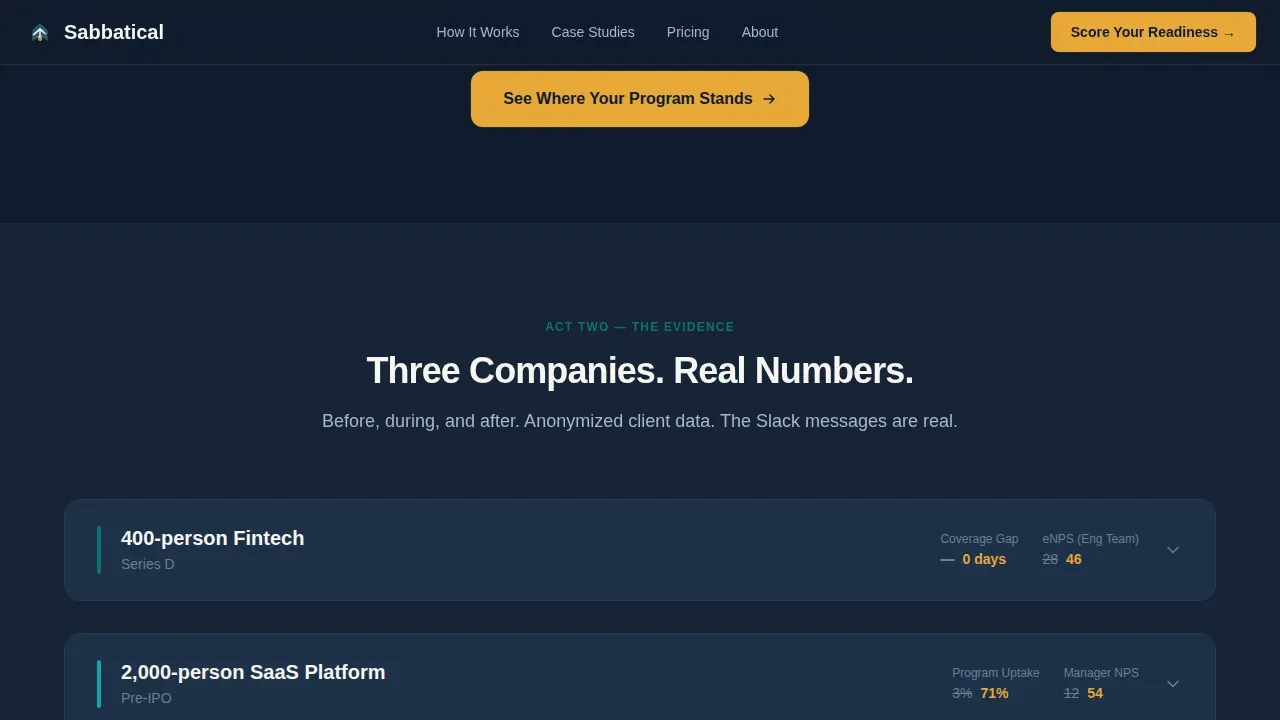
Act Two delivers three before-during-after case study stories drawn from a 400-person fintech, a 2,000-person Software-as-a-Service platform, and a pre-initial-public-offering biotech company. Each case study is rendered as a narrative with quoted communication excerpts, retention deltas, and eNPS shifts. These stories give People Ops leaders the peer-level proof they need to take the program to their leadership board. Readers see how each organization handled sabbatical requests, what changed during the managed sabbatical period, and what the after looked like in measurable terms.
Interactive Return-on-Investment Calculator
Act Three offers a real-time, interactive calculator comparing the cost of building a sabbatical program in-house against the cost of a managed service. The calculator updates dynamically as inputs change, allowing decision-makers to adjust headcount, tenure brackets, and estimated voluntary attrition rates. This tool turns an abstract business case into a specific number that a People Ops leader can take to their finance team. It directly addresses financial stability concerns, which is often the biggest barrier to committing to a structured sabbatical program.
Seven-Question Readiness Diagnostic
The sabbatical readiness quiz is the primary conversion engine. It presents questions one at a time, covering current sabbatical leave policy existence, average tenure of senior individual contributors, last voluntary attrition figures, whether coverage plans exist for key-person roles, HR team bandwidth, existing human resources information system platform, and company headcount bracket. The assessment aims to identify operational gaps, empower teams, and facilitate a productive program design conversation. Results deliver a readiness grade from A through D, a personalized gap summary, and a secondary call to action to book a program design call.
Teal Catalyst Visual System
The color system is functional, not decorative. Deep operational teal is used as the primary brand anchor across section headers and progress indicators. Midnight sprint navy provides the background on dark sections. Warm launchpad white creates breathing space across open sections. Amber is reserved exclusively for calls to action, progress bar advancement, and data highlight moments in the comparison table. The palette communicates operational seriousness while maintaining momentum through every scroll transition.
Scroll-Driven Interaction Design
Every transition between sections is designed to feel like turning a page in a pitch deck. Scroll reveals activate section content progressively. The counter in the hero section animates on load. The teal progress bar in the quiz advances in amber increments as each question is answered. The return-on-investment calculator updates in real time as inputs change. These interactions are built with a deliberate split between server-rendered static sections and client-side interactive components, keeping the page purposeful at every stage of the scroll.
Page sections overview
| Section | Purpose |
|---|---|
| Hero photo split | Establish mission, show live social proof counter |
| Comparison table act | Contrast ad-hoc policy against managed program across eight dimensions |
| Case study narratives | Deliver peer-level retention proof through three sequential company stories |
| ROI calculator act | Convert abstract cost concerns into a real, adjustable build-versus-buy number |
| Readiness quiz | Qualify and convert visitors through a seven-question diagnostic assessment |
| Linear footer row | Close the page with minimal, focused navigation and contact access |
Design & branding system
The visual identity follows a Startup Velocity theme with a Teal Catalyst color system. The design feels like a well-funded startup's internal dashboard at 7 AM: purposeful enough to signal operational seriousness, alive enough to signal momentum. Typography uses DM Sans for headings and Manrope for body and data text, keeping the reading experience clean and scannable for desktop-first decision-makers.
Key design details include:
- Primary color is deep operational teal (#0D7377), used for section anchors, progress indicators, and interactive states throughout the sabbatical process flow
- Background alternates between midnight sprint navy (#0F1B2D) for dark operational sections and warm launchpad white (#F7F5F0) for open reading space
- Amber (#E8A838) is reserved exclusively for calls to action, progress bar advancement, and data highlights in the comparison table to draw attention toward what matters next
Mobile & speed optimization
The template is built desktop-first, reflecting the reality that VP People Ops leaders and Chief People Officers reviewing a managed sabbatical program service are typically doing so on a desktop browser during a planned research session. Every section is fully responsive so the experience remains clean and readable on smaller screens without losing structural clarity.
Key optimization considerations include:
- Static sections such as the hero, comparison table, and case study narratives are structured for server-side rendering to keep initial load fast and stable
- Interactive components including the readiness quiz and return-on-investment calculator are client-side components, loading independently without blocking the critical path of the page
- Scroll reveal animations are set at a medium intensity, delivering enough motion to signal progression without creating friction for users who prefer a faster experience
How this template helps you convert
This template is designed to move VP People Ops leaders from awareness to action within a single scrolling session. It does not ask for commitment before it has earned it. Each section of the page does a specific job in the conversion sequence.
- The hero establishes credibility immediately with a live counter showing 214 managed sabbatical programs and a headline that speaks directly to the cost of losing senior employees to burnout, setting clear expectations for what the rest of the page will deliver.
- The comparison table and case study narratives build trust progressively, giving decision-makers the data, peer stories, and retention evidence they need to feel confident taking the program to their board, before any form or call is requested.
- The seven-question readiness diagnostic converts that trust into action by making the next step feel like a useful self-assessment rather than a sales pitch, delivering a personalized readiness grade and a pre-filtered calendar link that removes friction from the booking step.
Other information about this template
This template is purpose-built for the HR and Hiring category, specifically the Employee Wellness and Benefits subcategory, with a focus on the sabbatical program manager niche. It is the Sabbatical Score Your Readiness Sabbatical Program Manager landing page template designed for organizations that want to move beyond a static sabbatical leave policy template and into a fully operational program.
Sabbatical leave can be paid, unpaid, or partially paid depending on the employer's policies. A well-structured sabbatical leave policy sets clear expectations around eligibility, duration, compensation, and how roles will be handled while an employee is away. The duration of sabbatical leave can vary widely, typically ranging from three months to one year, and is granted at the company's discretion based on business needs. A sabbatical leave policy should detail the eligibility criteria, duration of leave, and maintenance of employment benefits such as health insurance and benefits continuation during the extended period.
Eligible employees must typically have worked full-time for a specified number of consecutive years to qualify. Employees at director and executive levels are also eligible to apply after a specified number of continuous years of full-time service. Approval of sabbatical requests is based on eligibility criteria, organizational needs, and individual readiness, including factors like tenure and performance. HR should ensure that the approval process for sabbatical requests is not discriminatory or biased in any way, and should ensure compliance with local, state, and federal employment laws.
A sabbatical leave policy should incorporate legal considerations that ensure compliance with national employment laws. It is important to review local, state, and federal laws when writing a sabbatical leave policy to ensure legal compliance and mitigate risk for the organization. Employees are encouraged to engage in productive activities during their sabbatical, such as continuing education, research, volunteering, cultural exploration, volunteering for nonprofit organizations, or pursuing a passion project. Sabbatical leave offers employees the extended period away from daily responsibilities needed to achieve meaningful personal growth and professional development.
A successful sabbatical requires 6 to 12 months of planning to ensure it is restorative rather than stressful. About 3 to 6 months before a sabbatical, a program manager should test their team's capability by stepping back from operational decisions. A clear interim leadership structure should be developed, including a written plan defining decision-making authority during the sabbatical. Before departing, employees and managers should conduct an honest assessment of current impact and how the absence will affect organizational goals. Financial stability is often the biggest barrier to a successful sabbatical. Organizations and individual contributors planning sabbatical leave should build a dedicated sabbatical fund separate from an emergency fund, targeting 14 to 15 months of expenses plus a 30 to 40 percent buffer.
Additional details worth noting about this template:
- The sabbatical leave policy template framework embedded in the quiz diagnostic covers all key components of a functioning program: coverage planning, knowledge transfer, reentry onboarding, manager training, and benefits administration
- Employees on paid sabbatical leave will not be required to use any accrued unpaid leave during the sabbatical period, and the employer remains responsible for health insurance and benefits continuation where applicable under the company's sabbatical leave policy
- The comparison table clearly distinguishes between paid sabbaticals, partially paid programs, and unpaid sabbatical leave options so decision-makers understand the full compensation spectrum when designing eligibility criteria for their organization
- Sabbatical plans should address not just the departure logistics but also the reentry phase, with training needed for returning employees and managers to ensure continuity and prevent a coverage gap from undermining the benefit
- The readiness quiz uses a Burnout Score and Sabbatical Archetype evaluation approach to help determine the ideal length and focus for each sabbatical, surfacing the passion project, volunteer work, creative projects, or professional development activities best suited to each employee's situation
- Organizations looking to develop or update their sabbatical policies can use a structured sabbatical leave policy template to streamline the management and application processes, ensuring the sabbatical process is fair, transparent, and aligned with long-term business needs
Theme
Startup Velocity
Creative direction
Case Study Narrative
Color system
Teal Catalyst
Style
Comparison Table
Direction
Quiz/Assessment
Page Sections
Eight-dimension Comparison Table
Sequential Before-during-after Case Studies
Interactive Build-versus-buy Calculator
Seven-question Sabbatical Readiness Diagnostic
Teal Catalyst Color and Typography System
Scroll-driven Interaction Architecture
Related questions
What is included in the seven-question sabbatical readiness quiz?
Can this template support both paid sabbaticals and unpaid sabbatical leave options?
Who is the primary decision-maker this landing page targets?
Does the template include case study content I can customize?
How does the return-on-investment calculator work?