Healing Space Grief Support Landing Page Template
Passage is a grief support landing page template built for counseling practices and healing services that walk with the bereaved long after the funeral ends. It pairs a Japanese Zen visual identity with a zigzag testimonial mosaic layout, guiding visitors gently toward a free guide download or a local group connection, without pressure or intake forms.
by Rocket studio
Quick summary
Passage is a single-page template designed for grief support and counseling practices. It uses a quiet Japanese Zen aesthetic, warm washi paper tones, and an alternating testimonial-plus-pathway layout to earn visitor trust before making any ask. The primary call to action is a free guide download. The secondary path connects visitors to a local gathering of peers.
Who this template is for
This template is built for practitioners, counselors, and healing services whose work centers on loss. It speaks directly to the people who need this kind of support most, and it gives practices a dignified, emotionally considered page to welcome them.
- Grief counselors and solo therapists running support programs for the bereaved
- Healing centers and community organizations offering guided conversations, group circles, or solo journaling programs
- Bereaved parents, adult children, and recently widowed individuals searching for support resources online
What problem this template solves
When someone is grieving, the world keeps moving and most people around them quietly stop asking. Society often imposes narrow expectations on how a person should grieve, confining the experience to a short window after the funeral. A generic website template cannot hold the weight of that reality. Grief is often described as love that has nowhere to go, and a page that feels clinical or pressured will send a bereaved visitor away before they ever read a single word.
This template solves that mismatch directly. It creates a space that feels like a quiet room, not a sales funnel.
- It removes intake form pressure and scheduling friction that can feel overwhelming during acute loss
- It gives visitors something useful first, a free downloadable guide, before asking for anything in return
- It validates the feelings of people grieving an unexpected death, an extended loss, or a death with no clear social script
What you get with this template
You get a fully structured, single-page layout that guides emotionally sensitive visitors through a clear, unhurried experience. Every section has a defined role. Every design decision reduces cognitive load and builds quiet trust.
- A portrait-centered hero section with a soft serif headline, generous negative space, and a subtext line naming three services without selling them
- A zigzag alternating section flow that pairs attributed testimonial tiles with support pathway descriptions, creating an accumulating mosaic of real voices
- A dual call-to-action section with an email capture for a free PDF grief companion and a zip-code lookup for local group connections
Feature list
This template delivers a set of carefully considered features drawn directly from the source design brief. Each one reflects a specific decision made in service of the bereaved visitor.
Portrait-Centered Hero Section
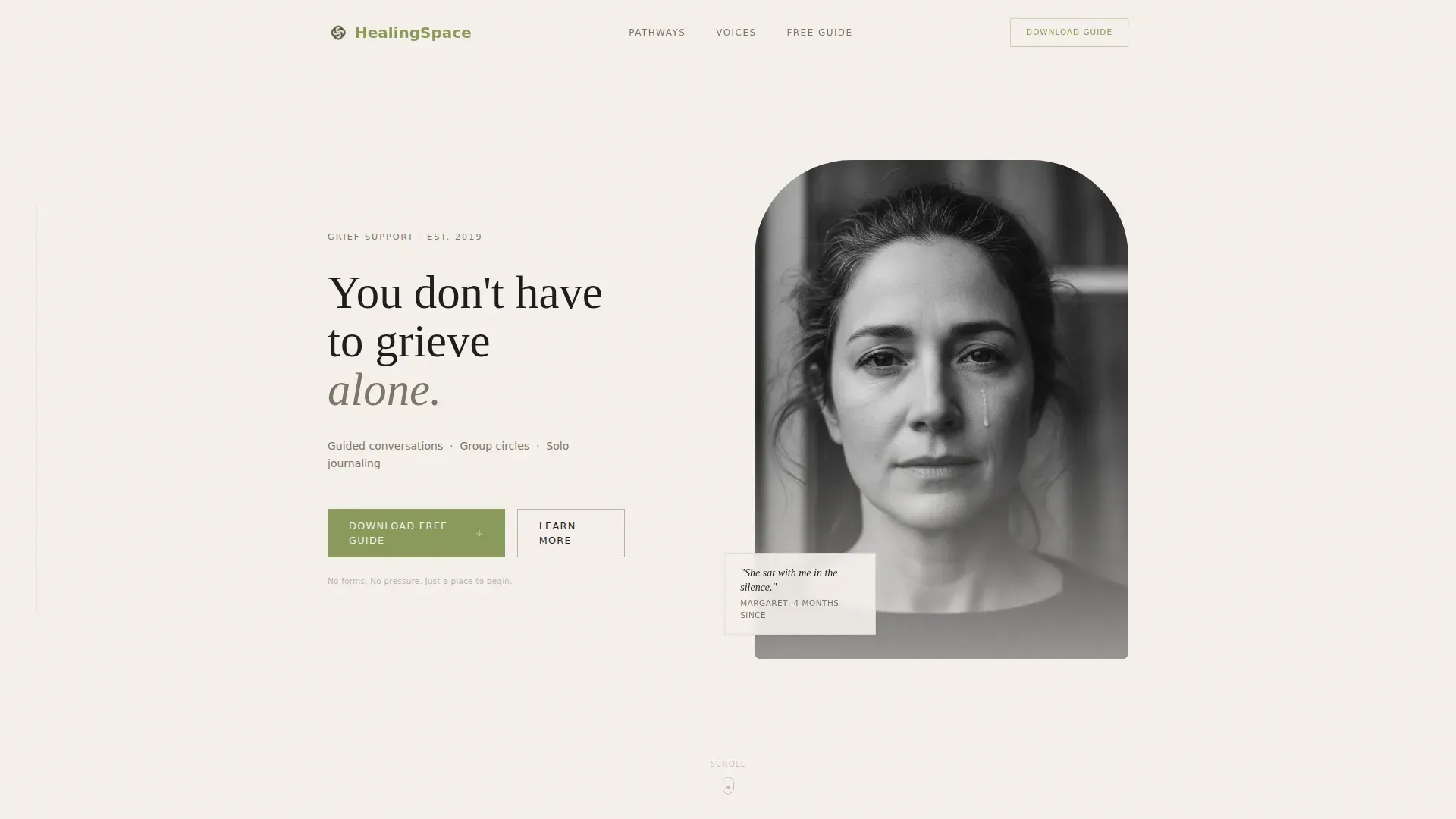
The hero opens with a softly lit portrait image framed by generous negative space on a warm washi paper background. A light serif headline reads "You don't have to grieve alone," and a single line of temple-stone gray subtext names the three available support pathways without framing them as products. This section sets the emotional tone for the entire page, establishing that the person behind the practice has already thought about what the visitor is carrying.
Testimonial Mosaic Zigzag Layout
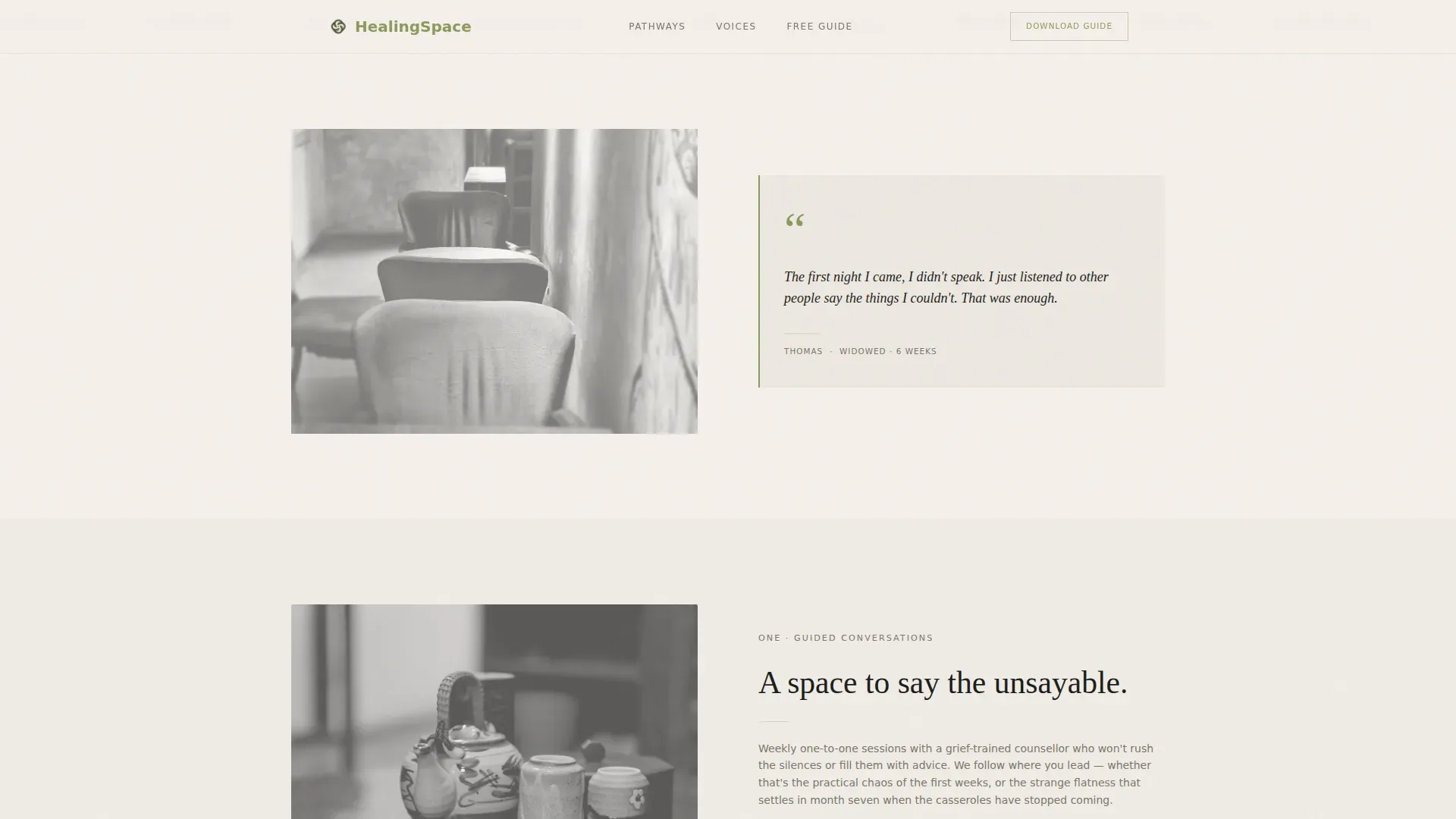
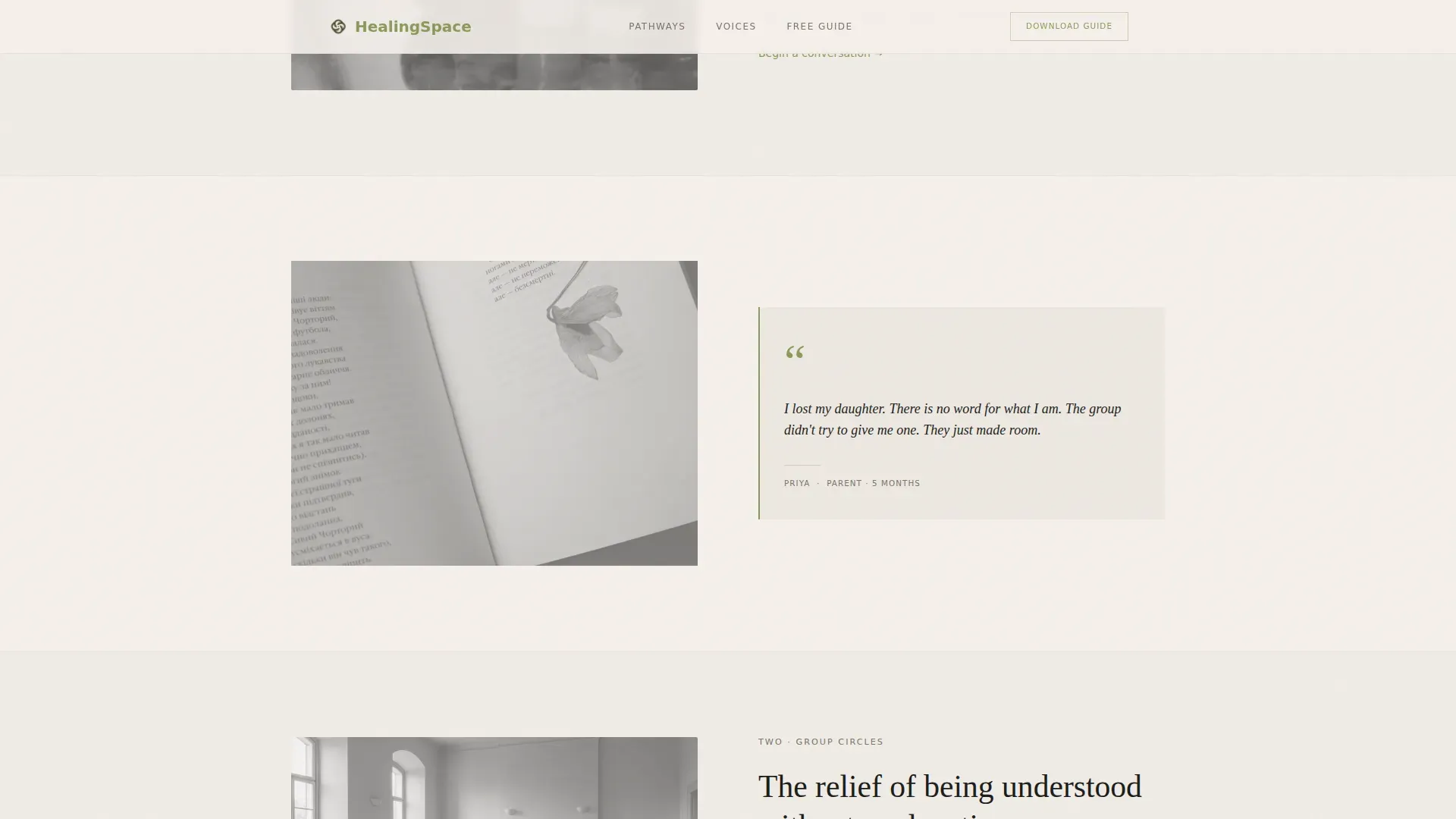
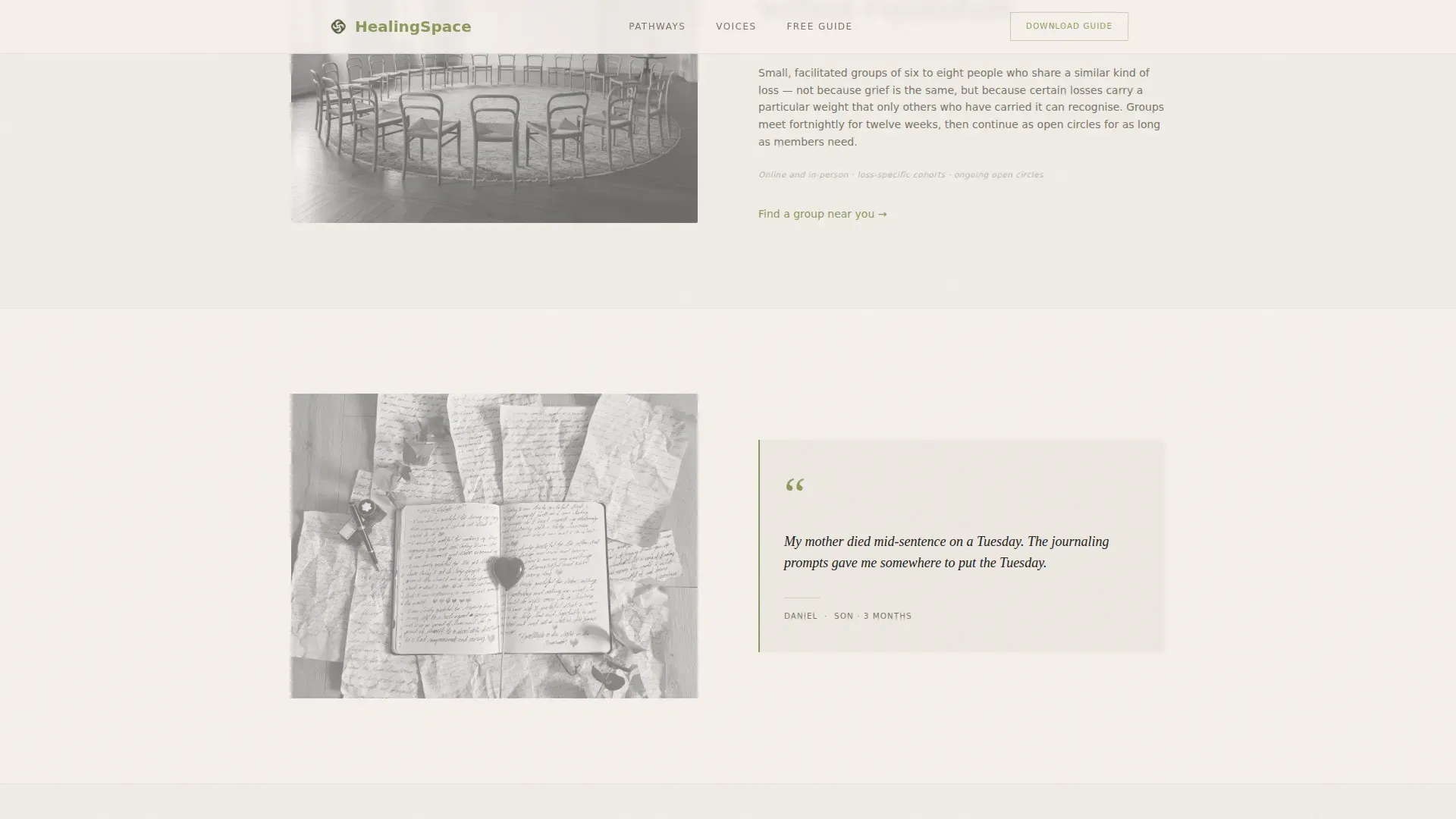
As the visitor scrolls, alternating sections pair short attributed testimonials with descriptions of each support pathway. Each testimonial is no more than two sentences, presented on a slightly warmer background tile in a handwritten-style typeface. The testimonials carry attribution by first name, relationship lost, and months since the death. This accumulation of honest voices creates what the brief calls emotional permission. By the time a visitor reaches the fourth section, they begin to recognize their own feelings in the story of a stranger.
Dual Call-to-Action Section
The page ends with two parallel options, neither of which pressures the visitor. The first is an email capture offering a free PDF called the First 30 Days Guide, accompanied by the reassurance line "We write once a week, gently." The second is a zip-code lookup field to help visitors find a group circle near them. Both paths are low-friction, self-directed, and designed for someone who may be reading the page late at night on a phone.
Japanese Zen Color System
The visual palette draws from a Japanese Zen design language. Washi paper white (#F5F0EB) is used as the primary background. Temple stone gray (#7A7568) carries body text and subtext. Ink-black (#1C1C1A) is reserved for display headings that breathe rather than shout. Dried-moss green (#8A9A5B) marks links, icons, and the gentlest interactive moments. Nothing gleams. Nothing pulses. Backgrounds alternate between warm paper white and the faintest wash of stone gray, so each section feels like turning a page in a handbound book.
Fraunces and DM Sans Typography Pairing
The template uses Fraunces, a variable serif with optical weight and emotional warmth, for all display headings and testimonial pull quotes. DM Sans handles body copy with clarity and calm. Together they form a pairing that feels literary without being precious. The type system is scaled for grief-aware readability, with generous line spacing and sufficient contrast between text and background tones.
Minimal Animation and Interaction Model
Every interactive element in this template is intentionally restrained. Sections fade in gently on scroll. Hover states shift subtly in the moss green. There are no auto-playing elements, no pulsing badges, and no escalating prompts. The email capture and zip-code field are the only interactive form elements on the page. This low-animation approach respects the cognitive and emotional state of a grieving visitor arriving late at night on a mobile device.
Page sections overview
| Section | Purpose |
|---|---|
| Hero Portrait | Opens with a warm, serif headline and portrait image that names three support pathways without selling |
| Testimonial Tile One | Pairs the first attributed testimonial with a description of guided conversations as a support pathway |
| Testimonial Tile Two | Pairs the second testimonial with a description of group circles and community gathering options |
| Testimonial Tile Three | Pairs the third testimonial with solo journaling programs for self-paced healing |
| Dual call to action Section | Offers a free PDF guide via email capture and a local group finder via zip-code lookup |
| Minimal Footer | Single-row footer with warm, minimal design and essential navigation links |
Design & branding system
The design language of this template draws from Japanese Zen minimalism. Every visual decision points toward calm, not conversion. The palette was chosen because a soothing color palette reduces anxiety on a grief recovery page, and low cognitive load is a core requirement for any page serving the bereaved.
- Four-color Zen palette: washi white (#F5F0EB), temple stone gray (#7A7568), ink-black (#1C1C1A), and dried-moss green (#8A9A5B) used with strict restraint
- Fraunces serif for emotional display headings and DM Sans for clean, readable body copy across all sections
- Alternating section backgrounds that shift between warm white and faint gray to create depth without contrast shock
Mobile & speed optimization
Grief is often processed late at night on a phone. The brief makes this explicit, and the template is designed mobile-first as a direct response to that reality. A visitor who has just spent a long night alone with their thoughts needs a page that loads cleanly and reads comfortably on a small screen.
- Mobile-first layout with a single-column flow that preserves the zigzag rhythm on smaller viewports
- Minimal JavaScript approach using server-rendered static components to reduce page weight and load friction
- Large, touch-friendly call-to-action fields with comfortable tap targets for the email capture and zip-code lookup
How this template helps you convert
Conversion here does not mean pressure. It means guiding a grieving visitor toward a resource or a community connection at their own pace. The template earns trust by giving something useful before asking for anything. That approach aligns with a core truth about grief support: healing takes time, and the first step is simply feeling understood.
- The testimonial mosaic builds emotional recognition across four alternating sections, so that by the time a visitor reaches the call to action, they feel seen rather than solicited
- The free PDF download lowers the barrier to engagement by offering immediate value, a practical First 30 Days Guide, through a single email field with no scheduling pressure
- The zip-code group finder offers a second path for visitors who are ready for human connection, pointing them toward a local gathering rather than a form or a consultation booking
Other information about this template
This section covers additional context about how the template fits into the broader landscape of grief support practice and digital resource delivery. Understanding this context helps practitioners decide whether this template fits their specific service model.
Grief is a personal experience that varies greatly from person to person. The grief process does not adhere to a specific timeline, and the grieving process can last much longer than most of society expects. Grief is often misunderstood, and societal norms frequently confine individuals to a narrow expression of their loss. That pressure to appear healed can leave grieving people feeling shame, isolation, and confusion about whether their feelings are acceptable. This template is designed to push back against that pressure by creating a page that does not rush anyone.
The template is particularly well suited to practices working with bereaved parents navigating an unexpected death, adult children who lost a parent suddenly, and recently widowed individuals still learning to carry the weight of daily life without their person. It also serves extended family members, close friends, and anyone supporting a grieving loved one from the outside. Children who are grieving the death of a parent or sibling, and parents navigating the death of a child, are among the most underserved groups in available grief resources, and this template's tone is calibrated for exactly that level of gravity.
The page structure aligns with research-backed principles for grief recovery pages. Educational, therapeutic, and interactive elements qualify as healing support services for grieving families. This template supports all three categories through its journaling pathway, group circles section, and guided conversation descriptions. Creating a space where individuals can speak openly about their feelings is essential to healing, and the page creates that space before the visitor even reaches the call to action.
Art-making and journaling are both recognized as therapeutic outlets during grief. The creative process can lead to a heightened awareness of emotional truths and help individuals derive personal meaning from their grief experiences. By featuring a dedicated solo journaling program pathway, this template supports practices that include expressive and creative healing methods alongside talk-based support.
Talking about a deceased loved one can be a healthy way for the grieving to process their emotions. The testimonial mosaic is built on this principle. Each tile gives a real voice to a real story of loss, creating an accumulating record of shared sorrow and shared hope. Visitors who feel alone in their grief begin to recognize that others carry similar weight, and that recognition is often the first moment of relief.
The page is appropriate for practices that also maintain a broader online presence. Practitioners who share resources through a facebook page or community group can link directly to this landing page as a primary resource hub. The email capture creates a gentle ongoing connection through weekly writing, not a sales sequence. The zip-code lookup supports community gathering without requiring a practitioner to manage individual scheduling.
- The template fits practices offering guided conversations, group circles, and solo journaling programs as described in the brief
- Bereaved parents, extended family members, and close friends can all find a relevant pathway within the page's three-section support structure
- The First 30 Days Guide email capture is suitable for practices that already have or plan to create a PDF resource for newly bereaved individuals
- The zip-code lookup section is a placeholder interaction that points toward a local group connection, appropriate for practices with regional gathering programs
- Practices working with children who have lost a parent or sibling, or with parents navigating the death of a child, will find the tone and language of this template calibrated for their audience
- The page does not include intake forms, scheduling tools, or backend integrations; it is a trust-first content and resource delivery page
- Physical appearance of the page is intentionally minimal: no stock photography is used in the hero, and the design relies on portrait photography and typography rather than decorative imagery
- The template is one point of entry in a broader support ecosystem; it is not intended to replace clinical intake or care coordination tools
Theme
Healing Space
Creative direction
Testimonial Mosaic
Color system
Japanese Zen
Style
Zigzag/Alternating
Direction
Content/Resource
Page Sections
Portrait-centered Hero with Serif Headline
Testimonial Mosaic Zigzag Layout
Dual Call-to-action Section
Japanese Zen Four-color Palette
Fraunces and DM Sans Type System
Minimal Animation and Interaction Model
Related questions
Is this template suitable for a solo grief counselor or a larger practice?
Can this template support practices working with bereaved parents and children specifically?
What content do I need ready before launching this template?
Does this template include scheduling or intake form functionality?
How does the testimonial mosaic section work in practice?