Glass Repair Marketing Professional Website Template
Glassreferral is a split-screen landing page built for glass repair businesses that run a structured referral program. It leads with real earnings data, walks referrers through a three-step process, and captures sign-ups through a sticky bottom bar. The design uses a Corporate Precision theme with an Ink and Paper color palette built to project authority and trust.
by Rocket studio
Quick summary
Glassreferral is a single-page referral program landing page designed for glass repair businesses. It opens with a testimonial card showing real earnings, then delivers hard program statistics before explaining how the process works. The layout is a clean 50/50 split screen styled in deep black, warm paper white, and notary blue.
Who this template is for
This template is built for glass repair businesses that want to turn satisfied customers into a reliable referral channel. It speaks directly to three types of people who are most likely to send consistent work your way.
- Past customers who have already had a windshield sealed or a storefront pane replaced
- Small contractors who occasionally route overflow glass jobs to other vendors
- Insurance adjusters who recommend repair vendors to claimants during claims processing
What problem this template solves
Most referral programs fail because they ask people to act before giving them a reason to trust the offer. This template reverses that order. It puts real payout data in front of the visitor first, removing skepticism before it can form.
- Referrers need proof that others have actually been paid before they will sign up
- Program mechanics are often buried in fine print rather than shown clearly upfront
- The sign-up path is usually unclear, causing potential referrers to leave without converting
What you get with this template
You get a fully structured, single-page layout that guides each visitor from curiosity to sign-up in a logical, data-led sequence. Every section earns the next one rather than asking for trust the page has not yet built.
- A split-screen testimonial header with real earnings attribution and a live stat cluster
- A stats-first scroll section with hard program numbers shown before any explanation
- A three-step horizontal timeline, sticky sign-up bar, and dual call-to-action paths
Feature list
This template delivers a focused set of purposeful components drawn directly from the design brief. Each one serves the referral program's specific conversion goal.
Split-Screen Testimonial Header
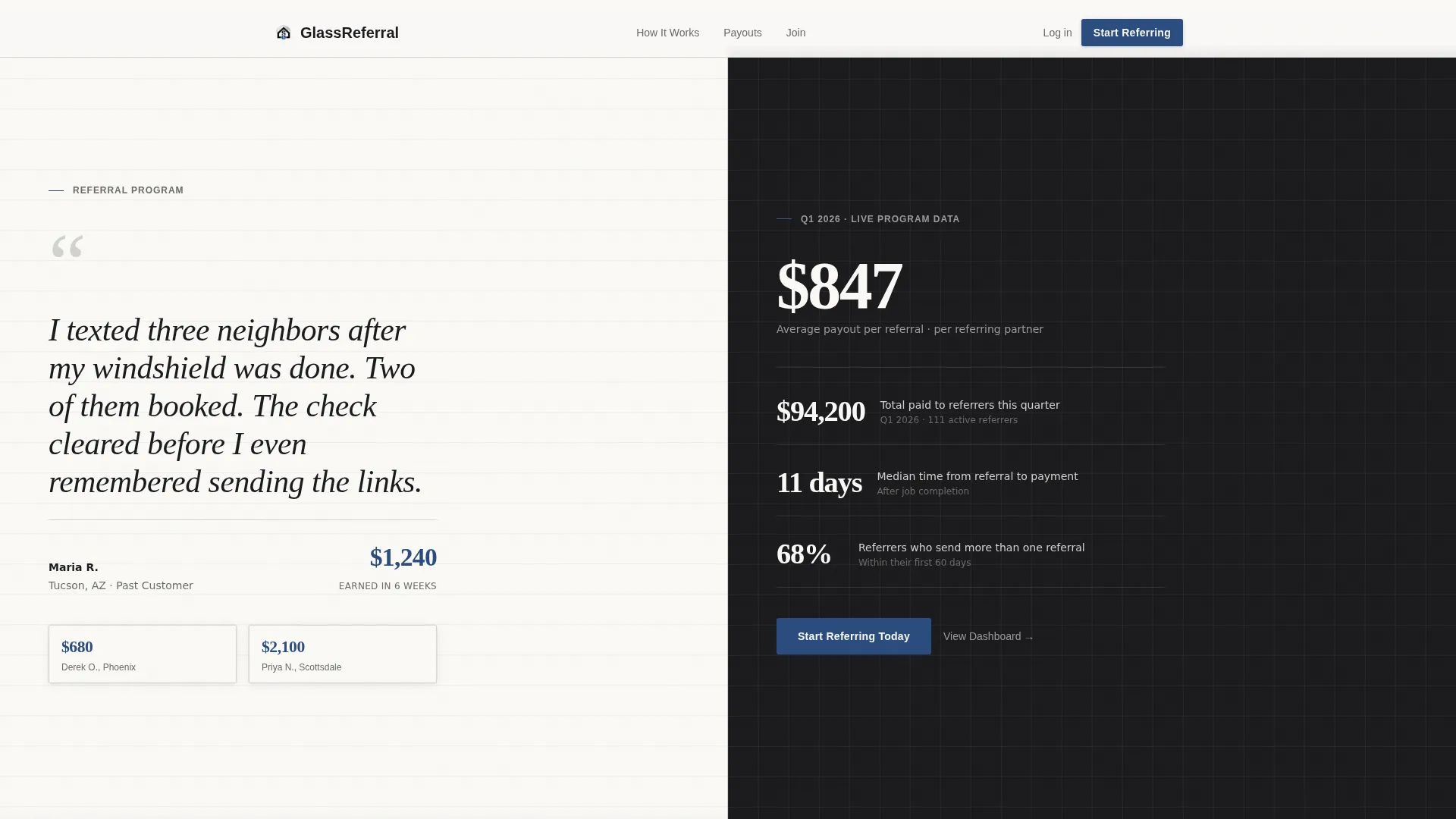
The header divides into two equal panels. The left side displays a single oversized referral testimonial in large serif type, attributed with a first name, city, and exact dollar amount earned. The right side shows a stat cluster covering average payout per referral, total paid to referrers this quarter, and median days from referral to payment.
Stats-First Scroll Section
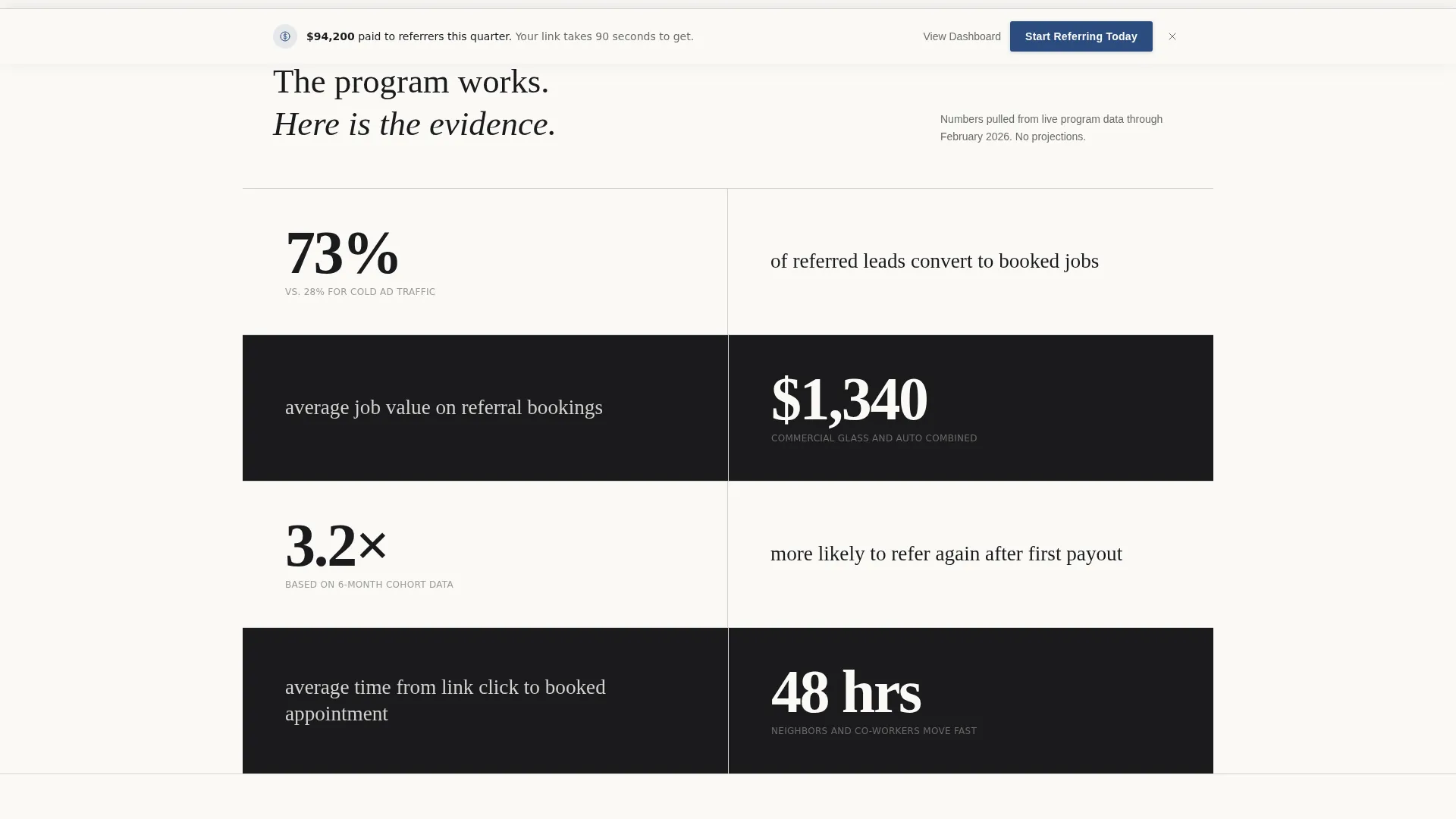
Immediately below the fold, hard numbers appear before any program copy does. Each stat pair occupies its own split frame: the figure on one side, one sentence of context on the other. This sequence builds credibility through evidence before the page introduces process.
Three-Step Process Timeline
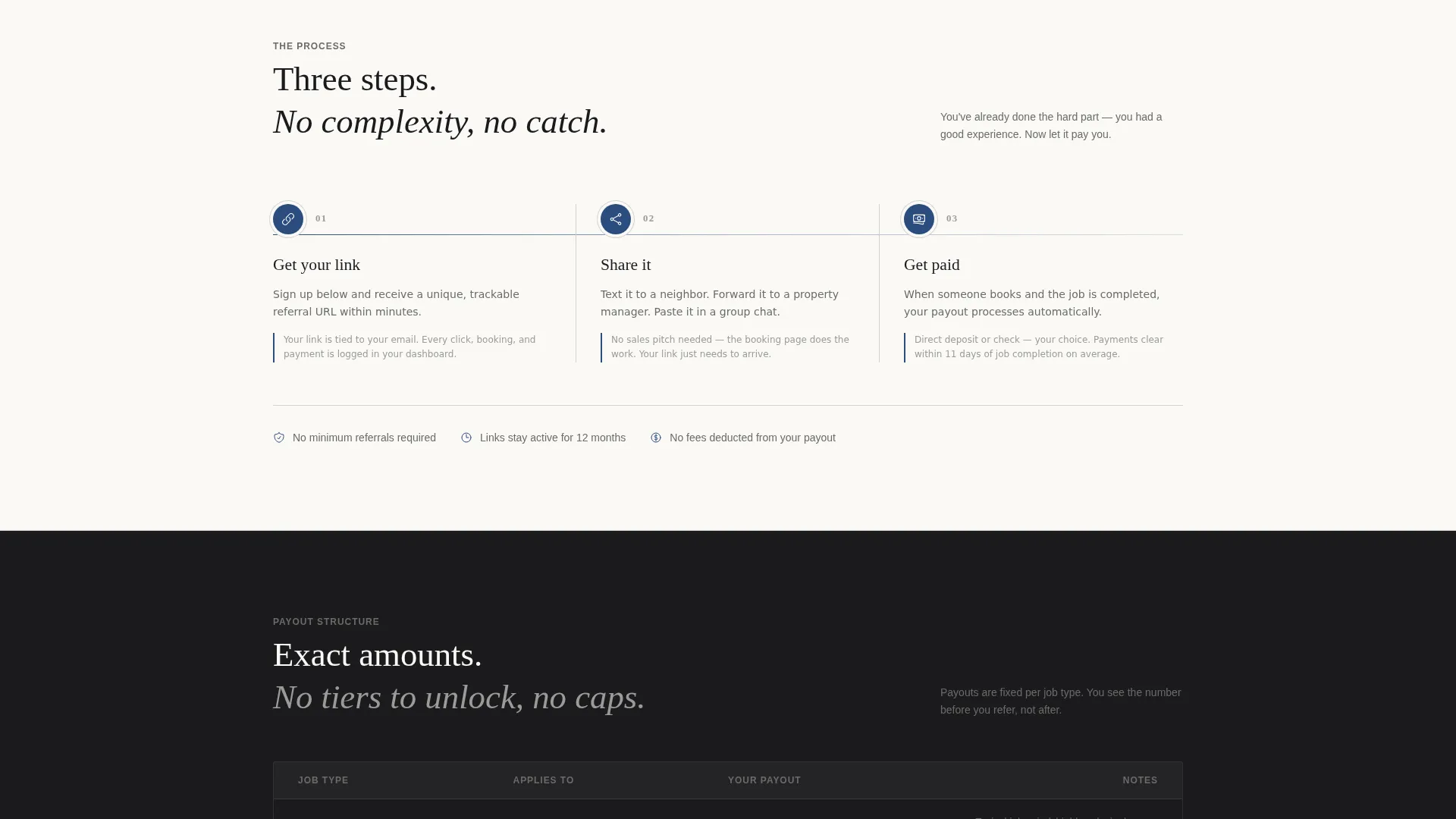
After the data section, a horizontal timeline reveals how the referral program works in three clear steps. Notary-blue connector lines link each stage visually. The rhythm moves from proof to process to payout, keeping the reader oriented at every point.
Sticky Bottom Sign-Up Bar
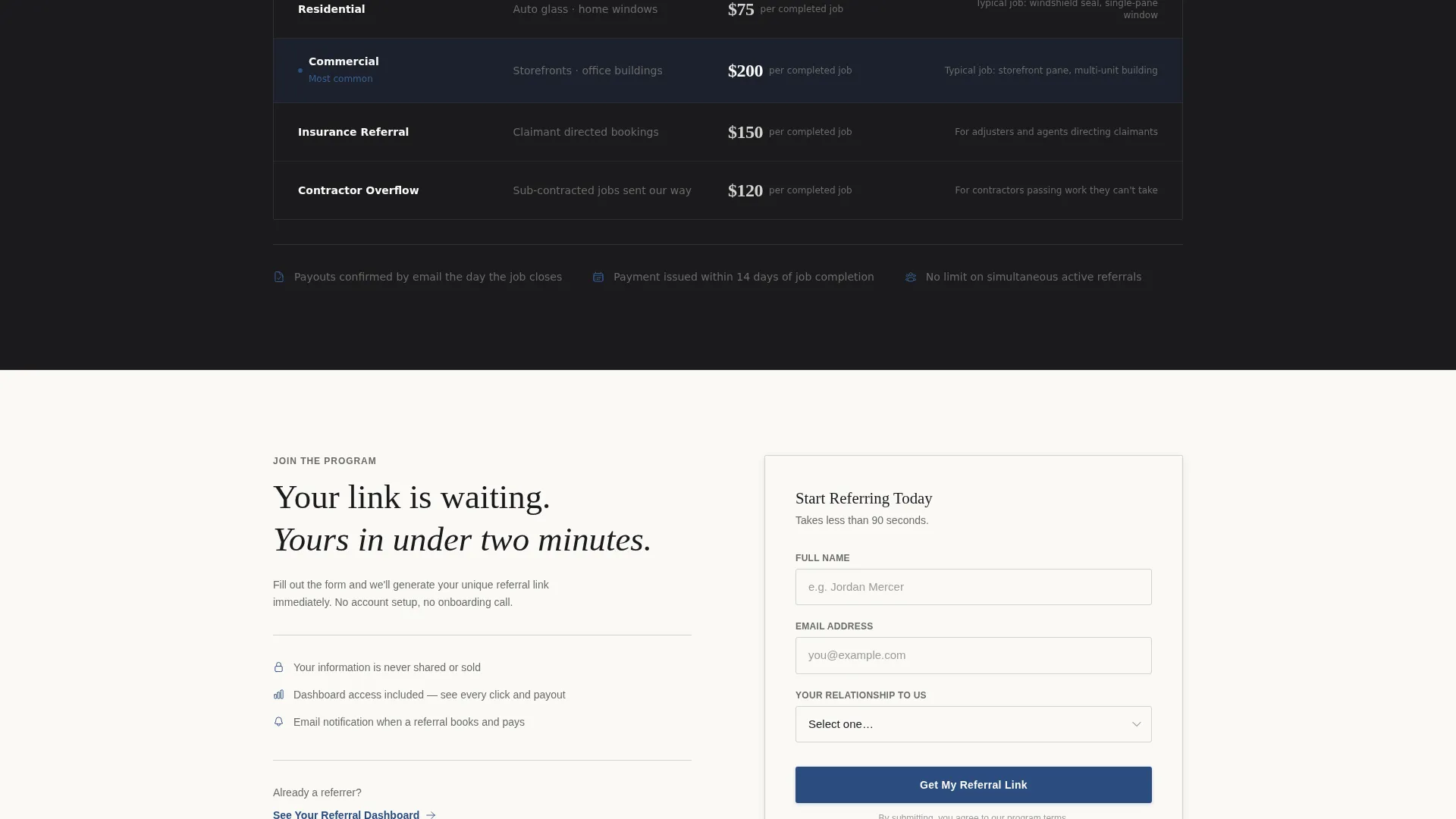
A persistent bottom bar appears after the first scroll and stays visible as the visitor reads. It anchors the primary call to action and holds the sign-up form with fields for full name, email, and a relationship-type dropdown covering past customer, contractor, and insurance professional.
Dual Call-to-Action Paths
The primary call to action reads "Start Referring Today" and captures new sign-ups. A secondary path labeled "See Your Referral Dashboard" links existing referrers directly to a login. Both paths are visible simultaneously, so no visitor has to hunt for their next step.
Trackable Referral Link Model
The program structure described on this page is built around individual trackable links handed to each referrer. The page copy and layout reflect this model directly, giving visitors confidence that their referrals will be credited accurately and paid promptly.
Page sections overview
| Section | Purpose |
|---|---|
| Testimonial Card Header | Opens with earned income proof and live program stats |
| Stats-First Impact Block | Delivers conversion rate, job value, and repeat-referrer data |
| How It Works Timeline | Explains the three-step process with notary-blue connectors |
| Payout Structure Detail | Breaks down exactly how and when referrers get paid |
| Sticky Sign-Up Bar | Captures new referrer leads with a persistent bottom call to action |
| Existing Referrer Login | Provides a secondary path for active referrers to their dashboard |
Design & branding system
The visual identity follows a Corporate Precision theme using an Ink and Paper color system. The palette is designed to feel like a freshly printed contract on heavyweight paper stock: no decorative elements, no photography, just structured authority.
- Deep manuscript black (#1B1B1E) forms the primary text and background base
- Warm bond-paper white (#FAF9F6) and ruled-line gray (#D2D2CF) carry content areas and borders
- Notary-stamp blue (#2B4C7E) is reserved for buttons, active states, and data highlight treatments
Mobile & speed optimization
The split-screen layout is structured to restack cleanly at smaller screen sizes, so mobile visitors move through the same logical section order as desktop readers. The design avoids heavy imagery entirely, which keeps the page visually light by default.
- No stock photography is used anywhere on the page, reducing visual load at every breakpoint
- The sticky bottom bar is designed to remain accessible on mobile without blocking content
- Typography-led sections and flat color blocks keep the layout coherent at any screen width
How this template helps you convert
This template is engineered around a specific conversion sequence: show proof first, explain the process second, and then ask for the sign-up. Every design decision reinforces that order.
- The testimonial header and stat cluster front-load social proof and program credibility before a single word of persuasion copy appears
- The payout structure section uses exact dollar figures to eliminate the most common objection, which is uncertainty about whether referrers actually get paid
- The sticky bar keeps the sign-up form reachable at all times, removing the friction of scrolling back to find the call to action
Other information about this template
This landing page template is part of the Glassreferral product line, designed specifically for the glass repair marketing niche. It sits at the intersection of professional services marketing and referral program design, making it well-suited for businesses that operate across residential, commercial, and insurance-adjacent glass repair verticals.
- The template style is Split Screen (50/50), giving equal visual weight to emotional proof and analytical data
- The header concept is a Testimonial Card, which leads with a named, dollar-attributed referral story rather than a generic hero image
- The creative direction is Stats-First Impact, meaning program numbers are the first piece of content the visitor encounters after the header
- The landing page direction is Lead Generation, and the primary form is intentionally short to reduce sign-up friction
Theme
Corporate Precision
Creative direction
Stats-First Impact
Color system
Ink & Paper
Style
Split Screen (50/50)
Direction
Lead Generation
Page Sections
Split-screen Testimonial Header
Stats-first Scroll Section
Three-step Process Timeline
Sticky Bottom Sign-up Bar
Dual Call-to-action Paths
Proof-led Payout Structure Section
Related questions
Who is this landing page template designed for?
What does the sign-up form collect from new referrers?
Does the template include a path for existing referrers?
Why does the page show statistics before explaining the program?
Can this template work for a glass repair business serving both residential and commercial clients?