Patent Agent Reviews & Booking Landing Page Template
Docket is a single-page landing page template built for patent agents who need to turn hard-earned client results into a credible, bookable online presence. It pairs a case study narrative scroll with a built-in scheduling flow, so solo inventors, startup teams, and R&D directors can read real prosecution stories and book a free patentability call without leaving the page.
by Rocket studio
Quick summary
Docket is a single-page patent agent landing page template that leads with authority and earns trust through specificity. It layers client case studies like a prosecution timeline, aggregates social proof into a cumulative record of outcomes, and closes with a structured booking flow. Every section is designed to make a qualified prospect feel understood before the first conversation begins.
Who this template is for
This template is built for patent practitioners who want their online presence to work as hard as their office actions do. It suits agents who already have client wins to show and need a format that frames those wins with the same precision as a well-drafted claim.
- Solo patent agents and small patent prosecution practices looking to attract new clients online
- Patent practitioners who handle mechanical, software, chemical, or design filings and want to segment their intake by category
- Agents building a lead generation page that captures both ready-to-book prospects and earlier-stage inventors who need nurturing
What problem this template solves
Most professional service pages list credentials and stop there. A patent agent's clients are not buying credentials; they are buying evidence that this practitioner has seen their problem before and solved it. Generic bios and vague testimonials do not answer the question a startup CTO or a garage inventor is actually asking: "Has this agent handled a situation like mine?"
- Unstructured review pages fail to show prosecution strategy, so prospects cannot assess whether the agent understands their specific filing situation
- No clear booking path means interested prospects leave without converting, even after reading positive reviews
- Early-stage leads with no filing history have no obvious next step and are lost before they become paying clients
What you get with this template
You get a fully structured one-page layout that moves a visitor from skepticism to scheduled call through sequenced, evidence-heavy sections. The page does not rely on decoration; it relies on the organized weight of documented client outcomes.
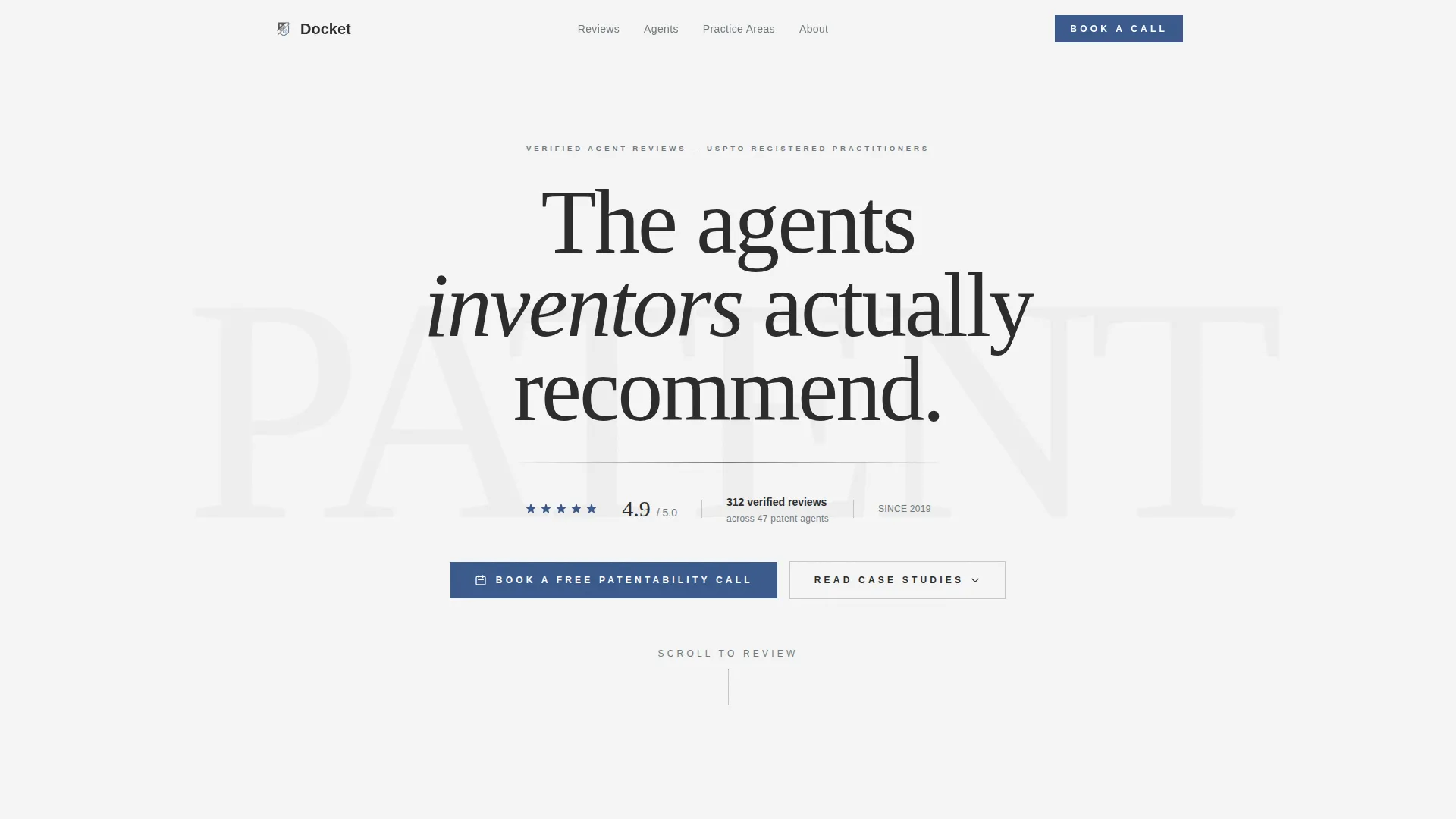
- A giant headline header with aggregate rating display and total review count, set in oversized serif type on a stark white background
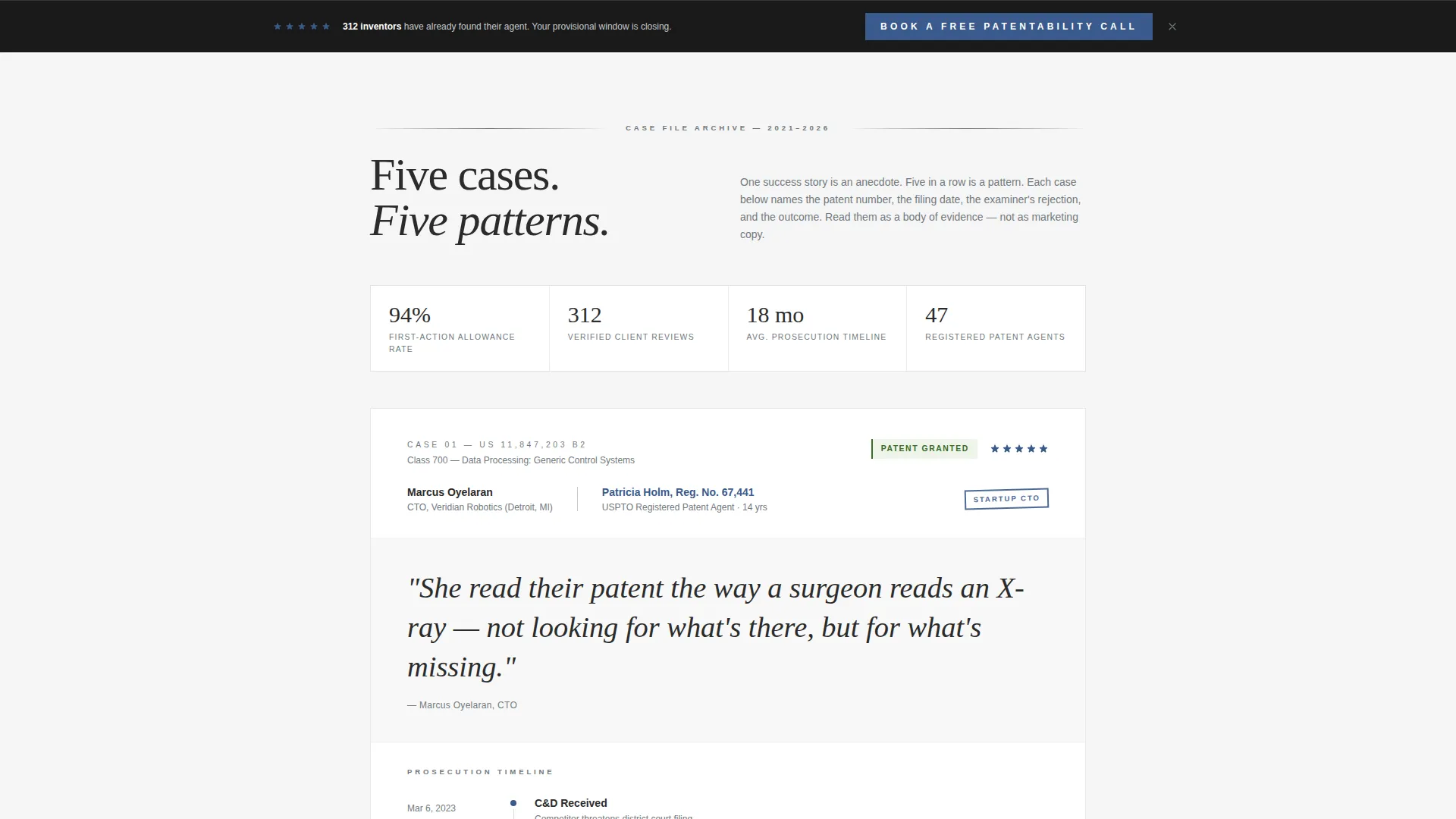
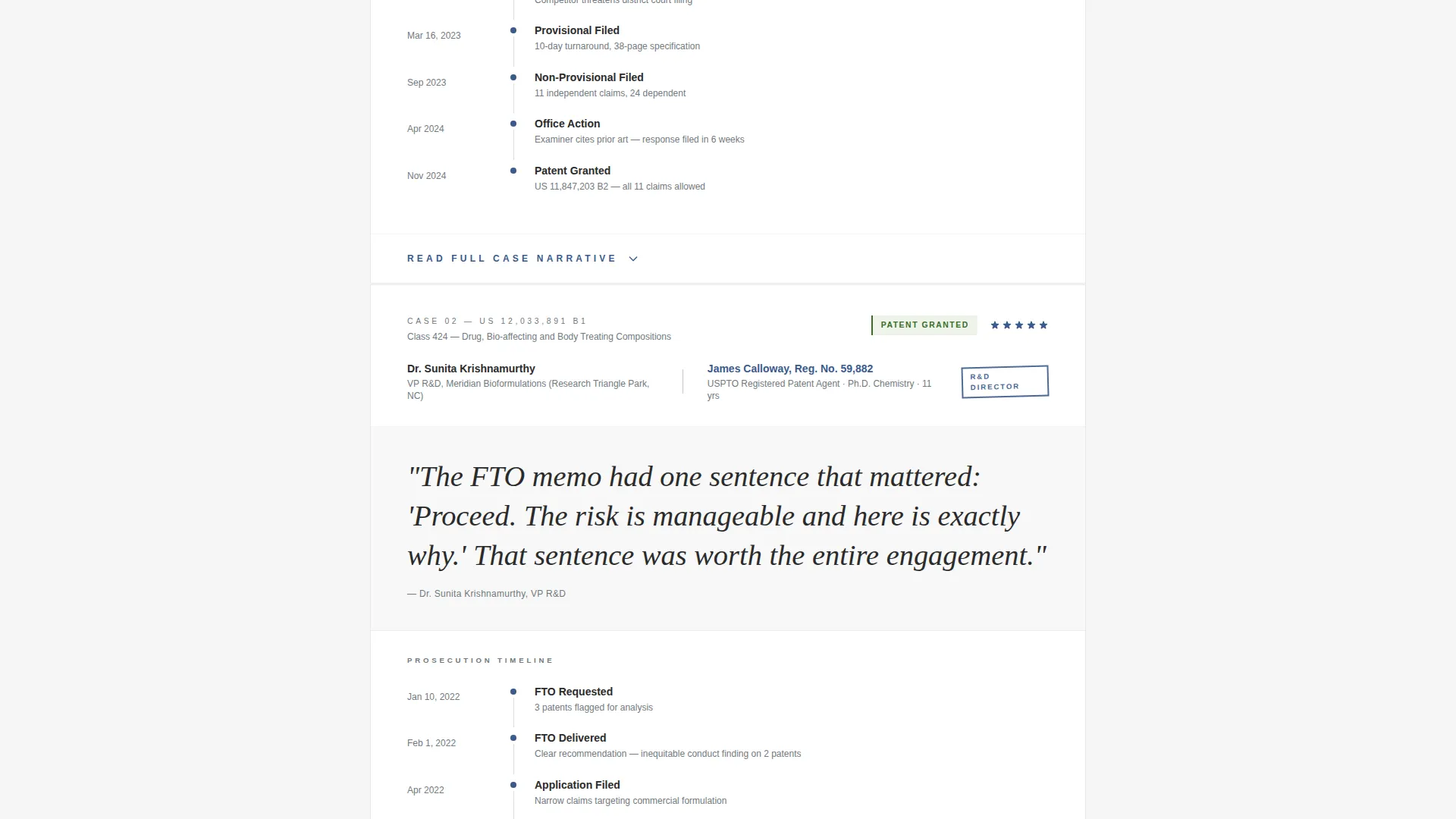
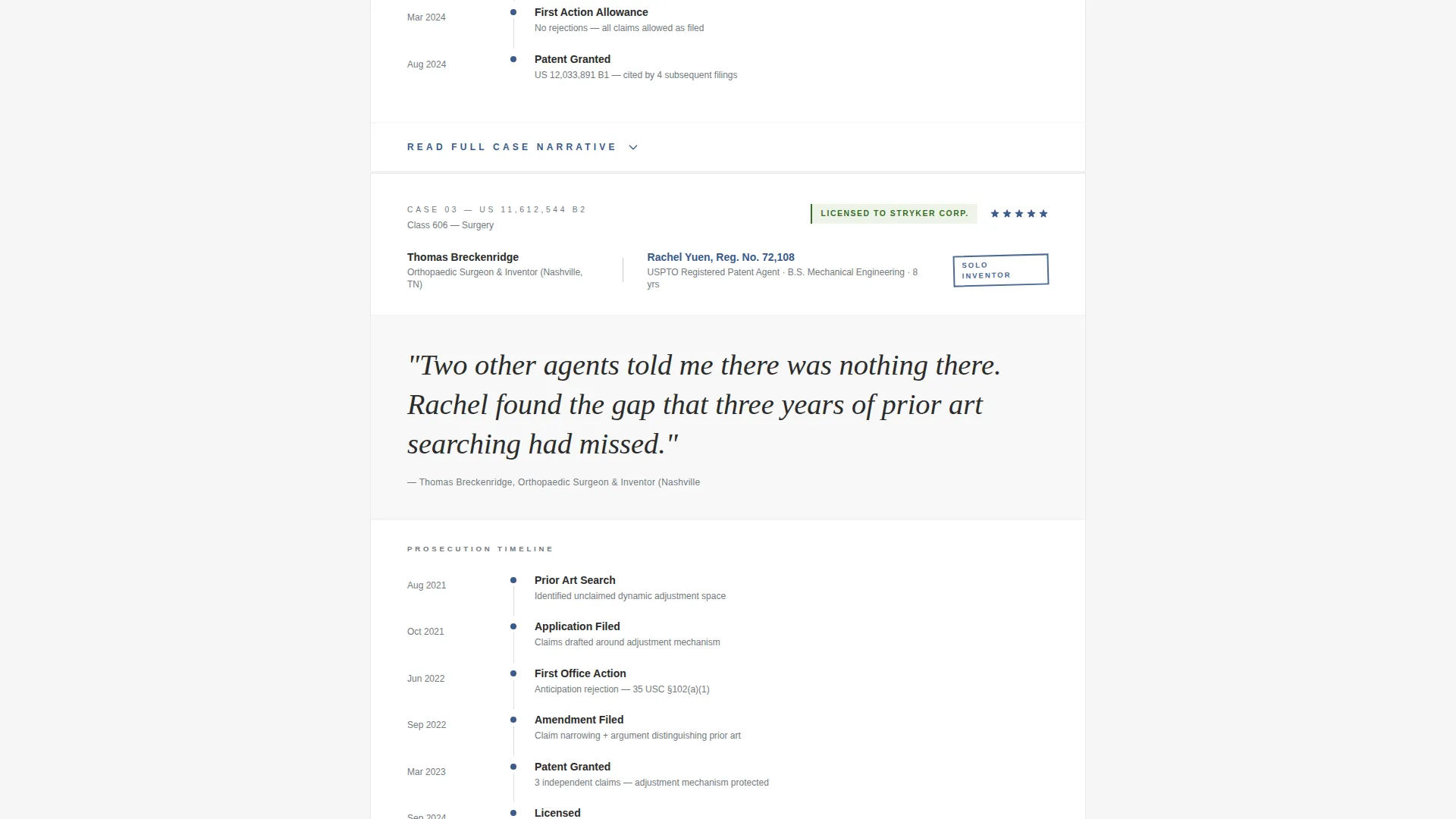
- A case study narrative scroll that structures each client story as a prosecution timeline: problem, strategy, and outcome
- A dual conversion path: a primary "Book a Free Patentability Call" scheduling bar and a secondary checklist download for earlier-stage leads
Feature list
A paragraph introducing the features section: each component below was designed around the specific workflow of a patent agent's client relationship, from the first inquiry to a scheduled consultation.
Giant Headline Header with Aggregate Rating
The header opens with a single oversized graphite serif line and a subline showing the agent's aggregate star rating, total review count, and a thin steel-colored rule. No images, no illustrations. The typography alone carries the authority of a legal brief's opening paragraph.
Case Study Narrative Scroll
Each scroll section is structured as a prosecution timeline: the client's problem first (a rejection, a lapsing provisional, a cease-and-desist), then the agent's strategy (claim amendments, continuation filings, prior art arguments), then the measurable outcome (patent granted, licensing deal closed, competitor application abandoned). Five stories in sequence build a pattern; eight build a case.
Pull-Quote Deposition Blocks
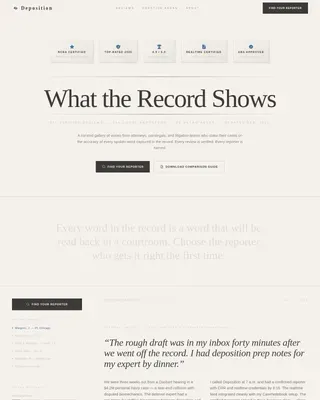
Large italic pull-quotes from real clients are set between case study sections like excerpts from a deposition. Each quote names a real patent class, a real timeline, and a real result, so the visitor feels the agent already understands their situation before the call.
Pinned Scheduling Bar with Intake Form
After the third testimonial, a slim steel-gray bar locks to the page with the primary call to action: "Book a Free Patentability Call." The intake form collects invention category (mechanical, software, chemical, or design), current filing status (new idea, provisional filed, or office action received), and opens a calendar picker tied to the agent's availability.
Secondary Lead Capture Path
A soft conversion option below the primary call to action reads: "Not ready to talk? Download our First-Filing Checklist." It captures email addresses from earlier-stage inventors who are not yet ready to book, keeping them in the pipeline without friction.
Monochrome Steel Branding System
The entire page uses a disciplined four-color palette: cold-rolled steel, patent-office white, deep graphite for body text, and a single filing-stamp blue accent reserved for links, ratings, and interactive elements. No gradients, no decorative elements. The palette communicates the quiet authority of a freshly printed office action.
Page sections overview
| Section | Purpose |
|---|---|
| Giant Headline Header | Opens with aggregate rating and sets authoritative tone |
| First Case Study | Establishes the prosecution timeline format with problem, strategy, outcome |
| Pull-Quote Block | Anchors first client voice with a specific, named outcome |
| Second Case Study | Builds on the pattern with a different filing category |
| Third Case Study | Deepens the evidence record before the primary call to action appears |
| Pinned Scheduling Bar | Locks the "Book a Free Patentability Call" action into view |
| Fourth Case Study | Continues cumulative proof building post-call to action |
| Fifth Through Eighth Stories | Completes the eight-story evidence sequence |
| Secondary Capture Path | Offers checklist download for earlier-stage leads |
| Page Footer | Closes with practice contact and filing-status guidance |
Design & branding system
The visual identity follows a Service Utility theme built entirely on a Monochrome Steel color system. The design philosophy mirrors the documents patent agents produce: no ornamentation, every element earning its place on the page.
- Color palette: cold-rolled steel (#71797E), patent-office white (#F5F5F5), deep graphite (#2B2B2B) for body text, and filing-stamp blue (#3A5A8C) used exclusively for links, ratings, and interactive elements
- Typography: oversized graphite serif for the headline, clean body text for case study prose, and large italic formatting for pull-quote deposition blocks
- Layout: centered headline with generous white space, full-width case study scroll, and a pinned slim bar for the primary conversion action
Mobile & speed optimization
The one-page layout is structured to read clearly on any screen size, which matters when a startup CTO receives a cease-and-desist and opens your page on a phone at the worst possible moment.
- The pinned scheduling bar and intake form are sized for thumb-friendly interaction on mobile screens
- Case study sections stack vertically on smaller viewports without losing the prosecution timeline hierarchy
- Pull-quote blocks remain legible and visually separated from body text at every screen width
How this template helps you convert
The page is designed around a single insight: a qualified prospect converts when they believe the agent already understands their specific problem. Every layout decision drives toward that moment.
- The aggregate rating and review count in the header establish immediate credibility before the visitor reads a single case study, lowering their guard before the evidence begins.
- The eight-story narrative scroll builds cumulative proof. By the third or fourth case study, the visitor is not reading reviews anymore; they are assembling their own case for booking the call.
- The two-path conversion system (immediate scheduling bar plus the checklist download) means neither ready-to-book prospects nor earlier-stage inventors leave the page without taking an action.
Other information about this template
This template is part of a broader category of editorial and magazine-style professional service landing pages. It suits any practitioner whose value is best communicated through documented client outcomes rather than credential lists alone.
- The template is categorized under Professional Services with a specific focus on patent agent online presence and patent agent booking page use cases
- The case study narrative format can be adapted for related intellectual property practitioners, such as patent attorneys or technology licensing consultants, without changing the core layout logic
- The "Book a Free Patentability Call" call to action and the "First-Filing Checklist" secondary path are named elements in the template and can be relabeled to match the practitioner's specific offer
- The design system is intentionally print-inspired, referencing the visual language of office actions, prosecution files, and patent application documents to create immediate credibility with technically literate clients
Theme
Educational Guide
Creative direction
Team & People
Color system
Navy Authority
Style
Split Screen (50/50)
Direction
Lead Generation
Page Sections
Giant Headline Header with Aggregate Rating
Case Study Narrative Scroll
Pull-quote Deposition Blocks
Pinned Scheduling Bar and Intake Form
Secondary Lead Capture Path
Monochrome Steel Branding System
Related questions
Who is this landing page template designed for?
How does the booking intake form work?
Does the template support leads who are not ready to book immediately?
Why are the testimonials structured as prosecution timelines instead of standard reviews?
Can the primary call-to-action label be changed to match my specific offer?