Dispatch - Employee Engagement Landing page Template
Dispatch is a modular card grid landing page built for transportation and logistics employee engagement platforms. It combines an odometer-style live user ticker, a pulsing avatar mosaic, and narrative case study cards to turn HR directors and ops managers into demo bookings. The design runs on a warm industrial palette with amber accents and cabin navy structure.
by Rocket studio
Quick summary
Dispatch is a click-through landing page template designed for frontline logistics engagement platforms. It opens with a live user count ticker and a crowd-building avatar mosaic, then guides visitors through a grid of case study cards that mix hard retention metrics with human stories. The goal is a single action: get HR directors into a guided product demo.
Who this template is for
This template speaks directly to the people responsible for keeping logistics workforces together. If you sell a platform that helps carriers or warehouse operators hold onto their workers, this page was built for your pitch.
- HR directors at regional carriers with 200 to 2,000 employees spread across time zones
- Ops managers at third-party logistics warehouses dealing with high annual turnover
- Fleet safety coordinators who tie driver connection directly to safety outcomes
What problem this template solves
Frontline logistics workers are hard to reach and easy to lose. Standard corporate engagement pages feel distant from the dock floor and the truck cab. This template solves the credibility gap between a platform's promise and a skeptical HR buyer's need for proof.
- Generic SaaS landing pages fail to speak the language of drivers, dispatchers, and dock supervisors
- HR buyers need concrete turnover and safety data before they will book a demo
- Emotional distance between a platform's features and a worker's daily reality kills trust
What you get with this template
You get a fully structured, single-page layout built around story-driven proof. Every section has a job to do, and every card earns its place on the grid.
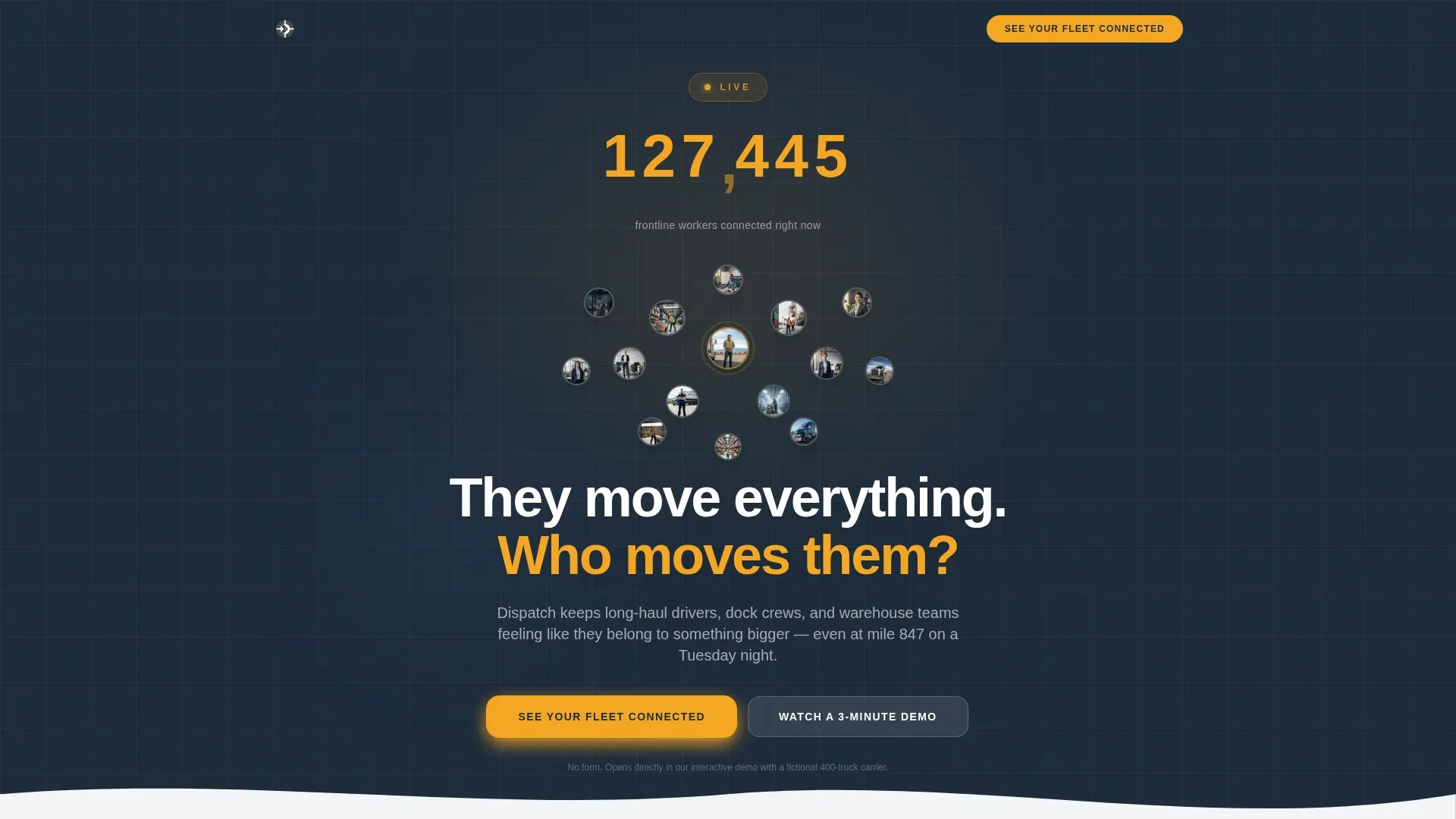
- A hero section with an animated odometer ticker, a pulsing avatar mosaic, and a primary call-to-action button
- A modular case study card grid that alternates between metric-heavy proof and emotional worker moments
- A persistent bottom call-to-action bar that appears after the third card row and stays visible while scrolling
Feature list
This template is built around components that earn trust through specificity and carry visitors toward a single conversion point.
Live User Count Ticker
A real-time odometer-style counter displays the number of frontline workers currently connected on the platform. Each digit clicks upward like an odometer, rendered in headlight amber against cabin navy. It appears first in the hero section and sets the scale of the platform immediately.
Pulsing Avatar Mosaic
Small circular avatars showing real worker faces, hard hats, reflective vests, and loading dock gloves populate outward from the center of the hero. Each avatar appears with a subtle pulse animation, building a visible crowd that makes the platform feel alive and populated.
Case Study Card Grid
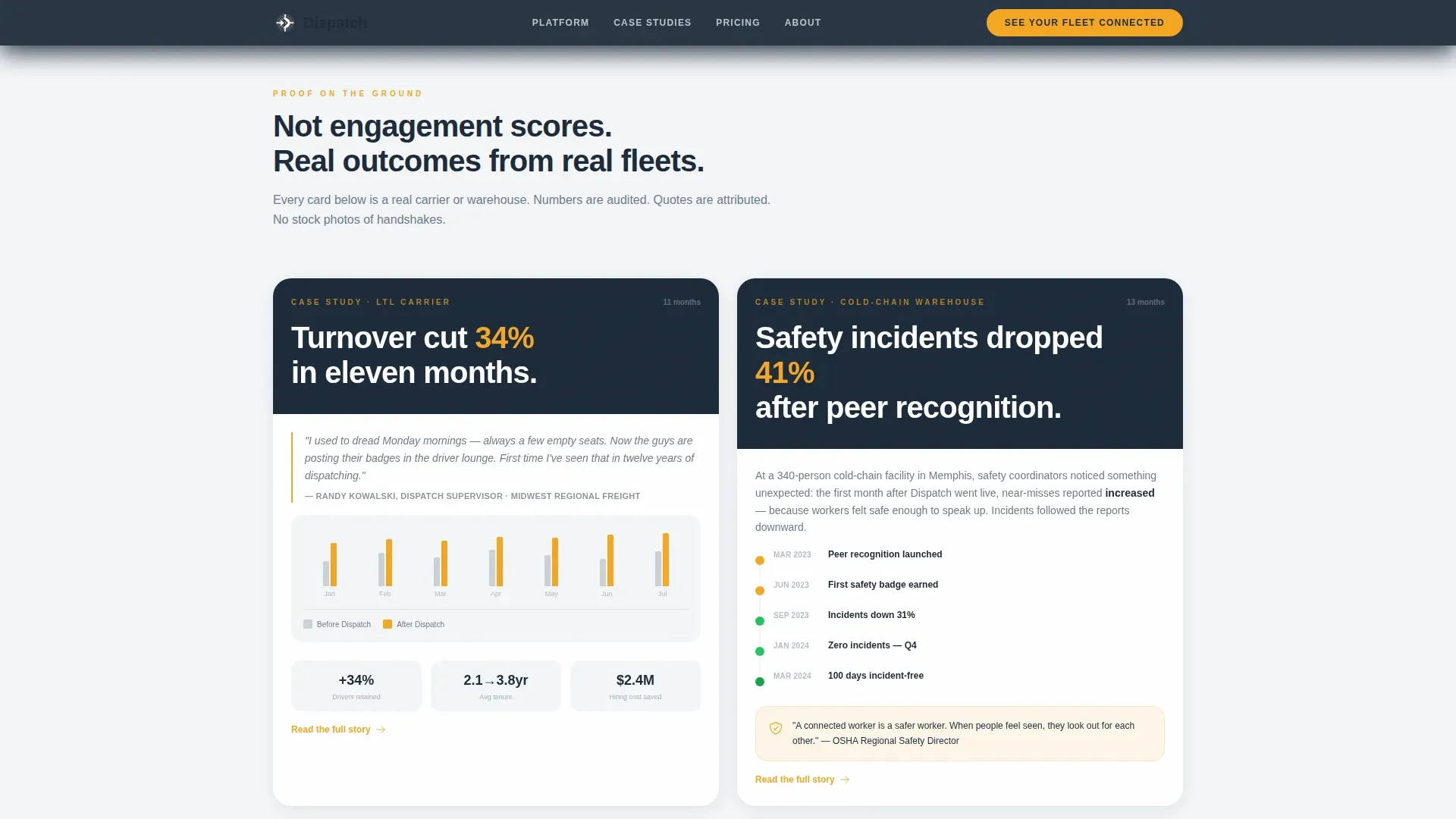
Each card in the modular grid tells a self-contained story. The first row leads with a regional LTL carrier that cut turnover 34% in eleven months and a cold-chain warehouse where safety incidents dropped after peer recognition launched. Cards alternate between data-heavy proof and emotional worker moments as visitors scroll deeper.
Persistent Call-to-Action Bar
After visitors pass the third card row, a floating bottom bar appears carrying the primary call-to-action. It stays visible while scrolling, creating a constant low-pressure prompt without interrupting the reading experience.
Scroll-Linked Card Reveals
Cards enter the viewport through staggered scroll-linked animations. Each reveal is timed to feel like a natural progression, not a technical effect. The pacing keeps visitors reading through the full evidence stack before reaching the final conversion section.
Dual Conversion Depth
Each case study card carries a secondary text link reading "Read the full story" that opens a detail page ending with the same demo call-to-action. This gives fast readers a direct path and slower, more cautious buyers a deeper trail of proof before committing.
Page sections overview
| Section | Purpose |
|---|---|
| Hero ticker area | Establishes platform scale with live user count and avatar crowd |
| Avatar mosaic build | Visualizes the frontline worker community in real time |
| Primary call to action | Directs visitors to the guided demo immediately below the hero |
| Case studies row one | Delivers turnover and safety metric proof through narrative cards |
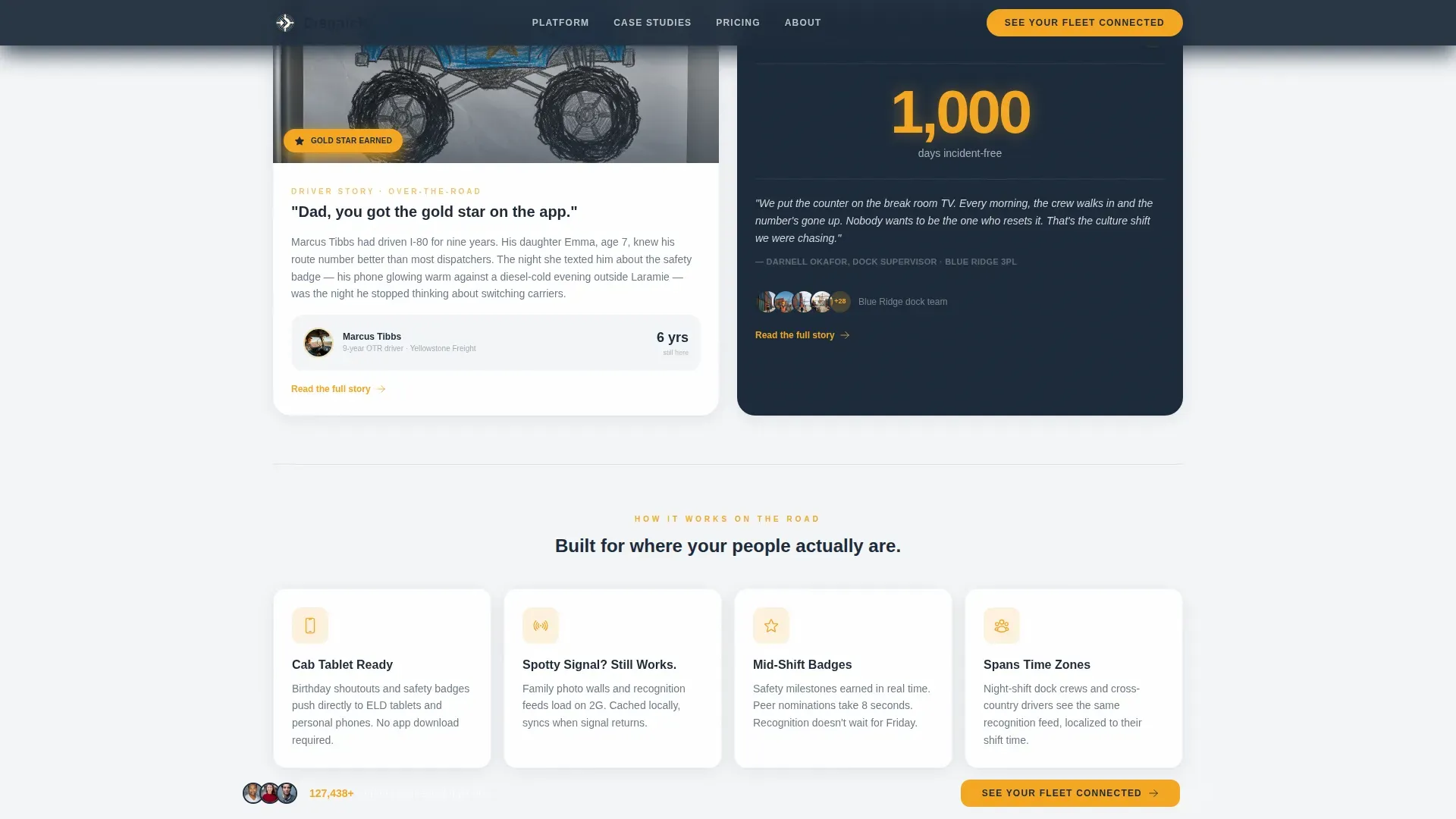
| Case studies row two | Adds emotional worker stories alongside the data |
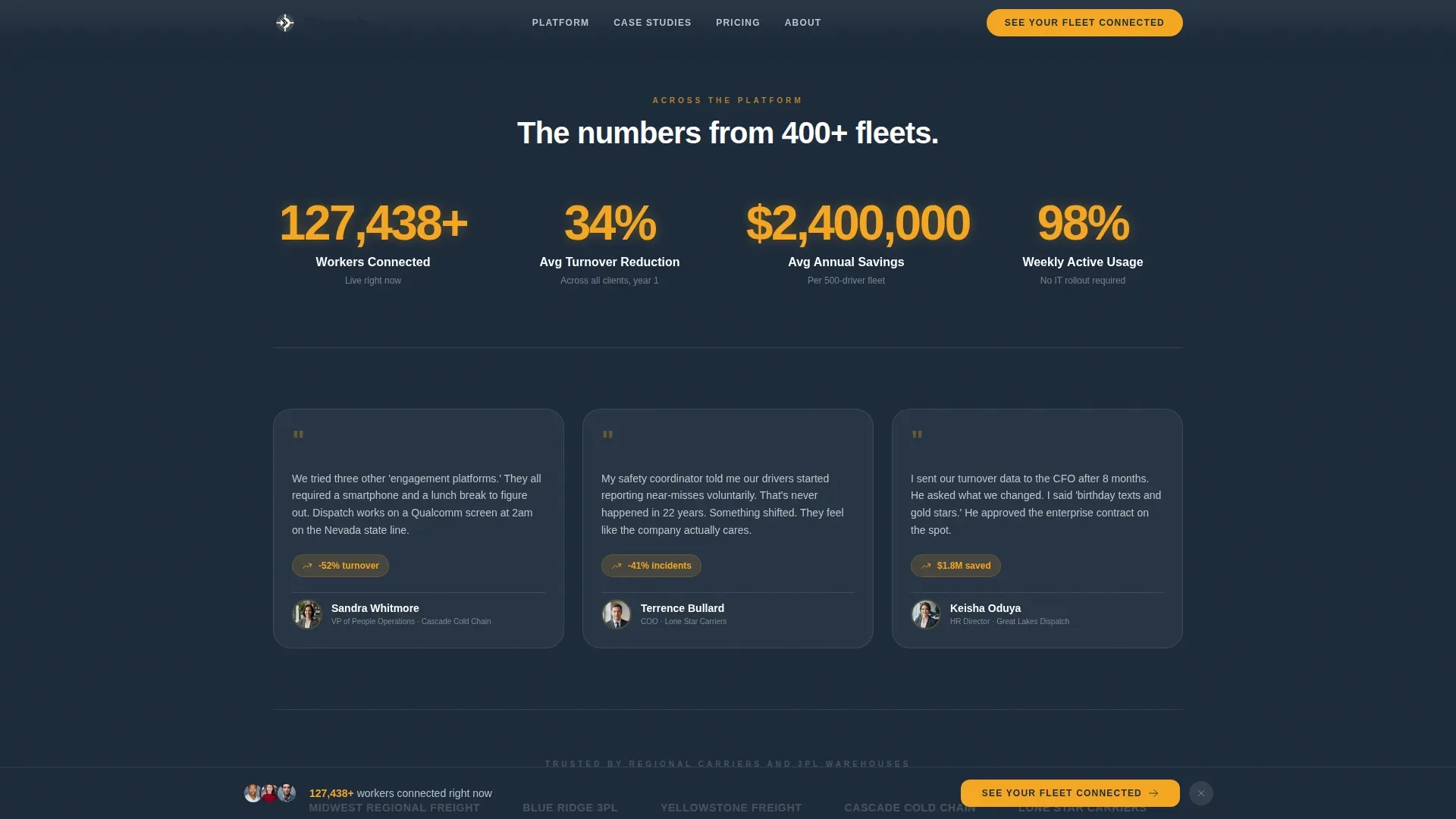
| Aggregate evidence wall | Stacks platform-wide metrics and client logo strip for social proof |
| Persistent call to action bar | Floats above the page after row three to maintain conversion pressure |
| Final call to action section | Full-width closing push with the primary demo button |
| Page footer | Horizontal flow footer with supporting links and context |
Design & branding system
The visual identity follows a warm industrial aesthetic described as the view through a clean windshield on an overcast morning. Every color choice has a purpose grounded in the environment of the people the platform serves.
- Soft overcast white (#F4F6F8) as the primary background keeps long reading sessions comfortable
- Highway-horizon gray (#6B7B8D) for body text and deep cabin navy (#1C2A3A) for card headers and primary buttons anchor the layout with weight and authority
- Warm headlight amber (#F5A623) on badges, interactive highlights, the ticker, and call-to-action elements glows like dashboard instruments against the darker backgrounds
Mobile & speed optimization
The template is built desktop-first to match how HR directors and ops managers actually review vendor pages. Mobile is treated as a secondary but fully supported context, recognizing that drivers and dock workers may share the page with family.
- Static case study cards are structured for server-side rendering, keeping the content grid fast on any connection
- The avatar mosaic and odometer ticker are isolated as client-side components so their animations do not block page content
- Card layouts reflow cleanly on smaller screens so the story grid remains readable on a phone with a spotty rural signal
How this template helps you convert
Every structural decision in this template points toward one action: getting a visitor into the interactive demo environment.
- The hero ticker and avatar mosaic create immediate credibility by showing platform scale before a visitor reads a single feature claim, reducing the first objection before it forms.
- The alternating card grid builds a layered argument, moving from specific carrier results to aggregate evidence so that by the time the persistent call-to-action bar appears, the case is already made.
- Dual conversion depth means both the quick decision-maker and the thorough researcher land on the same demo, just through different routes, so no buyer type is lost.
Other information about this template
This template sits at the intersection of HR technology marketing and the transportation and logistics sector. A few additional details are worth noting for teams evaluating this layout.
- The template is designed for a click-through flow with no form on the page itself. The primary call-to-action lands on a separate interactive demo environment pre-loaded with a fictional 400-truck carrier scenario.
- The Family First theme runs throughout the copy direction and visual framing, including the example of a driver's daughter drawing his truck with a gold star, connecting the platform to worker identity beyond the job.
- Typography uses DM Sans for headlines and Manrope for body text, both chosen for high legibility at the screen sizes where HR directors and fleet coordinators spend most of their time.
- Animation intensity is set to high across the template, covering the odometer ticker, avatar pulse crowd build, scroll-linked card reveals, and staggered grid entry effects.
- The footer follows a horizontal flow pattern consistent with modern B2B SaaS landing page conventions.
Theme
Family First
Creative direction
Case Study Narrative
Color system
Cloud Canvas
Style
Card Grid (Modular)
Direction
Click-Through
Page Sections
Live Odometer User Ticker
Pulsing Avatar Mosaic Hero
Narrative Case Study Card Grid
Persistent Floating Call to Action Bar
Dual Conversion Path Design
Scroll-linked Staggered Reveals
Related questions
Who is this template designed for?
Does this landing page include a lead capture form?
Can I replace the example case study cards with my own client stories?
How does the dual conversion path work in practice?
Is the template usable on mobile devices?