Food & Beverage Manufacturing Directory Website Template
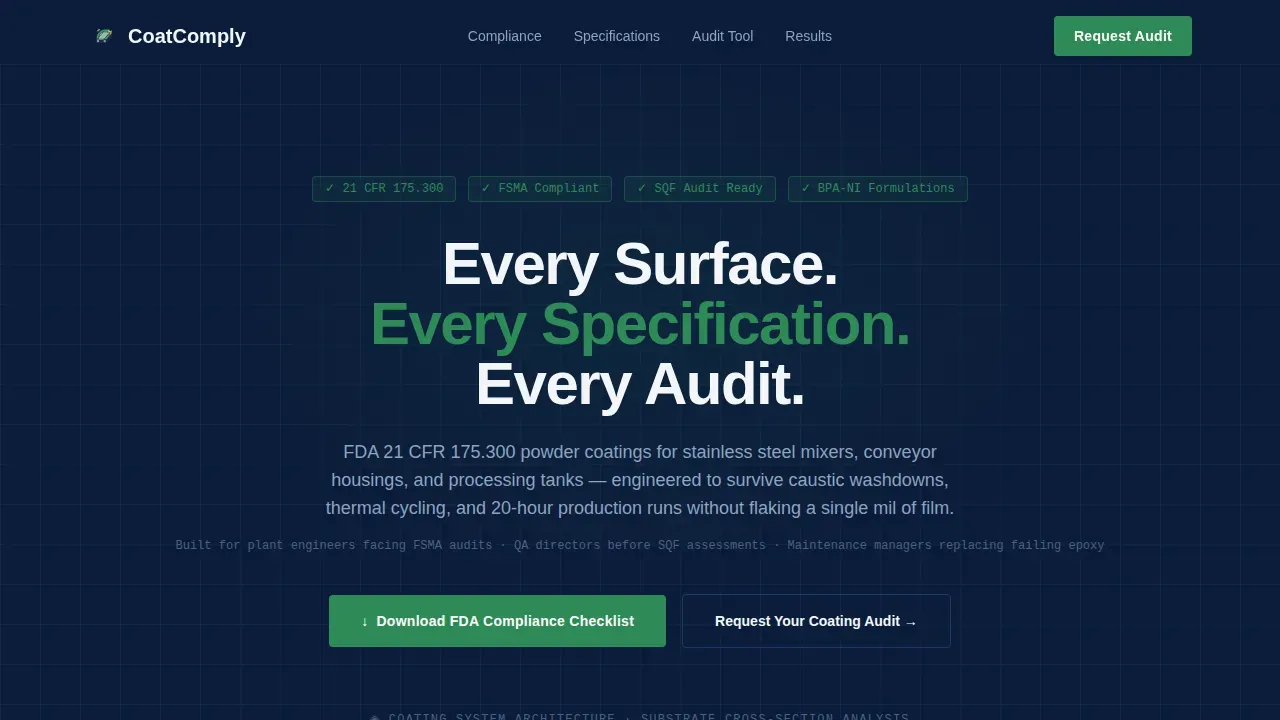
Comply is a single-column flow landing page template built for FDA-compliant food-grade powder coating operations. It targets plant engineers, quality assurance directors, and maintenance managers at dairy, beverage, bakery, and meat processing facilities. The template delivers a Data Command visual identity, an interactive compliance checklist, technical specification panels, and two conversion paths gated behind a three-field lead form.
by Rocket studio
Quick Summary
Comply is a precision-built landing page template for food-grade powder coating services operating under FDA 21 CFR 175.300. It speaks directly to plant engineers, quality assurance directors, and maintenance managers who need every coating specification documented, every regulatory standard cited, and every surface audit-ready before the inspector arrives.
Who This Template Is For
This template is built for B2B industrial coating operations that serve food and beverage manufacturing clients. The audience demands technical credibility, not lifestyle photography. If your customers arrive with FSMA audit findings or a third-party SQF assessment scheduled for next month, this template speaks their language.
- Plant engineers fielding open FSMA audit findings and seeking documented coating solutions
- Quality assurance directors at dairy and beverage bottling facilities preparing for SQF or third-party food safety inspections
- Maintenance managers replacing failing epoxy paint on filler nozzles and conveyor equipment every scheduled shutdown cycle
What Problem This Template Solves
Food processing facilities face a specific and costly problem: coating systems that were never designed for the regulatory demands of food contact environments. Peeling epoxy on processing equipment is not just a maintenance headache. It is a food safety risk that can trigger contamination findings, halt production, and create audit failure scenarios with measurable downtime costs. Buyers visiting this page have already experienced that pain. They need proof, not promises.
- Existing generic landing page templates do not present mil-thickness specs, cure schedules, or 21 CFR 175.300 compliance markers in a way that satisfies a technical buyer
- There is no structured interactive self-assessment that helps plant engineers and QA directors determine their own facility's coating risk profile before making contact
- Most templates push a sale immediately, before delivering the regulatory knowledge that builds trust with compliance-driven customers in food processing environments
What You Get With This Template
This template provides a complete single-column flow landing page ready to present a precision food-grade powder coating operation. Every section is engineered to deliver genuine regulatory knowledge first, then convert. The layout is built for desktop-first use at engineering workstations, with tablet-friendly formatting for floor review. You get a full visual system, all interactive components, and two conversion paths.
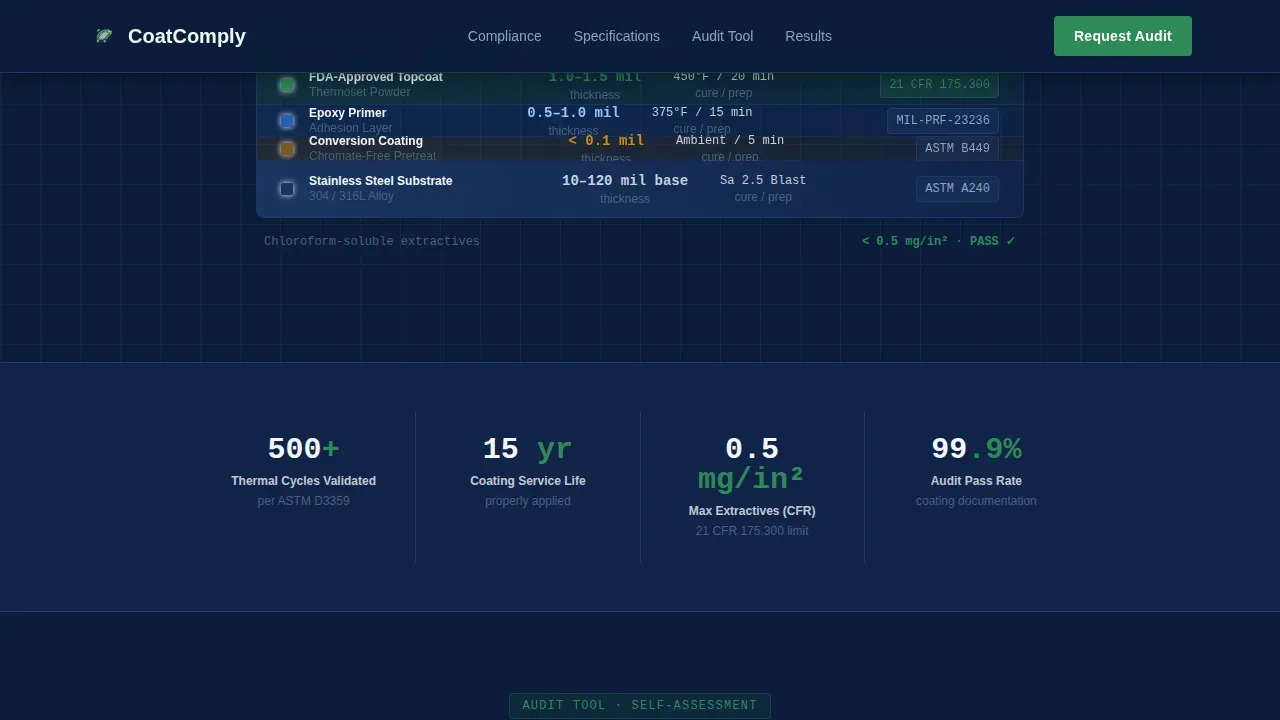
- A full-width infographic header with animated substrate cross-section, layer callouts, mil specs, cure temperatures, and 21 CFR 175.300 compliance markers displayed in monospaced figures against a deep navy field
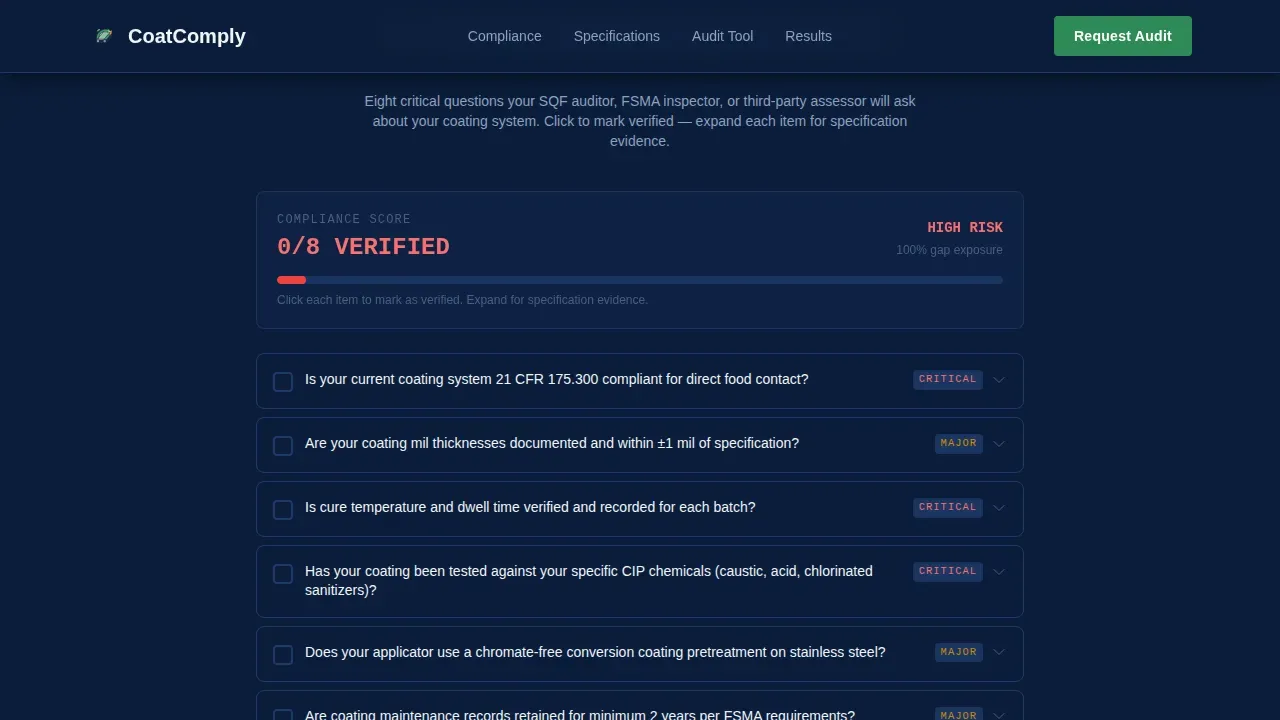
- An interactive compliance audit checklist where visitors self-assess their facility's coating risk factors, with green compliance-pass indicators and amber audit-risk callouts that escalate stakes as the visitor scrolls
- A gated download form for the FDA Coating Compliance Checklist requiring facility type, current coating system, and work email, plus a secondary consultation booking path labeled "Request Your Audit"
Feature List
This template ships with purpose-built components designed for one niche: food-grade powder coating compliance in regulated processing facilities. Every feature reflects the operational and regulatory demands described in the source brief.
Animated Substrate Cross-Section Header
The header is a full-width infographic, not a lifestyle photograph. It renders a technical cross-section of a coated substrate showing four distinct layers: the steel alloy base, the pretreatment conversion coating, the primer with mil thickness callouts, and the FDA-approved topcoat. Large monospaced figures display exact specifications. A subtle animated scan pulse draws the viewer's eye from substrate to surface, reinforcing the Data Command aesthetic. This header sets the tone immediately: data is the visual, and every number is there for a reason.
Interactive Compliance Audit Checklist
The compliance audit checklist is the centerpiece interactive component. It presents a series of regulatory questions, for example: "Is your current coating system 21 CFR 175.300 compliant for direct food contact?" Each question is followed by specification evidence. Visitors click through their own facility's risk factors, and the system scores their responses with green verified indicators or amber risk flags. By the end of the section, a visitor has essentially self-completed a gap analysis. This approach transforms passive reading into active self-diagnosis, which meaningfully improves engagement and lead quality.
Technical Specification Data Panels
Dedicated specification panels present mil thickness ranges, cure schedules, chemical resistance data, and surface performance metrics in a format that plant engineers and QA directors can verify against their own facility requirements. The panels are typeset in JetBrains Mono for numbers and specifications, with Manrope for explanatory body text. This separation of data from narrative reflects the HACCP monitoring dashboard aesthetic described in the design brief. Panels are structured so buyers can confirm intended use compliance and match coating properties to their specific needs without leaving the page.
Failure Cost Calculator Section
A dedicated section presents audit-failure scenarios with downtime cost figures and cautionary amber risk callouts. This section escalates the stakes of choosing a non-compliant coating system. It quantifies the consequences of peeling paint, contamination findings, and failed inspections in terms that resonate with operations managers and facility owners. The content is prepared to help visitors understand the full financial and regulatory exposure of maintaining an inadequate coating system.
Gated FDA Checklist Download Form
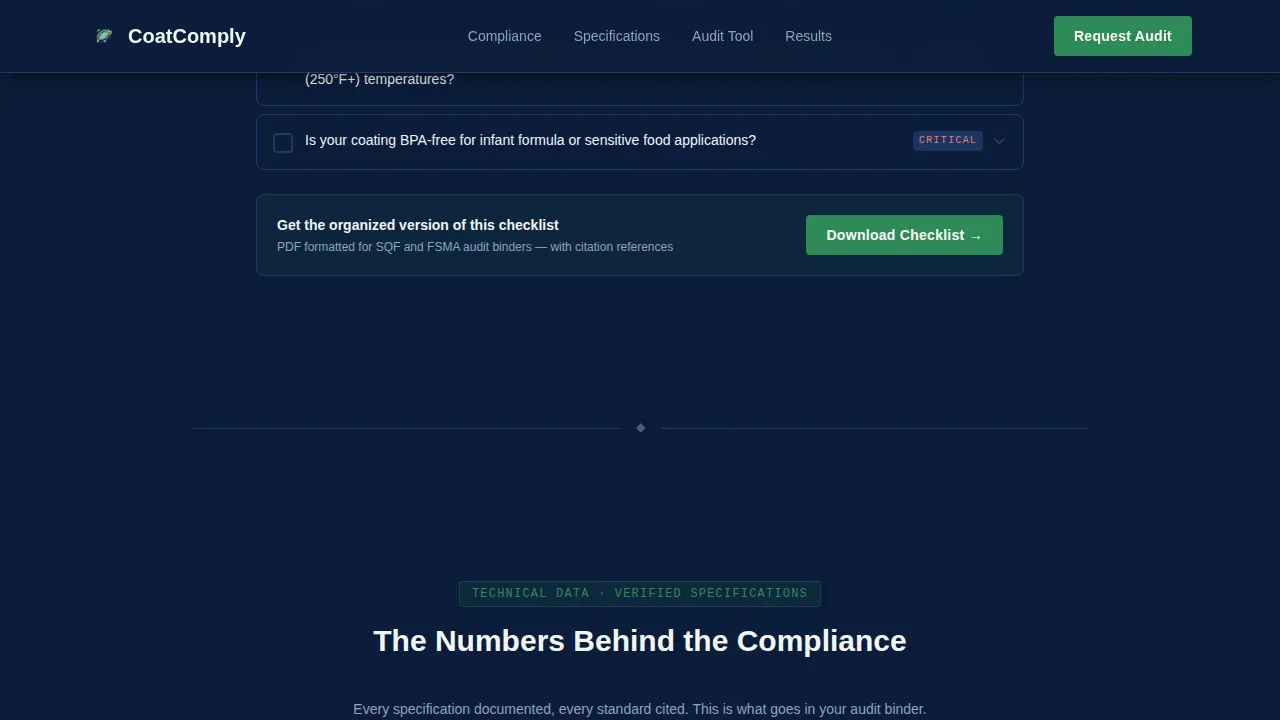
The primary conversion component is a three-field gated form. Visitors select their facility type from dairy, beverage, bakery, and meat processing options, identify their current coating system from epoxy, polyurethane, powder, or unsure, and provide their work email. The download delivers an FDA Coating Compliance Checklist. Because the page gives away substantial regulatory knowledge before the gate, the download feels like receiving the organized version of what the visitor has already been reviewing. A secondary call-to-action button reading "Request Your Audit" offers a free coating audit consultation as an alternative conversion path.
Social Proof and Verified Results Section
A verified results section presents client testimonials from food processing facilities with specific outcomes, job titles, and named facility contexts. Before-and-after coating scenarios give prospects a concrete reference point. This section reinforces the message that the coating operation has delivered documented, audit-ready results for real customers in comparable environments.
Page Sections Overview
| Section | Purpose |
|---|---|
| Infographic Hero Header | Displays animated substrate cross-section with mil specs and 21 CFR 175.300 compliance markers |
| Compliance Audit Checklist | Interactive self-assessment with regulatory questions, green pass indicators, and amber risk flags |
| Technical Specification Panels | Presents mil thickness, cure schedules, and chemical resistance data for buyer verification |
| Failure Cost Calculator | Quantifies audit-failure downtime costs and escalates coating risk stakes |
| Social Proof Section | Delivers facility-specific testimonials with job titles and before-and-after coating outcomes |
| Gated Download Form | Three-field lead capture for FDA Coating Compliance Checklist download |
| Secondary Audit call to action | "Request Your Audit" consultation booking path as an alternative conversion route |
| Footer Arc Split | Logo and tagline left, navigation links right, minimal layout |
Design & Branding System
The visual identity follows a Data Command theme built on the Navy Authority color system. The design aesthetic deliberately references the dashboard of a Hazard Analysis and Critical Control Points (HACCP) monitoring system: authoritative, clinical, and zero-tolerance for ambiguity. Every color and typographic choice reinforces regulatory credibility rather than brand warmth.
- Colors: deep regulatory navy (#0B1D3A) as the dominant background, sterile processing white (#F4F6F9) for content panels, compliance-pass green (#2E8B57) on checkmarks and verified badges, and cautionary amber (#D4880F) for audit-risk callouts
- Typography: JetBrains Mono for all specification numbers, mil measurements, and data figures; Manrope for body text and section headings, maintaining a clean separation between data and narrative
- Animation and interactivity: medium animation with an animated substrate scan pulse in the hero, scroll-reveal on checklist items, staggered number counters on specification panels, and high-interactivity components for the audit checklist and gated lead form
Mobile & Speed Optimization
The template is built desktop-first, reflecting the reality that plant engineers and QA directors review technical specifications at workstations. Tablet-friendly formatting supports floor-level use during facility walkthroughs or pre-inspection reviews. Static sections use Server Components for reliable rendering, while interactive checklist and form components use Client Components.
- Desktop-first layout optimized for workstation-based review of detailed specification panels, mil-thickness data, and compliance checklists
- Tablet-friendly responsive formatting for floor use during inspections, maintenance planning sessions, or pre-audit facility walkthroughs
- Server Components handle static content sections for consistent rendering; Client Components manage the interactive audit checklist and gated download form
How This Template Helps You Convert
This template earns the conversion by delivering genuine regulatory knowledge at every scroll position. Visitors do not arrive at a gate without context. They arrive at a gate after completing a self-guided gap analysis, reading specification evidence, and reviewing verified client outcomes. The two conversion paths serve different buyer readiness levels.
- The primary conversion is the gated FDA Coating Compliance Checklist download. The three-field form segments leads by facility type and current coating system, giving the coating operation qualified, contextual contact data from the first touchpoint.
- The secondary conversion is the "Request Your Audit" consultation button. This path captures buyers who are ready for direct contact and want a human to review their specific facility's coating risk profile rather than a downloadable resource.
Other Information About This Template
This template is designed for the comply fda certified food grade powder coating landing page template use case within the Food and Beverage Manufacturing category. It reflects the full regulatory and operational context of FDA-compliant coating operations serving dairy, beverage, bakery, and meat processing plants across the United States.
The FDA sets specific regulations for materials that come into contact with food to ensure safety and protect public health. The overall regulatory status of a food contact material is dictated by the regulatory status of each individual substance that comprises the article. This principle shapes how the template presents coating specifications: every substance, every layer, every component is documented individually.
FDA does not typically certify individual powder products. Instead, manufacturers ensure compliance using FDA-approved raw materials. The manufacturer certifies that the powder is formulated using only FDA-approved raw materials for it to be considered FDA compliant. Pigments approved under 21 CFR Part 178.3297 are considered safe for use in coloring polymers intended to come into direct contact with food. Those pigments have undergone evaluation to ensure they do not leach harmful substances into food. The FDA's regulations for pigments in polymeric food contact articles are separate from those governing color additives in personal care products, including cosmetics.
It is the responsibility of the manufacturer of a food contact substance to ensure that food contact materials comply with the specifications and limitations in all applicable authorizations. Components of a food packaging material used in compliance with a regulation in 21 CFR parts 174 through 179 need no further FDA review, which is an important efficiency advantage for facilities managing complex regulatory documentation.
FDA-compliant food-grade coatings are formulated to adhere to FDA Title 21 of the Code of Federal Regulations, ensuring substances do not contaminate food. These coatings create a nonporous, mold-resistant surface that allows for fast, easy cleaning and reduces bacterial growth on food contact surfaces. They provide superior non-stick properties, corrosion resistance, and high-temperature durability for processing equipment. FDA-compliant coatings are used across the entire food supply chain where equipment touches food, from fresh produce washing lines to meat processing conveyor systems to beverage bottling equipment.
VICTREX FG grades are cited as an example of high-performance food contact polymers for use in food, beverage, and water processing equipment. These are among the food contact polymers referenced when specifying materials for demanding food processing environments, including potable water contact applications.
Establishments must comply with the regulatory performance standards for sanitation cited in the FSIS guidelines, but may do so by whatever means they determine to be appropriate. The Food Code is a reference document for regulatory agencies responsible for overseeing food safety in retail outlets such as restaurants and grocery stores, and it provides useful context for understanding how food contact surface regulations extend across the supply chain.
Maintaining detailed food safety logs is a crucial component of any effective food safety management system. Food safety checklists serve as daily compliance partners for food businesses. Documenting and analyzing incidents helps identify trends or areas for improvement in food safety practices. Using comprehensive food safety resources ensures that your operation complies with local and international food safety regulations. Food safety tools can increase staff accountability and enhance training efforts. Implementing food safety measures builds customer trust and satisfaction. Digital tools can engage staff with interactive elements in food safety training. Establishing a food safety committee ensures continuous attention to improving safety standards across the business.
Food safety templates help maintain the highest standards of food hygiene and compliance. Food safety logs are essential tools for accurate record keeping in food safety management systems. Using food safety resources enhances efficiency and consistency in food service operations. Food safety management tools can be integrated into employee onboarding and training programs. Food safety templates can be tailored to address the unique responsibilities of each role within a food business.
- The template supports storage of facility-specific compliance documentation resources alongside the gated checklist download
- Certificates of Compliance are referenced as available for specific coating applications, allowing customers to verify regulatory standing
- The creative direction is Checklist and Audit, meaning the scrolling experience feels like moving through a compliance readiness assessment rather than a standard service page
- The header concept is Infographic, with no hero photography and no lifestyle imagery; the data and layer diagrams are the entire visual identity of the first screen
- The landing page direction is Content and Resource, meaning the page earns trust through knowledge delivery before asking for contact information
Theme
Data Command
Creative direction
Checklist & Audit
Color system
Navy Authority
Direction
Content/Resource
Page Sections
Animated Substrate Infographic Header
Interactive Compliance Audit Checklist
Technical Specification Data Panels
Failure Cost Calculator Section
Gated Compliance Checklist Download Form
Social Proof and Verified Results Section
Related questions
What is the FDA approved food safe coating?
Is powder coating FDA approved?
Does the FDA require all ingredients to be listed for food contact materials?
What information must be included on the label of food packaged using coated equipment?
What makes this landing page template suitable for a food-grade coating operation?