True Crime Community Landing Page Template
Casefile is a single-page landing page template built for true crime analysis communities. It uses an asymmetric 60/40 grid, a warm parchment-and-graphite color palette, and a Day-in-the-Life scroll narrative to pull visitors through an evening of case work. The layout guides readers toward a free-tier signup click without a form on the page.
by Rocket studio
Quick summary
Casefile is a click-through landing page template for true crime analysis communities. It pairs a moody half-page desk photograph with serif editorial typography and a scroll-driven evening narrative. Visitors follow one member through a night of case work, arriving at the signup call to action feeling like they already belong.
Who this template is for
This template is built for community founders and independent creators running a serious true crime analysis platform. It speaks directly to an audience that treats cold case research as a craft, not casual entertainment.
- True crime podcast hosts looking for a collaborator community to feature and grow
- Retired paralegals, night-shift nurses, and detail-obsessed researchers aged roughly 35 to 60
- Community builders who want a landing page that earns trust before asking for a click
What problem this template solves
Most community landing pages feel transactional. They list features, show a screenshot, and ask for a signup. For an obsessive-enthusiast niche like true crime analysis, that approach falls flat. Visitors need to feel the community before they consider joining it.
- Generic templates cannot convey the intimate, late-night atmosphere that defines this kind of community
- Passive true crime fans need a page that shows the difference between scrolling a podcast feed and doing real analytical work
- Community founders lose signups when the page does not match the depth their audience already brings
What you get with this template
You get a fully structured single-page layout with five named scroll sections, a defined visual identity, and a click-through conversion flow. Every design decision in this template is grounded in the Casefile community brief.
- A half-page hero with a styled desk photograph zone and a right-panel serif headline area
- Five time-stamped scroll sections that walk visitors through a member's evening from 7 p.m. to 11 p.m.
- Two conversion touchpoints: a primary call-to-action button and a secondary browse text link, both requiring no form fill
Feature list
This template is built around a small set of purposeful, well-integrated features.
Asymmetric 60/40 Grid Layout
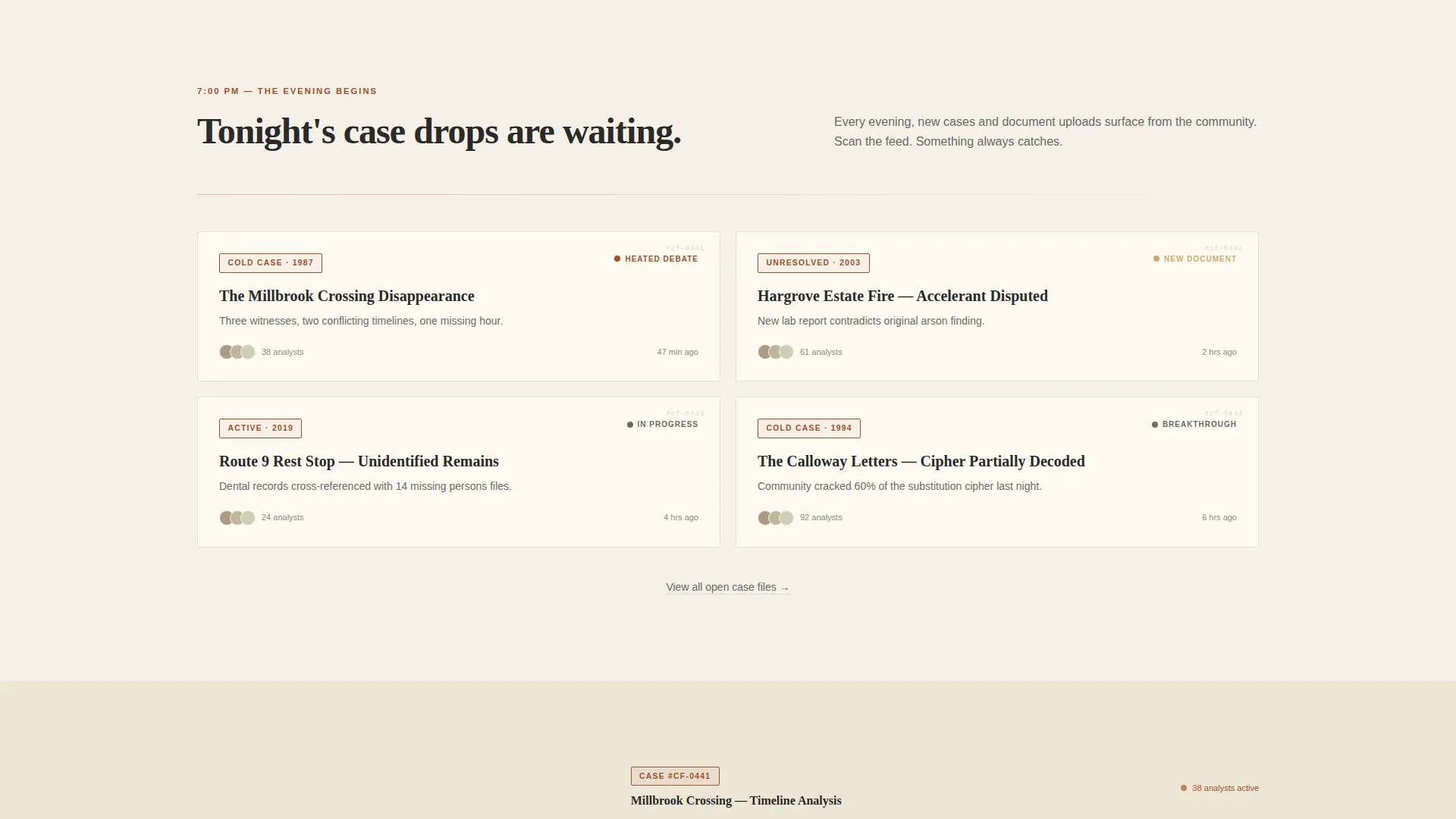
The page uses a 60/40 column split throughout. The wider left panel carries visual content like the desk photograph and case card feed, while the right panel holds headlines, body copy, and calls to action. This split gives the layout an editorial, spread-case-files feel that mirrors the community's desktop-first mindset.
Day-in-the-Life Scroll Narrative
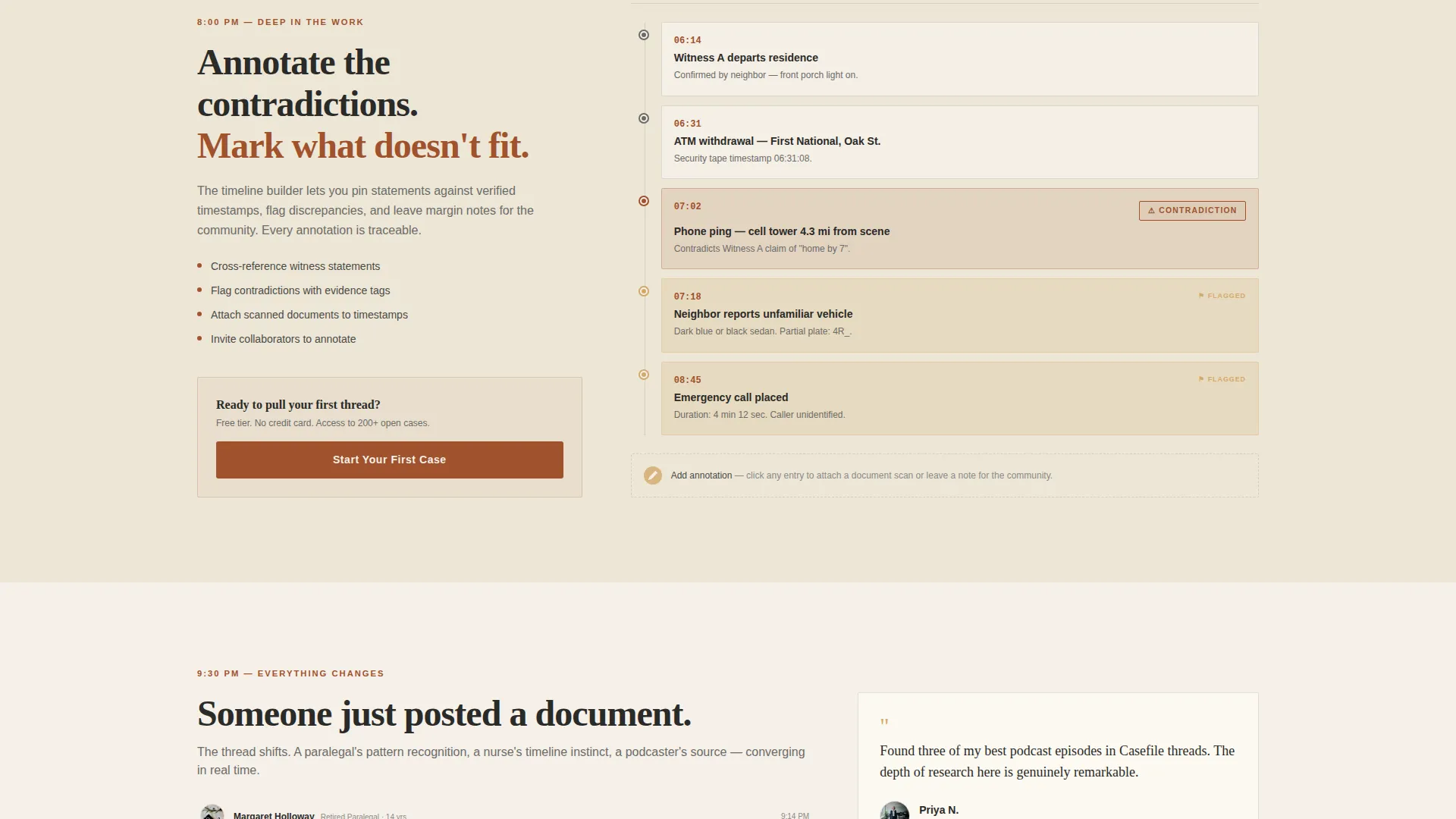
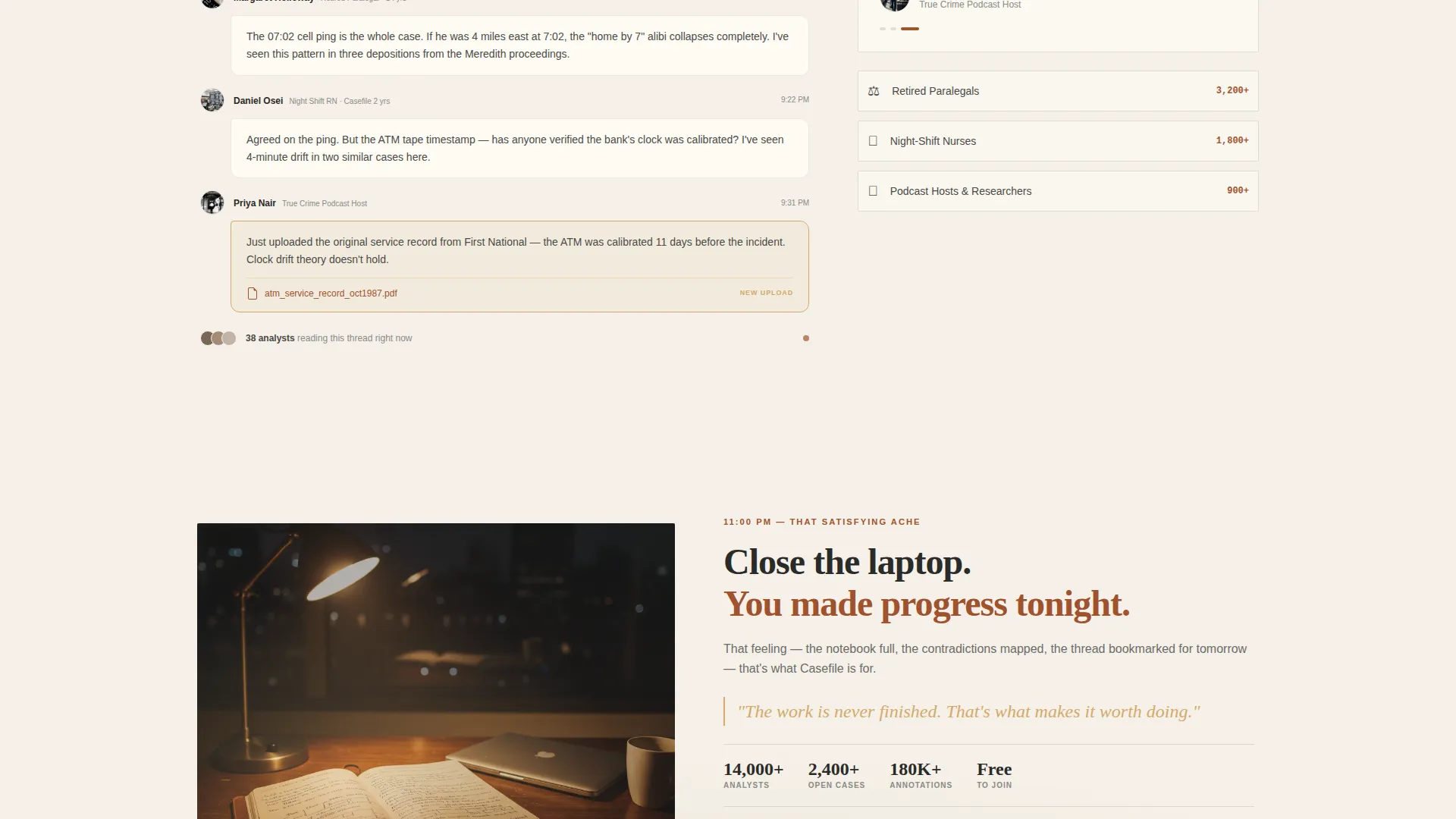
Five scroll sections map to a single member's evening: 7 p.m. case drops, 8 p.m. timeline building, 9:30 p.m. live thread debate, and 11 p.m. close. Each section shifts the desk scene subtly, with the mug emptying, the notebook filling, and the lamp casting longer shadows. The scroll itself feels like time passing in a quiet room.
Half-Page Photo and Text Hero
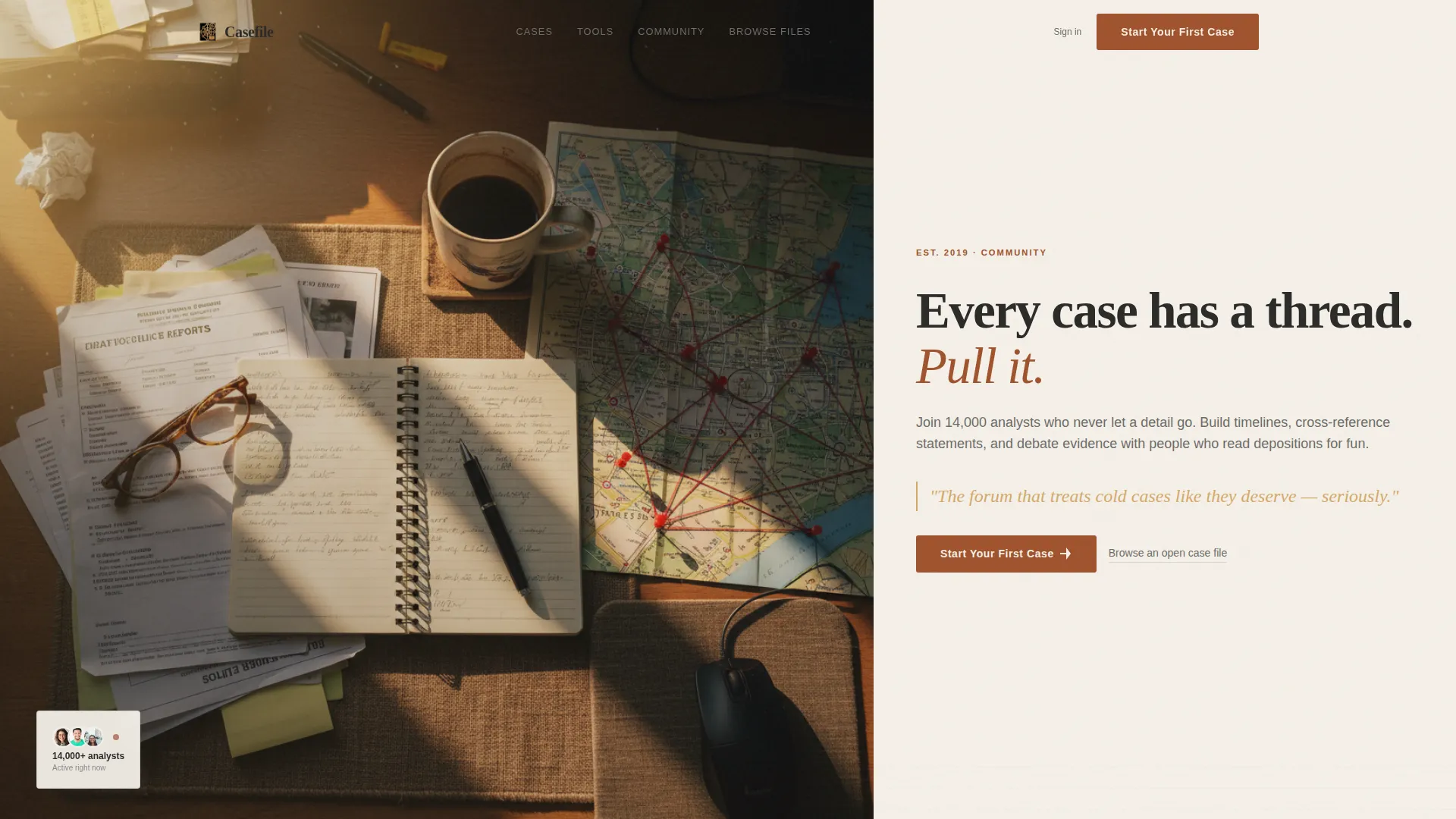
The header splits into a large moody overhead desk photograph on the left and a serif headline block on the right. The headline reads "Every case has a thread. Pull it." with a member-count social proof line beneath it. This composition sets the tone before the visitor reads a single word of body copy.
Click-Through Conversion Flow
No form appears anywhere on this page. The primary call to action, "Start Your First Case," appears after the second scroll section and again anchored at the bottom. A secondary text link, "Browse an open case file," gives skeptical visitors a low-commitment entry point to real content before they commit.
Social Proof Integration Points
The template includes a floating member badge in the hero panel, member archetype callouts in the live thread section, and testimonial quote slots. The member count of 14,000 analysts is baked into the hero copy as a concrete trust signal.
Warm Artisan Visual Identity System
Typography uses Fraunces for serif headlines and DM Sans for body text. The full color system is defined and applied across all interactive states. Hover cards, pull-quote highlights, and active navigation elements each have a designated color role within the palette.
Page sections overview
| Section | Purpose |
|---|---|
| Hero Desk Photo | Establishes mood with half-page overhead desk image and serif headline |
| 7 PM Case Drops | Asymmetric case card feed showing live community content |
| 8 PM Timeline Builder | Tool showcase zone with first call-to-action appearance |
| 9:30 PM Live Thread | Community testimonials and member archetype callouts |
| 11 PM The Close | Final call to action and secondary browse link |
| Minimal Footer | Horizontal flow footer with essential links |
Design & branding system
The visual identity follows a Warm Artisan theme using the Cloud Canvas color system. Every color has a specific role and applies consistently across backgrounds, text, accents, and interactive states.
- Soft parchment (#F5F0E8) dominates all backgrounds, evoking slightly yellowed paperback pages
- Pencil-graphite gray (#4A4A48) carries all body text, while muted sienna (#A0522D) marks key evidence labels and active navigation
- Warm lamplight gold (#D4A96A) applies to hover states and pull-quote highlights, replicating the effect of a desk lamp clicking on
Mobile & speed optimization
This template is designed desktop-first. The spread-case-files metaphor and asymmetric grid are native to wider screens. Mobile fallback layouts are accounted for in the template structure.
- The 60/40 asymmetric grid stacks gracefully on smaller screens without losing the editorial character
- Scroll-reveal stagger animations and GSAP timeline scrubbing apply on desktop, with simplified transitions on mobile
How this template helps you convert
The page earns the click rather than demanding it. Every structural decision is oriented toward making the visitor feel membership before they sign up.
- The Day-in-the-Life narrative delays the call to action until after the second scroll section, so the visitor has already experienced the community's rhythm before being asked to join.
- The two-path conversion model lets confident visitors click "Start Your First Case" while curious visitors follow "Browse an open case file," reducing the chance of losing anyone at the decision point.
Other information about this template
This template sits in the Blog and Editorial category under the True Crime Analysis Content subcategory. It is purpose-built for a true crime analysis online community rather than adapted from a generic community template.
- The template style is an Asymmetric Grid (60/40) with a Half-Page Photo and Text header concept
- Creative direction follows the Day-in-the-Life framework, and the conversion flow follows a Click-Through landing page direction
- The color system is Cloud Canvas and the overall theme is Warm Artisan, making it well-suited to editorial niches with a worn-in, intimate aesthetic
- This template is built for English-language audiences with US and UK cold case context in mind
Theme
Warm Artisan
Creative direction
Day-in-the-Life
Color system
Cloud Canvas
Style
Asymmetric Grid (60/40)
Direction
Click-Through
Page Sections
Asymmetric 60/40 Grid Layout
Day-in-the-life Scroll Narrative
Half-page Photo and Text Hero
Click-through Conversion Flow
Social Proof Integration Points
Warm Artisan Visual Identity System
Related questions
Does this landing page template include a signup form?
Who is this template designed for?
What typography does this template use?
Is this template desktop-first or mobile-first?
Can I use this template for a niche other than true crime?