Cadenza — Musician Portfolio Landing Page Template
Cadenza is a horizontal-scroll editorial landing page built for classical soloists who need to convert concert programmers, private event planners, and recording labels into confirmed bookings. The page moves like a musical phrase, cycling through full-bleed photography, waveform audio panels, repertoire grids, and press quotes before delivering a sliding booking drawer that makes the next step feel inevitable.
by Rocket studio
Quick summary
Cadenza is a single-page horizontal-scroll landing page designed for a classical performing artist. Every panel is crafted to build a case for booking before the visitor ever reaches the form. The layout draws from editorial magazine design, pairing deep black negative space with warm cream typography, electric magenta transitions, and chartreuse calls to action that reward the visitor for moving forward.
Who this template is for
This template is built for classically trained solo performers who need their online presence to work as hard as they do on stage. It speaks the language of concert music without softening the commercial edge. The page is desktop-first, though it adapts to mobile for programmers reviewing artists on the go.
- Concert series programmers sourcing soloists for 200-seat to 1,000-seat venues who need clear evidence of stage presence and critical standing
- Private event planners curating chamber music for gallery openings and estate dinners who need atmosphere and a direct booking path
- Recording labels and artist managers scouting musicians whose tone and voice translate through a studio microphone
What problem this template solves
Most classical musicians rely on PDFs, agency rosters, or plain portfolio sites that leave the visitor reading instead of listening. The gap between "impressive biography" and "confirmed booking" stays wide because nothing in the experience builds momentum. Cadenza closes that gap by structuring the scroll itself as the sales argument.
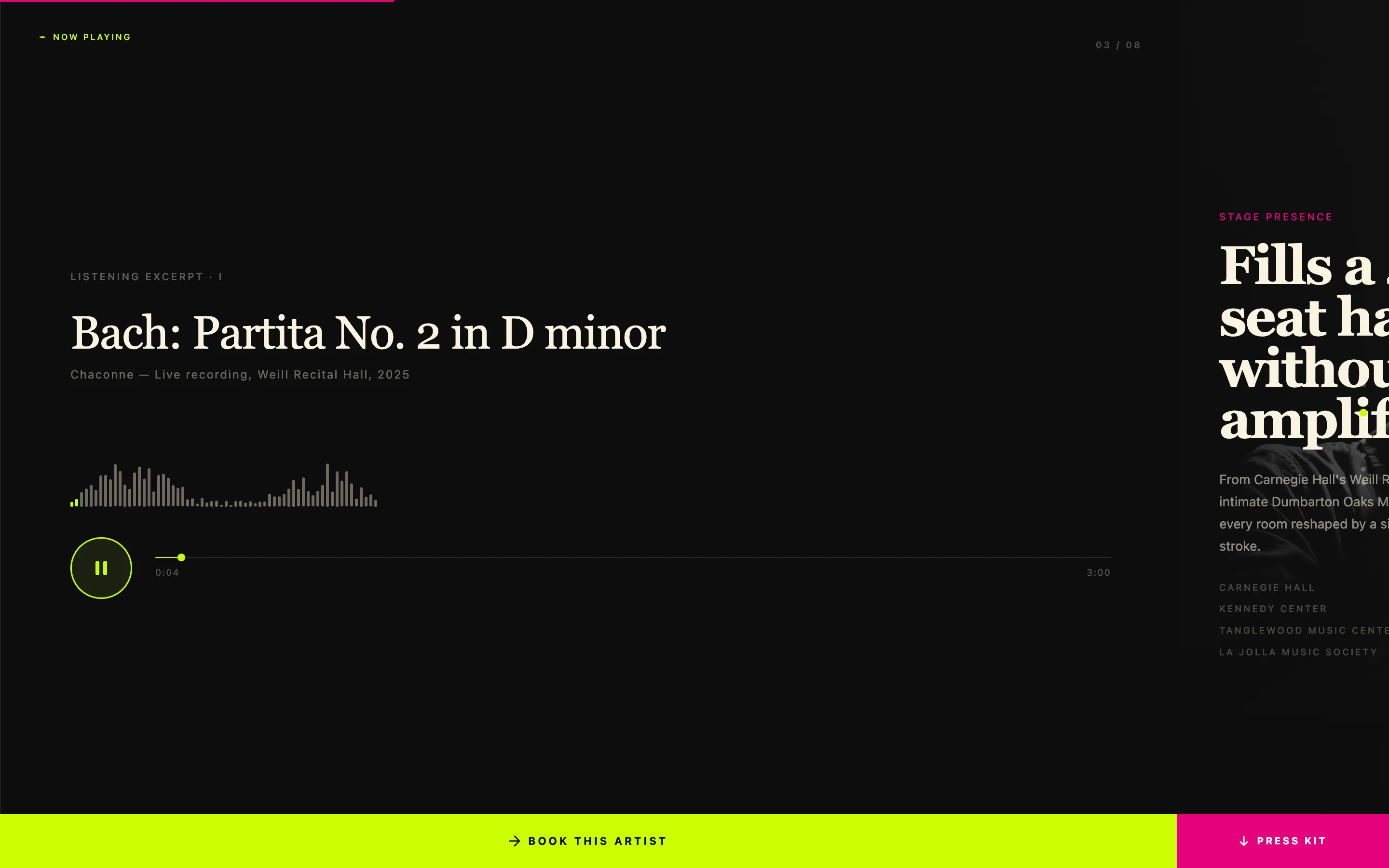
- Programmers rarely book a soloist they have not heard. The waveform audio panel plays a live clip before the visitor finishes reading the first panel, so the sound is in the room before any ask is made.
- Press quotes and repertoire grids appear mid-scroll, at the exact moment a programmer would naturally want proof. The visitor does not need to hunt for critical praise or compositions list; the page delivers it at the right time.
- The sticky "Book This Artist" call to action stays visible across every panel, so the chance to act is never more than one click away regardless of where the visitor is in the horizontal journey.
What you get with this template
You get a complete single-page horizontal-scroll layout with eight distinct content panels, a sticky booking call to action bar, a sliding booking drawer with a structured inquiry form, and a press kit download path. The page is built around Fraunces serif headlines and DM Sans body captions, with every color decision already made and documented in the design system.
- Eight fully designed panels: hero, pull-quote, audio, performance photography, repertoire grid, press quotes, instrument detail, and a closing booking call to action panel
- A sliding booking drawer with date selection, event type options (recital, chamber series, private gathering, recording session), venue size field, and a programme preferences input
- A secondary magenta "Download Press Kit" path for programmers who need board approval before committing to a date
Feature list
This section walks through the six capabilities that define what Cadenza delivers and why each one matters to a performing artist trying to fill a calendar.
Horizontal Scroll Panel Architecture
The page moves horizontally like a musical phrase, with each panel acting as a measure in a composed sequence. The movement builds from a quiet cinematic hero through audio and photography panels and arrives at a booking call to action that feels like the natural end of a musical sentence. The scroll itself carries the persuasive weight, so the visitor arrives at the form already convinced.
Full-Bleed Cinematic Hero
The header uses a full-bleed performance photograph shot from the music stand's perspective. The image bleeds past the viewport edges. No headline competes with the photograph. Instead, the artist's name appears small, typeset in a refined serif at the lower-left corner, styled like a photo credit in an arts magazine editorial spread.
Waveform Audio Panel with Scroll-Triggered Autoplay
A live audio clip begins playing softly as the panel enters the viewport, paired with an animated waveform visualization. The visitor hears the artist before they read a single line of critical praise. Subsequent audio panels increase in scale, moving from a solo piece to a duo to a full ensemble excerpt, so the listening experience has its own dynamics, from pianissimo to fortissimo.
Typographic Repertoire Grid
The repertoire list is styled as an elegant typographic grid that mirrors a magazine table of contents. Compositions are presented without clutter, using generous white space and refined type sizing. Programmers and conductors can scan the full list quickly, note the range of works, and assess whether the repertoire suits their concert series without leaving the page.
Editorial Press Quotes Panel
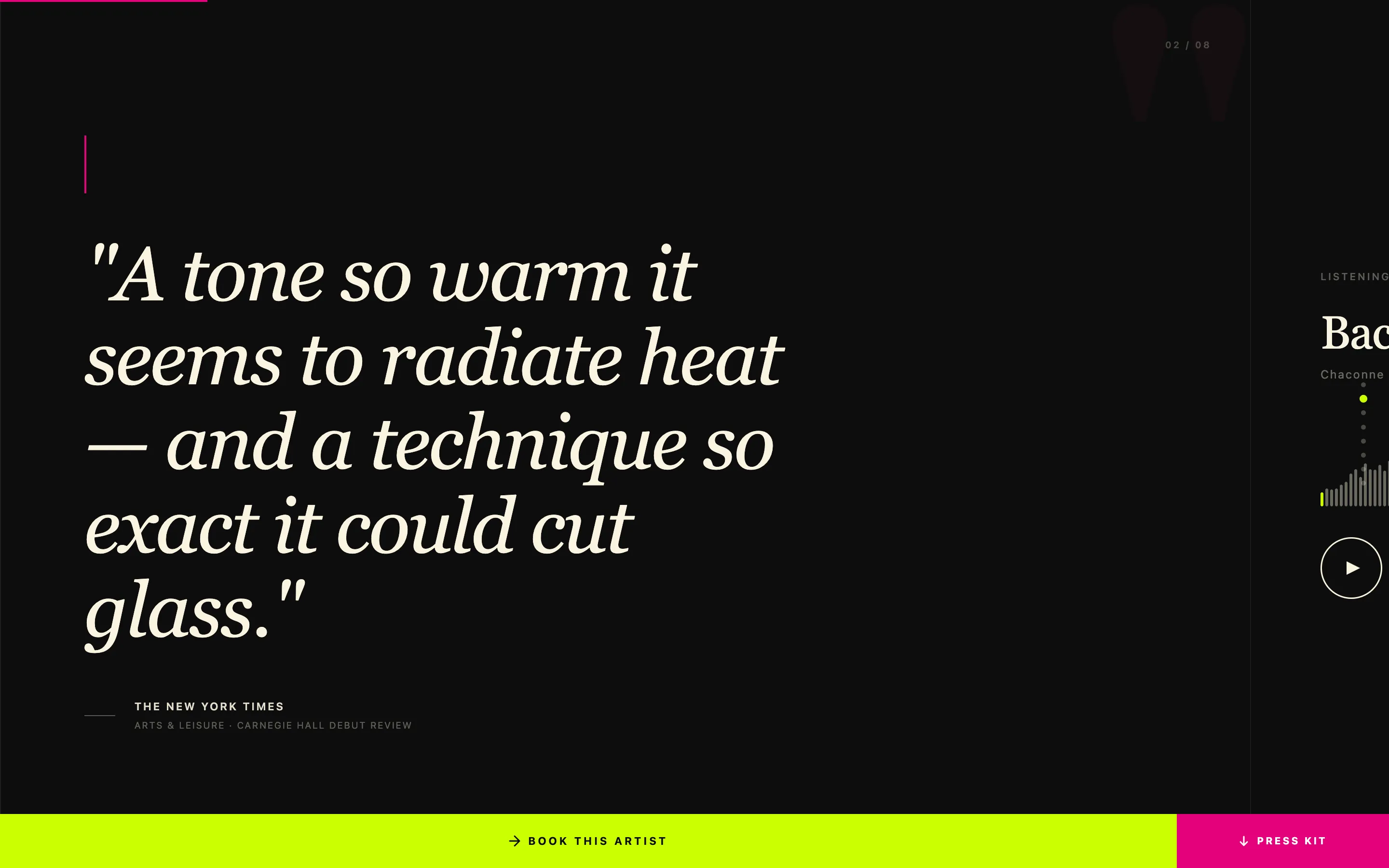
Critical praise is displayed in a dedicated panel using an editorial layout. Pull quotes appear in oversized serif type, styled like liner notes from a recording release. Featuring written quotes from notable institutions builds credibility for a classical musician in ways a biography alone cannot. The panel gives programmers something quotable to take into board conversations.
Sliding Booking Drawer with Structured Inquiry Form
Clicking "Book This Artist" opens a sliding drawer without navigating away from the page. The form captures the date, event type, venue size, and programme preferences in a single structured entry. A parallel path offers a magenta "Download Press Kit" button for programmers who need approval before committing. Both paths are visible and accessible across every panel through the sticky bottom bar.
Page sections overview
| Section | Purpose |
|---|---|
| Hero Full-Bleed | Establishes stage presence through cinematic photography with minimal type |
| Pull Quote Panel | Opens the editorial voice with an oversized serif liner-notes quote |
| Waveform Audio Panel | Lets visitors hear the artist live before reading any biographical text |
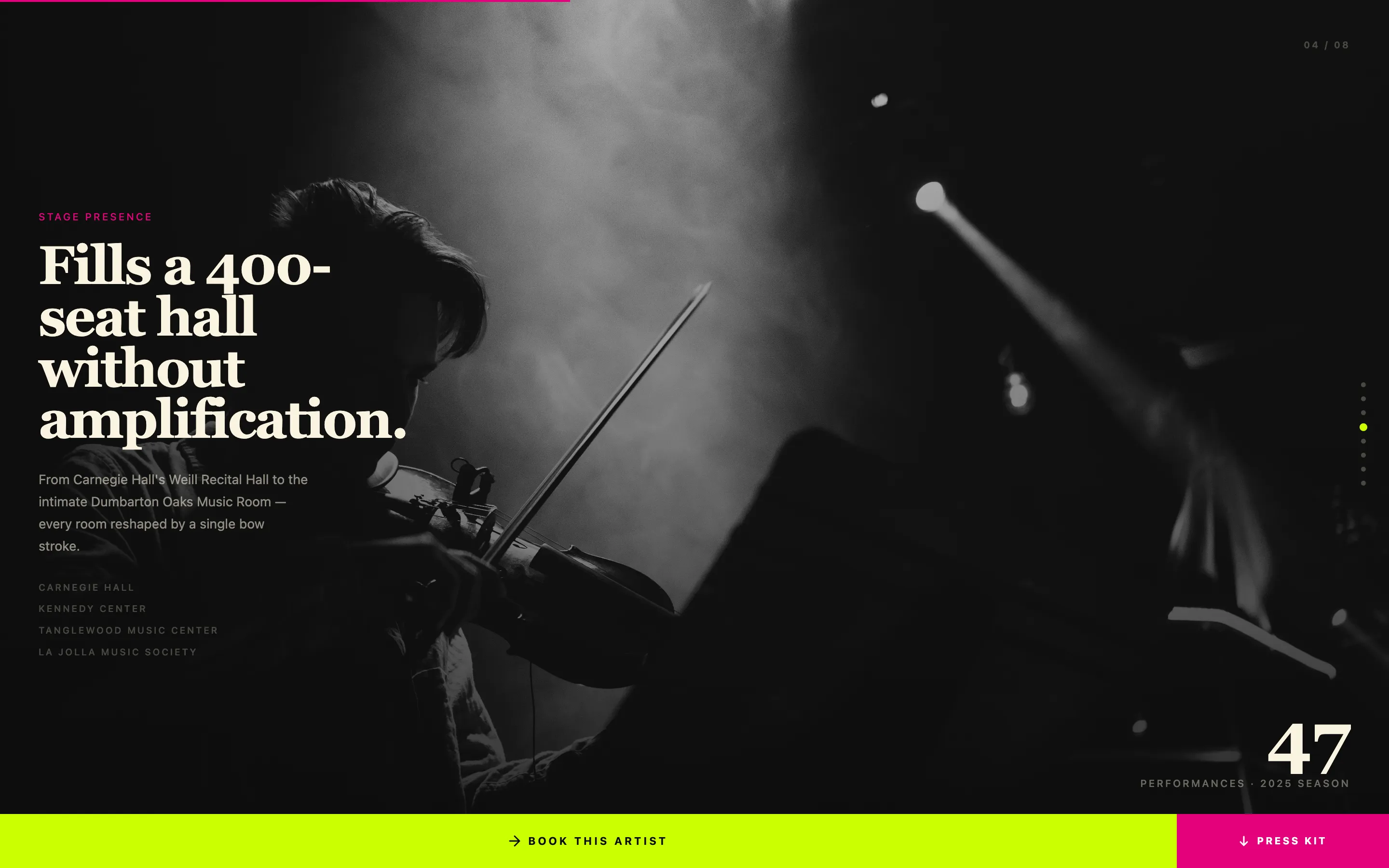
| Performance Photo Panel | Reinforces stage presence with a second full-bleed concert photograph |
| Repertoire Grid Panel | Displays compositions in an elegant typographic magazine-contents layout |
| Press Quotes Panel | Delivers critical praise in an editorial pull-quote format |
| Instrument Detail Panel | Pairs a close-up instrument photograph with a caption and a second audio excerpt |
| Booking Call to Action | Triggers the sliding booking drawer as the natural final note of the scroll |
| Sticky Booking Bar | Keeps "Book This Artist" and "Download Press Kit" visible on every panel |
| Superhuman Minimal Footer | Closes the page with a refined, extremely minimal footer pattern |
Design & branding system
The Cadenza design system is built around a Dopamine Pop color palette applied to a classical editorial context. The result feels like a neon sign reflected off a marble concert hall floor: classical gravity electrified by contemporary confidence. Every color serves a specific role. Black dominates negative space. Cream carries body text and pull quotes. Magenta marks section transitions. Chartreuse appears only when the visitor acts, functioning as a reward color that fires on clicks and scroll interactions.
- Typography: Fraunces serif for editorial headlines, pull quotes, and the artist name; DM Sans for body captions, form labels, and repertoire list text
- Color system: deep editorial black (#0D0D0D) as the dominant field, warm newsprint cream (#FAF3E0) for body text, electric magenta (#E4007C) for section transitions and secondary actions, sharp chartreuse (#CCFF00) reserved for interactive elements and the primary call to action
- Spacing and layout: ample negative space throughout, full-bleed imagery that bleeds past viewport edges, and a column-based magazine-like structure that makes each panel feel like a printed spread
Mobile & speed optimization
The page is designed desktop-first because horizontal scroll is the primary experience for concert programmers reviewing artists at a desk. A mobile fallback converts the horizontal flow to a standard vertical scroll, preserving all eight panels and the sticky booking bar. Images are optimized for low file size to keep loading times fast without sacrificing the visual quality that a classical music portfolio demands.
- Lazy audio loading: audio clips load only as their panels approach the viewport, using IntersectionObserver triggers to avoid blocking the initial page load
- Scroll-linked animations are scoped to the horizontal scroll container and degrade gracefully on touch devices, so no content is hidden or inaccessible on smaller screens
How this template helps you convert
The horizontal scroll is the sales engine. By the time a visitor reaches the final panel, they have heard the sound, seen the stage presence, and read the critical praise. The booking form feels like the natural next note in the phrase rather than an interruption.
- Audio before biography: the waveform panel plays the artist's sound early in the scroll, establishing the voice and tone before any written claim is made, which is exactly the sequence a programmer needs to feel confident signing off on a booking.
- Sticky call to action across every panel: "Book This Artist" in chartreuse stays pinned to the bottom edge throughout the entire horizontal journey, so the visitor never has to scroll back or search for the next step. The sliding drawer opens without leaving the page, which keeps the momentum of the scroll intact and makes it easy to complete a booking inquiry in a single session.
Other information about this template
The Cadenza editorial magazine classical musician landing page template draws on a broader tradition of classical music presentation that scholars and musicologists have studied across centuries. Understanding the history of performance practice helps clarify why the editorial format works so well for a solo recitalist.
- The word cadenza refers to improvised or composed passages in classical music that allow performers to showcase technical skill and interpretative abilities. The practice has evolved over time, and musicologists note that Baroque cadenzas typically began on the written note and included a messa di voce followed by improvised ornamentation, while Romantic cadenzas became far more elaborate. Domenico Corri was a significant source for ornamentation practices during the Classical period, providing detailed notational examples that scholars still reference today.
- Classical cadenzas often recapitulate harmonic ideas and are not harmonically static; they move toward a resolution, much as this landing page moves the visitor toward a booking. To write effective cadenzas, one must understand the harmonic roots and stylistic characteristics of the period. The same logic applies to building a persuasive artist page: understand your audience's expectations and resolve toward their goal.
- The history of classical music promotion in London is directly relevant to any soloist building an international profile. Johann Peter Salomon played a major role in promoting Beethoven's music in England and brought Joseph Haydn to London twice, significantly impacting the musical landscape there. Beethoven's relationship with English audiences grew through correspondence with folk song collector George Thomson, and his compositions were later published by Muzio Clementi's piano factory, which served as a major entry point for German and other European works into the English market. The Philharmonic Society, founded in London in 1813, became Beethoven's most important institutional partner. His Ninth Symphony received its London premiere in 1825, a moment musicologists and scholars still discuss as a turning point in the city's concert life.
- Cadenza as a community platform connects classical music enthusiasts worldwide and provides resources including a Concerts Guide updated automatically with concerts from across Europe and beyond, a Musicians' Directory free to join, a multi-lingual Classical Music Glossary covering French, German, English, and other languages, and Socratic Dialogues that foster deep discussion. Cadenza also encourages user contributions in areas including concert listings and musicians' advertising, making it a living community service for the classical music world.
- Many orchestras are now focusing on community engagement and outreach programs to attract new audiences, and classical music festivals are increasingly incorporating contemporary compositions alongside traditional repertoire. There is a growing trend of musicians collaborating with artists from other genres, and digital platforms are being used to stream concerts and reach global audiences. This template supports that broader movement by giving soloists a direct-booking presence that can sit alongside any community or streaming strategy.
- Programmers who book own concerts for their series, whether in January, June, or July, need a dependable reference point for assessing an artist. This template gives them that reference in one scrollable session. The page is designed so that, by the end, the visitor has everything they need to make a confident recommendation to a board or a client, hundreds of details absorbed without the friction of navigating multiple pages.
- The template is ready to customize without requiring programming skills. No-code tools make it possible for a singer, a violin soloist, or an ensemble leader to launch and update a production-ready page. The selling proposition is simple: sign up, place your content, and the design system does the rest. The page is complete on day one, and taking it live requires only that you populate the panels with your own photography, audio, press text, and repertoire list.
Theme
Editorial Magazine
Creative direction
Sound & Rhythm
Color system
Dopamine Pop
Direction
Direct Sales
Page Sections
Horizontal Scroll Panel Architecture
Waveform Audio with Scroll-triggered Autoplay
Full-bleed Cinematic Hero Panel
Sliding Booking Drawer with Inquiry Form
Editorial Press Quotes and Repertoire Grid
Sticky Booking Bar Across All Panels
Related questions
Can a singer or instrumentalist other than a violinist use this template?
How does the horizontal scroll work on a phone or tablet?
Can I update the repertoire grid and press quotes myself?
What happens when a visitor clicks 'Download Press Kit'?
Is the audio autoplay handled in a browser-friendly way?