Architects Mastermind Community Landing Page Template
Atelier is a masonry-style landing page template built for an architects mastermind community. It opens with an oversized testimonial card, then scrolls through a founder origin story grid, ungated micro-lessons, and member evidence cards. The primary call to action gates a Fee Restructuring Playbook PDF behind a simple email form. Editorial in tone, honest in voice.
by Rocket studio
Quick summary
Atelier is a single-page template designed for a private architects mastermind group. It uses a masonry card grid to tell a founder's origin story, surface member proof, and deliver three free micro-lessons before asking for anything. The primary call to action downloads a 12-page Fee Restructuring Playbook behind an email and firm-size form field.
Who this template is for
This template is built for practicing architects who want to attract and convert peers into a paid or gated professional community. It speaks directly to the real frustrations of studio life, not generic membership messaging.
- Sole practitioners underpricing their fees and working unsustainable hours
- Mid-career associates planning to open their own firms
- Small-firm principals running two-to-eight person studios who want structured peer accountability
What problem this template solves
Most professional community pages lead with features and pricing. Architects tune that out fast. This template leads with honesty: a real burnout story, a real member result, and genuinely useful content before any form appears.
- There is no trust-building narrative on a standard membership sign-up page
- Visitors leave before seeing the value because the ask comes too early
- Architecture-specific business knowledge, such as fee negotiation and client selection, is rarely communicated with credibility on community pages
What you get with this template
You get a fully structured, single-page layout built around an editorial masonry grid. Every section flows in a deliberate sequence: proof first, story second, value third, then the ask.
- A hero testimonial card, a scrollable origin story grid, three ungated micro-lesson cards, member evidence cards, and a gated call-to-action section with a curriculum overlay
- A warm editorial color system using architectural graphite, drafting-paper warm white, open-sky blue, and deep slate
- Fraunces serif display type paired with DM Sans body text for a serious yet readable typographic feel
Feature list
A paragraph overview before the feature items: each feature below maps directly to a described component or behavior in the template brief.
Oversized Hero Testimonial Card
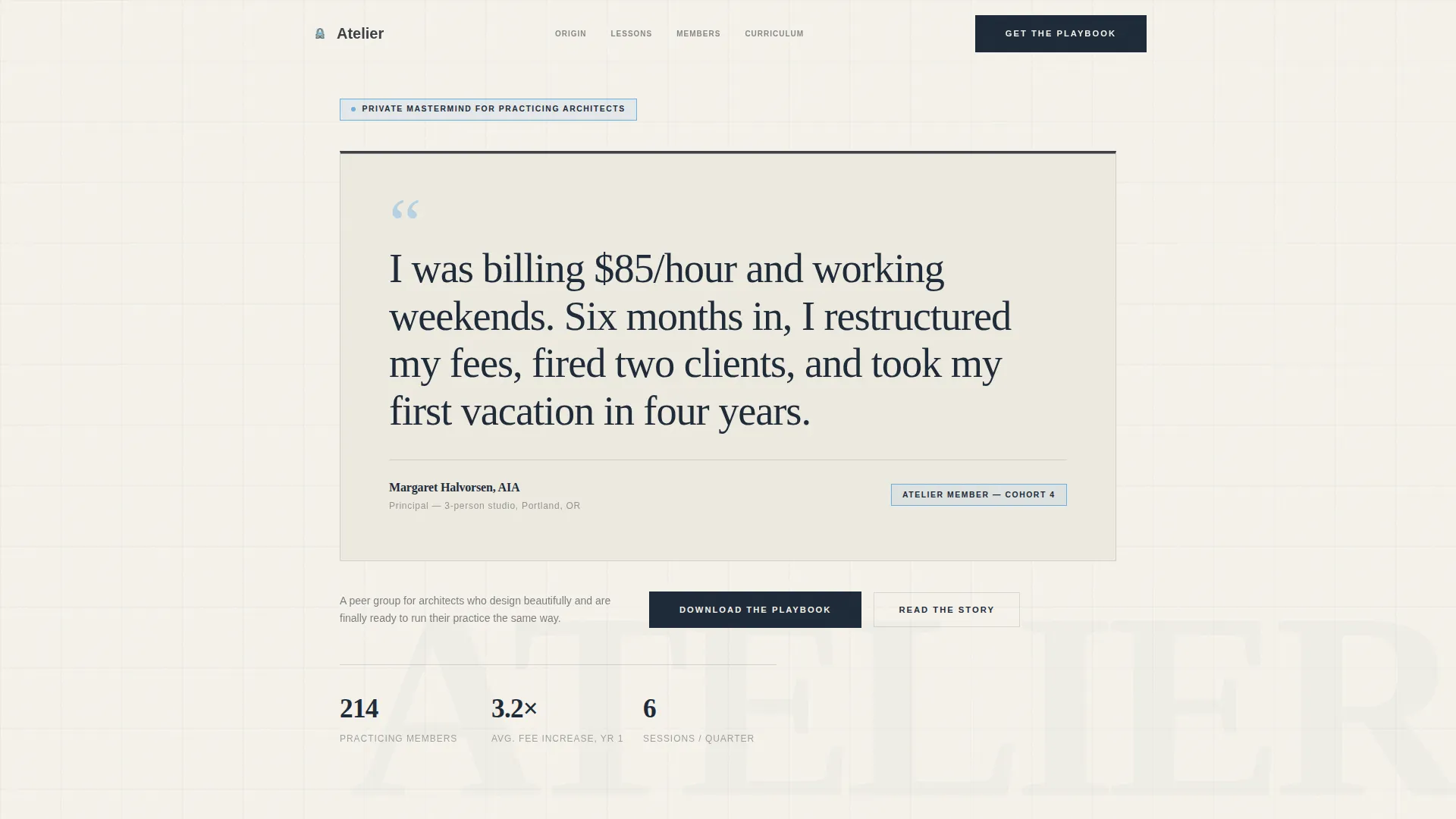
The header is a single full-width card set in large handset type on a cream background. It quotes a real member result, includes a thin graphite rule above the text, and places a sky-blue membership badge below. No portrait or logo competes for attention.
Masonry Origin Story Grid
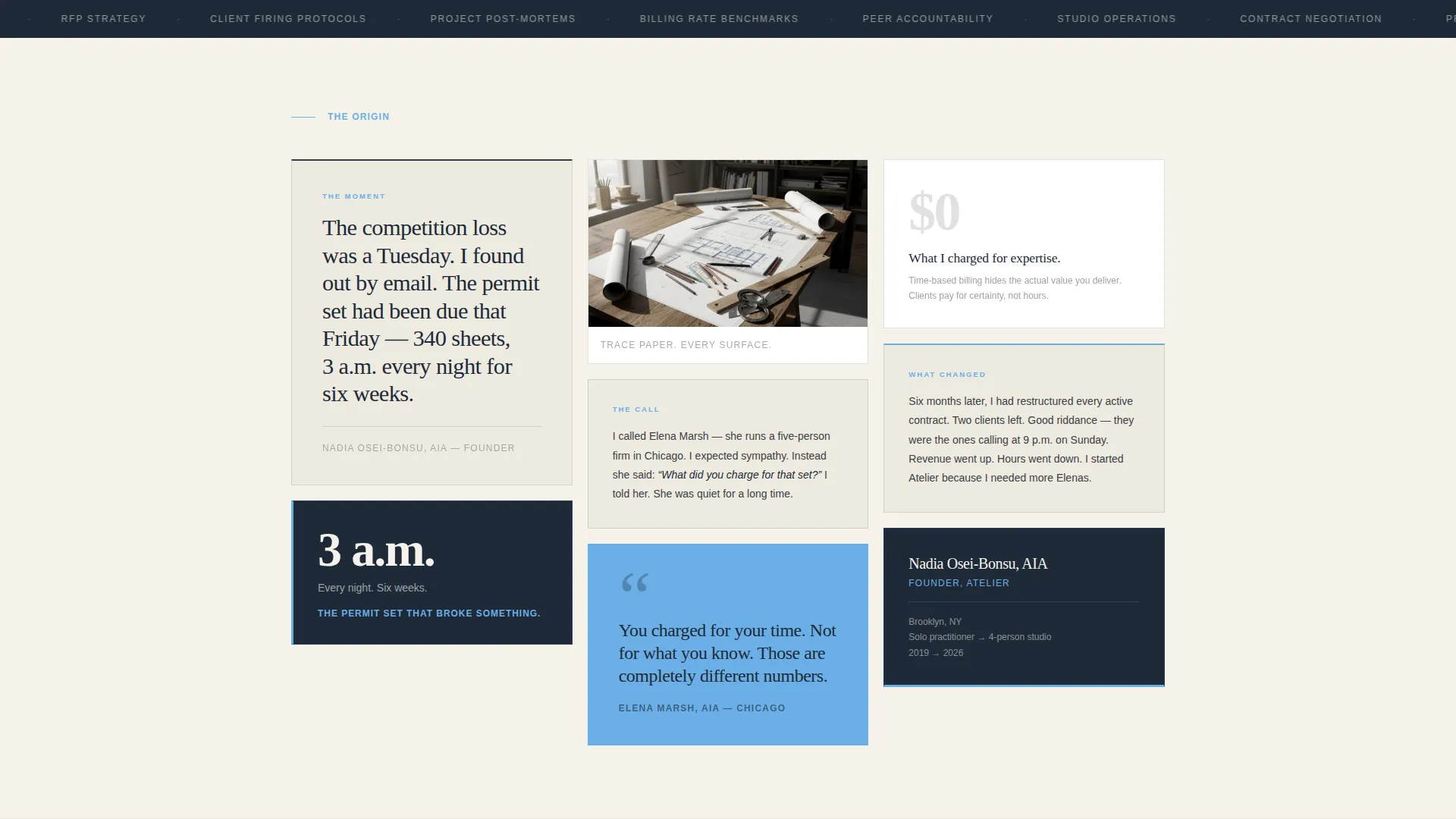
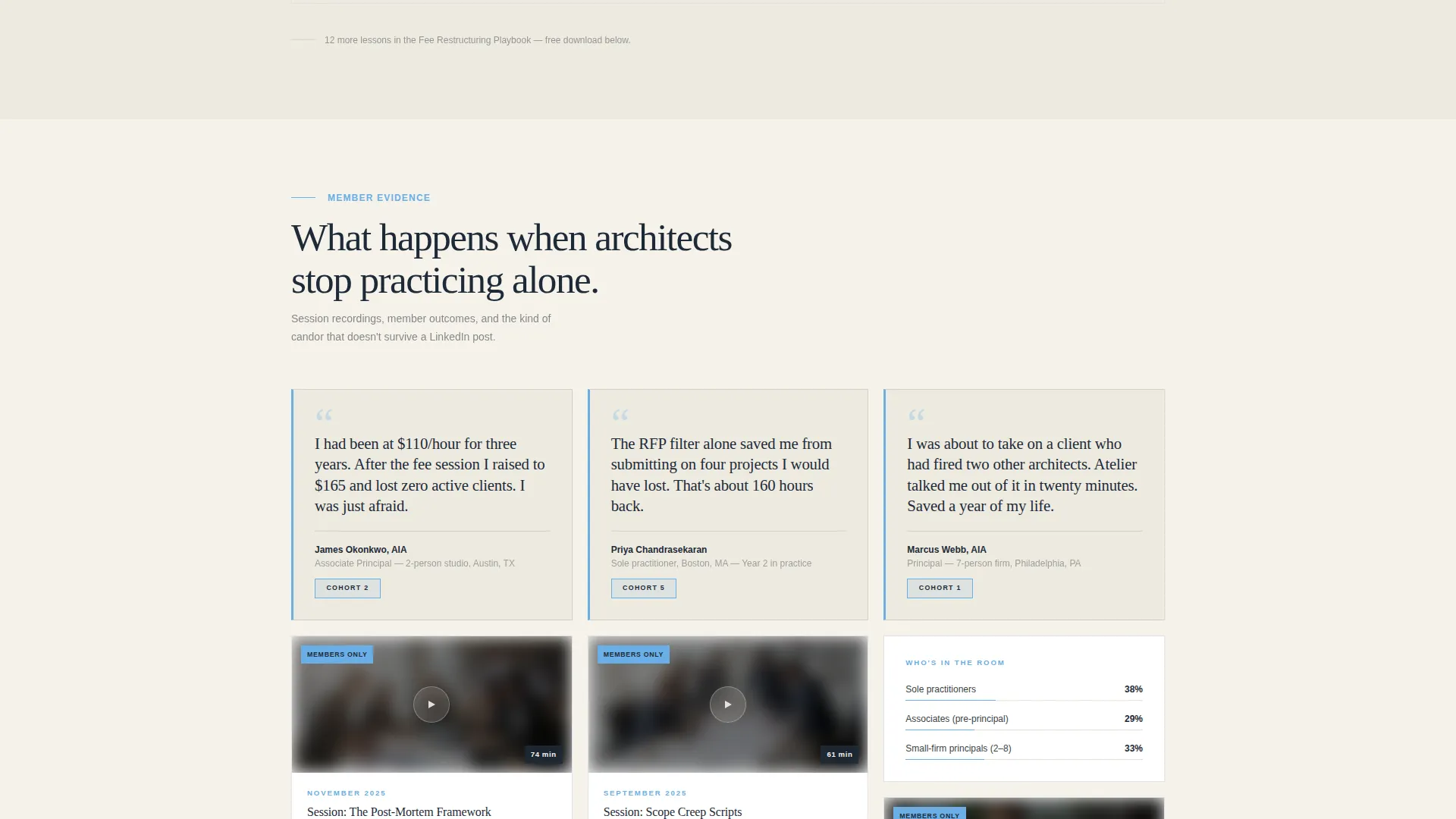
The page body is a Pinterest-style masonry grid. Cards begin with the founder's burnout narrative and widen progressively into member stories, session recording thumbnails with blurred previews, and curriculum snapshots. Each row builds from personal confession to collective evidence.
Ungated Micro-Lesson Cards
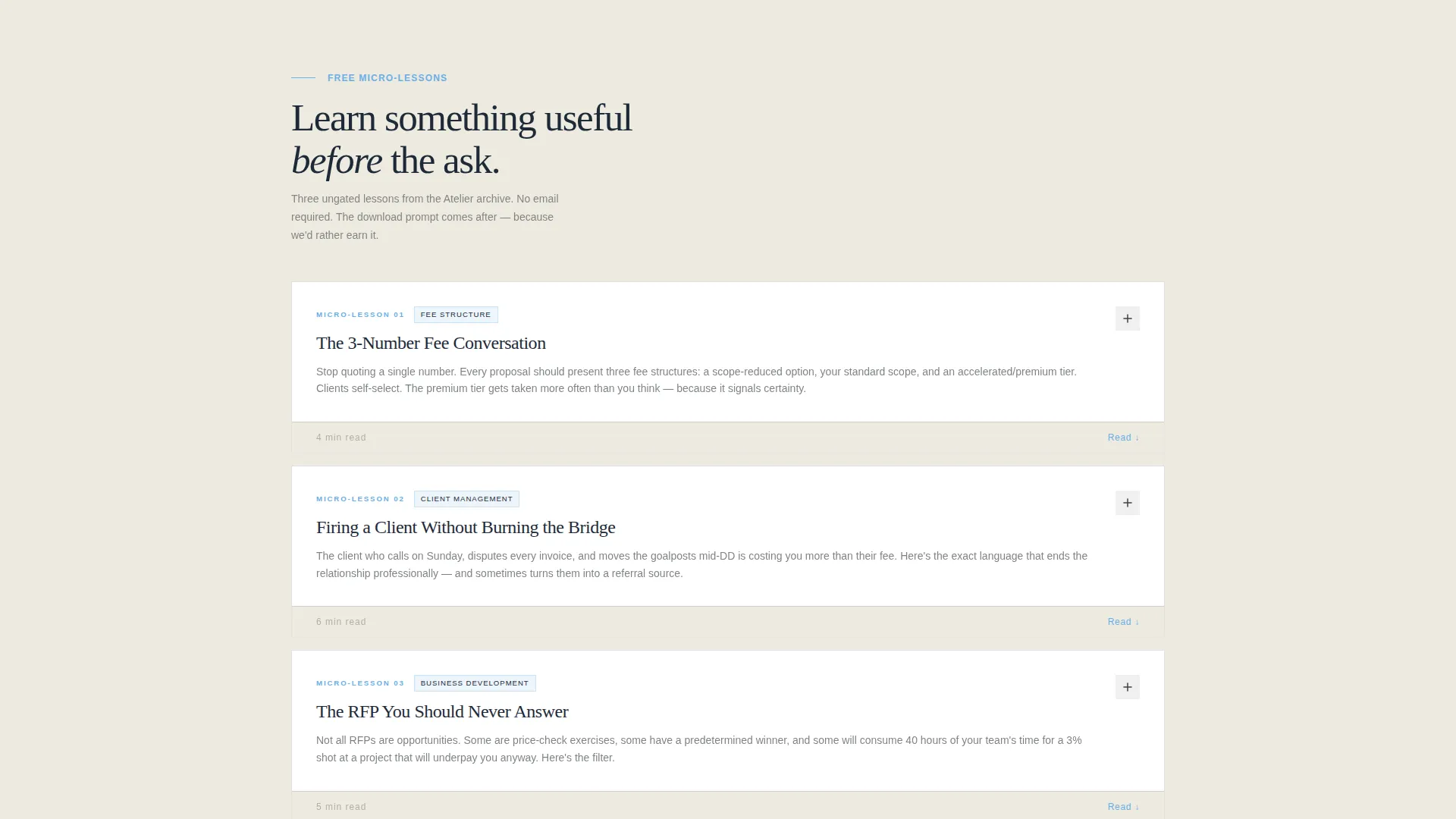
Three cards in the grid deliver real, usable content before any form appears. Visitors learn something concrete about architecture business practice before they are ever asked for their email address.
Gated Fee Playbook Download Form
The primary call to action prompts visitors to download a 12-page Fee Restructuring Playbook. The form captures an email address and a firm-size field. Value is already established by the time the visitor reaches this section.
Curriculum Overlay Modal
A secondary call to action opens a full-curriculum overlay without leaving the page. Visitors can browse the full session topic list before committing, reducing hesitation at the form step.
Scroll Reveal and Card Hover Interactions
The template includes scroll-triggered reveal animations, staggered card entrances, a marquee element, and card hover depth effects. Interactive surfaces, including every clickable card and button, use sky blue as a consistent visual signal.
Page sections overview
| Section | Purpose |
|---|---|
| Hero Testimonial Card | Opens with a real member result in oversized type to establish immediate credibility |
| Origin Story Grid | Founder burnout narrative told through masonry cards that widen into member proof |
| Micro-Lesson Cards | Three ungated content cards that deliver real value before the email form appears |
| Member Evidence Section | Member quotes, firm sizes, cities, and session recording thumbnails with blurred previews |
| Fee Playbook Call to Action | Gated form capturing email and firm size to download the 12-page PDF playbook |
| Curriculum Overlay | Modal overlay listing the full session curriculum, accessible without leaving the page |
| Footer | Linear single-row footer pattern with essential links |
Design & branding system
The visual identity follows an Educational Guide theme. It feels like a well-worn notebook left open on a drafting table: serious ink on soft paper, with the sky pressing optimism through the glass.
- Color system uses four values: architectural graphite (#3B3F45) for body text and borders, drafting-paper warm white (#F5F2EB) as the page ground, open-sky blue (#6AAFE6) for all clickable surfaces and badges, and deep slate (#1E2A38) anchoring headers and pull quotes
- Masonry cards float on the warm white ground, bordered in graphite hairlines, with sky blue marking every interactive element
- Typography pairs Fraunces as the serif display face for headlines and pull quotes with DM Sans as the clean sans-serif body font
Mobile & speed optimization
The template is built desktop-first to match the primary audience of architects working at studio workstations. Mobile parity is included so the page holds up when shared or browsed on a phone.
- Scroll reveal animations, staggered card entrances, and the marquee element are handled on the client side while static sections use server-rendered components
- The masonry grid reflows cleanly across screen widths without losing the editorial column structure
- The gated form and curriculum overlay modal are both functional and readable at mobile viewport sizes
How this template helps you convert
The conversion strategy in this template is sequenced deliberately. Value arrives before the ask, which lowers resistance at every step.
- Three ungated micro-lesson cards give visitors a concrete reason to trust the community before they see any form, so the email ask feels like a fair exchange rather than a barrier.
- The curriculum overlay lets visitors self-qualify by reviewing the full session list. Visitors who open it are already persuaded; the form is the natural next step.
Other information about this template
This template is categorized under Community and Nonprofit, specifically for an architects community niche. It is suitable for any architects mastermind group or peer learning community operating in the architecture industry.
- The page is localized for a United States audience: English language, USD pricing references, and MM/DD/YYYY date formatting
- The footer uses a linear single-row pattern, keeping the bottom of the page clean and uncluttered
- Animation intensity is set to medium: present enough to feel alive, restrained enough to keep focus on the content
- The template style is Masonry/Pinterest, with the creative direction rooted in an origin story narrative arc
- This layout can support a community run by a solo founder or a small organizing team without requiring a complex content system
Theme
Educational Guide
Creative direction
Origin Story
Color system
Slate & Sky
Style
Masonry/Pinterest
Direction
Content/Resource
Page Sections
Oversized Hero Testimonial Card
Masonry Origin Story Grid
Ungated Micro-lesson Cards
Gated Fee Playbook Form
Curriculum Overlay Modal
Scroll Reveal and Hover Interactions
Related questions
Who is the primary audience for this template?
Can I use this template without a PDF playbook ready?
Does the template include the micro-lesson content?
What makes this different from a standard membership sign-up page?
Is this a single page or a multi-page template?