Aluminum Products & Booking Website Template
Alloy is a precision-focused landing page template built for aluminum specification consultancies. It combines a before/after case study hero, modular flip-card engagement process, an interactive five-question diagnostic quiz, and an alloy risk scoring system, all styled in a Corporate Precision aesthetic that earns the trust of procurement managers, plant engineers, and operations directors before a single meeting is booked.
by Rocket studio
Quick summary
Alloy is a card-grid landing page template engineered for aluminum specification consultancies that serve aerospace, automotive, and packaging industries. The template leads with a case study split frame, walks visitors through a four-phase engagement process using hover-flip cards, and closes with a five-question diagnostic quiz that delivers a personalized alloy risk score, converting technical credibility into booked consultation requests.
Who this template is for
This template is intended for consultants and advisory firms whose core service is aluminum alloy grade selection, temper specification, and supplier qualification. It is specifically designed around the daily pressures of industrial procurement and engineering teams who need answers, not marketing language. If your company guides manufacturers through specification decisions before a purchase order is signed, this template form was built to represent that service with authority.
The page is aligned with practitioners who deal in precision materials decisions, certified documentation, compliance requirements, and performance accountability. It suits the following audiences:
- Procurement managers at aerospace subcontractors managing mill certifications, alloy grade approvals, and supplier qualification documentation
- Plant engineers at automotive suppliers retooling extrusion lines for lightweighting programs and needing grade-temper-supplier recommendations with traceable data
- Operations directors at packaging firms identifying the root cause of rising scrap rates from downstream alloy selection errors and seeking a structured solution
What problem this template solves
Wrong-grade alloy selection is a costly, frequently underreported failure mode across manufacturing industries. Procurement teams under deadline pressure often default to a familiar alloy series without formally weighing the mechanical performance requirements of the actual application. The result: stress-corrosion cracking, fatigue failures, poor formability, or weld cracking that surfaces only after fabrication or field deployment. At that point, the cost of the wrong grade far exceeds what a qualified specification service would have charged.
The confusion between closely related alloy designations, for example, specifying 3003 when the application demands 5052, is not always visible at ordering time. It becomes visible in scrap reports, rejected assemblies, failed test specimens, and warranty claims. This template exists to help alloy consultancies communicate exactly how they prevent that outcome, and to convert the engineers and procurement leads who are already living with those problems into booked consultation requests.
This template directly addresses the following pain points:
- No clear way to demonstrate the four-phase specification methodology, Audit, Specification, Sourcing, and Validation, in a format that a technical buyer finds credible
- No structured mechanism to qualify an inbound lead by industry, failure mode, current alloy series, annual tonnage, and certification status before the first call
- No visual proof of deliverables, redlined spec sheets, supplier scorecards, tensile test reports, that show the engagement is documented, repeatable, and accountable
What you get with this template
This template provides a complete, structured landing page layout tailored specifically to the aluminum specification consulting service model. Every section is purpose-built to reduce buyer uncertainty and guide the visitor from problem recognition through to a booked review session. The page form follows a logical engagement narrative, and each component is grounded in the actual deliverables and process steps that make this type of service credible to an engineering audience.
You receive a complete, ready-to-adapt layout that includes:
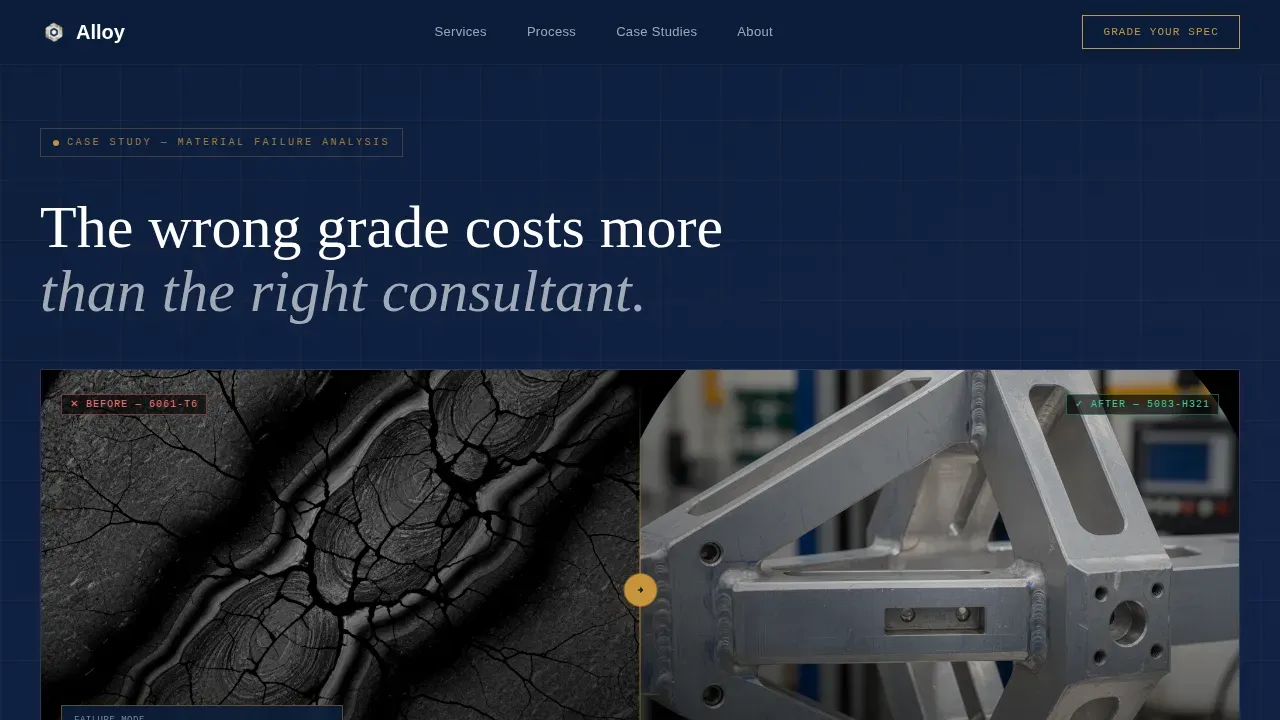
- A before/after hero section showing a real failure case study alongside the re-specified solution, with a fade-in headline, alloy swap data overlay, cost delta callout, and cycle-life improvement note
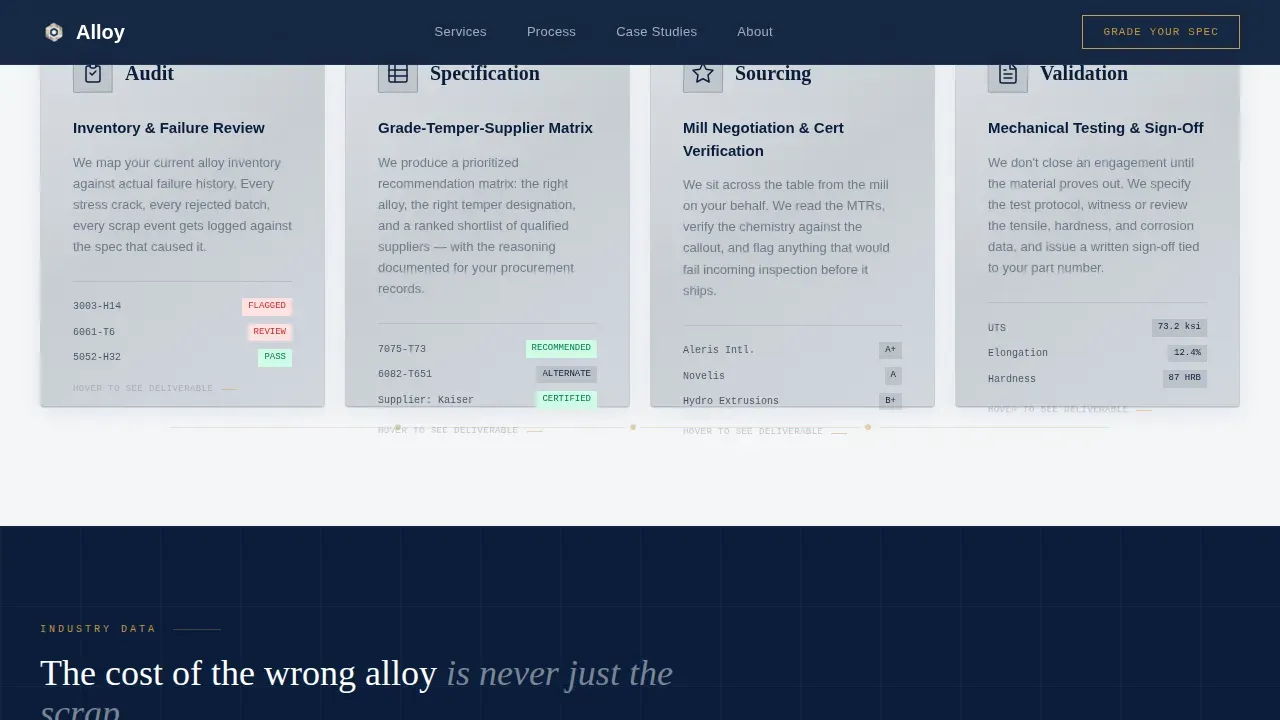
- A modular flip-card engagement process section covering all four service phases, Audit, Specification, Sourcing, and Validation, each card revealing a deliverable thumbnail on hover
- A five-question diagnostic quiz with scoring logic, personalized alloy risk score output, a result summary paragraph, and a secondary booking call to action
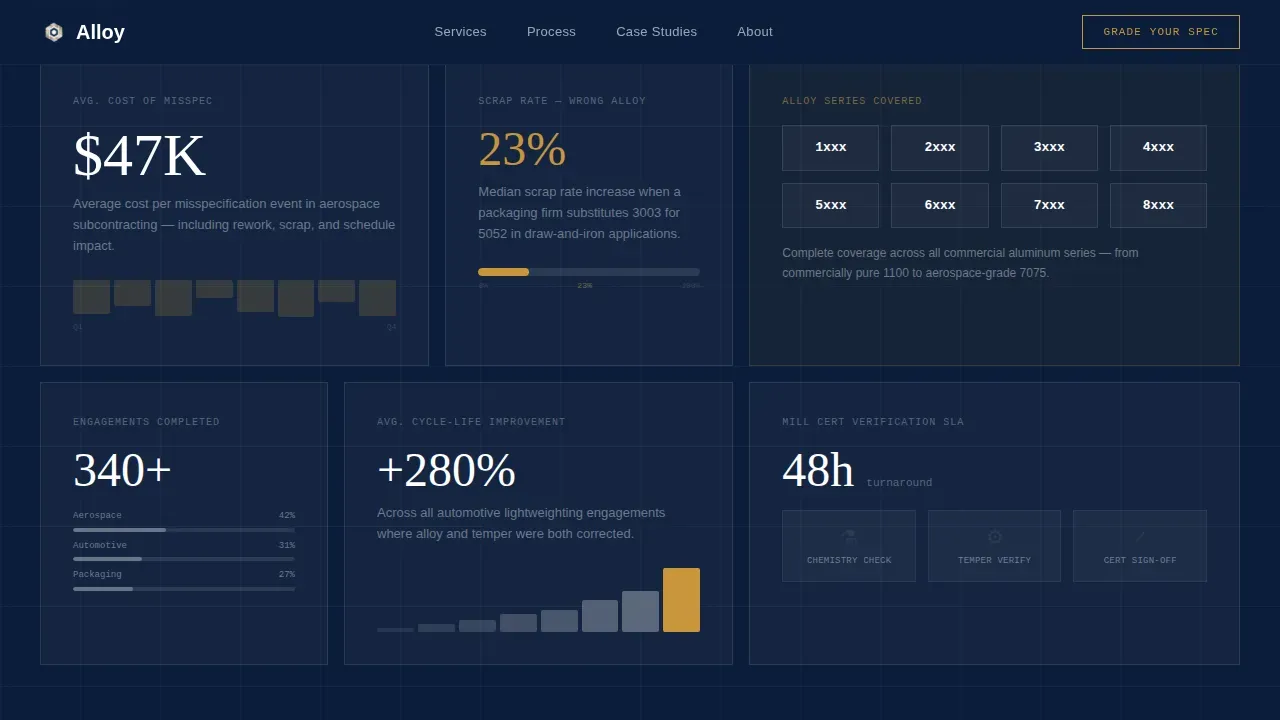
- An alloy risk metrics bento grid displaying failure mode statistics and cost-of-wrong-grade data in a structured, data-forward layout
- A social proof section with industry-specific testimonials from aerospace, automotive, and packaging clients including concrete outcome metrics
- A linear single-row footer with standard navigation and contact details
Feature list
This template form is built around six core functional and design capabilities. Each one directly serves the business goal of converting a technically skeptical industrial buyer into a qualified consultation request.
Before/After Case Study Hero with Data Overlay
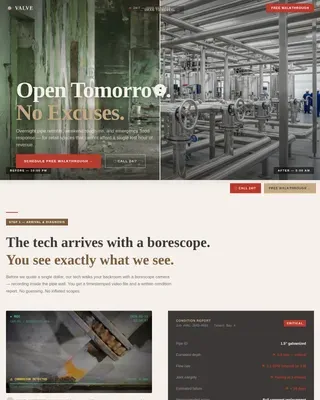
The hero section opens with a split-frame layout: a close-up photograph of stress-corrosion cracking along a 6061-T6 weld seam on the left, and the re-specified assembly performing under load on the right. A small data overlay on the right panel notes the alloy swap, cost delta, and cycle-life improvement. A single headline fades in above the frame: "The wrong grade costs more than the right consultant." This section sets the performance and reliability standard the entire page must meet. It communicates the cost of inaction in one visual statement before the visitor reads a single word of body copy.
Modular Hover-Flip Engagement Cards
Four modular cards form the core of the engagement process section. Each card represents one phase of the consulting workflow: Audit, Specification, Sourcing, and Validation. On hover, each card performs a CSS three-dimensional flip to reveal a thumbnail of the actual deliverable for that phase, a redlined specification sheet, a supplier scorecard, a mill certification document, or a tensile test report. Scrolling through this section feels like walking a visitor through an engagement from handshake to sign-off. Every card reinforces that the service is documented, repeatable, and aligned with industrial quality standards. The form of this section also builds trust with reviewers who evaluate process rigor before committing budget.
Five-Question Diagnostic Quiz with Alloy Risk Score
The quiz is the centerpiece conversion tool. It asks five targeted questions: industry vertical (aerospace, automotive, packaging, marine, or architectural), primary failure mode experienced, current alloy series in use, annual tonnage range, and whether existing mill certifications are on file. Responses feed a scoring engine that generates a personalized alloy risk score. The result page displays a summary paragraph aligned to the visitor's specific situation and a secondary call to action, "Book a Spec Review", that opens a calendar scheduler. The quiz earns the click by delivering immediate, specific diagnostic value before requesting any contact details. This form of lead qualification is far more effective for this service than a static contact request form because it makes the visitor feel understood before they commit.
Alloy Risk Metrics Bento Grid
A structured bento grid section presents failure mode statistics and cost-of-wrong-grade data in a format that resonates with data-oriented buyers. The grid layout allows multiple data points to coexist without crowding: failure detection rates, scrap cost examples, performance degradation statistics, and industry-specific risk factors. This section establishes the scale of the problem in measurable terms. It reinforces the service's value proposition using the language that procurement managers and plant engineers use internally when they build the business case for an outside specification service.
Industry-Specific Social Proof Section
The social proof section features testimonials from clients across aerospace, automotive, and packaging industries. Each testimonial includes the reviewer's role title, company type, and a concrete outcome metric, scrap rate reduction, cost delta, or cycle-life improvement. This approach is far more credible to an industrial buyer than generic praise. It functions as a brief, targeted set of mini case studies. Case studies and testimonials in this format showcase how a specific grade change solved a documented performance or failure issue, which is exactly the kind of evidence that leads procurement and engineering teams to request a formal specification review.
Corporate Precision Design System with Gold call to action Accents
The visual identity applies a Navy Authority color system that communicates authority, precision, and material expertise without relying on decorative elements. Deep command navy dominates the header and footer as structural bookends. Brushed aluminum silver card surfaces float on a technical white field, mimicking the cross-section of a freshly milled billet. Anodized gold appears only on interactive highlights and call-to-action borders, the way a critical dimension gets circled on a shop drawing. Typography uses JetBrains Mono for data labels, Fraunces for editorial headlines, and DM Sans for body text, ensuring that the page reads like a machinist's reference handbook rather than a marketing brochure.
Page sections overview
| Section | Purpose |
|---|---|
| Hero Case Study | Opens with before/after split showing real alloy failure and re-specified solution with data overlay and fade-in headline |
| Engagement Process Cards | Four hover-flip modular cards covering Audit, Specification, Sourcing, and Validation phases with deliverable thumbnails |
| Alloy Risk Metrics | Bento grid displaying failure mode statistics, cost-of-wrong-grade data, and industry-specific performance benchmarks |
| Grade Your Spec Quiz | Five-question diagnostic tool generating a personalized alloy risk score with result summary and booking call to action |
| Client Testimonials | Industry-specific social proof with role titles, company types, and concrete outcome metrics from real engagements |
| Single-Row Footer | Linear footer with navigation, contact details, and consistent brand treatment in deep navy |
Design & branding system
The design language of this template is engineered rather than decorated. Every color, typeface, and spacing decision serves a single goal: make a procurement manager or plant engineer feel like they are reading a precision reference document, not a sales pitch. The palette is derived from the physical properties of aluminum itself, the color of authority, metal, and careful measurement. The result is a page that feels like it was built by people who understand materials and process rigor, not by a generic web agency.
Key design attributes in this template include:
- Navy Authority color palette: deep command navy (#0B1D3A) for primary backgrounds and structural framing, brushed aluminum silver (#C8CDD3) for card surfaces, technical white (#F4F6F8) for open breathing space, and anodized gold (#C9963B) reserved exclusively for interactive highlights and call-to-action borders
- Typography system: JetBrains Mono for data labels and specification callouts, Fraunces for editorial section headlines, and DM Sans for body text and form labels, each selected to reinforce the machinist's handbook aesthetic
- Animation profile: medium animation intensity including CSS three-dimensional card flip on hover, fade-in hero headline on load, scroll-triggered section reveals, and smooth quiz state transitions, interactive without being distracting
Mobile & speed optimization
This template is desktop-first by design. The target users, procurement managers, plant engineers, and operations directors, primarily work at desktop workstations. The complex quiz scoring logic, card grid layout, and data-forward bento grid all benefit from the wider viewport available on desktop screens. The flip-card interactions and multi-column layouts are optimized for that context first. That said, the template is structured to remain functional and readable on smaller screens.
The following structural choices support performance and layout integrity:
- Static-heavy architecture with client-side components isolated specifically to the quiz scoring logic and the card flip interactions, keeping the bulk of the page lightweight and fast to render
- Quiz and card interaction components are scoped as isolated client modules, reducing the performance footprint of interactivity on sections that do not require it
- Data-heavy content areas are designed for clear readability at standard desktop resolutions, with table and grid structures that maintain their form on medium-sized viewports
How this template helps you convert
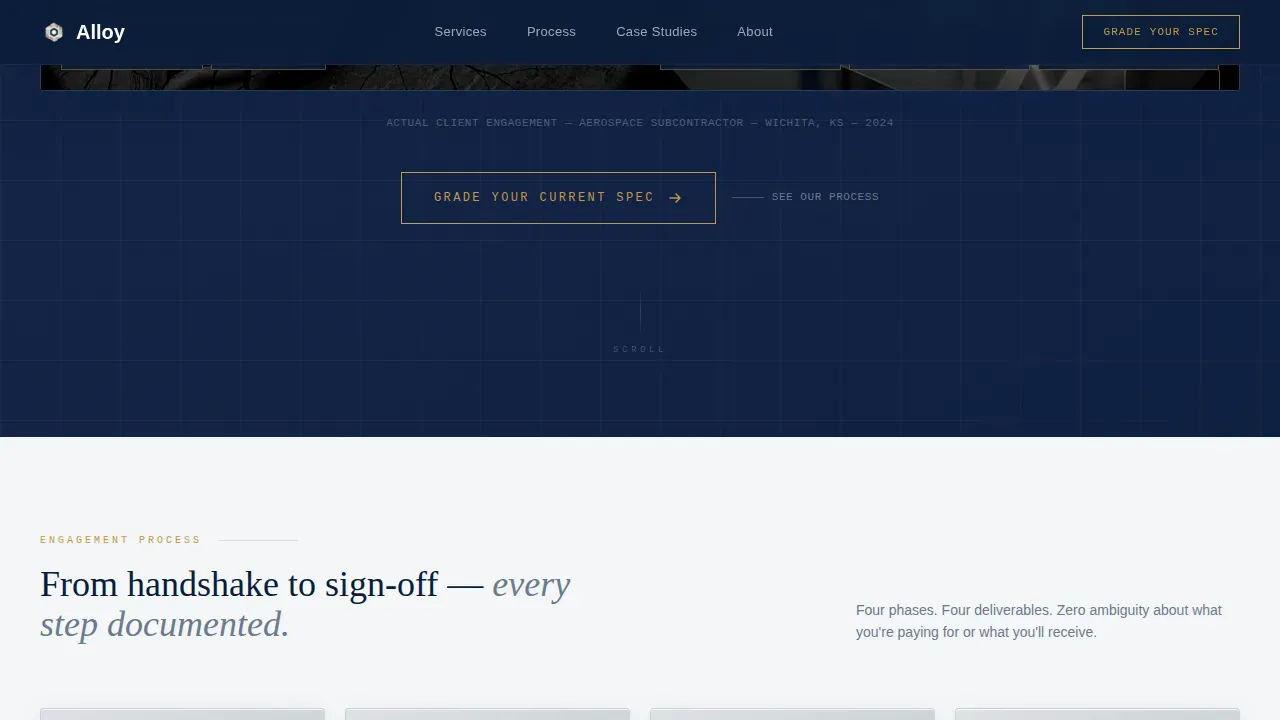
The Alloy template is structured around a progressive trust-building sequence. Each section earns the next click by adding value rather than demanding commitment. The visitor moves from problem recognition (hero case study) through methodology credibility (flip cards) and risk quantification (bento metrics) to self-diagnosis (quiz) and finally to a low-friction booking action. This sequence is intentional and mirrors the way a technical buyer actually evaluates a professional service firm.
Three specific mechanisms drive conversion performance in this template:
- The diagnostic quiz form converts passive interest into active engagement by offering a personalized alloy risk score before asking for contact details. The five-question form captures essential details about the visitor's industry, failure history, current alloy series, tonnage volumes, and certification status, making the booking call to action feel like a logical next step rather than a cold request.
- The hover-flip card section converts skepticism about process rigor into confidence by showing actual deliverable thumbnails. When a procurement manager or plant engineer can see a redlined specification document, a supplier scorecard, or a tensile test report on the back of a card, they understand exactly what they are requesting when they book a review.
- The before/after hero section converts undecided visitors by making the cost of inaction concrete and visual. A sharp photograph of stress-corrosion cracking is more persuasive than any performance claim in a bullet list. It names the problem, sets the standard, and positions the consultancy as the solution before the visitor has scrolled past the first section of the page.
Other information about this template
This template is well-suited to consultancies and organizations that operate in alignment with formal industry standards, including ISO 9001, AS9100 (the aerospace quality management standard), and ASTM material specifications. The page structure supports clear, documented service descriptions intended to communicate compliance posture and process accountability to clients in regulated industries. Buyers in aerospace, automotive, and packaging sectors frequently require that their service providers demonstrate familiarity with applicable standards before a relationship advances to approval or contract stage.
The template form is also aligned with best practices for alloy specification pages more broadly. A well-structured alloy precision grade specification landing page template must include a clear unique selling proposition, detailed material data, technical data sheets, and a direct call to action for quotes or downloads. This template satisfies all of those requirements through its built-in sections and quiz flow. Key additional information about how this template supports specification consulting best practices includes:
- Specification-grade content structure: the page form supports grade designation statements, alloy series descriptions, mechanical property callouts (yield strength, tensile strength, elongation, hardness), and heat treatment specification details that are aligned with how procurement and engineering teams evaluate specification documents
- Compliance and certification framing: the service description sections are structured to accommodate compliance statements referencing applicable standards such as AMS, ASTM, ISO, or MIL-SPEC designations, which are frequently referred to in aerospace and defense supply chain qualification processes
- Processing capability documentation: the template can accommodate processing capability descriptions that note weldability, machinability rating, and recommended heat treatments, details that are subject to review by plant engineers evaluating suitability for specific manufacturing applications
- K&S Precision Metals is an example of a well-known company in the precision metals supply industry that demonstrates how materials organizations align with regulations such as Proposition 65, REACH Compliance, RoHS Compliance, and Hazardous Materials Compliance requirements, exceeding lead-free standards and meeting stringent environmental and safety regulations. Companies serving similar regulated industries can use this template's structure to communicate their own compliance posture clearly and with appropriate documentation
- The Bruker S1 TITAN is an example of handheld alloy testing and analysis equipment frequently referred to in industrial specification workflows. This device can identify most alloys within two to five seconds, provides near-laboratory-quality alloy determination in a lightweight package, and features a silicon drift detector (SDD) with exceptional speed and detection limits, the kind of equipment detail that adds credibility to specification service descriptions and can be incorporated into case study or methodology content on pages built with this template
- Alloy tubing examples frequently cited in specification reference contexts include: Aluminum Tubing (Alloy 3003-H14), renowned for its precision and durability; Brass Tubing (Alloy 260/272), which meets ASTM B135 standards; Copper Tubing (Alloy 122), known for its seamless construction; and Stainless Steel Tubing (Alloy 304/304L), produced through a welding process per ASTM A269 standards, all examples of grade-level specificity that this template's content structure is designed to support
- Precision tolerance documentation is a core use case for this template. Specification pages that explicitly define dimensional tolerances, tighter-than-standard tolerances that justify a precision grade designation, give procurement teams the confidence they need to initiate an approval process and cut a purchase order. The template's layout accommodates this level of technical description with appropriate visual hierarchy
- Request for Quote flow support: the quiz and booking sequence in this template mirrors the logic of a standard request for quote (RFQ) process, capturing essential details such as industry vertical, annual quantity or tonnage, failure mode history, and existing certification status, all aligned with the information that a specification consultant needs to prepare a meaningful initial assessment
- Transportation, storage, and maintenance requirements are additional specification details that can be incorporated into the page's content areas when relevant to the materials being discussed. These details contribute to the overall completeness of a specification service description and help customers understand the full scope of the advisory engagement
Theme
Corporate Precision
Creative direction
Step-by-Step Guide
Color system
Navy Authority
Style
Card Grid (Modular)
Direction
Quiz/Assessment
Page Sections
Before/after Case Study Hero Section
Hover-flip Modular Engagement Cards
Five-question Diagnostic Quiz with Risk Scoring
Alloy Risk Metrics Bento Grid
Industry-specific Social Proof Section
Corporate Precision Navy Authority Design System
Related questions
What industries is this template designed to serve?
Does the quiz require a form submission before showing results?
Can the engagement process cards be adapted to different service phases?
What typography and color system does this template use?
Is the social proof section customizable with real client outcomes?