Private Jet Manufacturer Landing Page Template
Airframe is a dashboard and data grid landing page built for a precision private jet manufacturer. It targets fractional ownership operators, sovereign wealth funds, and charter companies with a case study narrative structure, engineering blueprint visuals, and a monochrome steel palette. Every section leads with operator economics and hard performance metrics before asking for a commitment.
by Rocket studio
Quick summary
Airframe is a single-page, data-driven landing page designed for a precision private jet manufacturer. It presents real operator economics through sequential case study grids, an animated before-and-after header, and engineering deep-dive sections. The visual identity reads like a technical drawing: precise, cold, and built entirely around information that earns its place on the page.
Who this template is for
This template is purpose-built for manufacturers and programs that sell high-value aviation assets to institutional and commercial buyers. It speaks the language of fleet economics, not brochure copy.
- Fractional ownership operators evaluating next-generation fleet additions
- Sovereign wealth funds building or expanding aviation investment portfolios
- Charter companies replacing aging aircraft with more fuel-efficient airframes
What problem this template solves
Most aviation manufacturer pages lead with photography and aspirational language. That approach loses the technical buyer within seconds. Decision-makers sourcing aircraft at this level need data, operator proof, and clear per-unit economics before they engage.
- Visitors leave when a page offers lifestyle imagery instead of performance metrics
- B2B buyers in aerospace require verifiable case studies and comparative figures, not promises
- Long sales cycles start with trust, and trust starts with showing the math before asking for a meeting
What you get with this template
You get a fully structured, single-page layout built around the case study narrative format. Each scroll section advances the story from single-aircraft replacement to full fleet transition, compounding evidence as the visitor moves down the page.
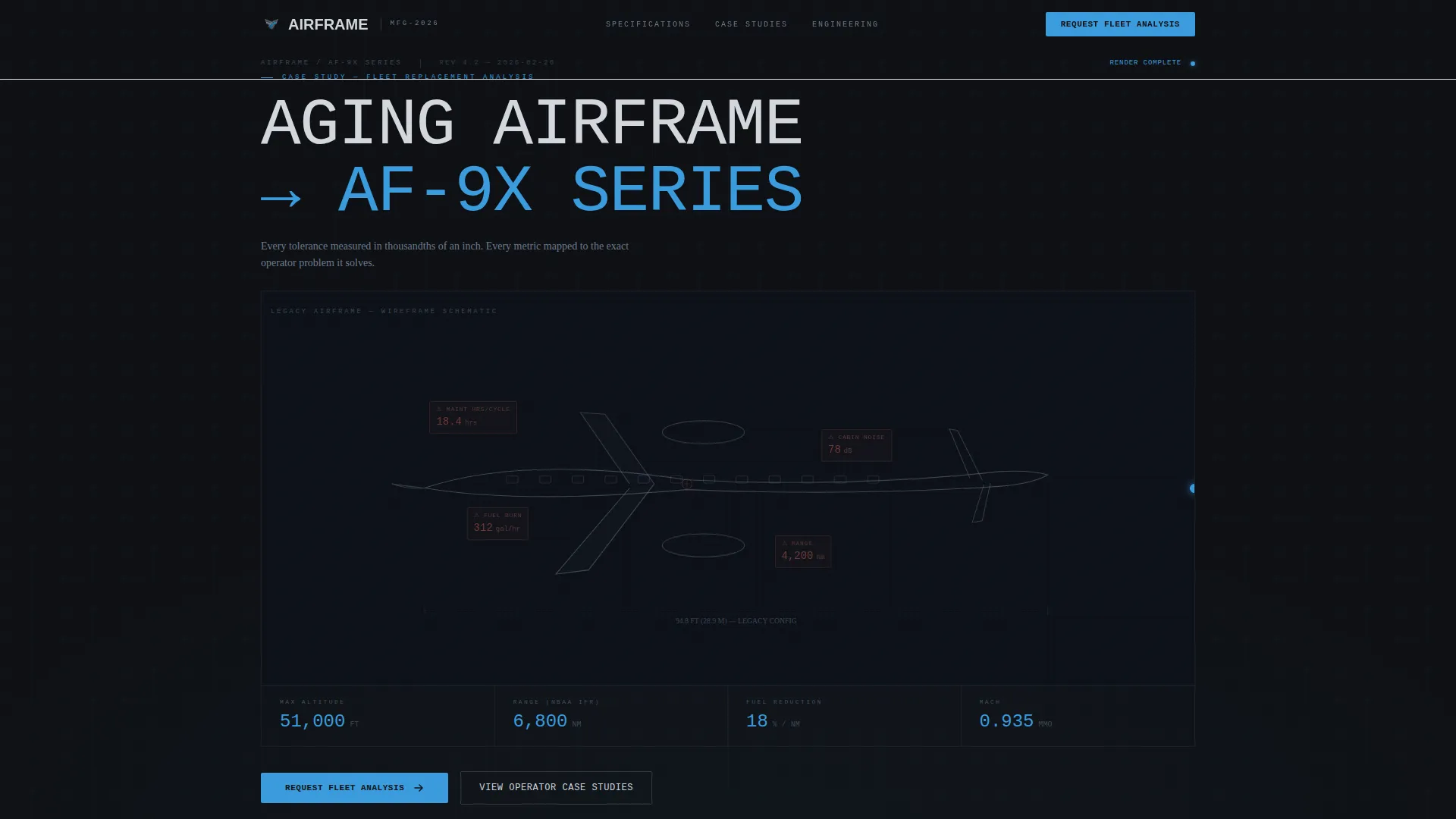
- An animated case study header that transitions wireframe schematics to photorealistic cutaway renders
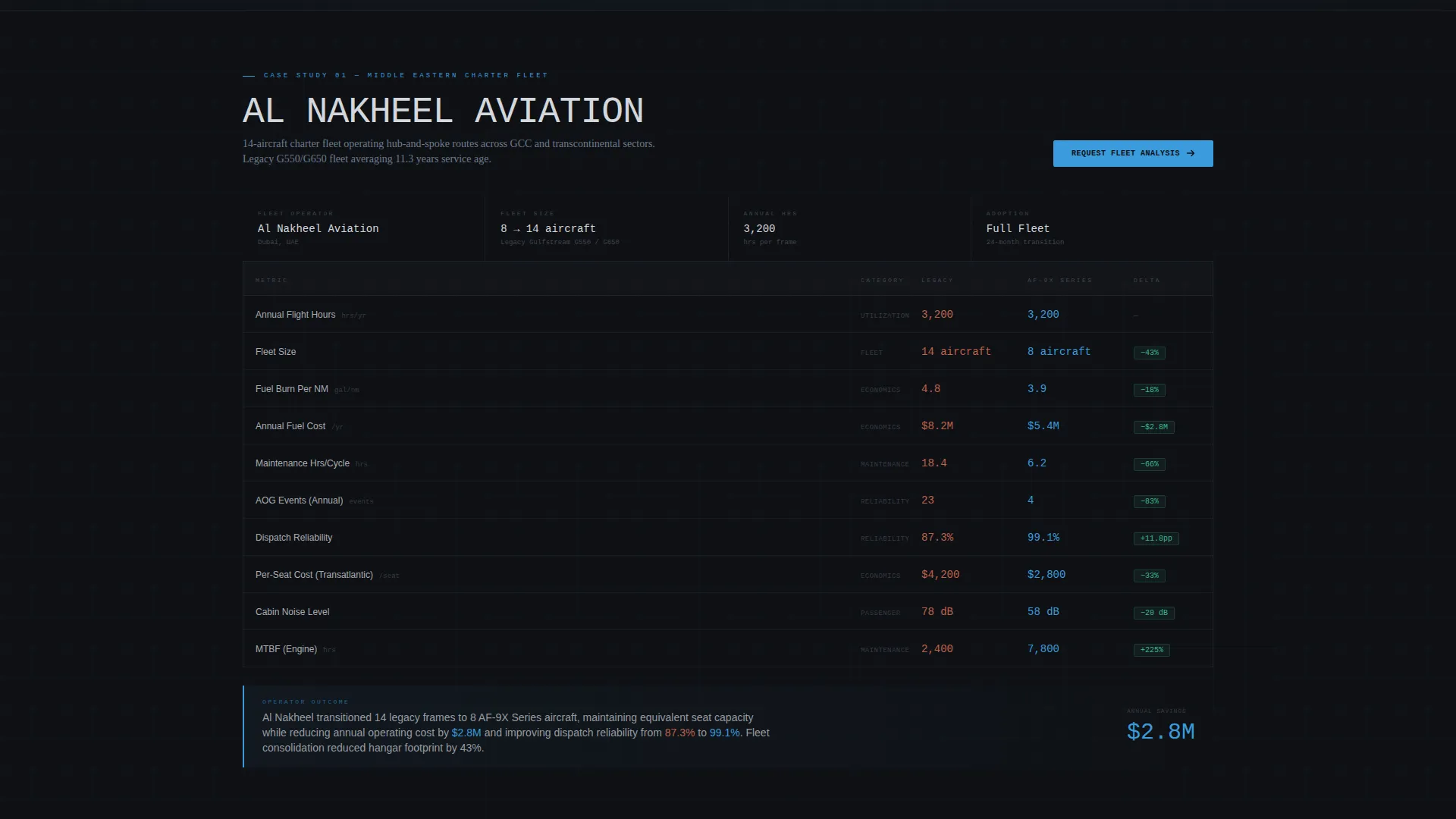
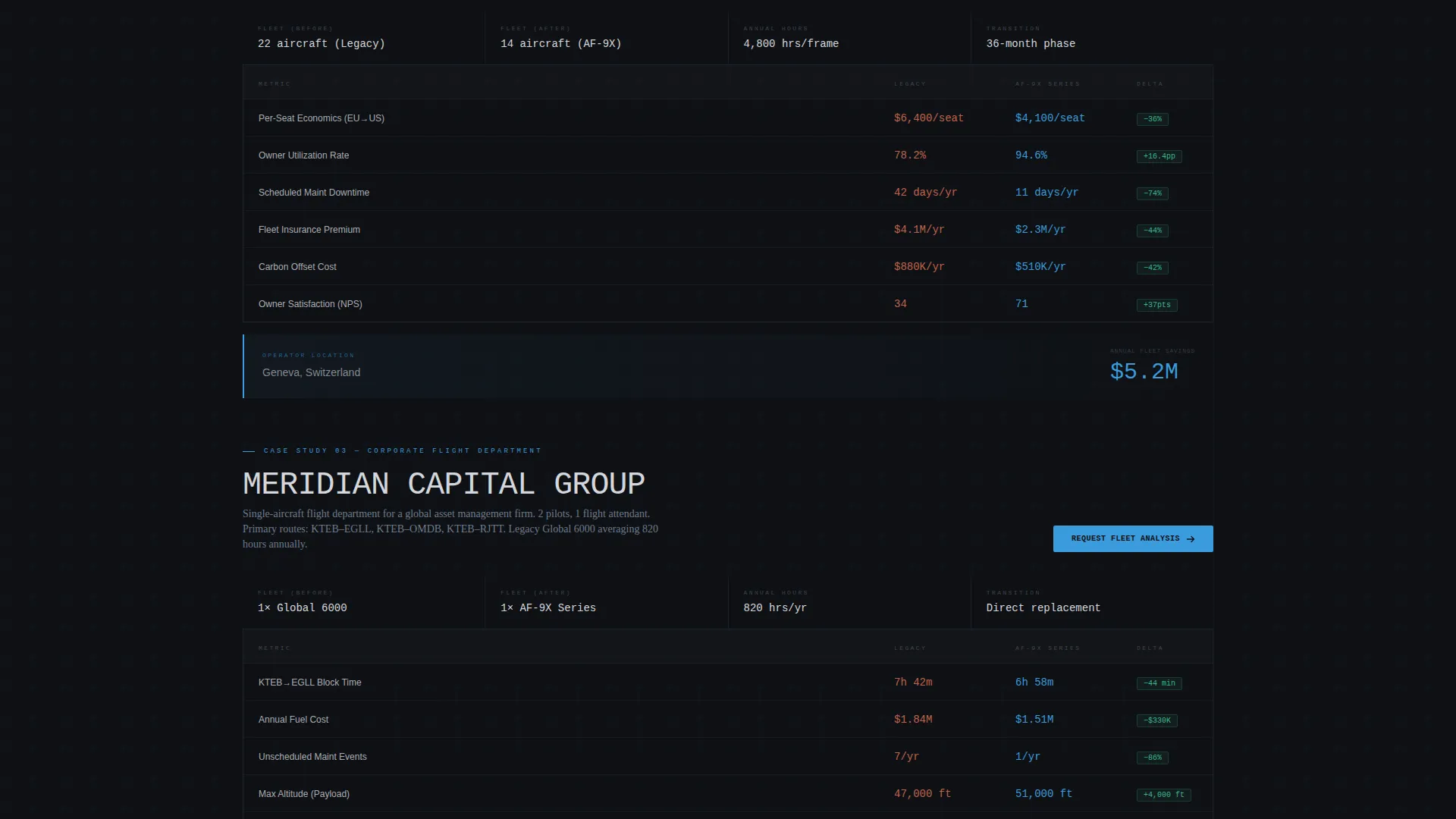
- Three operator profile data grids covering a Middle Eastern charter fleet, a European fractional program, and a corporate flight department
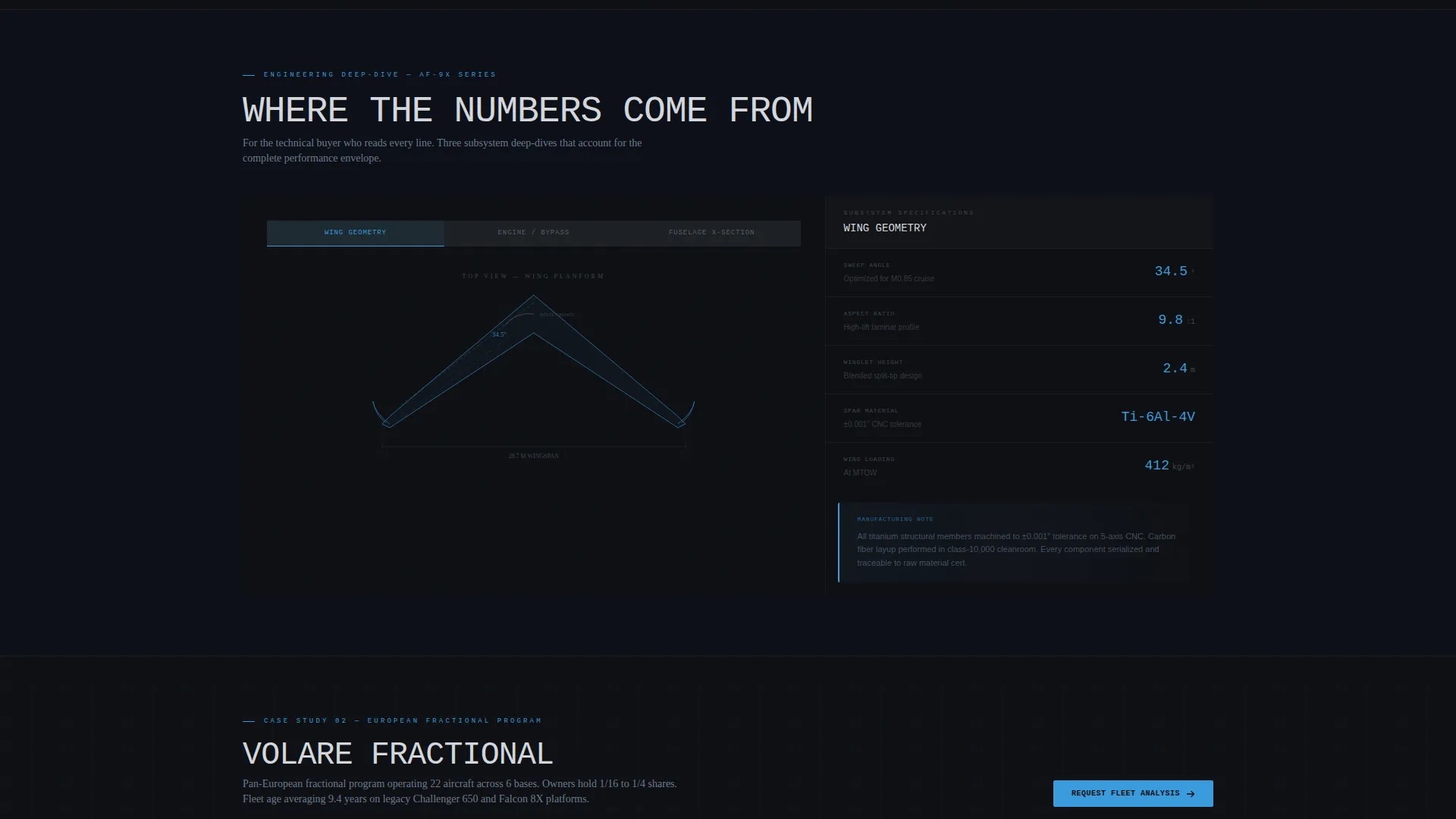
- Engineering deep-dive sections covering wing geometry, engine bypass ratios, and fuselage cross-section overlays between grids
- A primary call-to-action form capturing fleet size, aircraft types, annual utilization hours, and preferred contact window
- A secondary gated download path offering a performance comparison document to qualify serious decision-makers
Feature list
This template is built on a small number of carefully chosen components. Each one serves the technical buyer and the conversion goal at the same time.
Animated Before/After Header
The header splits into two halves. The left renders the operator's current aircraft as a sparse wireframe schematic with annotated pain points: maintenance hours per cycle, fuel burn per nautical mile, and cabin noise in decibels. The right reveals the replacement airframe as a photorealistic cutaway. A thin scan line sweeps left to right, transitioning wireframe to render in real time.
Operator Case Study Data Grids
Three sequential data grids present real fleet profiles as structured tables. Each grid shows fleet size, annual flight hours, per-seat economics, dispatch reliability percentages, and maintenance interval comparisons, all shown before and after adoption of the new airframe.
Engineering Deep-Dive Sections
Between each case study grid, the template includes focused engineering sections. Wing geometry, engine bypass ratios, and fuselage cross-section overlays give the technical buyer content worth reading closely. These sections reward detail-oriented visitors without slowing down those who skim.
Primary Fleet Analysis Form
The primary call-to-action anchors at the close of each case study grid. The form captures fleet size, current aircraft types via a dropdown with tail-number-level specificity, annual utilization hours, and a preferred contact window. It appears at exactly the right moment: after the visitor has already seen the data work.
Gated Performance Comparison Download
A secondary conversion path offers a downloadable performance comparison document. It is gated behind company name and role fields. This path filters serious decision-makers from early-stage researchers without turning away either group.
Engineering Blueprint Visual System
The entire page uses a monochrome steel color system. Interactive data points and hover states use precision-laser blue exclusively. The palette reads like a technical drawing under fluorescent light: no warmth, no decoration, only information.
Page sections overview
| Section | Purpose |
|---|---|
| Animated Header Split | Transitions wireframe pain points to photorealistic cutaway render |
| Charter Fleet Grid | Shows before/after economics for a Middle Eastern charter operator |
| Wing Geometry Deep-Dive | Covers wing design with annotated engineering overlays |
| Fractional Program Grid | Presents per-seat economics for a European fractional fleet |
| Engine Bypass Section | Details engine bypass ratios with technical cross-section visuals |
| Corporate Fleet Grid | Compares maintenance intervals for a corporate flight department |
| Fuselage Cross-Section | Overlays fuselage geometry improvements with metric callouts |
| Fleet Analysis Form | Primary call-to-action capturing fleet and utilization details |
| Performance Download Gate | Secondary path qualifying visitors by company name and role |
Design & branding system
The visual identity follows an Engineering Blueprint theme. Every color, spacing choice, and typographic decision reflects the factory floor environment described in the brief: precise, functional, and stripped of anything decorative.
- Color palette: mill-finish aluminum (#D4D7DC) for backgrounds, deep hangar shadow (#1A1D23) for dark fields, machined titanium (#6B7B8D) for secondary elements, and precision-laser blue (#3A9BDC) reserved exclusively for interactive data points and hover states
- Typography and layout follow a technical drawing logic: grid-aligned, annotation-style labels, and no lifestyle photography anywhere on the page
- The scan line animation in the header reinforces the engineering computation metaphor without relying on decorative motion
Mobile & speed optimization
A data-heavy dashboard layout must still perform on smaller screens and slower connections. The template is structured with this in mind at the layout level.
- Data grids are designed to reflow cleanly on smaller viewports without losing comparative context between columns
- The scan line header animation is contained and purposeful, avoiding the render cost of heavy video or large image sequences
- Section-by-section scroll progression keeps content loading in manageable blocks rather than forcing the browser to process the full page at once
How this template helps you convert
The conversion strategy is built into the page structure itself. By the time a visitor reaches the first call-to-action, they have already processed three rounds of operator proof.
- The before/after header creates immediate credibility by showing the exact pain points the product solves, in the visitor's own operational language, before a single word of sales copy appears.
- Each case study grid compounds the argument with a new operator profile and a new set of verified metrics, so the "Request Fleet Analysis" call-to-action feels like a natural next step rather than a cold ask.
- The gated download provides a second conversion path for visitors who are not yet ready to request a meeting, capturing qualified leads at an earlier stage of the buying process.
Other information about this template
This template is categorized under Aerospace and Defense, specifically within the Aircraft and Aviation subcategory, with a niche focus on the private jet manufacturer market. It is built for Partnership and B2B conversion scenarios where the sales cycle is long and the buyer is technically sophisticated.
- The dashboard and data grid template style makes it well suited for presenting comparative performance data across multiple operator profiles
- The case study narrative creative direction means the page tells a compounding story across scroll, not a flat brochure layout
- The header concept follows a Case Study Before/After format, a structure specifically chosen to anchor the visitor's attention on the problem before revealing the solution
- The template is designed as a single landing page and is not configured as a multi-page website structure
Theme
Engineering Blueprint
Creative direction
Case Study Narrative
Color system
Monochrome Steel
Style
Dashboard/Data Grid
Direction
Partnership/B2B
Page Sections
Animated Before/after Header
Operator Case Study Data Grids
Engineering Deep-dive Sections
Primary Fleet Analysis Form
Gated Performance Comparison Download
Monochrome Steel Visual System
Related questions
Who is the intended buyer for this template?
Can the case study data grids be edited to reflect my own operator data?
What makes the header animation different from a standard video background?
How does the gated download work as a conversion tool?
Is this template suitable for a single aircraft or an entire product family?