Education Equity Landing Page Template
Advocate is a hero-dominant landing page template built for grassroots education equity organizations. It leads with a full-viewport team photo, grows into a masonry community gallery of family stories, and drives action through a Parent Action Toolkit download. The Desert Rose color system and documentary visual style create a warm, urgent, and deeply human experience for every visitor.
by Rocket studio
Quick summary
Advocate is a single-page template designed for education equity advocacy groups and parent-led coalitions. It opens with a cinematic team photo that fills ninety percent of the screen, then draws visitors through a growing gallery of real family stories before presenting a clear resource download and a board meeting calendar link. Every design choice serves one goal: make a first-generation or under-resourced parent feel seen before they are ever asked to act.
Who this template is for
This template is built for nonprofit organizers, coalition leaders, and community advocates working at the intersection of education, family rights, and civic participation. It works best when the organization's credibility comes from the community itself rather than from institutional authority.
- Grassroots education equity groups mobilizing parents around school budget and curriculum decisions
- Nonprofit teams serving single mothers, grandparent caregivers, and first-generation immigrant families navigating school systems
- Community organizers who need a resource hub that converts visitors into toolkit downloaders and meeting attendees
What problem this template solves
Many advocacy organizations struggle to build trust with the exact families they want to reach. A polished, corporate-looking page can feel alienating to a parent who has never been invited into a school board meeting. This template solves that disconnect directly.
- It leads with people, not programs, showing real faces and forty-word family stories before any form appears
- It removes friction by asking only for a first name and email, with one optional context question
- It gives visitors two clear paths: download a practical toolkit or find their district's next board meeting
What you get with this template
You get a fully structured, single-page layout that moves visitors from emotional connection to concrete action. Every section is pre-built and purposeful, so your team spends time filling in your community's real stories rather than building page structure from scratch.
- A full-viewport hero section with a translucent text anchor and a primary call-to-action button
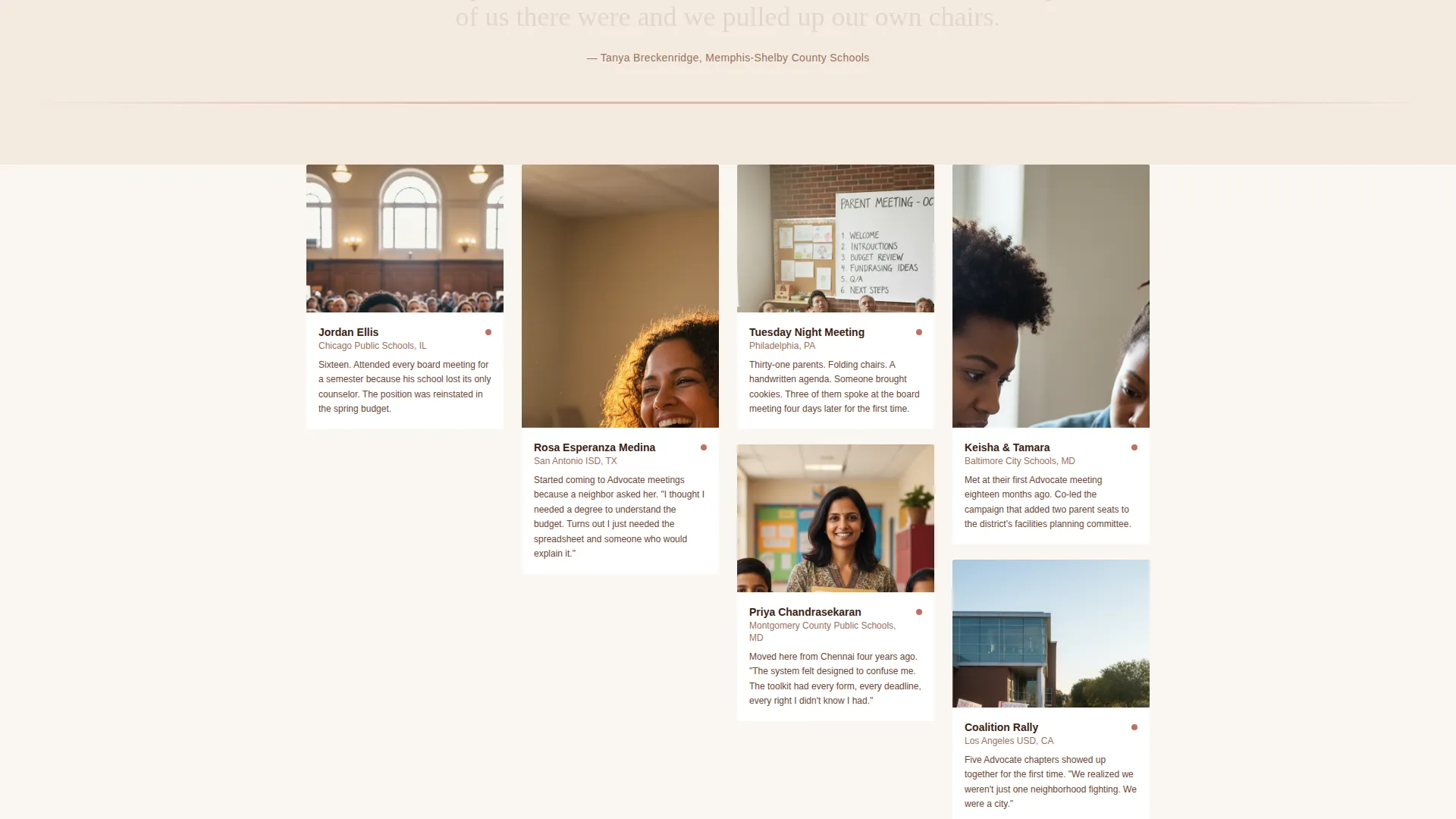
- A masonry community gallery designed to grow visually denser as the visitor scrolls, paired with full-width pull quote strips
- A sticky toolkit call-to-action bar with a minimal name-and-email form and an optional "What's your fight?" dropdown
Feature list
This template is built around a small number of high-impact features. Each one is designed to serve the specific conversion goals of a parent-focused advocacy organization.
Full-Viewport Hero with Text Anchor
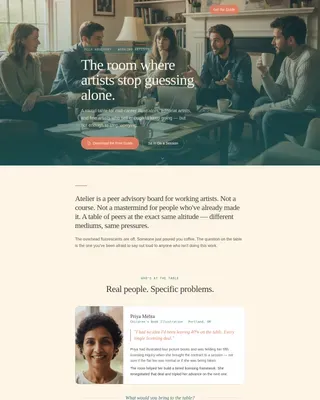
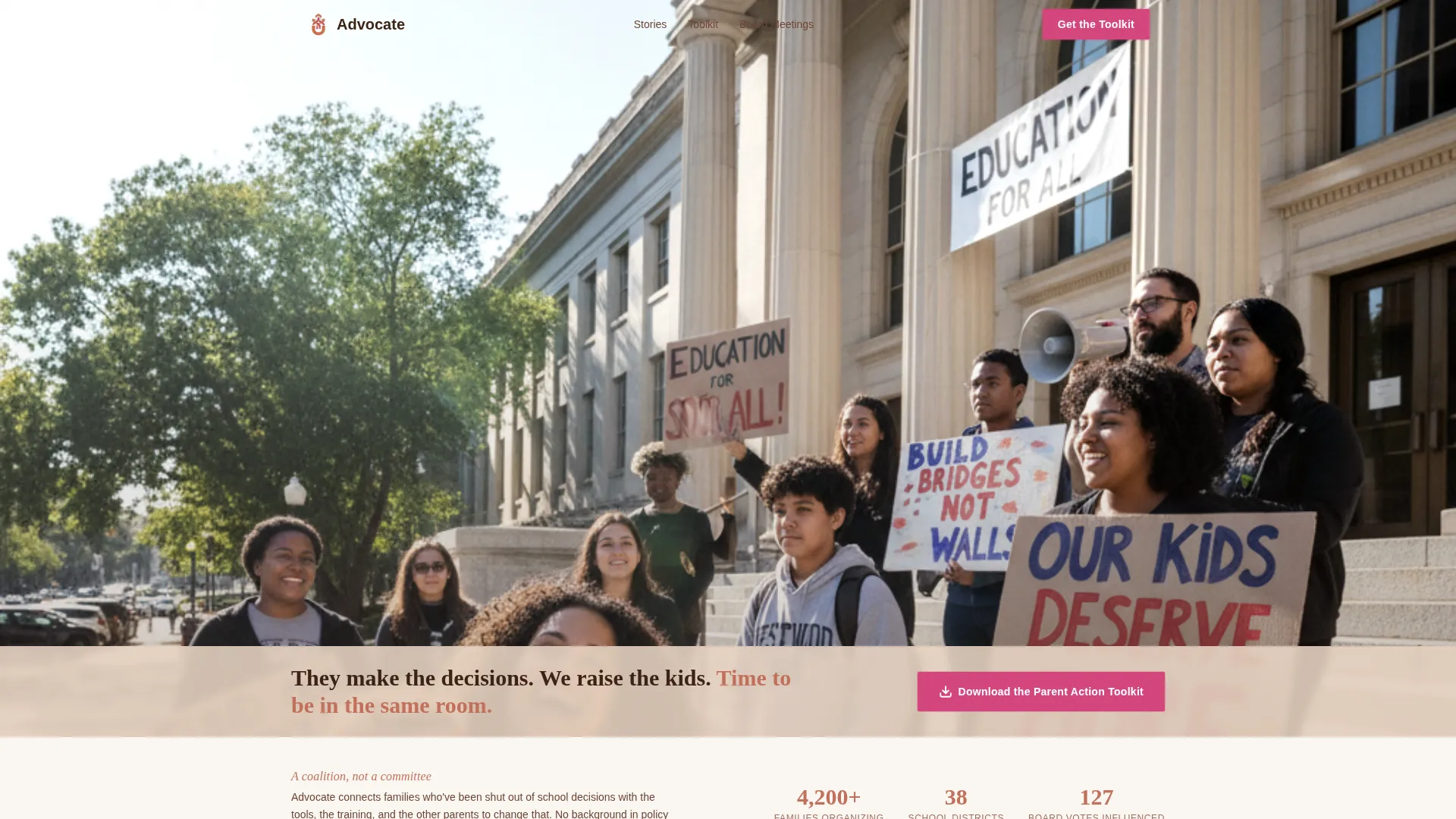
The hero image fills ninety percent of the viewport. A single line of text sits at the bottom edge inside a translucent adobe dust bar, written in mesquite brown. The layout is built to feel monumental, not corporate.
Masonry Community Gallery
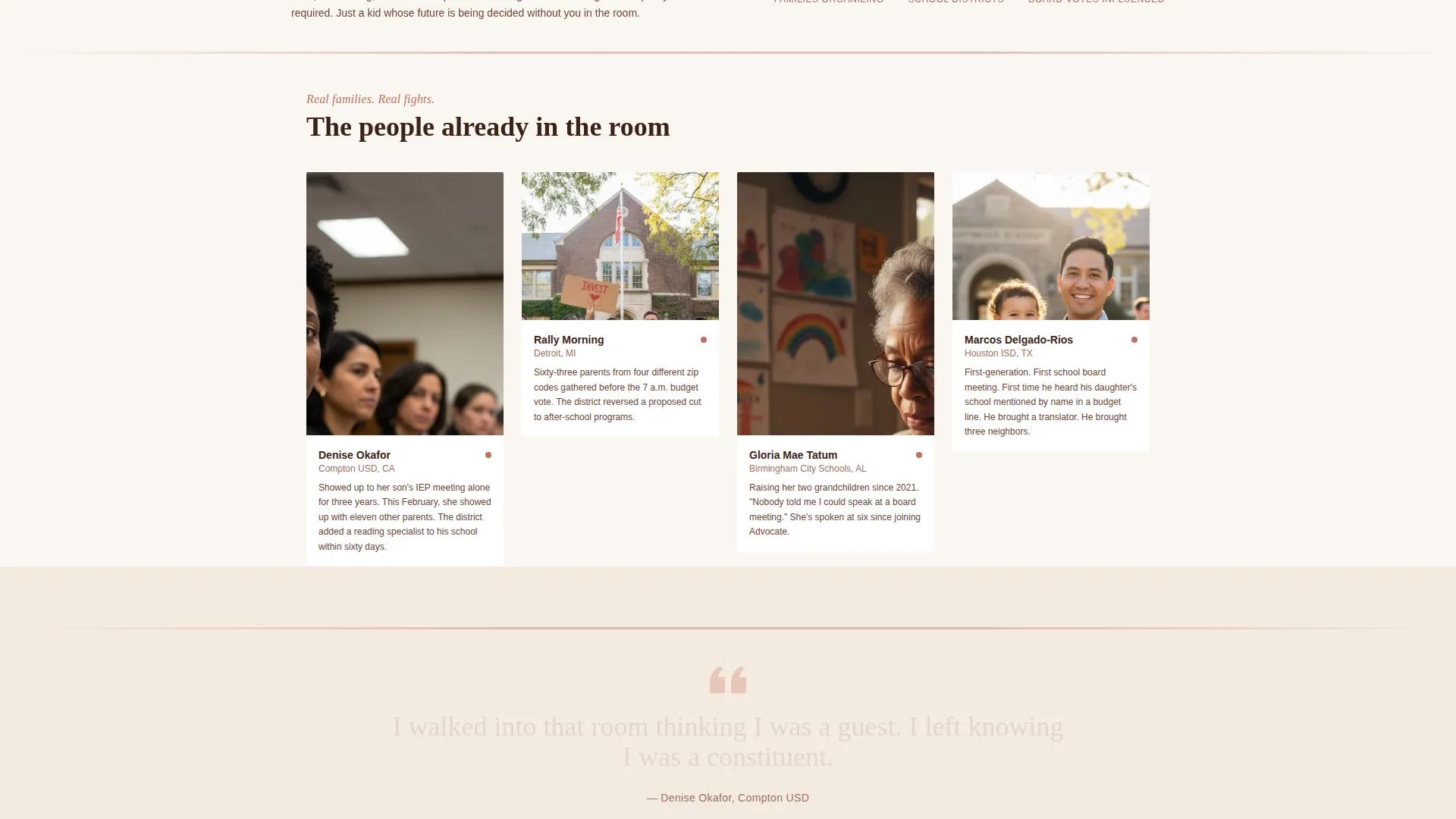
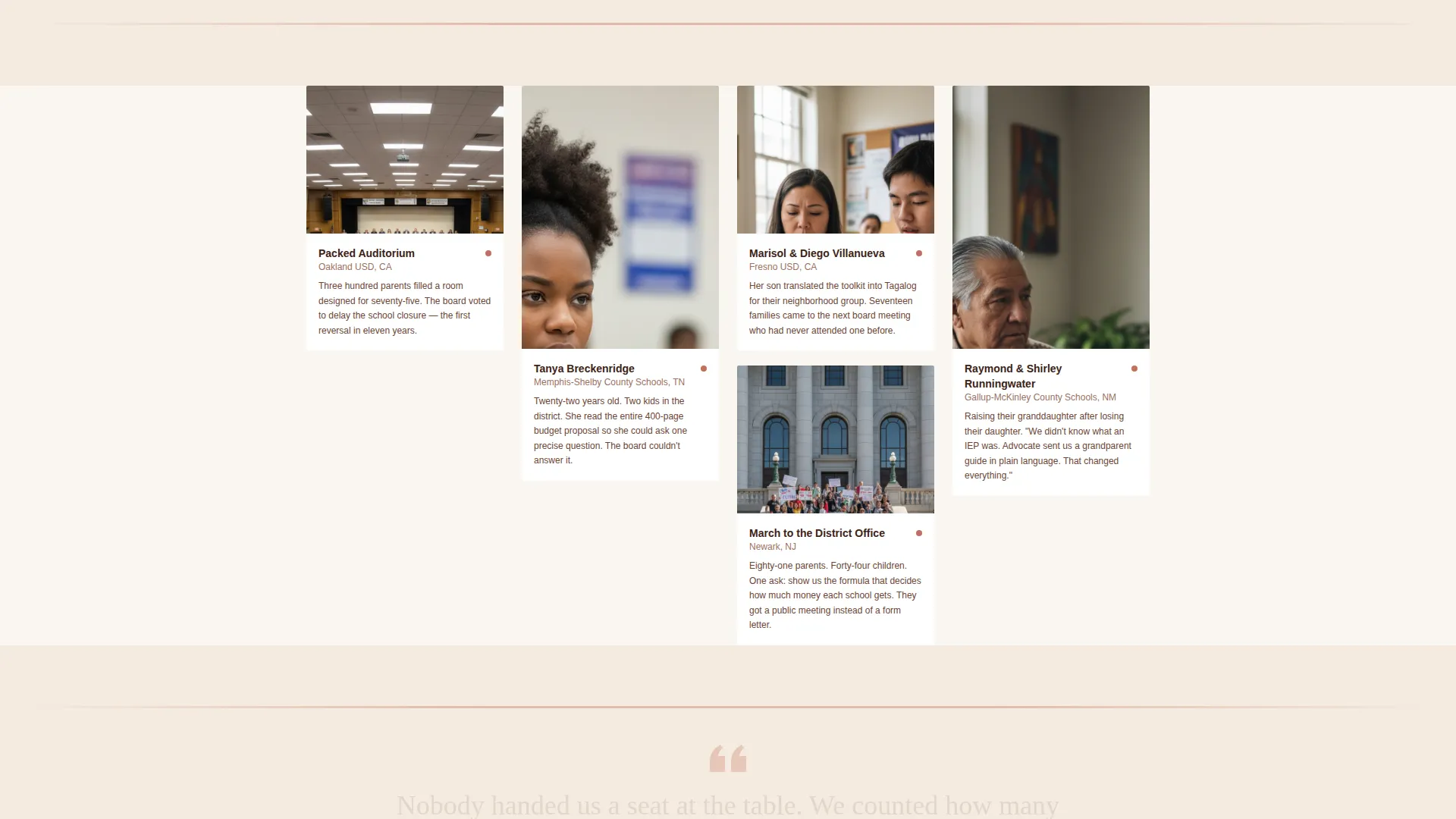
Family stories are arranged in a masonry grid that staggers and densifies as the visitor scrolls. Each story uses one photo and approximately forty words. The visual rhythm alternates between intimate single-family frames and collective group shots, building a sense of a movement gaining numbers.
Sticky Toolkit Call-to-Action Bar
After the third gallery cluster, a sticky bar appears at the bottom of the screen. It carries the primary call to action and persists as the visitor continues scrolling, keeping the download offer visible without interrupting the story flow.
Minimal Opt-In Form
The form asks for a first name and an email address. An optional dropdown asks "What's your fight?" with choices including school funding, special education, curriculum, discipline policy, and other. This keeps the barrier to entry low for time-pressed parents.
Pull Quote Manifesto Strips
Between gallery clusters, full-width strips display parent pull quotes in large terracotta serif type. These sections use scroll-reveal animation to bring each word into view, reinforcing the emotional weight of the community's voice.
Board Meeting Calendar Link
A secondary call-to-action section invites visitors to find their district's next school board meeting through a searchable calendar link. This gives action-ready visitors a concrete next step beyond the toolkit download.
Page sections overview
| Section | Purpose |
|---|---|
| Hero: Full Viewport | Establish emotional authority with a team photo and anchored tagline |
| Primary call to action Strip | Present the toolkit download immediately after the hero |
| Community Gallery Cluster One | Introduce individual family stories in masonry layout |
| Pull Quote Strip | Reinforce parent voice with a large serif quote |
| Community Gallery Cluster Two | Deepen the story rhythm, mixing intimate and group shots |
| Pull Quote Strip | Continue the manifesto cadence between gallery segments |
| Community Gallery Cluster Three | Densest gallery section, conveying collective scale |
| Sticky call to action Bar | Reintroduce toolkit download as a persistent scroll companion |
| Manifesto Strip | Scroll-reveal pull quote that anchors the page's core message |
| Board Meeting Finder | Searchable calendar link for immediate civic action |
| Footer | Minimal single-row footer with essential organization links |
Design & branding system
The Desert Rose color system is built around warmth, urgency, and human presence. Every color choice maps to a specific function, so the visual hierarchy always guides the eye toward the right action.
- Sun-warmed terracotta (#C2705B) warms section dividers, photo borders, and serif pull quote text; adobe dust (#E8D5C4) and white alternate as section backgrounds; deep mesquite brown (#3B2316) carries all body text
- Prickly pear magenta (#D4467E) is reserved exclusively for buttons and urgent callouts, so every clickable element has a distinct, unmistakable signal
- Typography pairs Fraunces serif for display headings and pull quotes with DM Sans for body copy, creating a contrast between documentary warmth and clean readability
Mobile & speed optimization
The template is built mobile-first because the primary audience is most likely visiting on a phone, often in a waiting room or between school drop-off and a work shift. Every layout decision accounts for a small screen and an interrupted browsing session.
- Images are lazy-loaded so the page begins rendering immediately, even on slower mobile connections
- Animations use CSS-first logic with blur-and-translate entrance effects and masonry stagger, keeping motion smooth without relying on heavy JavaScript
- The sticky call-to-action bar is designed to remain unobtrusive on small screens while staying accessible with a single thumb tap
How this template helps you convert
This template earns the click by building trust before it asks for anything. The conversion path is deliberately sequenced so that by the time a visitor sees the form, they have already spent time with the community.
- The hero places twelve real parents and organizers front and center before any ask appears, establishing that this is a community of real people, not a donation funnel
- The masonry gallery accumulates family stories and group photos in a rhythm that makes the movement feel large and growing, so a new visitor feels they are joining something already in motion
- The toolkit call to action appears first beneath the hero and returns as a sticky bar after the third gallery cluster, giving action-ready visitors two clean moments to convert without pressure
Other information about this template
This template is categorized under Community and Nonprofit, with a specific focus on education equity advocacy and education and literacy nonprofit work. It is intended for organizations operating in the United States, using informal community voice and USA English throughout.
- The template style is Hero-Dominant at a ninety-to-ten ratio, meaning the hero section commands the vast majority of initial screen space before any secondary content appears
- The creative direction follows a Community Gallery approach, using documentary warmth and a handmade-feeling aesthetic rather than polished stock imagery
- The Family First theme runs through every layout decision, from the church-basement informality of the gallery to the kitchen-table warmth of the color palette
- The landing page direction is Content and Resource, meaning the primary conversion goal is a downloadable toolkit rather than a donation or membership signup
- The header concept is a Team Photo, specifically a candid, unpolished group shot taken from slightly below eye level to give the assembled parents and organizers a monumental visual presence
Theme
Family First
Creative direction
Community Gallery
Color system
Desert Rose
Style
Hero-Dominant (90/10)
Direction
Content/Resource
Page Sections
Full-viewport Hero with Text Anchor
Masonry Community Gallery
Sticky Toolkit Call-to-action Bar
Minimal Opt-in Form with Context Dropdown
Scroll-reveal Pull Quote Strips
Board Meeting Calendar Link
Related questions
Can I replace the placeholder family photos with my organization's own images?
Does the toolkit download require a payment processor or e-commerce setup?
Can I edit the 'What's your fight?' dropdown to match my organization's focus areas?
Is this template suitable for an organization focused on a single issue like special education advocacy?
What does the footer include?